
You open your dashboard and the numbers don't add up. Your Meta Ads manager is reporting a strong week of conversions. Your Google Analytics tells a different story. And your CRM? It's showing something else entirely. If you've ever stared at three screens showing three different realities and wondered which one to believe, you already understand the core problem this article is about.
Inaccurate tracking is one of the most common and most damaging issues in modern marketing. It's not just an inconvenience. When your data is wrong, every decision downstream is wrong too: which campaigns to scale, which channels to cut, how to allocate next quarter's budget. The compounding effect of acting on bad data is significant, and most teams don't realize how much it's costing them until the damage is already done.
The good news is that tracking inaccuracy is not random noise. It has specific, diagnosable causes rooted in browser privacy changes, architectural limitations of pixel-based tracking, attribution model mismatches, and data fragmentation across tools. Each of these problems has a real solution. This article breaks down exactly why your tracking is inaccurate and what you can do to fix it at the root level.
The Hidden Cost of Trusting Broken Data
Here's the scenario that plays out in marketing teams every day. A paid social campaign looks like it's performing well based on platform-reported ROAS. The team scales the budget. But three months later, the pipeline hasn't grown, and revenue targets are being missed. What happened? The conversions the platform was reporting weren't real conversions in any meaningful business sense. They were tracking artifacts, duplicate events, or misattributed sessions that made a mediocre campaign look like a winner.
This is the hidden cost of broken tracking: you don't just lose visibility, you actively make worse decisions. When your data says one channel is driving results and it isn't, you scale spend in the wrong direction. When your data underreports performance from an organic or email channel, you cut or underfund it. The misdirection compounds over time.
There's another layer that makes this even more consequential. Ad platforms like Meta and Google use your conversion signals to train their bidding and targeting algorithms. When you feed these platforms inaccurate or incomplete conversion data, you're not just misreading your own performance. You're actively degrading the platform's ability to find and target the right audience for you. Bad data in means worse campaign performance out, and the cycle reinforces itself.
The most telling symptom of tracking failure is the gap between what ad platforms report and what your CRM or revenue data shows. A small discrepancy is expected because different tools use different attribution windows and models. But a large, persistent gap is almost always a sign of structural tracking problems. The challenge is that most teams normalize this gap. They accept it as "just how it is" and move on. They build mental models around which number to trust and which to ignore. What they rarely do is dig into why the gap exists and fix the underlying cause.
Fixing that gap starts with understanding what's actually breaking your tracking. And the first place to look is the fundamental shift happening at the browser level.
Browser Privacy Changes and the Decline of Pixel Reliability
Over the past several years, the major browsers and mobile operating systems have made a series of decisions that have fundamentally changed how tracking works. These weren't minor tweaks. They were structural changes to how user data is handled, and they've had a significant impact on the reliability of pixel-based conversion tracking.
Safari's Intelligent Tracking Prevention, which Apple has been developing and expanding since 2017, limits the lifespan of cookies set by third-party scripts and restricts cross-site tracking. Firefox's Enhanced Tracking Protection blocks known tracking domains by default. Apple's App Tracking Transparency framework, introduced with iOS 14, requires apps to request explicit user permission before tracking activity across other apps and websites. The majority of users, when asked, decline.
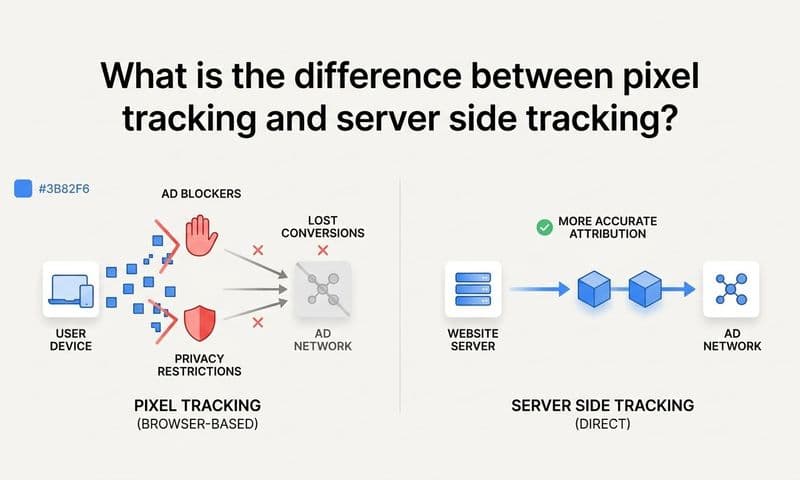
What this means in practice is that a significant portion of your website visitors are arriving in a state where traditional pixel-based tracking is already limited or broken before they even interact with your content. A user on Safari may have their pixel-set cookies expire within 24 hours. A user on Brave browser or with uBlock Origin installed may block your tracking scripts from firing at all. A user who clicked your Meta ad on their iPhone may have opted out of cross-app tracking, meaning Meta never received the signal that they converted.
This is the critical point: these are not configuration errors you can fix by updating your tag manager setup. They are structural changes to the browser and OS environment that pixel-based tracking was built on. The architecture itself is no longer reliable for capturing the full picture of conversion activity.
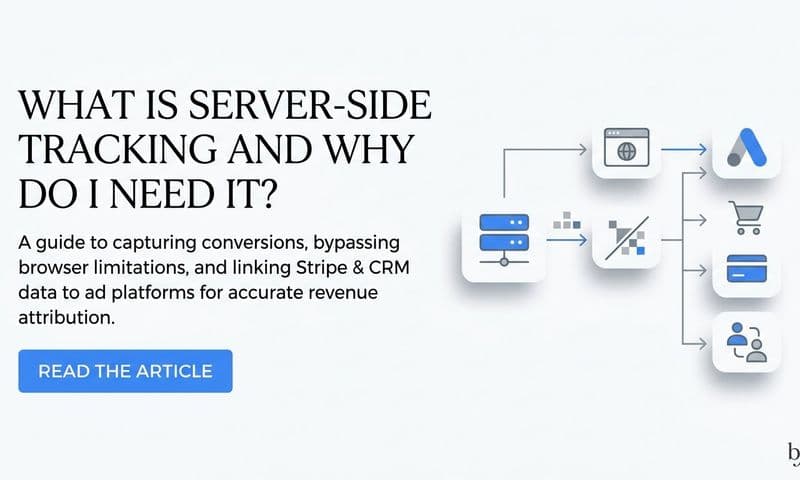
The solution is not to find a smarter way to place pixels. The solution is to move the data collection off the browser entirely. Server-side tracking, which we'll cover in detail later, sends conversion data from your web server directly to ad platforms, bypassing browser restrictions completely. It's the architectural response to an architectural problem. But before getting to the fix, it's worth understanding all the ways pixel-only tracking falls short on its own terms.
Why Pixel-Only Tracking Leaves Gaps in Your Data
Even in a world without aggressive browser privacy protections, pixel-based tracking has inherent limitations that create gaps in your data. Understanding these gaps helps you see why a pixel-only approach was never a complete solution, even when it worked better than it does today.
Pixels fire when a page loads and JavaScript executes correctly in the browser. This sounds simple, but there are many ways it can fail. Ad blockers prevent tracking scripts from loading entirely. Slow connections cause pages to partially load, with tracking scripts often deprioritized or abandoned. Single-page application architectures, common in modern web apps and SaaS products, don't trigger traditional page load events, meaning standard pixel implementations miss key interactions unless they're specifically configured to handle virtual page views. Each of these scenarios creates a silent gap: a real conversion event that happened but was never recorded.
There's also the cross-device problem. Pixel tracking relies on cookies tied to a specific browser on a specific device. A user who sees your LinkedIn ad on their phone during their commute, researches your product on their work laptop in the afternoon, and signs up from their home desktop in the evening will appear as three completely separate, unconnected sessions in your analytics. The conversion gets credited to whatever channel touched that final desktop session, and the mobile ad and the research session are invisible to your attribution model. This is not an edge case in B2B SaaS. It's the norm.
Deduplication is another underappreciated source of inaccuracy. When you implement both a browser-side pixel and server-side event tracking for the same conversion, you need deduplication logic to prevent the same event from being counted twice. Platforms like Meta use event IDs to match and deduplicate events, but this only works if the event IDs are implemented correctly on both the client and server side. When deduplication fails, conversions are double-counted, ROAS looks inflated, and your optimization algorithms are training on phantom signals. When it's missing entirely, the problem is even worse.
The cumulative effect of these gaps is that pixel-only tracking gives you a partial, distorted view of your actual conversion activity. Some events are missed entirely. Others are counted twice. Cross-device journeys are fragmented. And the degree of distortion varies by audience, device mix, and browser distribution in ways that are nearly impossible to audit without a more robust tracking infrastructure in place. Understanding fixing conversion tracking gaps at the structural level is essential before any optimization effort can be trusted.
Attribution Model Mismatches and the Last-Click Illusion
Even if your tracking were technically perfect and capturing every event correctly, you'd still face a separate problem: different tools in your stack use different attribution models, and those models often produce wildly different answers to the same question.
Most ad platforms default to last-click or last-touch attribution. This model assigns 100% of the credit for a conversion to the final interaction before the conversion event. It's simple, easy to understand, and deeply misleading in most B2B contexts. The last click before a sign-up is often a branded search or a direct visit, meaning the buyer already knew who you were and had already been influenced by earlier touchpoints. Last-click attribution rewards the channel that closed the deal while ignoring every channel that built the case for it.
In B2B SaaS, this distortion is particularly severe. Buyers typically research across multiple sessions, channels, and weeks before making a decision. A prospect might first encounter your brand through a LinkedIn thought leadership post, then see a retargeting ad, then read a blog post through organic search, then attend a webinar, and finally convert after clicking a direct link from an email. Last-click attribution gives all the credit to the email and assigns zero value to everything that came before it. If you're using this data to make budget decisions, you'll systematically underfund the channels that are actually building awareness and pipeline.
The problem gets worse when different tools use different models. Your Google Ads account might use data-driven attribution with a 30-day window. Your Meta Ads account might use a 7-day click, 1-day view window. Your CRM might attribute revenue to the first touch. Your analytics platform might use linear attribution. When you compare numbers across these tools, they will never reconcile, not because the data is wrong, but because each tool is answering a fundamentally different question about the same journey.
Most teams respond to this by picking one number to trust and dismissing the others. A better response is to understand why the numbers differ and move toward a unified attribution framework that gives you a consistent, multi-touch view of the buyer journey across all channels and all stages of the funnel.
UTM Breakdowns and Cross-Channel Tracking Failures
UTM parameters are the backbone of source tracking for most marketing teams. When they work, they tell you exactly which campaign, channel, and ad drove a visitor to your site. When they break, traffic arrives with no source data, gets classified as direct, and disappears from your channel-level reporting.
UTM stripping happens more often than most teams realize. Link shorteners that don't pass through query parameters, redirect chains that drop URL parameters at each hop, email clients that rewrite links for click tracking, and certain social platforms that strip query strings before sending users to your site are all common culprits. The result is a steady leak of attribution data that inflates your direct traffic numbers and hides the true performance of your paid and organic channels. Understanding how UTM tracking works and where it commonly breaks is the first step toward plugging these leaks.
Cross-channel journeys compound this problem. A buyer who moves through paid social, organic search, email, and direct visits over several weeks is generating data in multiple tools, none of which are talking to each other. Your ad platform sees the paid click. Your email platform sees the email open and click. Your analytics platform sees the sessions but can't connect them to a single identity. Your CRM sees the lead but has no idea which touchpoints influenced the decision. Each tool is reporting a fragment of the same journey, and no one has the complete picture.
The most significant gap is usually between your ad platforms and your CRM. Ad platforms report conversions based on pixel events or form fills. Your CRM tracks leads, opportunities, and closed-won revenue. These two data sets are rarely connected automatically. That means the sales-qualified leads, pipeline opportunities, and closed deals that your ads ultimately drove are never tied back to the original ad click that started the journey. You're optimizing campaigns based on top-of-funnel events while the actual revenue impact remains invisible.
Fixing Inaccurate Tracking with a Server-Side and Attribution-First Approach
Now that you understand the specific causes of tracking inaccuracy, the path to fixing it becomes clearer. The solution isn't a single tool or a one-time configuration change. It's an architectural shift toward server-side data collection, first-party identity resolution, and unified attribution across your entire marketing stack.
Server-Side Tracking via Conversion APIs: The most direct response to browser privacy changes and ad blocker interference is moving your conversion tracking off the browser and onto your server. Meta's Conversion API and Google's Enhanced Conversions both allow you to send conversion events directly from your web server to the ad platform, bypassing browser restrictions entirely. These server-side events reach the platform regardless of whether the user has an ad blocker, regardless of Safari's ITP settings, and regardless of iOS tracking permissions. Implementing server-side tracking alongside your existing pixel, with proper deduplication using event IDs, recovers a meaningful portion of the conversion events that browser-based tracking was missing.
First-Party Data Enrichment: With third-party cookies declining in reliability, first-party data has become the foundation of accurate attribution. This means using data you collect directly from your users, such as email addresses, CRM records, and product usage data, to connect anonymous ad clicks to real user identities. When you can tie a browser session to a known user in your CRM, you can resolve cross-device journeys, connect ad clicks to downstream revenue, and build attribution models that reflect the actual buyer journey rather than a fragmented, cookie-dependent approximation of it.
Unified Attribution Across Ad Spend and Revenue: The reconciliation problem between ad platforms and CRM data doesn't get solved by looking at each tool in isolation. It gets solved by connecting them in a single attribution layer that pulls ad spend data, CRM pipeline data, and closed-won revenue into one view. When you can see the full path from first ad click to closed deal, you stop optimizing toward proxy metrics and start optimizing toward actual revenue. This is where multi-touch attribution models become genuinely useful: not just as an academic exercise in credit distribution, but as a practical tool for understanding which channels and campaigns are actually moving buyers through your funnel.
Platforms like Cometly are built specifically to address these layers. Cometly connects your ad platforms, CRM, and website data in real time, implementing server-side event tracking through Conversion API integrations, resolving cross-device journeys using first-party data, and providing multi-touch attribution models that show you the complete customer journey from first touch to revenue. Instead of reconciling conflicting numbers across five different tools, you get a single source of truth that reflects what's actually happening in your pipeline.
The AI-powered insights layer adds another dimension: rather than just reporting what happened, Cometly identifies which ads and campaigns are driving the highest-quality conversions and surfaces recommendations for where to scale and where to pull back. This means the data you're acting on is not just accurate, it's actionable.
The Bottom Line on Tracking Accuracy
Inaccurate tracking is not an inevitable cost of doing business in a complex digital environment. It is the result of specific technical gaps: browser privacy changes that have undermined pixel reliability, architectural limitations of client-side tracking, attribution model mismatches across your tool stack, UTM parameter failures, and the absence of a unified connection between ad spend and revenue data. Each of these gaps has a real solution.
Fixing your tracking is not just a technical exercise. It directly improves how your ad platform algorithms perform, how you allocate budget across channels, and how accurately you can attribute revenue to marketing activity. When your data is accurate, every decision downstream improves: which campaigns to scale, which channels to invest in, and how to demonstrate marketing's impact on the business.
The teams that take tracking seriously don't just have better reporting. They have better campaigns, better budget efficiency, and a clearer picture of what's actually driving growth. That advantage compounds over time.
If you're ready to stop guessing and start working from a complete, trustworthy view of your marketing performance, Cometly gives you the infrastructure to get there: server-side event tracking, multi-touch attribution, CRM and revenue integration, and AI-powered recommendations across every channel. Get your free demo and see exactly what's driving your pipeline and revenue.