Most marketing teams are making six-figure budget decisions based on data that is, at best, incomplete. The dashboards look clean. The conversion numbers roll in. But underneath that surface-level reporting, a quiet erosion is happening. Browser-based tracking is losing signal, and the gap between what your analytics say and what is actually happening in your business keeps growing.
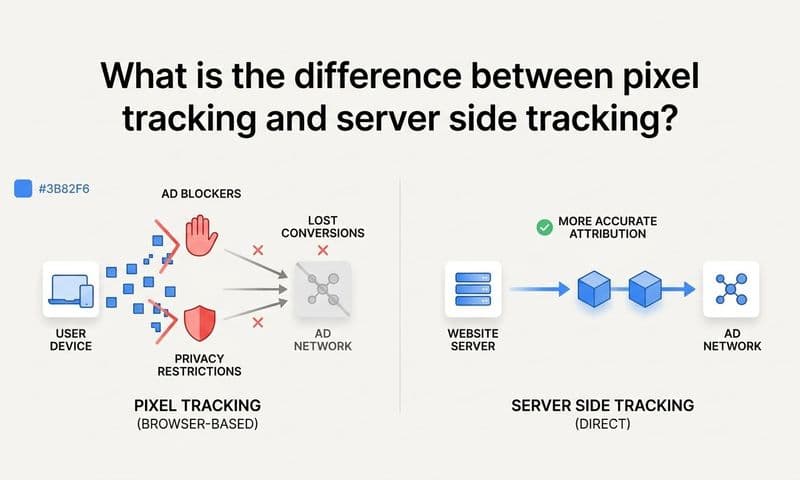
This is not a hypothetical future problem. It is happening right now, across every B2B SaaS team that relies on client-side pixels and third-party cookies to measure campaign performance. Ad blockers strip out tracking scripts before they fire. Safari's Intelligent Tracking Prevention shortens cookie lifespans to the point of near-uselessness. Privacy-focused browsers block third-party data collection by default. The result is a steady bleed of conversion data that never gets recorded.
Server side tracking is the modern answer to this problem. Instead of relying on a user's browser to fire a pixel and set a cookie, server side tracking sends conversion events directly from your server to ad platforms and analytics tools. It bypasses browser restrictions entirely. It works with first-party data. And for B2B SaaS teams trying to connect ad spend to pipeline and revenue, it is quickly becoming a foundational requirement rather than a nice-to-have.
By the end of this guide, you will understand exactly why server side tracking matters, how it works under the hood, and how it changes the way you measure and optimize your campaigns. Let's start with the problem it is solving.
The Silent Data Problem Costing You Ad Budget
Here is something worth sitting with: a meaningful portion of the conversions your campaigns generate are never recorded. Not because the conversions did not happen, but because the tracking mechanism that was supposed to capture them got blocked, degraded, or expired before it could do its job.
Browser-based pixels work by executing JavaScript in the user's browser at the moment of a conversion. That JavaScript sets a cookie, fires a request to the ad platform, and logs the event. The entire chain depends on the browser cooperating. And increasingly, browsers are not cooperating.
Safari's Intelligent Tracking Prevention (ITP) is one of the most significant culprits. ITP limits the lifespan of cookies set by JavaScript to as little as one day in certain scenarios. For B2B buyers who research a solution over days or weeks before converting, this means the original ad click that started the journey is long gone from the attribution record by the time the form gets filled out.
Ad blockers present a different but equally damaging problem. When a user has an ad blocker installed, tracking scripts often fail to load at all. The pixel never fires. The conversion event is never sent. From the ad platform's perspective, that customer does not exist.
Firefox and other privacy-focused browsers block many third-party cookies by default. As more users migrate to privacy-first browsing environments, the reach of client-side tracking continues to shrink.
The downstream consequences of this data loss are significant. Ad platforms like Meta and Google use conversion signals to train their machine learning algorithms. When those signals are incomplete, the algorithm is optimizing toward a distorted picture of your customer. It may be learning from a biased subset of conversions, which means it is targeting the wrong audiences, bidding inefficiently, and inflating your cost per acquisition without you realizing it.
For B2B SaaS teams specifically, the problem compounds. Your sales cycles are long. Your buyers do extensive research. The gap between first touch and closed deal can span weeks or months. Every missing touchpoint in that journey makes your attribution less reliable, your budget decisions less defensible, and your ability to scale campaigns more uncertain.
The frustrating part is that the conversions are happening. The revenue is real. The tracking just is not capturing it accurately. That disconnect between reported performance and actual business outcomes is what server side tracking is designed to close.
How Server Side Tracking Actually Works
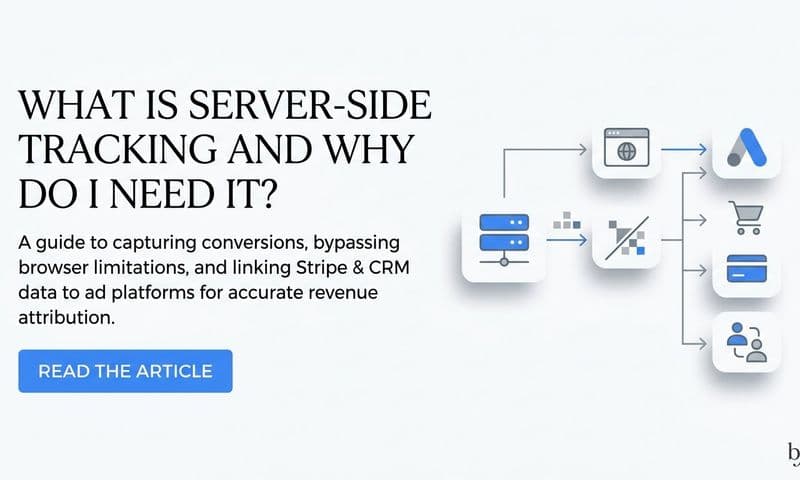
The core idea behind server side tracking is straightforward: move the tracking logic off the user's browser and onto your server. Instead of asking a browser to fire a pixel and hope nothing blocks it, your server captures the conversion event and sends it directly to the destination platform via a secure server-to-server connection.
The data flow looks like this. A user takes an action on your site, whether that is filling out a demo request form, starting a free trial, or completing a purchase. Your server receives that event, enriches it with first-party data you have collected, and sends it to Meta, Google, or any other platform you are using. The browser's behavior is irrelevant to this process. Ad blockers cannot intercept it. Browser privacy settings cannot degrade it. The event gets delivered reliably, every time.
The key infrastructure components that make this work are worth understanding.
Conversion APIs: Meta's Conversions API (CAPI) and Google's Enhanced Conversions are the primary server-to-server mechanisms for the two largest ad platforms. Both allow advertisers to send hashed first-party data directly from their server to the platform, completely bypassing browser-level restrictions. This is not a workaround or a hack. It is the officially supported, recommended approach from both platforms for advertisers who want reliable conversion measurement.
First-party identifiers: One of the most powerful aspects of server side tracking is the ability to send hashed personal identifiers alongside conversion events. When a user fills out a form, you capture their email address. When that event is sent server-side, you can include a hashed version of that email. The ad platform uses it to match the conversion to a known user with far greater accuracy than a browser cookie alone could achieve. Phone numbers and user IDs serve the same purpose. This dramatically improves match rates and the quality of the signal the platform receives.
Event deduplication: Most teams run both a browser pixel and server side events simultaneously. This is actually the recommended approach because it provides redundancy. If the browser pixel fires successfully and the server event also fires, you need a mechanism to prevent the same conversion from being counted twice. Both Meta and Google provide deduplication using event IDs. You assign a unique ID to each conversion event, and the platform uses it to recognize and discard duplicates. The result is accurate counts without double-counting.
Think of server side tracking as building a direct, private channel between your business and the ad platforms you use. You control the data. You control when it gets sent. And you are no longer dependent on a browser environment you cannot control to deliver the signals your campaigns depend on.
For teams using a platform like Cometly, this infrastructure is built in. Server-side events flow through the platform, get enriched with CRM and revenue data, and are sent to ad platforms with the match quality needed to power accurate attribution and better algorithmic optimization.
Why Server Side Tracking Matters for B2B Attribution
B2B attribution is genuinely hard. Your buyers are not making impulse purchases. They are researching, comparing, talking to colleagues, attending demos, and cycling through multiple touchpoints across different devices and sessions before they ever close. Browser-based tracking was never designed to handle this kind of complexity, and its limitations become most visible in B2B contexts.
The most fundamental limitation is that client-side pixels can only see browser behavior. They capture page views, form fills, and on-site events. They cannot see what happens after a lead enters your CRM. They cannot record when a deal moves to the proposal stage. They have no visibility into the demo that happened over video call, the sales conversation that moved a prospect from evaluation to decision, or the closed-won event that represents actual revenue.
Server side tracking changes this completely. Because events are sent from your server rather than a browser, you can send any event you have data for, including CRM milestones. When a lead becomes a qualified opportunity, that is a server event. When a trial converts to a paid subscription, that is a server event. When a deal closes in your CRM, that is a server event. All of these can be sent back to ad platforms and attribution tools with the original click data attached, connecting your ad spend directly to real revenue outcomes.
This is what makes lead quality attribution possible. Without server side tracking, most B2B teams are measuring success at the form fill. They know which campaigns drove demo requests, but they cannot tell which campaigns drove closed deals. That distinction matters enormously when you are allocating budget. A campaign that drives a high volume of low-quality leads looks great on a cost-per-lead basis but terrible on a cost-per-acquisition basis. Server side tracking gives you the data to see the difference.
Multi-touch attribution also depends on complete touchpoint data. If your attribution model is missing events because client-side pixels failed to fire, every model you run is working with a distorted picture. First-touch, last-touch, linear, time-decay: all of these models produce unreliable outputs when the underlying event data has gaps. Server side tracking fills those gaps, giving your attribution models the complete, accurate data they need to produce insights you can actually act on.
For B2B SaaS teams trying to justify marketing spend to leadership, this matters beyond just optimization. When you can show a clear, data-backed line from a specific campaign to pipeline and closed revenue, budget conversations become much easier. That level of visibility is only possible with server side tracking in place.
The Direct Impact on Ad Platform Performance
Ad platforms are not passive recipients of your conversion data. They actively use it to train machine learning models that determine who sees your ads, when, and at what bid. The quality of the conversion signals you send has a direct effect on how well those models perform on your behalf.
When conversion data is incomplete or noisy, the algorithm learns from a biased sample. It may over-index on certain audience segments that happen to convert in ways the pixel can capture, while ignoring higher-value segments whose conversions are being missed. The result is inefficient spending, inflated CPMs, and a cost per acquisition that is higher than it needs to be.
Server side tracking improves this by sending richer, more reliable conversion signals. Meta publicly surfaces this through its Event Match Quality score in Events Manager, which reflects how well conversion events can be matched to Facebook users. Higher match quality is directly associated with better ad delivery and optimization. When you send server-side events with hashed emails and phone numbers, your match quality scores improve, and the algorithm has better data to work with.
Google's Enhanced Conversions work on the same principle. By sending hashed first-party identifiers alongside conversion events, you improve the accuracy of conversion measurement and give Google's bidding algorithms a stronger signal to optimize toward.
The practical benefits show up in several ways. Better audience matching means your retargeting campaigns reach the people who actually converted on your site, not a degraded approximation based on cookie data. Lookalike and similar audience campaigns become more effective when the seed audience is built from complete, high-quality conversion data. And smart bidding strategies perform better when the conversion signals driving them are accurate and comprehensive.
For B2B SaaS teams running paid campaigns at scale, this is not a marginal improvement. Better data quality feeds better algorithmic decisions, which compounds over time as the platform learns more accurately what your best customers look like. Investing in server side tracking infrastructure is, in a meaningful sense, investing in the performance of every campaign you run going forward.
What You Can Track That Client-Side Pixels Miss
One of the most practical reasons to implement server side tracking is the category of events it unlocks that browser pixels simply cannot reach. These are not edge cases. For B2B SaaS companies, they often represent the most important signals in the entire funnel.
Offline conversions and CRM milestones: Everything that happens after a lead enters your CRM is invisible to browser-based tracking. Demo requests that get confirmed by a sales rep, discovery calls that qualify a prospect, proposal stages, and closed-won deals all live in your CRM, not in a browser session. Server side tracking lets you send these events to ad platforms with the original click attribution attached. This means you can measure which campaigns are actually driving revenue, not just which campaigns are driving form fills.
Cross-device journeys: B2B buyers research on multiple devices. They might click an ad on their phone during a commute, continue their research on a work laptop, and convert on a desktop later in the week. Cookie-based tracking breaks down across devices because cookies are browser and device-specific. Server side tracking with first-party identifiers, like a hashed email collected at any point in the journey, can stitch these cross-device sessions together into a coherent user journey. This gives you a far more accurate picture of how your campaigns are contributing to conversions across the full path to purchase.
High-value micro-conversions deep in the funnel: Product events, feature activations, and subscription upgrades are powerful intent signals that never appear in browser-level analytics. When a trial user activates a key feature, that is a meaningful signal that they are moving toward conversion. When a customer upgrades their plan, that represents expansion revenue tied to specific marketing activity. These events live in your product and billing systems, not in a browser. Server side tracking brings them into your attribution data, giving you visibility into the full funnel from first ad click to long-term customer value.
Taken together, these capabilities mean that server side tracking does not just improve the accuracy of the events you were already tracking. It expands the range of what you can measure, connecting marketing activity to business outcomes that were previously invisible to your analytics stack.
Building a Reliable Attribution Foundation
Understanding why server side tracking matters is one thing. Turning that understanding into a working attribution system is another. The good news is that you do not need to implement everything at once to start seeing meaningful improvements.
A practical starting point is to prioritize Conversion API implementation for your highest-spend ad channels first. If Meta and Google represent the bulk of your paid media budget, getting server side events flowing to those platforms delivers the most immediate impact on data quality and algorithmic performance. From there, you can layer in CRM event syncing to capture the full funnel, connecting demo completions, pipeline stages, and closed deals back to the original ad attribution.
The most powerful setup combines server side tracking with a centralized attribution platform that brings all of this data into a single view. This is where teams move from having better data to having actionable insight. When your ad click data, CRM events, and revenue data are all flowing into one place, you can see which campaigns are driving not just leads but qualified pipeline and closed revenue. That is the single source of truth that makes confident budget decisions possible.
Cometly is built for exactly this purpose. It connects your ad platforms, CRM, and website to track the entire customer journey in real time, with server-side event tracking and Conversion API integration built in. Every touchpoint from first ad click to closed-won revenue is captured, enriched, and made available for analysis. The platform's AI surfaces recommendations based on complete, accurate data, so you can scale what is working and cut what is not, with the confidence that comes from knowing your data is reliable.
Teams that invest in this kind of tracking infrastructure make faster decisions, waste less budget, and scale campaigns with a clear understanding of what is actually driving results. In a landscape where data quality is increasingly the competitive differentiator, getting your attribution foundation right is not optional.
The Bottom Line on Server Side Tracking
Server side tracking is not a technical luxury reserved for enterprise teams with large engineering resources. It is a foundational requirement for any B2B SaaS company that is serious about understanding what its marketing is actually doing.
The case for it comes down to four things. First, it restores data accuracy by bypassing the browser restrictions and ad blockers that are degrading client-side tracking. Second, it improves ad platform optimization by sending richer, more reliable conversion signals that power better algorithmic decisions. Third, it provides complete funnel visibility by capturing CRM events and offline conversions that browser pixels can never see. And fourth, it enables reliable revenue attribution by connecting ad spend to pipeline and closed deals, not just form fills.
Together, these capabilities give marketing teams the data foundation they need to make confident decisions, justify spend, and scale campaigns without flying blind on ROI.
If you are ready to stop making budget decisions based on incomplete data, Cometly gives you the infrastructure to do it right. From server-side conversion tracking and Conversion API integration to multi-touch attribution and AI-driven recommendations, it connects every touchpoint from first ad click to closed-won revenue in one place. Get your free demo today and start building the attribution foundation your campaigns deserve.