
You can run both strategies at the same time and still get mediocre results if you do not know which one is actually driving your pipeline. This is the uncomfortable truth that many B2B SaaS marketing teams discover only after burning through budget on campaigns that felt productive but never clearly connected to revenue.
Account based marketing and inbound marketing represent two fundamentally different philosophies about how to attract and win customers. One is precise and deliberate, built around a defined list of target accounts. The other is expansive and compounding, designed to pull buyers toward you as they search for solutions. Both can work. Both can fail. And the difference between success and mediocrity often comes down to whether you understand which motion is actually generating pipeline.
This guide is for marketing leaders who want practical clarity, not just theory. If you are trying to decide where to focus your team's energy and budget, or if you are already running both strategies and struggling to measure their impact, this article will help you think through the decision with more precision. More importantly, it will show you why attribution is not just a reporting exercise: it is the foundation that makes either strategy improvable.
Two Philosophies, One Goal: Winning Revenue
At their core, account based marketing and inbound marketing are both trying to do the same thing: connect your product with the buyers who need it most and convert those buyers into paying customers. But they approach that goal from completely opposite directions.
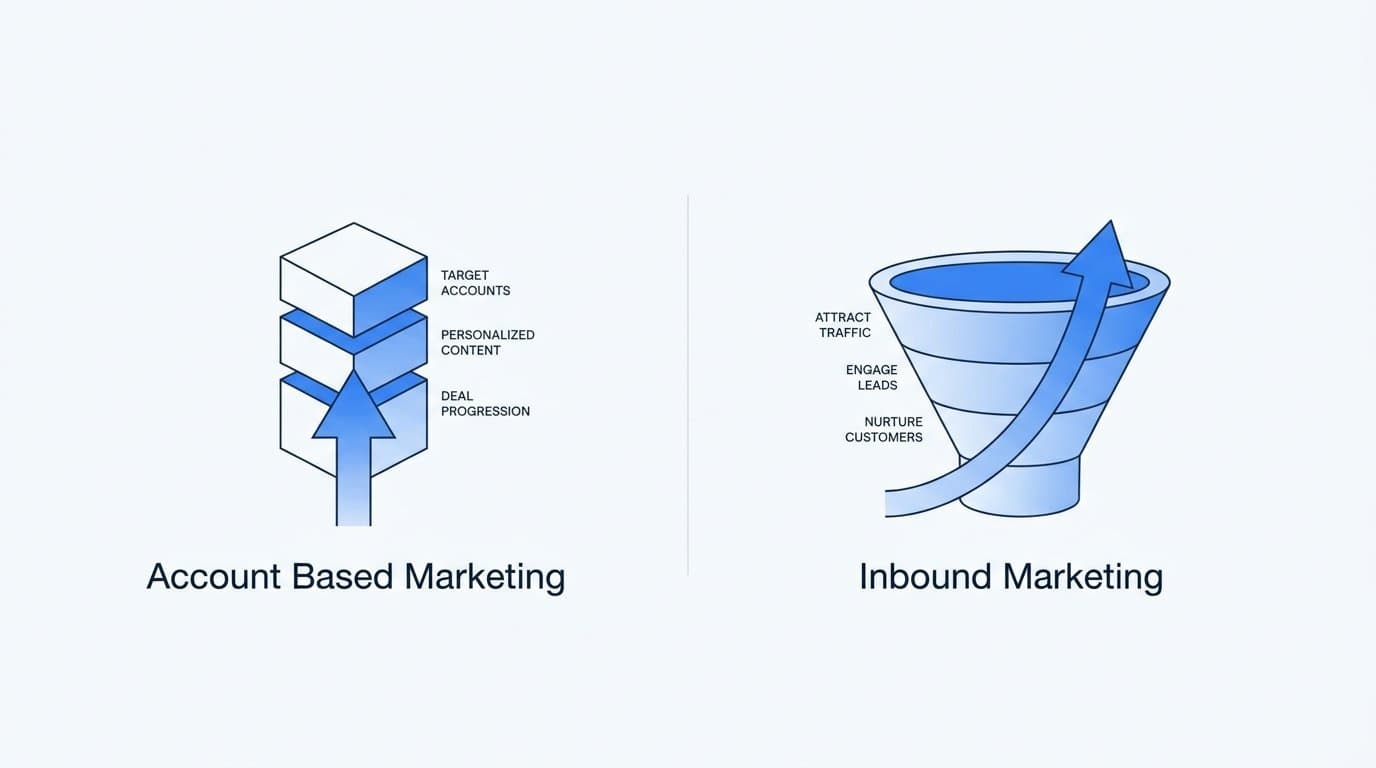
Account based marketing is a targeted, outbound-influenced strategy. You start by identifying a specific list of high-value accounts, typically based on your ideal customer profile, firmographic data, and sales intelligence. Then you build coordinated campaigns around those accounts, reaching the right people within each organization through paid ads, direct outreach, personalized content, and events. You are not waiting for these accounts to find you. You are going to find them.
Inbound marketing works in reverse. Instead of selecting accounts and pursuing them, you create content, optimize for search, and build a presence across channels that attracts buyers who are already researching solutions like yours. The prospect initiates the relationship by clicking on a blog post, downloading a guide, or signing up for a trial. Your job is to be visible and valuable at the moment they are looking. Over time, inbound assets continue to generate traffic and leads without requiring ongoing spend, creating a compounding return that grows as your content library expands.
The directional difference matters more than it might seem. ABM requires you to know who you want before they know they want you. That means investing in account intelligence, sales and marketing alignment, and personalized campaign execution. Inbound requires you to understand what your buyers are searching for and meet them there with content that earns their trust. That means investing in SEO, content production, and nurture sequences that guide prospects through a longer self-directed journey.
Both strategies aim at the same outcome: revenue. But they operate with different resource profiles, different timelines, and different definitions of success. Understanding that distinction is the first step toward using either one effectively.
Where Each Strategy Earns Its Keep
Not every B2B SaaS company should invest equally in both strategies. The right balance depends on several factors specific to your business: the size of your total addressable market, the length of your sales cycle, your average contract value, and whether demand for your category already exists or needs to be created.
ABM earns its keep when your TAM is narrow and your deals are large. If you are selling to a defined universe of, say, enterprise logistics companies or mid-market financial services firms, you do not need to attract millions of visitors. You need to get in front of the right hundred or thousand accounts, build relationships with multiple stakeholders within each buying committee, and move those accounts through a longer, more complex sales process. ABM is designed for exactly this scenario. It gives your sales and marketing teams a shared focus, a shared account list, and a coordinated playbook for multi-threaded outreach.
The signals that indicate ABM is the right primary motion include: a clearly defined ideal customer profile, high average contract values, sales cycles measured in months rather than weeks, and a sales team capable of executing personalized outreach at scale. If your deals regularly involve five or more stakeholders and require executive buy-in, ABM gives you the structure to address that complexity systematically.
Inbound marketing earns its keep when demand already exists and your buyers are actively searching. If your category is well understood, if prospects are typing questions into Google that your product answers, and if your TAM is broad enough that volume matters, inbound is often the most capital-efficient way to build pipeline over time. It is particularly well-suited for product-led growth motions, where self-serve discovery and free trial adoption are central to the buying journey. Inbound also works well for lower ACV segments where the economics of high-touch ABM outreach do not pencil out.
The signals that favor inbound include: a broad TAM, strong search demand in your category, a product that buyers can evaluate independently, and a business model where volume and conversion rate matter more than account-level personalization. If your buyers are doing their own research and making decisions without heavy sales involvement, inbound gives you the reach to be part of that research process.
The honest answer for many mature B2B SaaS companies is that both signals are present to some degree. You have a segment of high-value enterprise accounts that deserve ABM treatment, and a broader market of smaller buyers who are searching for solutions you offer. In that case, the question is not which strategy to choose. It is how to allocate resources between them and how to measure each one accurately.
How Measurement Differs Between ABM and Inbound
Here is where many marketing teams run into trouble. They apply the same measurement framework to both strategies and end up with data that is either misleading or incomplete.
Inbound marketing is naturally suited to volume-based metrics. You track organic traffic, lead volume, cost per lead, conversion rates at each stage of the funnel, and cost per acquisition across channels. Attribution models for inbound often rely on first-touch or last-touch logic: credit the blog post that brought someone in, or credit the landing page where they finally converted. These models are imperfect, but they provide a reasonable proxy for understanding which content and channels are generating demand.
ABM measurement requires a completely different lens. When you are targeting a defined list of accounts, lead volume is not the right metric. You might generate very few leads from your target accounts in a given month, but if those leads represent meaningful pipeline from your highest-priority accounts, that is a success. The metrics that matter for ABM are account-level engagement, pipeline influence, deal velocity, and revenue impact from targeted accounts. Standard MQL metrics can actually mislead ABM teams because they reward volume over quality.
This creates a real operational challenge for teams running both strategies. If you are measuring everything through the same lead-volume dashboard, your inbound program will always look more productive than your ABM program, even if ABM is generating larger deals with higher win rates. You need separate measurement frameworks that reflect the goals of each motion.
But there is a deeper challenge that affects both strategies: the buyer journey rarely follows a clean, single-channel path. Consider a common B2B SaaS scenario. A prospect at a target account reads one of your inbound blog posts while researching a problem. Three weeks later, they see a retargeted LinkedIn ad from your ABM campaign. A month after that, they attend a webinar you hosted. Then a sales rep follows up, and they request a demo. Which touchpoint gets credit for that deal?
First-touch attribution credits the blog post. Last-touch credits the sales follow-up. Neither tells the full story. This is precisely why multi-touch attribution is not optional for teams running ABM and inbound together. You need a model that distributes credit across all the touchpoints that influenced the deal, whether those touchpoints came from inbound content, ABM ads, or sales activity. Without that full-funnel visibility, you are optimizing in the dark.
Running Both Strategies Without Losing Visibility
Many mature B2B SaaS companies run ABM and inbound simultaneously. Inbound fills the top of the funnel broadly, building brand awareness and capturing demand from buyers who are actively searching. ABM then accelerates specific high-value accounts that are already in the pipeline or showing strong intent signals. The two motions are complementary when they are coordinated. The challenge is keeping attribution clean across both.
Without proper tracking, your marketing data becomes a patchwork of disconnected signals. Your inbound analytics tell you about traffic and lead volume. Your ABM platform tells you about account engagement and ad impressions. Your CRM tells you about pipeline and deals. But none of these systems are talking to each other, so you cannot see how a prospect's journey across all three environments actually contributed to a closed deal.
Customer journey tracking is the foundation for resolving this challenge. When you can see every touchpoint an account has had, from an organic blog visit to a targeted LinkedIn ad to a sales email click to a product demo, you can start to understand which combination of tactics is actually moving deals forward. You can see that accounts who engaged with three or more inbound content pieces before entering an ABM sequence tend to close faster. Or that ABM retargeting is most effective when it follows inbound engagement rather than running independently. These insights are only visible when you have a unified view of the customer journey.
Pipeline attribution and revenue attribution are the connective tissue that makes this visibility actionable. Pipeline attribution shows which marketing activities influenced deals at each stage of the funnel, giving you a way to evaluate the contribution of both ABM and inbound to the deals currently in play. Revenue attribution goes further, connecting specific campaigns, ads, and content pieces to closed-won revenue. This is the metric that truly validates either strategy.
The teams that get this right are the ones who invest in attribution infrastructure before scaling either motion. They build the tracking layer that connects their ad platforms, CRM, and website behavior into a single data model. Then they use that data to make decisions about where to allocate budget, which accounts to prioritize, and which content is actually contributing to pipeline rather than just generating traffic.
Without that infrastructure, you are essentially running two separate programs that cannot communicate with each other. You will always be guessing about which one is working, and you will always be at risk of underinvesting in the motion that is actually driving revenue.
The Attribution Layer That Makes Both Strategies Smarter
Think of attribution as the operating system that runs underneath both your ABM and inbound programs. Without it, both strategies generate activity and data, but you cannot connect that activity to the outcomes that matter. With it, every campaign decision becomes more informed, every budget allocation becomes more defensible, and every conversation with leadership about marketing ROI becomes more grounded in actual revenue impact.
A modern marketing attribution platform connects your ad spend, CRM data, and website behavior into a unified view of the customer journey. For inbound, this means you can see which organic and paid channels are generating traffic that actually converts to pipeline, not just traffic that inflates your session count. For ABM, it means you can see which targeted campaigns are influencing accounts that are already in your pipeline and which ones are opening doors to new accounts on your target list.
Server-side conversion tracking and first-party data enrichment have become increasingly important for both strategies. As browser privacy changes continue to limit the reliability of pixel-based tracking, teams that rely on client-side pixels are seeing their conversion data degrade. Server-side tracking sends conversion events directly from your server to ad platforms like Meta and Google, bypassing browser restrictions and maintaining signal quality. This matters for ABM retargeting because your ad platforms need accurate conversion data to optimize toward the accounts that are most likely to convert. It matters for inbound because your cost-per-acquisition calculations are only as accurate as your conversion tracking.
First-party data enrichment takes this further by matching website behavior and ad interactions to known accounts and contacts in your CRM. When you can tie an anonymous website visit to a specific account on your ABM target list, you have a signal that is far more actionable than a raw page view. You can trigger an ABM campaign, alert a sales rep, or adjust your bidding strategy based on real account-level intent data rather than probabilistic assumptions.
This is where Cometly provides a meaningful advantage for B2B SaaS marketing teams. Cometly acts as the attribution layer that gives your team a single source of truth across both ABM and inbound, connecting every ad click, content interaction, and CRM event to pipeline and closed revenue in real time. Instead of toggling between disconnected dashboards, you can see which channels and campaigns are generating actual revenue, compare attribution models to understand how credit should be distributed across touchpoints, and use AI-driven recommendations to identify which ads and campaigns are performing across every channel. That visibility is what allows you to scale the right motion with confidence rather than guessing.
Choosing Your Path Forward
If you are still deciding where to focus, here is a practical framework. If your TAM is narrow and your ACV is high, start with ABM. Build your ideal customer profile, define your target account list, align your sales and marketing teams around that list, and invest in the personalized, multi-channel campaigns that ABM requires. Measure success at the account level, not the lead level.
If your TAM is broad and demand already exists in your category, invest in inbound first. Build the content library, optimize for search, and create the nurture sequences that guide buyers through their self-directed research journey. Measure success through traffic quality, conversion rates, and cost per acquisition across channels.
If you have both signals, which is common for B2B SaaS companies at scale, build the attribution infrastructure before scaling either motion. The strategy you cannot measure is the strategy you cannot improve. Trying to scale ABM without account-level attribution is like running paid ads without conversion tracking. You will spend money, generate activity, and have no reliable way to know what is working.
Both ABM and inbound generate touchpoints across multiple channels and multiple timeframes. The buying journeys they create are rarely linear, and the credit for a closed deal rarely belongs to a single campaign or piece of content. The teams that win are the ones who can see the full picture: every touchpoint, every channel, every stage of the journey, connected back to the revenue it ultimately generated.
That visibility does not just make your reporting more accurate. It makes your strategy smarter. When you know which combination of inbound content and ABM outreach moves deals fastest, you can replicate that pattern intentionally. When you know which channels are generating pipeline from your target accounts, you can allocate budget with precision. When you can connect marketing activity to closed revenue, you can have a different kind of conversation with your leadership team about what marketing is actually worth.
Putting It All Together
ABM and inbound marketing are not competitors. They are complementary strategies that serve different stages of market maturity and different segments of your total addressable market. ABM gives you precision and control over high-value accounts. Inbound gives you reach and compounding returns across a broader audience. Used together, they cover more of the market than either could alone.
The real competitive advantage does not come from choosing one over the other. It comes from measuring both with the same rigor, understanding how they interact across the customer journey, and using that data to make faster, smarter decisions about where to invest next.
Most marketing teams are not losing because they picked the wrong strategy. They are losing because they cannot clearly see which parts of their strategy are working. That is an attribution problem, and it is one that is entirely solvable.
If your team is ready to stop guessing and start making decisions grounded in real revenue data, Cometly can give you the full-funnel attribution you need across both your ABM and inbound programs. From the first ad click to the last content interaction to closed-won revenue, every touchpoint becomes visible and measurable. Get your free demo today and see exactly which channels and campaigns are driving your pipeline.