
Every B2B SaaS marketing leader eventually hits the same fork in the road. Do you cast a wide net and pull in as many leads as possible, then sort through them to find the ones worth pursuing? Or do you identify your highest-value target accounts upfront and concentrate every resource on winning those specific companies? This is not an abstract debate about marketing philosophy. It is a concrete resource allocation decision with direct consequences for pipeline, revenue, and growth trajectory.
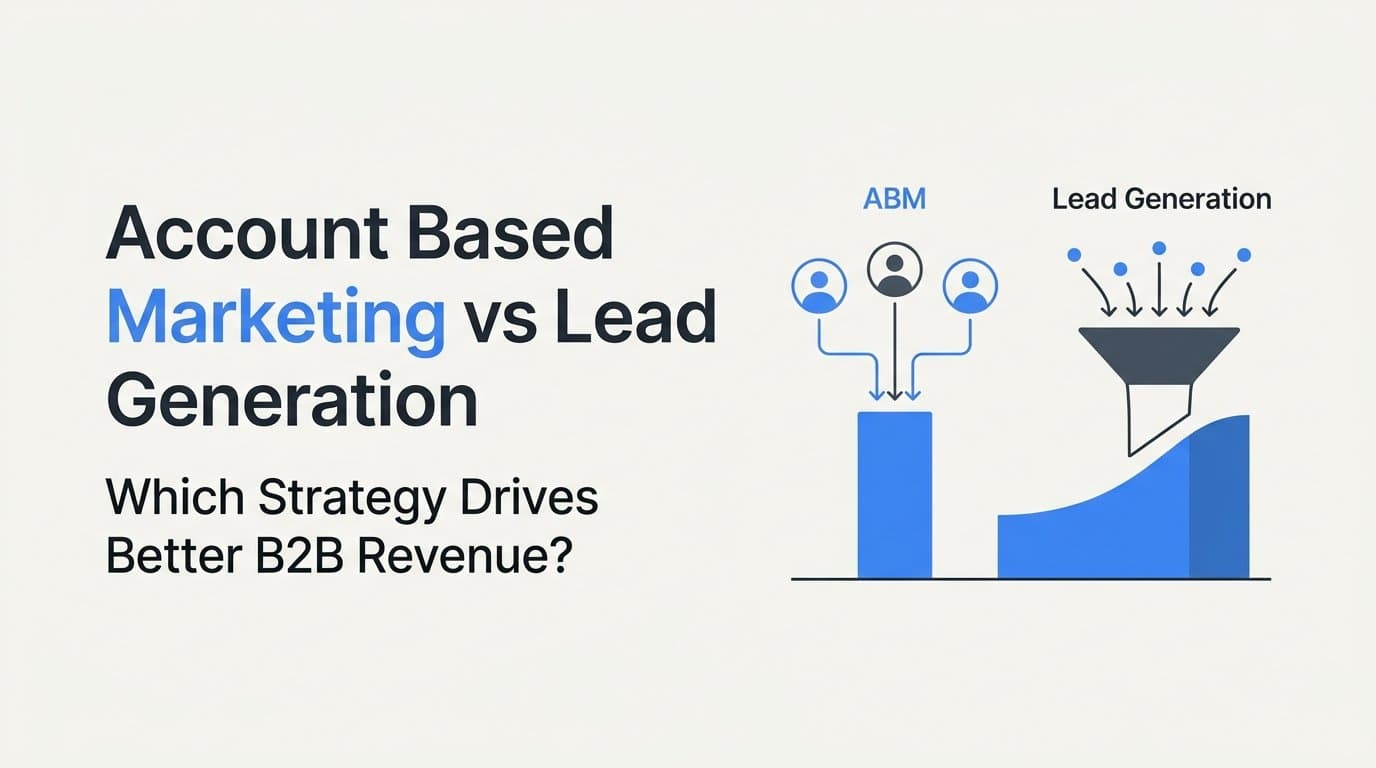
Lead generation and account based marketing represent two fundamentally different answers to the same question: how do you acquire customers efficiently? Lead generation bets on volume. You create content, run ads, and build inbound channels that attract a broad pool of potential buyers, then qualify them through a funnel. Account based marketing (ABM) inverts that logic entirely. You define your ideal accounts first, then orchestrate targeted outreach, personalized ads, and coordinated sales activity specifically for those companies.
Both approaches work. Both also fail in predictable ways when applied to the wrong situation or measured incorrectly. This article breaks down how each strategy works, where each excels, what metrics actually matter for each, and how to decide which approach fits your current growth stage. The through-line across all of it is attribution: your ability to connect marketing activity to revenue is what makes either strategy measurable and scalable.
Two Fundamentally Different Philosophies for Winning Customers
Lead generation starts with an audience and works toward a customer. The core assumption is that if you attract enough relevant contacts through content marketing, paid search, social advertising, and gated assets, a meaningful percentage of them will qualify as real opportunities. Volume is the primary lever. You optimize for top-of-funnel reach, then rely on conversion rates and nurture sequences to filter the signal from the noise.
ABM starts with a customer and works backward. Before a single ad runs or a single email goes out, the team has already defined a list of specific companies that fit the ideal customer profile. Marketing and sales then align to engage the buying committee within those accounts through personalized campaigns, direct outreach, and targeted content. The primary lever is not volume but relevance and account engagement.
This structural difference has real implications for how you allocate budget and define success. In a lead generation program, spend is distributed across channels designed to maximize reach and top-of-funnel throughput. A strong month is one with high lead volume and an acceptable cost per lead. In an ABM program, spend is concentrated on a defined account list, often with higher cost-per-touch but significantly higher expected deal value. A strong month is one where target accounts show meaningful engagement signals and progress through buying stages.
Budget concentration: ABM directs resources toward fewer targets with higher precision. Lead generation spreads resources broadly to maximize opportunity volume. Neither approach is inherently more efficient without knowing your average contract value, sales cycle length, and market size.
Campaign architecture: Lead generation campaigns optimize for audience-level signals like interest and search intent. ABM campaigns are built around specific companies and personas within those companies, often using account-level targeting in platforms like LinkedIn and programmatic display.
Definition of success: Lead generation teams typically measure success in leads, MQLs, and cost per acquisition. ABM teams measure success in account engagement rate, account progression, and influenced pipeline from the target account list. These are not interchangeable metrics, and using the wrong framework to evaluate either strategy leads to bad decisions.
Understanding this structural difference is the prerequisite for everything else. The strategy you choose shapes your campaigns, your team structure, your tech stack, and your reporting. Getting clear on which philosophy fits your situation is the first and most important decision.
The Case for Lead Generation: Strengths and Blind Spots
Lead generation is the natural starting point for most B2B SaaS companies, and for good reason. When your addressable market is large, your average contract value is lower, and your sales cycle is relatively short, high-volume inbound channels are efficient. Paid search captures buyers who are actively researching solutions. SEO-driven content builds compounding organic traffic. Social advertising extends reach to audiences who match your buyer profile. These channels are well-understood, relatively easy to launch, and produce measurable top-of-funnel results quickly.
The model also generates valuable market intelligence. When you run lead generation at scale, you learn which messages resonate, which channels attract buyers who actually convert, and which customer profiles tend to close fastest. That data is genuinely useful, especially in the early stages of a company when you are still refining your ICP.
Here is where it gets complicated. In B2B SaaS, the gap between lead volume and closed revenue is often wide and difficult to bridge. Many leads are low-intent contacts who downloaded a resource out of curiosity, not buyers who are actively evaluating solutions. Marketing teams generate volume, but sales teams spend significant time working leads that were never going to convert. This creates friction between marketing and sales, and it makes ROI genuinely hard to prove.
The measurement problem compounds the issue. Without accurate attribution, lead generation programs tend to optimize for the metrics that are easiest to track: form fills, MQL volume, and cost per lead. These metrics feel like progress but they can be deeply misleading. A campaign that generates hundreds of MQLs might produce almost no closed revenue if those leads are poorly qualified or poorly attributed. Meanwhile, a campaign that generates fewer leads but consistently produces high-intent buyers might be undervalued because its downstream revenue impact is not being tracked properly.
Where lead generation works best: Large addressable markets, lower ACV products, short sales cycles, and situations where brand awareness and market education are primary goals.
Where it falls short: High-ACV enterprise deals, markets with a defined set of ideal accounts, and situations where the sales team is capacity-constrained and cannot afford to work unqualified leads.
The fix is not to abandon lead generation but to measure it correctly. Connecting lead generation activity to pipeline and closed revenue, rather than stopping at MQL volume, transforms the program from a cost center into a measurable growth driver.
The Case for ABM: Strengths and Blind Spots
Account based marketing is purpose-built for the complexity of high-ACV B2B deals. When a single contract is worth tens or hundreds of thousands of dollars, and when closing that contract requires buy-in from multiple stakeholders across different functions, the personalized and coordinated approach of ABM makes intuitive sense. You are not trying to attract an anonymous audience. You are trying to win a specific company, and you know who the decision-makers are.
The strengths of ABM are clearest in situations where the target account list is well-defined and the ICP is sharp. Personalized ads that speak directly to a company's industry, pain points, or competitive situation outperform generic demand generation creative. Coordinated outreach where marketing and sales are aligned on messaging and timing creates a more coherent buyer experience. Tailored content that addresses the specific concerns of a buying committee accelerates the decision-making process.
The limitations are equally real. ABM requires a level of organizational alignment that many teams underestimate. Marketing and sales need to agree on the target account list, the ICP definition, the messaging hierarchy, and the handoff process. Without that alignment, ABM becomes expensive outreach to the wrong companies with inconsistent messaging.
Intent data is another prerequisite that teams often overlook. Knowing which accounts are in-market, actively researching solutions like yours, is what separates ABM programs that move efficiently from those that burn budget on accounts that are not ready to buy. Without reliable intent signals, you are essentially guessing which accounts to prioritize.
Measurement complexity: Traditional lead-level metrics simply do not capture what matters in ABM. A target account might interact with six different touchpoints across three channels before a sales conversation ever happens. If you are only tracking form fills or last-click conversions, you will miss the contribution of most of those interactions. You need account-level tracking that surfaces engagement signals across channels and connects them to account progression through buying stages.
Scale and speed constraints: ABM is inherently slower to launch than lead generation. Building a target account list, developing personalized creative, coordinating sales outreach, and setting up account-level tracking takes time. For companies that need pipeline quickly, this ramp-up period is a real cost.
ABM works best when you have a defined ICP, a capable sales team, strong sales and marketing alignment, and the patience to build the infrastructure correctly. When those conditions are in place, the return on investment can be substantially higher than broad lead generation, particularly for complex enterprise deals.
The Metrics That Actually Drive Decisions
The most common failure across both strategies is measuring the wrong thing. Teams optimize for metrics that are easy to track rather than metrics that reflect actual business outcomes. Fixing this is not a reporting exercise. It is a strategic imperative that changes how you allocate budget and evaluate programs.
For lead generation programs, the metrics that matter are pipeline-connected, not top-of-funnel. Track lead-to-opportunity rate by channel and campaign. Track cost per pipeline dollar, not just cost per lead. Track revenue attribution by source so you can see which channels are actually producing closed deals, not just form fills. These metrics require connecting your ad platforms and marketing channels to your CRM and revenue data, but they tell you something genuinely useful about whether your spend is working.
Key lead generation metrics:
Lead-to-opportunity rate: What percentage of leads from each channel actually become sales opportunities? This surfaces channel quality differences that cost-per-lead metrics obscure.
Cost per pipeline dollar: How much marketing spend does it take to generate one dollar of sales pipeline? This normalizes for deal size differences across channels.
Revenue attribution by channel: Which channels and campaigns are connected to actual closed revenue? This requires multi-touch attribution, not last-click.
For ABM programs, the metrics shift to account-level signals. Track what percentage of your target accounts are showing meaningful engagement with your content, ads, or outreach. Track how accounts are progressing through defined buying stages over time. Track influenced pipeline from target accounts, meaning deals where ABM activity touched the account before or during the sales cycle. Compare deal velocity and win rates for accounts that were part of your ABM program versus those that were not.
Key ABM metrics:
Account engagement rate: What percentage of your target account list is actively engaging with your campaigns and content?
Account progression: Are target accounts moving through defined buying stages? Stalled accounts signal a need to adjust messaging or outreach strategy.
Influenced pipeline: What is the total pipeline value from deals where your ABM program had meaningful touchpoints?
The common thread is that both strategies require attribution infrastructure that connects marketing activity to revenue outcomes. Last-click attribution and platform-reported conversions give you a distorted view of what is working. Multi-touch attribution that tracks the full customer journey from first interaction to closed deal is the foundation for making confident budget decisions in either program.
Matching Strategy to Growth Stage
The right strategy is not universal. It depends on where your company is in its growth trajectory, how well-defined your ICP is, and what your sales capacity looks like. Getting this match right saves significant time and budget.
Early-stage B2B SaaS companies typically benefit from leading with lead generation. When your ICP is still being refined, broad inbound channels surface market signals that sharpen your understanding of who actually buys and why. Lead generation at this stage is partly a customer discovery exercise. The data you collect about which profiles convert, which channels attract buyers versus researchers, and which messages resonate becomes the foundation for everything that comes later.
Growth-stage companies with a defined ICP, an established sales team, and higher ACVs are in a different position. They have enough data to build a credible target account list. Their sales team can handle the coordination that ABM requires. And their deal sizes justify the higher cost-per-touch of personalized account-level campaigns. At this stage, ABM or a hybrid approach typically produces better ROI than continuing to scale broad lead generation alone.
The hybrid model is increasingly common among growth-stage B2B SaaS companies. Lead generation runs in parallel with ABM, serving different functions. Lead generation builds pipeline broadly and continues to surface market signals. ABM runs focused programs for the top tier of target accounts where the deal value and strategic fit justify concentrated investment. The two programs complement each other rather than compete.
The critical requirement for a hybrid approach is attribution infrastructure that can measure both programs independently. If you cannot separate the pipeline contribution of your ABM program from your lead generation program, you cannot make informed decisions about where to invest more. You need to be able to see, clearly, which accounts engaged through ABM touchpoints and how those accounts performed compared to accounts that came through lead generation channels.
A useful way to think about the progression: use lead generation to discover what works, use that data to build your ABM target list, and use attribution to measure both programs with the rigor they deserve.
Why Attribution Is the Foundation for Both Strategies
Whether you run ABM, lead generation, or both, your ability to connect marketing activity to revenue is what separates teams that scale confidently from teams that guess. This is not a nice-to-have capability. It is the operating system that makes either strategy work at scale.
In B2B SaaS, buying cycles are long. A prospect might first encounter your brand through a paid search ad, then read three blog posts over the following month, then attend a webinar, then respond to a sales email, and then convert six months after that first click. If your attribution only captures the last touchpoint, you will systematically undervalue the channels and campaigns that created awareness and intent earlier in the journey. You will shift budget away from what is actually working.
Server-side conversion tracking and multi-touch attribution models solve this problem by capturing the full customer journey across channels. First-touch attribution tells you where buyers are coming from. Last-touch tells you what closes them. Linear and data-driven models distribute credit across the journey in ways that reflect the contribution of each touchpoint. Having access to multiple models lets you understand the journey from different angles rather than committing to a single, inevitably incomplete view.
The same infrastructure that improves your attribution also improves your ad platform performance. When you send enriched conversion events back to Meta and Google through their Conversion APIs, you give those platforms more complete data about which clicks are producing real business outcomes. This improves their targeting and optimization algorithms, which improves the quality of traffic you attract. It is a compounding advantage that builds over time.
Cometly is built specifically for this challenge. It connects your ad platforms, CRM, and website data into a single source of truth, giving you a complete view of the customer journey from first ad click to closed-won revenue. You can analyze which campaigns are driving qualified leads or engaging target accounts, compare attribution models side by side, and feed enriched conversion data back to Meta and Google to sharpen ad platform optimization. For B2B SaaS teams running lead generation, ABM, or a combination of both, Cometly provides the attribution layer that makes each program measurable and scalable.
Building a Strategy You Can Actually Measure
The account based marketing vs lead generation decision is ultimately a resource allocation question, and like any resource allocation question, it should be driven by data rather than instinct or trend-chasing.
Lead generation is the right starting point when your market is broad, your ACV is moderate, and you are still learning which customer profiles convert best. It builds pipeline volume, generates market intelligence, and creates the data foundation that informs everything that comes next. The key is measuring it against pipeline and revenue outcomes, not just top-of-funnel volume.
ABM is the right move when you have a defined ICP, a capable sales team, and deal sizes that justify concentrated investment in specific accounts. It requires more upfront coordination and infrastructure, but when the conditions are right, it produces higher-quality pipeline and stronger win rates on the accounts that matter most.
A hybrid approach combines the strengths of both, using lead generation for broad pipeline development while running parallel ABM programs for your highest-value target accounts. This model works best when you have attribution infrastructure that can measure each program independently and surface clear signals about where to invest more.
None of this works without accurate measurement. The teams that scale marketing efficiently are the ones that can see, with confidence, which channels and campaigns are producing real revenue. That visibility is what allows you to make bold budget decisions, defend your programs to leadership, and continuously improve what is working.
Ready to elevate your marketing game with precision and confidence? Discover how Cometly's AI-driven recommendations can transform your ad strategy. Get your free demo today and start capturing every touchpoint to maximize your conversions.