
Ad tracking pixels were once the backbone of digital marketing measurement. A small snippet of code placed on your website would fire when a user visited a page, clicked a button, or completed a purchase, sending that data back to your ad platforms. For years, this worked well enough. But the tracking landscape has shifted dramatically.
Browser privacy updates, cookie deprecation, ad blockers, and iOS privacy changes have eroded pixel reliability to the point where many B2B SaaS marketing teams are flying blind on attribution. If you are still relying solely on browser-based pixel tracking, you are likely missing a significant portion of your conversion data. The result is distorted ROAS calculations, misallocated budget, and ad platform algorithms that optimize on incomplete signals.
The good news is that the marketing technology space has responded with a range of more durable, privacy-resilient tracking alternatives. These approaches range from server-side tracking and Conversion APIs to UTM-based attribution and first-party data strategies. Each has distinct strengths depending on your tech stack, traffic volume, and attribution goals.
This article breaks down seven proven alternatives to traditional ad tracking pixels, explaining how each works, when to use it, and how to implement it effectively. Whether you are a growth marketer at a B2B SaaS company or an agency managing multi-channel campaigns, these strategies will help you build a tracking foundation that holds up in the modern privacy-first environment.
1. Server-Side Tracking
The Challenge It Solves
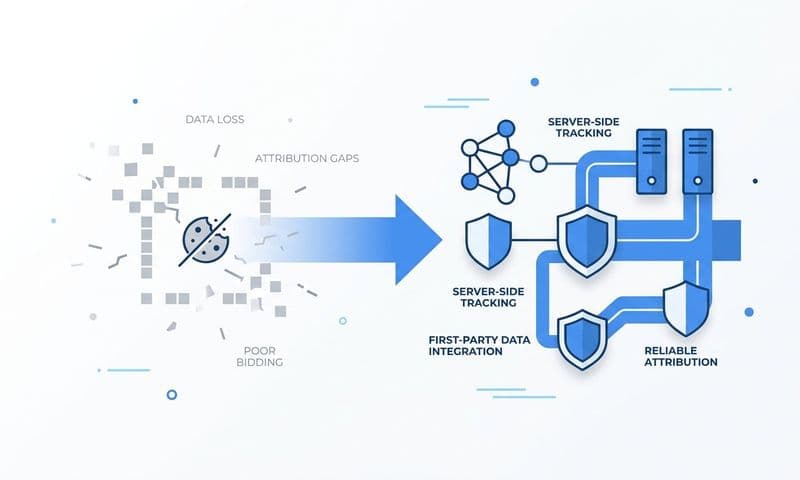
Traditional browser-fired pixels are vulnerable at every step of the user's journey. Ad blockers intercept pixel requests before they leave the browser. Safari's Intelligent Tracking Prevention limits how long tracking cookies persist. Firefox blocks third-party trackers by default. Each of these restrictions chips away at your conversion data, leaving your ad platforms working with incomplete signals and your attribution reports telling only part of the story.
The Strategy Explained
Server-side tracking routes conversion events through your own server before forwarding them to ad platforms. Instead of a browser-fired JavaScript tag, you send event data from your backend directly to the destination endpoint. Because the request originates from a server rather than a user's browser, it bypasses ad blockers, cookie restrictions, and browser privacy settings entirely.
This approach gives you far greater control over what data is collected, how it is processed, and where it is sent. You can enrich events with CRM data, apply deduplication logic, and ensure that every meaningful conversion action gets recorded accurately. Google Tag Manager's server-side container is one widely used implementation path, though purpose-built solutions also exist for teams with more complex requirements.
Implementation Steps
1. Set up a server-side tagging container using Google Tag Manager's server-side configuration or a comparable solution, and deploy it to a subdomain on your own domain to maintain first-party context.
2. Migrate your most critical conversion events, such as form submissions, trial sign-ups, and demo requests, from client-side tags to server-side event triggers first, then expand from there.
3. Implement deduplication logic to prevent double-counting events that may be sent from both client-side and server-side sources during the transition period.
4. Validate your server-side events using the diagnostic tools available within your tag management platform and compare reported conversions against your CRM records to confirm accuracy.
Pro Tips
Do not abandon client-side tracking entirely during your migration. Running both in parallel with deduplication enabled gives you redundancy and helps you identify gaps. Prioritize server-side tracking for high-value conversion events first, where underreporting has the most direct impact on budget allocation decisions.
2. Conversion APIs (Meta CAPI and Google Enhanced Conversions)
The Challenge It Solves
Even when server-side tracking is in place, ad platforms still need a way to match your conversion events to the users who saw or clicked your ads. Traditionally, this matching relied on browser cookies. As cookies become less reliable, ad platforms have developed their own server-to-server solutions that use hashed first-party data to perform that matching without depending on browser state.
The Strategy Explained
Meta's Conversions API and Google's Enhanced Conversions both work by accepting hashed customer data, such as email addresses, phone numbers, and names, directly from your server. The ad platform then attempts to match that hashed data against its own user records to attribute the conversion to the correct campaign and ad.
Meta officially recommends using CAPI alongside the browser pixel rather than replacing it, because the combination improves event match quality scores. Google Enhanced Conversions similarly supplements standard conversion tracking with hashed first-party data to recover conversions that would otherwise go unattributed. Both approaches are documented and supported natively by the platforms themselves, making them among the most reliable attribution methods available today.
Implementation Steps
1. Identify the first-party data points you collect at key conversion events, typically email address at form submission or sign-up, and confirm you have the appropriate data handling agreements in place with your users.
2. Hash the relevant customer data fields using SHA-256 before sending them to Meta CAPI or Google Enhanced Conversions, following each platform's specific formatting requirements.
3. Configure your server-side event payload to include both the hashed customer data and the relevant event parameters, such as event name, event time, and any custom conversion values.
4. Monitor event match quality scores within Meta Events Manager and Google Ads conversion diagnostics to assess how effectively your hashed data is matching to platform users, and refine your data inputs accordingly.
Pro Tips
The quality of your event matching depends directly on the quality and completeness of the first-party data you send. Collecting email at every meaningful conversion point, and ensuring that data is clean and consistently formatted, will meaningfully improve your match rates and the accuracy of your ad platform reporting.
3. UTM Parameter Tracking
The Challenge It Solves
When pixel-based attribution fails, you need a fallback that captures campaign source information at the moment a user arrives on your site, before any cookies are set or blocked. UTM parameters solve this by embedding attribution data directly in the URL, making it available to your analytics platform and CRM the instant a session begins, regardless of browser privacy settings.
The Strategy Explained
UTM parameters are query string values appended to destination URLs in your ads. When a user clicks a tagged link, your analytics platform reads those parameters and associates the session with the corresponding campaign, source, medium, and ad. Because this data is captured server-side when the page loads, it is not subject to the same browser restrictions that affect third-party cookies or pixel requests.
The real power of UTM tracking comes from building a consistent, structured naming convention and ensuring that UTM data flows through your entire stack, from your analytics platform into your CRM and attribution tool. When a lead submits a form, their UTM data should be captured alongside their contact record so you can connect ad-level spend to pipeline and revenue downstream.
Implementation Steps
1. Define a standardized UTM naming convention across your team covering utm_source, utm_medium, utm_campaign, utm_content, and utm_term, and document it in a shared reference guide to ensure consistency across all campaigns.
2. Use a UTM builder tool or a shared spreadsheet template to generate tagged URLs for every paid ad, email campaign, and external link, eliminating manual inconsistencies.
3. Configure your CRM to capture UTM parameters from form submissions by passing hidden field values that pull from the URL or from a first-party cookie you set on the user's initial session.
4. Audit your UTM data regularly within your analytics platform to identify inconsistencies, missing parameters, or naming convention drift that would fragment your attribution data.
Pro Tips
Store UTM values in a first-party cookie on your own domain when a user first lands on your site. This preserves the attribution source across multiple pages and sessions, even if the user does not convert immediately. Platforms like Cometly automate this process, capturing UTM data and associating it with CRM records throughout the customer journey.
4. First-Party Data Collection
The Challenge It Solves
Third-party cookies were always a workaround, a way to track users across domains without a direct relationship with them. As that workaround disappears, the marketers who will maintain accurate attribution are those who have invested in collecting data directly from their own systems. First-party data is not subject to browser restrictions because it comes from interactions your users have directly with your product, website, or team.
The Strategy Explained
First-party data collection means building an attribution layer from events that happen within your own systems: form submissions captured in your CRM, trial activations recorded in your product database, demo completions logged in your calendar tool, and revenue events tracked in your billing platform. None of these events depend on a browser pixel firing correctly. They exist in your systems regardless of what the user's browser does.
The key is connecting these events back to the marketing touchpoints that preceded them. When a user submits a form, your CRM should capture not just their contact details but also the UTM parameters, referrer data, and click IDs associated with their session. This creates a first-party attribution record that you own and control, independent of any ad platform's measurement infrastructure.
Implementation Steps
1. Audit your existing data collection points across your website, CRM, and product to identify where first-party conversion signals are already being generated but not yet captured for attribution purposes.
2. Implement hidden form fields that capture UTM parameters, referrer data, and click IDs at every lead capture point, storing these values alongside the contact record in your CRM.
3. Connect your billing or revenue platform, such as Stripe, to your attribution stack so that closed-won revenue events can be traced back to the original marketing touchpoints that generated the lead.
4. Establish a regular data hygiene process to ensure that first-party records are complete, deduplicated, and consistently structured across your CRM and analytics tools.
Pro Tips
Think of your CRM as your primary attribution database, not just a sales tool. Every marketing touchpoint that can be associated with a contact record is a first-party attribution signal. The more complete those records are, the more accurate your downstream reporting will be, regardless of what happens in the browser.
5. Multi-Touch Attribution Models
The Challenge It Solves
Even when you recover lost conversion data through server-side tracking and Conversion APIs, you still face the question of how to assign credit across multiple touchpoints. Last-click attribution, the default for most ad platforms, gives all credit to the final interaction before conversion. For B2B SaaS companies with sales cycles that span weeks or months and involve multiple channels, this creates a deeply misleading picture of which marketing efforts are actually driving results.
The Strategy Explained
Multi-touch attribution models distribute conversion credit across all the touchpoints in a customer's journey rather than assigning it entirely to one. Common models include linear attribution, which splits credit equally across all touches; time-decay attribution, which gives more weight to touchpoints closer to conversion; and position-based attribution, which emphasizes the first and last touches while distributing remaining credit across the middle.
For B2B SaaS specifically, where a buyer might engage with a LinkedIn ad, read a blog post, attend a webinar, and then convert through a Google search weeks later, multi-touch models reveal which channels are building awareness and nurturing intent versus which are closing. This distinction is critical for making informed budget allocation decisions across the full funnel.
Implementation Steps
1. Map your typical customer journey by reviewing CRM data and session records to understand how many touchpoints buyers typically have before converting, and which channels appear most frequently at each stage.
2. Select an attribution model that reflects your business reality. For longer B2B sales cycles, a time-decay or position-based model often provides more actionable insight than a linear split.
3. Implement your chosen model within a dedicated attribution platform rather than relying on ad platform native reporting, which is inherently biased toward crediting its own channels.
4. Compare model outputs side by side to understand how credit distribution shifts across channels and use those insights to inform budget reallocation decisions rather than treating any single model as absolute truth.
Pro Tips
No single attribution model is perfect. The value of multi-touch attribution is not in finding the "correct" answer but in revealing patterns that last-click reporting hides entirely. Use model comparisons to challenge assumptions about which channels are undervalued, particularly upper-funnel channels like paid social that rarely get last-click credit but often initiate the buying journey.
6. Cookieless Tracking with URL-Based Click IDs
The Challenge It Solves
Ad platforms have always relied on browser cookies to connect an ad click to a downstream conversion. When a user clicks a Facebook ad, Meta drops a cookie that it later reads when a pixel fires on your thank-you page. As cookies become less persistent and less available, that connection breaks. Click IDs offer a way to maintain ad-level attribution without depending on cookie persistence.
The Strategy Explained
When a user clicks an ad on Meta or Google, the platform appends a click ID to the destination URL. Meta uses fbclid and Google uses gclid. These parameters are present in the URL at the moment the user lands on your site, before any cookie-related restrictions apply. By capturing these click IDs server-side and storing them in your CRM alongside the user's contact record, you can maintain a persistent link between the ad click and any downstream conversion events, even in cookieless environments.
Both Meta and Google officially document click ID capture as part of their server-side attribution workflows. When you later send a conversion event via CAPI or Enhanced Conversions, including the original click ID dramatically improves the platform's ability to attribute that conversion to the correct ad, campaign, and audience without relying on cookie matching.
Implementation Steps
1. Configure your landing pages to read fbclid and gclid values from the URL query string when a user arrives, and store those values in a first-party cookie on your own domain immediately upon page load.
2. Pass the stored click ID values through your form hidden fields so that when a user converts, the click ID is captured alongside their contact information in your CRM.
3. Include the click ID in your server-side event payloads when sending conversion data to Meta CAPI or Google Enhanced Conversions, following each platform's parameter specifications for click ID inclusion.
4. Validate that click IDs are being captured and passed correctly by reviewing a sample of recent CRM records and confirming that the fbclid or gclid fields are populated for traffic from paid campaigns.
Pro Tips
Click IDs have a limited lifespan on the platform side, so capturing and storing them quickly is important. Setting a first-party cookie with a longer expiration window on your own domain ensures you retain the click ID even if the user does not convert on their first visit. Platforms like Cometly handle click ID capture and CRM association automatically, removing the need for custom development work.
7. Marketing Attribution Platforms
The Challenge It Solves
Each of the strategies covered in this article generates a piece of the attribution puzzle. Server-side tracking recovers lost conversion events. Conversion APIs improve platform-side matching. UTM parameters create a first-party campaign record. Click IDs extend attribution into cookieless environments. But if these signals live in separate systems with no unified view, you still cannot answer the fundamental question: which channels and campaigns are actually driving pipeline and revenue?
The Strategy Explained
A dedicated marketing attribution platform consolidates all of your tracking signals into a single, unified data layer. It ingests server-side events, UTM data, click IDs, CRM records, and revenue data, then applies attribution models to give you a complete picture of how your marketing spend translates into business outcomes. Instead of reconciling data across five different tools, you have one source of truth that reflects the entire customer journey from first ad click to closed-won revenue.
For B2B SaaS companies, this is particularly valuable because the sales cycle involves multiple stakeholders, long timeframes, and touchpoints across many channels. An attribution platform designed for this context can connect ad spend to pipeline stages and revenue events, show which campaigns generate leads that actually close, and send enriched conversion signals back to ad platforms to improve algorithmic optimization. Cometly is built specifically for this use case, connecting ad platforms, CRM systems, and websites to capture every touchpoint and apply attribution models that reflect how B2B buyers actually behave.
Implementation Steps
1. Audit your current tracking stack to identify which signals you are already capturing and where the gaps are, then select an attribution platform that can ingest all of your existing data sources without requiring you to rebuild from scratch.
2. Connect your ad platforms, including Meta, Google, and LinkedIn, along with your CRM and billing platform, to create a unified data pipeline that flows all conversion signals into a single attribution layer.
3. Configure your attribution models within the platform to match your business reality, and use the platform's reporting to compare model outputs and identify channels that are undervalued or overvalued in your current budget allocation.
4. Use the platform's Conversion API or event forwarding capabilities to send enriched, deduplicated conversion signals back to your ad platforms, improving the quality of data that feeds their optimization algorithms.
Pro Tips
Look for a platform that connects revenue data, not just lead data. For B2B SaaS, the most important attribution question is not which channel drives the most form fills but which channel drives the most closed revenue. A platform that integrates with Stripe or your CRM's deal stage data gives you attribution that reflects actual business outcomes, not just top-of-funnel activity.
Putting It All Together
Building a tracking stack that does not depend on a single browser-based pixel is no longer optional for B2B SaaS marketing teams. The strategies covered in this article work best when layered together rather than used in isolation.
Start by implementing server-side tracking and Conversion APIs to recover lost conversion signals and feed better data to your ad platforms. Layer in structured UTM parameters to create a consistent first-party attribution foundation that flows through your CRM. Add click ID capture to extend attribution across cookieless environments. Then bring it all together with a multi-touch attribution platform that gives you a complete, accurate view of which channels and campaigns are actually driving pipeline and revenue.
The goal is not to replace pixels with a single alternative. It is to build a resilient, multi-layered tracking system where each method reinforces the others. Here is a practical prioritization framework for getting started:
Start here: Server-side tracking and Conversion API setup for your highest-value conversion events. This is the highest-leverage move for recovering lost data immediately.
Then add: Structured UTM parameters and click ID capture across all paid campaigns, with CRM integration to store those values alongside contact records.
Then build: A first-party data layer that connects CRM events and revenue data to your marketing touchpoints, giving you attribution that extends beyond the browser session.
Finally, unify: Bring all signals together in a dedicated attribution platform that applies multi-touch models and sends enriched conversion data back to your ad platforms.
Cometly is built specifically for this. It connects your ad platforms, CRM, and website to capture every touchpoint across the customer journey, applies attribution models that reflect how B2B buyers actually behave, and sends enriched conversion signals back to Meta, Google, and other ad platforms to improve optimization. If you are ready to move beyond unreliable pixel tracking and build attribution that scales, Get your free demo today and start capturing every touchpoint to maximize your conversions.