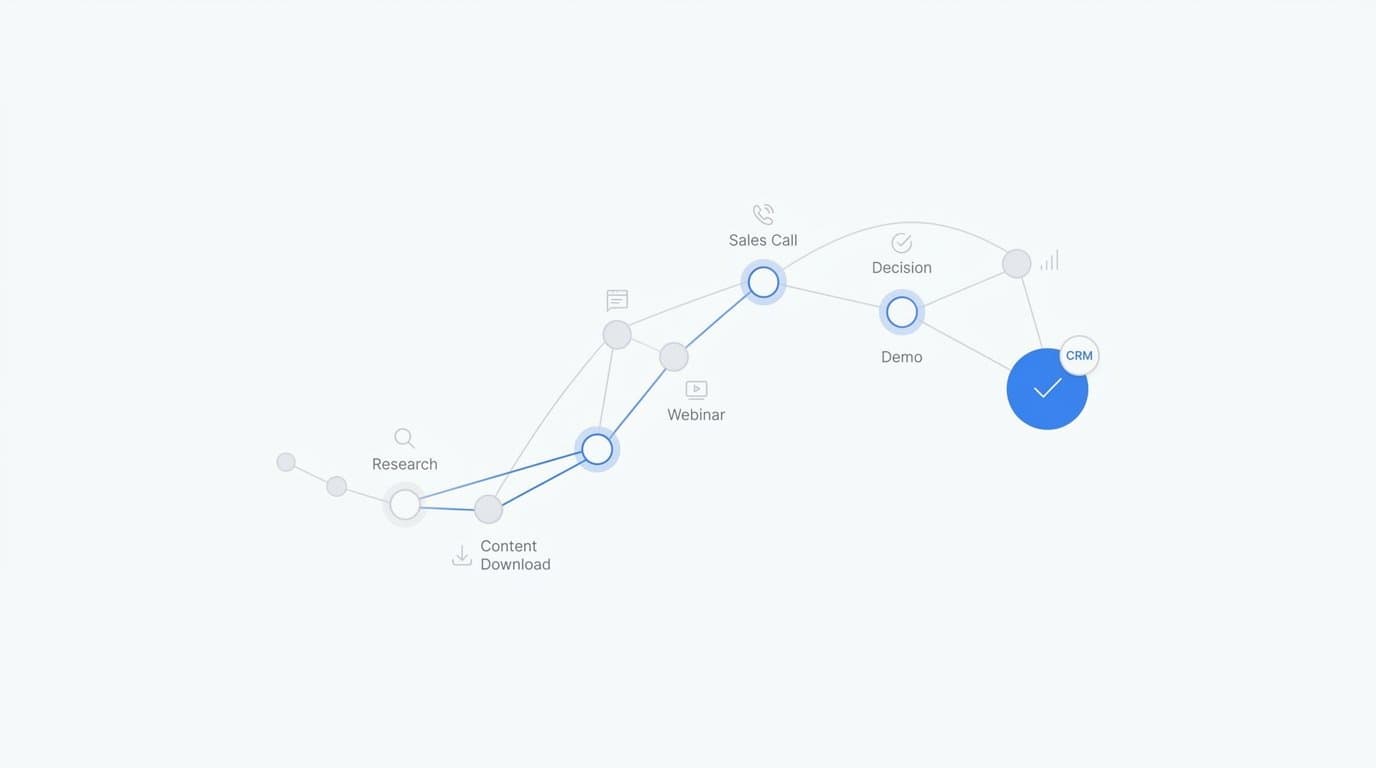
B2B buyers rarely convert after a single interaction. Before they ever fill out a demo request or pick up a phone for a sales call, they have already read three blog posts, watched a product walkthrough on YouTube, checked your G2 reviews, and had an internal conversation with two colleagues who never touched your website at all. By the time they appear in your CRM, the journey is already well underway.
Most marketing teams only see the last mile of that journey. They know a lead came from a demo request form, but they have no visibility into the LinkedIn ad that started the conversation six weeks ago, the retargeting campaign that brought the buyer back, or the case study download that pushed them from curious to serious. Without that full picture, budget decisions get made on incomplete data, and channels that are quietly driving pipeline get defunded because they cannot prove their contribution.
Understanding B2B buyer journey touchpoints is not a reporting exercise. It is a revenue discipline. Every interaction a buyer has with your brand before they close is a signal, and the teams that capture, connect, and act on those signals have a structural advantage over the ones flying blind. This guide breaks down what those touchpoints are, where the data gaps live, how to fix them, and how to turn touchpoint intelligence into decisions that actually move the revenue needle.
The Long Road to a B2B Purchase Decision
B2B buying is fundamentally different from B2C, and that difference matters enormously for how you think about touchpoints. A consumer buying a pair of headphones might click an Instagram ad and check out within ten minutes. A company evaluating a marketing analytics platform might spend three months researching, involve a VP of Marketing, a Director of Revenue Operations, and a CFO, and generate dozens of touchpoints across multiple sessions and devices before a contract is signed.
This multi-stakeholder, multi-session reality means that no single touchpoint tells the full story. One person on the buying committee might have found you through a Google search. Another might have seen your LinkedIn ad. A third might have heard your founder on a podcast. Each of those individuals is experiencing their own version of the buyer journey, and together they form a collective decision-making process that unfolds over weeks or months.
The three broad phases of the B2B buyer journey each generate their own distinct set of touchpoints. In the awareness phase, buyers are identifying that they have a problem and beginning to explore what solutions exist. In the consideration phase, they are actively evaluating specific vendors, consuming content, and comparing options. In the decision phase, they are narrowing down their shortlist, talking to sales, and working toward a final choice. Each phase involves different channels, different content formats, and different buyer behaviors.
The most underappreciated part of the journey is what some marketers call the dark funnel: the extended middle period where buyers are researching independently and generating almost no trackable signals. They are reading reviews on G2 or Capterra, watching demo videos on YouTube, asking peers for recommendations in Slack communities, and having internal conversations that never touch your website. This self-directed research phase can last weeks, and traditional pixel-based tracking captures almost none of it.
This is precisely why touchpoint tracking in B2B requires a more sophisticated approach than simply dropping a pixel on your website and calling it a day. The journey is long, it involves multiple people, and a significant portion of it happens in channels you cannot directly observe. Building a complete touchpoint picture requires intentional strategy across your entire marketing and sales stack.
Mapping the Most Common B2B Buyer Journey Touchpoints
To track touchpoints effectively, you first need a clear map of where they occur. The touchpoints that matter most vary by phase, and understanding that structure helps you identify where your current tracking has gaps.
Awareness-Stage Touchpoints: These are the first moments of contact between a buyer and your brand. Paid search ads on Google capture buyers who are actively searching for solutions to a problem they have already identified. LinkedIn and social ads reach buyers who may not be searching yet but match the profile of someone who should know you exist. Organic content, whether blog posts, SEO-optimized landing pages, or YouTube videos, captures buyers who are researching independently. Podcasts, industry newsletters, and thought leadership content also belong here. These touchpoints plant the initial seed of recognition, and they are often the ones that get the least attribution credit despite doing the heaviest lifting in starting the journey.
Consideration-Stage Touchpoints: Once a buyer knows you exist and has a problem worth solving, they move into a more active evaluation mode. Website visits and blog post reads signal growing interest. Case study downloads, webinar registrations, and ebook requests indicate that a buyer is willing to exchange their contact information for deeper information. Email nurture sequences keep your brand present during the extended research period. Retargeting ads re-engage buyers who visited your site but did not convert. Demo request forms are often the threshold between consideration and decision. These touchpoints are where intent starts to crystallize, and they are critical for understanding which content and channels are doing the most work in moving buyers forward.
Decision-Stage Touchpoints: By this point, the buyer is close to a decision. Sales calls and discovery conversations, proposal reviews, free trial activations, and pricing page visits all belong here. Peer review platforms like G2 and Capterra often see heavy traffic at this stage as buyers look for validation from people who have already made the same decision. These final touchpoints before a deal closes are often the only ones that get credited in last-click attribution models, which creates a deeply distorted picture of what actually drove the opportunity.
The important thing to recognize is that no single touchpoint closes a B2B deal on its own. A buyer who converts after a sales call was not converted by that call alone. They were converted by the entire sequence of interactions that built enough trust, clarity, and urgency to make them ready for that conversation. Mapping the full touchpoint landscape is the first step toward understanding that sequence.
Why Single-Touch Attribution Fails B2B Marketing Teams
Attribution models are the rules you use to assign credit to touchpoints when a conversion happens. And in B2B, the model you choose has enormous consequences for how you allocate budget and evaluate channel performance.
Last-click attribution is the most common default, and it is also the most misleading for B2B. It gives 100% of the credit to the final touchpoint before conversion. In practice, this almost always means the demo request form, the sales call, or the direct website visit right before signup gets all the credit. The paid LinkedIn ad that first introduced the buyer to your brand six weeks ago gets nothing. The retargeting campaign that brought them back after they went dark gets nothing. The webinar that moved them from passive interest to active evaluation gets nothing.
The result is predictable: marketing teams see their LinkedIn campaigns showing zero conversions in their last-click reports, conclude the channel is not working, and cut the budget. Pipeline drops three months later, and no one connects the dots because the data never captured the relationship in the first place.
First-touch attribution has the mirror-image problem. It gives all the credit to the initial awareness touchpoint and ignores everything that happened after. This rewards top-of-funnel channels but makes it impossible to evaluate the nurture content, retargeting sequences, and mid-funnel campaigns that are doing the work of moving buyers from aware to ready. Neither model reflects the reality of a complex, multi-month B2B sales cycle.
Multi-touch attribution distributes credit across all the touchpoints in a buyer's journey. There are several approaches worth understanding. Linear attribution gives equal credit to every touchpoint, which is simple but does not account for the fact that some interactions matter more than others. Time-decay attribution gives more credit to touchpoints that occur closer to the conversion event, which makes sense for shorter sales cycles but can undervalue early-stage awareness for longer ones. Data-driven attribution uses machine learning to assign credit based on which touchpoints actually correlate with conversions in your specific data, making it the most accurate model for teams with sufficient conversion volume.
For B2B SaaS teams with sales cycles measured in weeks or months, data-driven and position-based models tend to reflect actual buyer behavior far better than single-touch models. The key is choosing a model that matches the length and complexity of your actual sales cycle, not just the default setting in whatever analytics tool you opened first.
The Data Gaps That Distort Your Touchpoint Picture
Even if you have the right attribution model in place, your touchpoint data is only as good as your ability to capture it. And right now, a significant portion of touchpoints are going unrecorded for reasons that have nothing to do with your tracking setup and everything to do with how the modern web works.
Browser privacy changes have fundamentally altered what pixel-based tracking can see. Safari's Intelligent Tracking Prevention and Firefox's enhanced privacy protections have dramatically shortened the lifespan of third-party cookies. Ad blockers, which are particularly common among the technical and professional audiences that B2B SaaS companies often target, block tracking scripts entirely. The result is that a meaningful share of the touchpoints your buyers are having with your ads and website simply never get recorded by traditional client-side tracking. Channels that look underperforming in your reports may actually be driving significant activity that your tools cannot see.
Cross-device behavior compounds this problem in ways that are easy to underestimate. A buyer might see your LinkedIn ad on their personal phone during their commute, research your product on their work laptop that afternoon, and then convert on a shared team device a week later. Without server-side tracking and first-party data strategies to stitch those sessions together, your analytics platform sees three separate anonymous users instead of one buyer moving through a coherent journey. Your attribution model is working with fragmented data, and the picture it produces is distorted as a result.
CRM and ad platform data silos create a third category of gap. Your ad platforms know what campaigns generated clicks and what those clicks cost. Your CRM knows which leads became opportunities and which opportunities became customers. But if those two systems are not connected, you cannot answer the most important question in B2B marketing: which specific ads and campaigns sourced the deals that actually closed? The lead exists in Salesforce or HubSpot. The original touchpoint that sourced it is lost somewhere in a spreadsheet export that no one has updated in two months.
These gaps are not edge cases. They are structural features of the current tracking environment, and they affect every B2B marketing team that has not built an intentional strategy to address them. Understanding where your data breaks down is the prerequisite for fixing it.
How to Build a Touchpoint Tracking System That Actually Works
Fixing your touchpoint tracking requires addressing the problem at multiple layers: how you collect data, how you structure it, and how you connect it across systems. Here is what a reliable touchpoint tracking foundation looks like in practice.
Server-Side Tracking and Conversion API Integrations: The most important upgrade most B2B marketing teams can make right now is moving from pixel-based to server-side event tracking. Platforms like Meta's Conversion API and Google's Enhanced Conversions allow you to send conversion events directly from your server to the ad platform, bypassing the browser entirely. This means ad blockers, cookie restrictions, and privacy settings no longer create gaps in your conversion data. Server-side tracking captures touchpoints that client-side pixels miss, and it sends higher-quality signals back to the ad platforms, which improves their machine learning and targeting performance as a direct result.
UTM Parameter Discipline: Server-side tracking solves the data capture problem, but UTM parameters solve the attribution problem. Every paid touchpoint, every email link, every social post that drives traffic to your site needs a structured UTM strategy. That means consistent naming conventions for source, medium, campaign, content, and term parameters across every channel and every team member who manages campaigns. When a lead converts and lands in your CRM, the UTM data attached to their first or last session is what allows you to trace that conversion back to the specific ad that sourced it. Without that structure, your source data becomes a mess of inconsistent labels that makes accurate attribution impossible.
Connecting Ad Platforms, Website Analytics, and CRM: The final layer is integration. Capturing touchpoints accurately and tagging them consistently only matters if the data flows into a single place where you can see the full journey from first ad click to closed revenue. This is where a dedicated attribution platform provides value that native ad platform reports and disconnected spreadsheets simply cannot replicate. When your ad spend data, website analytics, and CRM pipeline data are connected in one system, you can see which campaigns are generating leads, which leads are converting to opportunities, and which opportunities are closing. That end-to-end visibility is what turns touchpoint data from a reporting curiosity into a revenue management tool.
Turning Touchpoint Data Into Revenue Decisions
Capturing every touchpoint is the foundation. But the real value is in what you do with that data once it is clean, complete, and connected.
The first question worth answering is: which touchpoint sequences correlate with the fastest deal velocity and highest average contract value? Not all touchpoints are created equal. A buyer who attended a live webinar before requesting a demo may convert faster than one who only read a blog post. A buyer who engaged with a specific piece of content before their first sales call may close at a higher value. Your touchpoint data will reveal these patterns, but only if you are capturing the full journey and connecting it to downstream revenue outcomes.
Once you can see those patterns, you can use them to reallocate budget toward the channels and content types that appear most frequently in the journeys of your highest-value customers. This is how marketing shifts from a cost center with an unclear ROI to a predictable revenue driver with measurable contribution to pipeline. Instead of asking "how much did we spend on LinkedIn this quarter," you can ask "which LinkedIn campaigns appeared in the journeys of deals that closed above our target ACV, and how do we scale those?"
AI-powered analysis accelerates this process significantly. The volume of touchpoint data generated by even a mid-sized B2B marketing program is too large to analyze manually with any depth. AI can surface patterns in touchpoint sequences that human analysts would take weeks to find, such as which combination of content interactions before a demo request correlates with a shorter sales cycle, or which awareness channels tend to source the buyers who eventually become your highest-retention customers. These insights allow marketing teams to actively engineer the buyer journey rather than simply observe it after the fact.
Platforms like Cometly are built specifically for this kind of analysis. By connecting ad platform data, website events, and CRM outcomes in a single attribution layer, Cometly gives B2B SaaS marketing teams the ability to see which touchpoints are driving revenue, not just which ones are generating clicks. The AI recommendations surface which campaigns and channels deserve more budget based on actual pipeline contribution, and the data flows back to ad platforms to improve targeting and optimization. It is the difference between reporting on what happened and using data to shape what happens next.
Putting It All Together
B2B buyer journey touchpoints are not just a marketing analytics concept. They are the raw material of every revenue decision your team makes. When you understand what touchpoints exist, where they occur in the journey, and how to capture them accurately, you stop making budget decisions based on incomplete data and start making them based on what is actually driving pipeline.
The progression is straightforward, even if the implementation takes effort. Start by mapping the touchpoints that exist across your awareness, consideration, and decision stages. Identify where your current tracking breaks down, whether that is browser restrictions creating pixel gaps, cross-device behavior fragmenting sessions, or CRM and ad platform silos preventing you from connecting spend to revenue. Build the tracking infrastructure to close those gaps, starting with server-side conversion tracking and consistent UTM conventions. Then connect your data into a single attribution layer where you can see the full customer journey and route budget toward what is actually working.
The goal is not perfect attribution, because perfect attribution in a complex B2B buying environment is not achievable. The goal is accurate enough attribution to make better decisions than your competitors, who are still running last-click reports and wondering why their LinkedIn campaigns are not converting.
B2B buyers leave a trail of signals at every stage of their journey. The teams that capture and act on those signals have a structural advantage. If you are ready to stop flying blind and start connecting every ad click to closed revenue, Get your free demo of Cometly today and see what your buyer journey actually looks like from first touch to closed-won.