
You've launched the campaign. Leads are coming in. Budget is being spent. But the deals your sales team is closing right now? Those started with a Google ad click six months ago, a LinkedIn post someone shared in a Slack channel, and three separate website visits from two different devices. By the time the contract is signed, your tracking tools have long forgotten any of it.
This is the defining challenge of conversion tracking for long sales cycles. The mechanics of B2B SaaS buying simply do not match the mechanics of standard marketing measurement. Ad platforms were largely built for e-commerce, where someone sees an ad, clicks, and buys within hours. B2B SaaS deals involve multiple stakeholders, extended evaluation periods, internal consensus-building, and months of touchpoints before anyone ever talks to sales.
When your attribution window is seven days and your sales cycle is seven months, you are not measuring your marketing. You are measuring a tiny, unrepresentative slice of it and making budget decisions on that incomplete picture. Campaigns that are quietly building pipeline get cut. Channels that close deals get defunded because the credit never connects back to them. Meanwhile, teams pour budget into whatever drove the last click before a form fill, even if that channel had nothing to do with the actual decision.
The good news is that this is not an unsolvable problem. It is a measurement strategy problem, and teams that build the right infrastructure from first click to closed-won revenue gain a real advantage. Proper conversion tracking for long sales cycles requires rethinking your events, your data architecture, your attribution models, and how you report on performance over time. This article walks through each layer of that infrastructure so you can build a system that actually reflects how your buyers buy.
Why Standard Conversion Tracking Fails B2B Sales Cycles
The mismatch starts with attribution windows. Most major ad platforms default to a seven-day click window for conversion reporting. Some offer 28-day options, but even that falls far short of a typical B2B SaaS sales cycle that can stretch from three months to a full year. What this means in practice is that your campaign dashboard shows zero conversions on ads that are actively driving pipeline, because the deal has not closed within the window the platform is looking at.
This creates a dangerous feedback loop. The platform sees no conversions, so its algorithm stops optimizing toward the audiences and behaviors that are actually working. You see no conversions in your reports, so you pause or cut the campaign. The pipeline dries up three months later, and no one connects it back to the budget decision made in week two.
Pixel-based tracking compounds the problem. Browser pixels rely on cookies to identify users across sessions, and those cookies have a limited lifespan. Privacy-focused browsers like Safari and Firefox restrict cross-site tracking aggressively, and ad blockers prevent pixels from firing altogether. In a B2B buying process, a prospect might research your product anonymously for weeks across multiple browsers and devices before ever filling out a form. By the time they identify themselves, the original tracking thread has broken.
Committee-driven purchases make this worse. A B2B deal rarely involves one person. A champion discovers your product, shares it with a director, who loops in finance, who asks IT to evaluate security. Each stakeholder is doing their own research on their own device. Standard pixel tracking sees these as separate, unconnected users. There is no mechanism to stitch those sessions into a single buying journey.
The final failure point is revenue attribution. Even when a lead is tracked, most basic setups stop there. The lead enters a CRM, moves through stages, and eventually closes as a deal. But there is no bridge connecting that closed-won revenue back to the original ad click, the content piece that drove the demo request, or the nurture email that re-engaged a dormant prospect. ROI becomes invisible. Marketing can point to lead volume but cannot demonstrate revenue contribution, which is exactly the metric that matters to finance and leadership. Teams dealing with inaccurate conversion tracking face this exact blind spot every reporting cycle.
Standard conversion tracking was built for a different kind of purchase. Applying it to B2B SaaS buying journeys without modification does not just give you incomplete data. It actively misleads your decisions.
Mapping the Journey: Where Tracking Events Must Fire
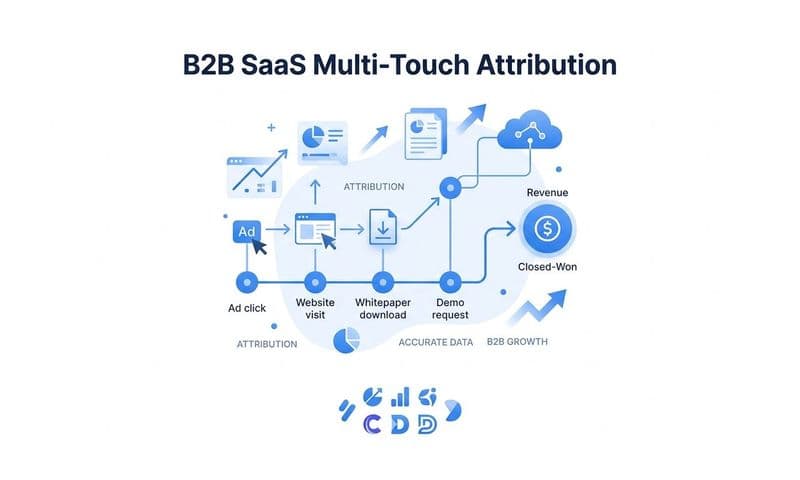
If you want accurate conversion tracking for long sales cycles, you need to instrument the entire journey, not just the top and bottom. Think of it as placing checkpoints along a route that takes months to complete. Each checkpoint gives you signal about where a deal is heading, long before it closes.
The key stages where tracking events should fire include: first ad click, content engagement (blog reads, video views, resource downloads), demo or trial request, marketing qualified lead handoff, sales qualified lead status, opportunity creation in the CRM, and closed-won revenue. Each of these is a distinct event with distinct meaning. Treating them all as variations of "a conversion" collapses information you need. Understanding event tracking in Google Analytics is a useful starting point for structuring these checkpoints correctly.
This is the difference between lead attribution and pipeline attribution. Lead attribution tracks when someone fills out a form. Pipeline attribution tracks what happens to that lead afterward, which stage it reaches, how long it stays there, and whether it eventually becomes revenue. For B2B SaaS teams, pipeline attribution is the more mature and more accurate approach because lead volume is a poor proxy for revenue when cycles are long and qualification rates vary by channel.
A channel that drives a hundred leads but converts five to closed-won is very different from a channel that drives twenty leads but converts twelve. Without pipeline attribution, you fund the first channel because it looks better on a lead report. With pipeline attribution, you fund the second because it actually produces revenue.
Micro-conversions play a critical role during the long stretches between major milestones. These are the smaller behavioral signals that indicate intent before a deal closes: pricing page visits, competitor comparison page views, webinar registrations, case study downloads, and return visits to product pages. These events do not represent revenue, but they represent movement. They are leading indicators of pipeline health that allow you to evaluate campaign performance in near real time rather than waiting months for deals to close.
Setting up micro-conversion tracking requires defining what signals matter for your specific buyer journey. For a product-led growth motion, that might be trial activation events. For a sales-led motion, it might be a second meeting booked or a proposal viewed. The specifics depend on your process, but the principle is the same: instrument the journey at every stage so you always have signal, even when the final outcome is still months away.
Server-Side Tracking and First-Party Data: The Technical Foundation
Here is where the infrastructure conversation gets technical, but it matters enormously for long-cycle tracking. Client-side pixels, the kind that fire in a user's browser when they visit a page, have a fundamental reliability problem. Cookies expire. Browsers block tracking. Ad blockers prevent pixels from loading. In a buying journey that spans months, the probability that a client-side pixel will successfully maintain the tracking thread from first click to closed deal approaches zero.
Server-side tracking via Conversion APIs solves this by moving the data transfer off the browser entirely. Instead of relying on a pixel in the user's browser to send data to Meta or Google, your server sends the event data directly to the ad platform's API. The user's browser settings, ad blockers, and cookie restrictions become irrelevant because the data never passes through the browser at all. The case for why server-side tracking is more accurate than client-side methods is especially compelling when buying journeys stretch across many months.
Meta's Conversion API and Google's Enhanced Conversions are the primary implementations of this approach. They allow you to send conversion events, including offline events like closed-won revenue, directly from your server or CRM to the ad platform. This is how you close the gap between a deal that closes six months after the original ad click and the campaign that drove it.
First-party data is the thread that makes this work. When a prospect first clicks your ad and lands on your site, you capture identifiers: email address when they download a resource, company name when they fill out a form, phone number when they request a demo. These identifiers become the persistent link across the entire sales cycle. Even if their cookie expires, even if they switch devices, even if they go dark for two months, the first-party data in your CRM keeps the connection alive.
First-party data enrichment ties anonymous ad clicks to identified users, creating a record that persists regardless of how long the cycle takes. When that user eventually becomes a closed deal, you can trace the journey back through your CRM data to the original touchpoint, even if it happened nearly a year ago.
One technical requirement that often gets overlooked when implementing server-side tracking alongside existing pixel setups is event deduplication. If both your browser pixel and your server-side API are sending the same conversion event, your ad platform will count it twice, inflating your conversion numbers and distorting your optimization signals. Deduplication uses a unique event ID to tell the platform that two incoming signals represent the same event, so only one is counted. This is not optional. Without it, your data becomes unreliable in the opposite direction, showing too many conversions rather than too few. Teams looking to address these issues systematically should review fixing conversion tracking gaps as part of their implementation checklist.
Choosing the Right Attribution Model for Extended Buying Journeys
Even with perfect tracking infrastructure, the attribution model you choose determines what story your data tells. For long sales cycles, the model choice is not a minor reporting preference. It directly shapes which channels get budget and which get cut.
Last-click attribution is the default for many tools, and it is particularly damaging in long-cycle environments. It assigns 100% of the conversion credit to the final touchpoint before a deal closes. In a B2B buying journey, that final touchpoint is often a branded search, a direct visit, or a sales email. The awareness campaign that introduced the prospect to your brand six months ago gets zero credit. The webinar that re-engaged them after a dormant period gets zero credit. The retargeting ad that brought them back to the pricing page gets zero credit. All of that work is invisible.
The result is systematic underinvestment in top-of-funnel and mid-funnel channels, and systematic overinvestment in bottom-of-funnel channels that are really just harvesting demand that other channels created.
Multi-touch attribution models distribute credit across the full journey. Linear attribution splits credit equally across every touchpoint. Time-decay attribution gives more credit to touchpoints closer to the conversion, on the logic that they were more influential in the final decision. Position-based attribution, sometimes called U-shaped, gives the most credit to the first and last touchpoints while distributing the remainder across the middle. A deeper look at multi-touch attribution models can help you evaluate which approach fits your specific sales motion.
Each model has trade-offs. Linear treats every touchpoint as equally valuable, which is rarely true. Time-decay still undervalues awareness. Position-based makes assumptions about the relative importance of first and last touch that may not reflect your actual buyer behavior. The right choice depends on your sales motion, your cycle length, and what you are trying to optimize for.
Data-driven attribution is the most sophisticated approach available, and for teams with sufficient conversion volume, it is worth pursuing. Rather than applying a fixed rule to distribute credit, data-driven attribution analyzes your actual conversion path data and assigns credit based on which touchpoints statistically influenced outcomes. It learns from your specific buyer behavior rather than imposing a generic model onto it.
The practical implication is that data-driven attribution tends to surface the true value of mid-funnel channels that rule-based models consistently undervalue. For B2B SaaS teams running long cycles, that visibility is exactly what is needed to make confident budget decisions. Reviewing the best software for tracking marketing attribution can help you identify platforms that support data-driven models at scale.
Connecting CRM Data to Ad Performance: Closing the Loop
Tracking leads is useful. Tracking revenue is what actually matters. The gap between those two things is where most B2B marketing measurement falls apart, and closing it requires a direct integration between your CRM and your ad platforms.
Here is how the feedback loop works. A prospect clicks a LinkedIn ad, fills out a demo request form, enters your CRM as a lead, progresses through qualification stages, and six months later closes as a customer worth a specific contract value. That closed-won event, with its associated revenue, needs to flow back to LinkedIn so the platform knows which ad, audience, and creative contributed to that outcome. Without that signal, LinkedIn's algorithm is optimizing toward form fills, not toward the leads that actually become revenue.
This distinction matters more than most teams realize. Ad platforms are powerful optimization machines, but they optimize toward whatever signal you give them. If you give them lead volume, they find you more leads. If you give them closed-won revenue, they find you more customers. The quality of your optimization signal determines the quality of your results over time.
Offline conversion imports are the mechanism for this in Google Ads. Meta's Conversion API handles it on the Meta side. The process involves exporting closed-won data from your CRM, matching it to the original ad click using the click ID or first-party identifiers, and uploading it back to the platform. Offline conversion tracking done consistently trains ad platform algorithms on your actual revenue outcomes, improving targeting quality with every deal that closes.
Pipeline velocity is another metric that becomes visible once CRM data is connected to ad performance. Velocity measures how quickly leads from a given channel move through pipeline stages toward close. A channel might produce leads that take four months to close on average, while another produces leads that close in six weeks. Even before deals fully close, velocity data helps you allocate budget toward channels that produce faster-moving opportunities, improving both efficiency and forecasting accuracy.
This level of insight is simply not possible without CRM integration. Lead volume and cost per lead, the metrics most teams rely on, tell you nothing about velocity, deal size, or close rate by channel. Revenue attribution requires revenue data, and revenue data lives in your CRM. Teams using Salesforce can accelerate this process significantly by exploring a Google Analytics Salesforce integration to unify their reporting stack.
Building a Measurement Framework That Scales With Your Sales Cycle
All of the technical infrastructure in the world does not help if your reporting framework does not account for the time dynamics of your sales cycle. This is where many teams make a final, critical mistake: they evaluate campaign performance over windows that are too short to capture the outcomes they care about.
If your average sales cycle is five months and you are reviewing campaign performance monthly, you are consistently looking at incomplete data. Campaigns that are building real pipeline look like failures because the deals have not closed yet. You make cuts based on a snapshot that does not represent reality, and you repeat the cycle.
The practical solution is to calibrate your reporting windows to your actual average sales cycle length. If deals typically close in four to six months, your primary performance evaluation should look at cohorts of leads over at least that time horizon. You can still run shorter-window reports on micro-conversions and pipeline stage progression as leading indicators, but budget decisions should be anchored to windows that allow outcomes to fully develop.
A practical measurement framework for long-cycle B2B SaaS teams includes several layers. First, define your conversion events at every pipeline stage and implement tracking for each one. Second, set up server-side tracking and Conversion API integrations to ensure data reliability across long time horizons. Third, integrate your CRM so that deal stage progression and closed-won revenue flow back to your attribution system. Fourth, establish a reporting cadence that separates leading indicators reviewed weekly from lagging indicators reviewed quarterly. Following best practices for tracking conversions accurately at each of these layers prevents the data gaps that undermine long-cycle measurement.
The reporting cadence piece is often underestimated. Weekly reviews should focus on micro-conversion rates, pipeline stage advancement, and ad spend pacing. Quarterly reviews should focus on channel-level ROI, closed-won attribution, and pipeline velocity by source. These are different questions requiring different time horizons, and conflating them leads to bad decisions.
A unified attribution platform brings all of this together by connecting ad data, CRM events, and revenue outcomes into a single source of truth. This replaces the disconnected reality most teams live in, where ad platform dashboards, CRM reports, and spreadsheets all tell slightly different stories that cannot be reconciled. When your data lives in one place and speaks one language, you can actually trust what it tells you.
Cometly is built specifically for this challenge. It connects your ad platforms, CRM, and website to track the entire customer journey in real time, giving you pipeline and revenue attribution across every channel. With server-side conversion tracking, Conversion API integration, and 70-plus native integrations, it provides the technical foundation that long-cycle B2B SaaS teams need to measure what actually matters.
The Bottom Line on Long-Cycle Attribution
Long sales cycles are not a tracking problem. They are a measurement strategy problem. The tools exist to connect first ad click to closed-won revenue across months of touchpoints, devices, and stakeholders. What most teams lack is the intentional architecture to make those tools work together.
When you build proper conversion tracking infrastructure, the payoff is significant. You stop cutting campaigns that are quietly building pipeline. You start feeding ad platforms the revenue signals they need to optimize toward your best customers. You gain visibility into which channels produce deals that close faster and at higher values. And you can walk into budget conversations with data that connects marketing spend to revenue outcomes, not just lead volume.
The teams that win in B2B SaaS marketing are not necessarily the ones with the biggest budgets. They are the ones who know where their budget is actually working, and they know it because they built the measurement infrastructure to see it clearly.
If you are ready to build that infrastructure and finally connect your ad spend to real revenue outcomes, Cometly is the platform designed to make it happen. From server-side tracking and multi-touch attribution to CRM integration and AI-driven recommendations, it gives B2B SaaS marketing teams a single source of truth for every stage of the customer journey.
Get your free demo today and start capturing every touchpoint so you can measure, optimize, and scale with confidence.