B2B marketers have spent years building attribution systems on a foundation that was never designed to hold. Third-party cookies became the default mechanism for connecting ad clicks to pipeline and revenue, and for a while, they worked well enough. But browser restrictions have tightened, privacy standards have evolved, and ad platform signal quality has declined. The result is a growing gap between what your attribution reports show and what is actually driving your business.
For B2B SaaS companies, this gap is especially costly. Your sales cycles are not measured in hours or days. They span weeks, sometimes months, crossing multiple sessions, devices, and decision-makers before a deal closes. Every time a cookie expires, gets blocked, or gets cleared before that deal reaches closed-won, you lose a critical piece of the attribution story. Budget decisions get made on incomplete data. High-performing channels get cut. Underperforming ones get scaled.
This article is a practical guide to understanding cookieless attribution for B2B, why the old approach is failing, and what modern teams need to build instead. Whether you are just starting to audit your tracking setup or ready to implement server-side infrastructure, the sections below will walk you through the full picture from the structural problem to the technical solution to the tools that make it work in practice.
Why Cookie-Based Tracking Was Always a Poor Fit for B2B
Third-party cookies were not designed with B2B in mind. They emerged as a solution for e-commerce and direct-response advertising, where a user sees an ad, clicks, and converts within a short window. That model maps neatly onto cookie behavior. A user visits a product page, a cookie fires, they purchase two days later, and the attribution connects cleanly.
B2B buying journeys do not work that way. A typical SaaS deal might start with a paid LinkedIn impression, followed by an organic search visit a week later, a demo request from a direct visit, a follow-up email sequence, a sales call, and a contract signed six weeks after the first touchpoint. That journey crosses multiple devices, multiple sessions, and often multiple stakeholders from the same account. Cookies are not built to survive that journey.
Under Safari's Intelligent Tracking Prevention, third-party cookies are restricted to a short lifespan. Cross-site tracking is limited significantly. A lead who first clicked your ad on an iPhone browsing Safari, then returned on a work laptop running Chrome two weeks later, looks like two completely separate users to a cookie-based system. The attribution chain breaks, and the first touchpoint that drove awareness disappears from your reports entirely.
This structural mismatch has been quietly distorting B2B attribution data for years. Most teams have not fully reckoned with the extent of the problem because their dashboards still show numbers. The issue is not that data stops flowing. It is that the data that flows is systematically incomplete. Channels that drive early-stage awareness get undervalued because their contribution is lost before the deal closes. Channels that appear at the end of the journey get over-credited because they are the last touchpoint the cookie managed to capture.
The downstream consequences are real. Marketing budgets get allocated based on which channels appear to perform best in last-touch or short-window attribution reports, not which channels actually generate qualified pipeline. For B2B SaaS companies where customer acquisition costs are high and deal values are significant, those misallocations compound over time into meaningful revenue impact.
Understanding this structural problem is the starting point. Cookieless attribution for B2B is not about adopting a new technology trend. It is about fixing a measurement system that has been producing inaccurate results for longer than most teams realize.
The Shift Is Already Here, Not Coming
There is a common misconception that cookieless attribution is a future challenge to prepare for. The reality is that a significant portion of B2B web traffic has been operating in a cookieless or cookie-limited environment for years. Safari introduced Intelligent Tracking Prevention well before the current wave of industry attention on cookie deprecation. Firefox followed with Enhanced Tracking Protection. Chrome has progressively restricted third-party cookies, and further changes continue to roll out.
When you look at the browsers your B2B audience actually uses, the picture becomes clearer. Safari is dominant on mobile and popular among professionals using Apple hardware. Firefox has a meaningful presence in technical and developer communities. Together, these browsers represent a substantial share of B2B web traffic that has been effectively cookieless for some time. If your attribution setup relies on third-party cookies, it has already been producing incomplete data for that portion of your audience.
Ad platforms have responded to this environment by reducing the data they return through pixel-based tracking. Browser-side pixels are subject to the same restrictions that affect third-party cookies. When a browser blocks or limits the pixel from firing, the conversion event never reaches the ad platform. Meta's pixel, Google's tag, and similar tools all face this constraint. The result is reduced conversion visibility, which directly impacts how ad platform algorithms optimize your campaigns.
This matters practically because ad platform optimization relies on conversion signals to learn which users to target and which placements to prioritize. When conversion data is incomplete due to browser blocking, the algorithm works with a degraded signal. Campaign performance suffers not because your ads are worse, but because the feedback loop that drives optimization has been disrupted.
For B2B teams running demand generation across Meta, Google, and LinkedIn, this is an active present-day problem. Reporting discrepancies between ad platform data and CRM data are often a symptom of this signal loss. If you are seeing gaps between the leads your CRM records and the conversions your ad platforms report, browser-level blocking is frequently a contributing factor.
The shift to cookieless attribution is not a preparation exercise. It is a response to conditions that already exist in your data today.
First-Party Data and Server-Side Tracking: Building a Reliable Foundation
If third-party cookies are the problem, first-party data is the foundation of the solution. First-party data is any data collected directly by your business through your own website, your CRM, your product, and your email interactions. Because you collect this data directly from your users with their knowledge, it is not subject to the browser restrictions that affect third-party cookies. It is also more accurate, more durable, and more useful for B2B attribution than any third-party signal.
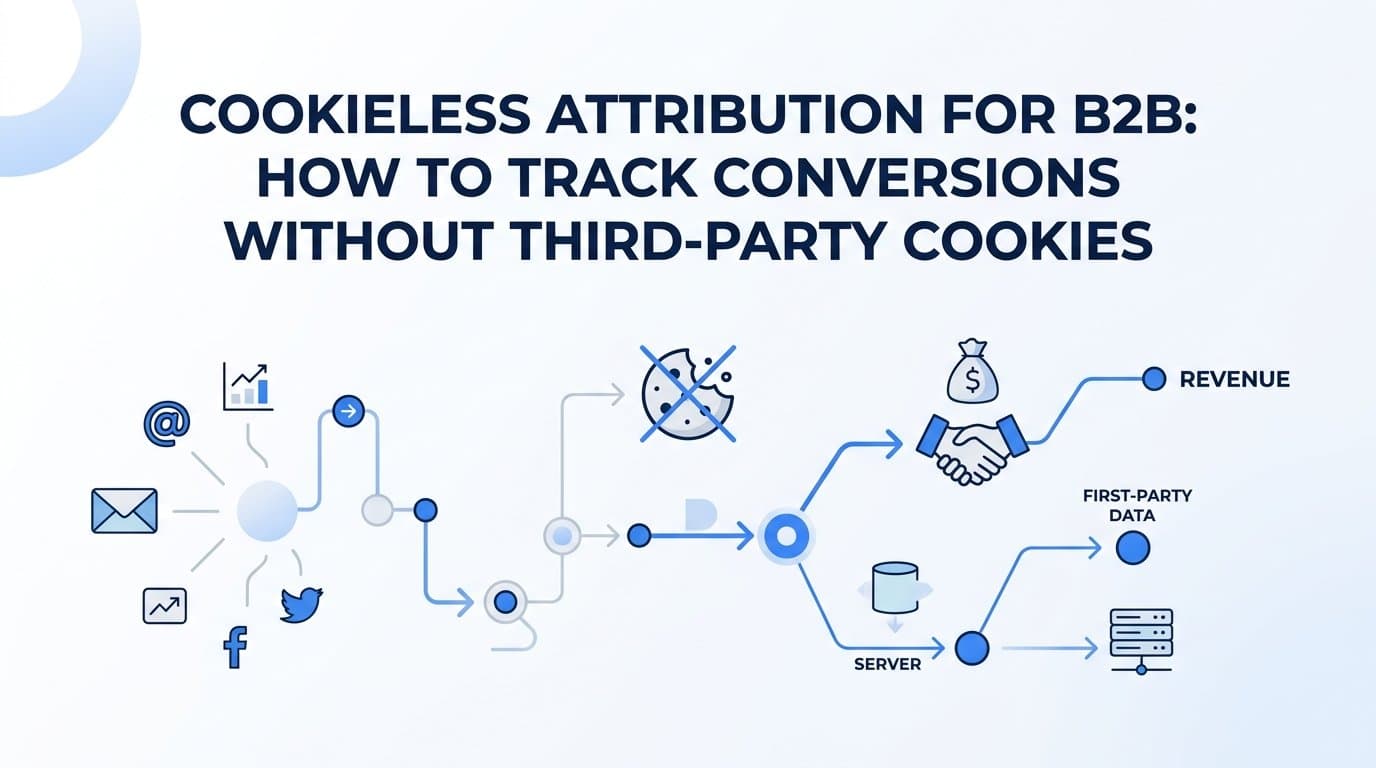
The most important technical shift that accompanies this move to first-party data is server-side tracking. Traditional pixel-based tracking sends conversion events from the user's browser to the ad platform. This approach is vulnerable to browser blocking, ad blockers, and the cookie restrictions described above. Server-side tracking inverts this flow. Instead of the browser sending the event, your server sends it directly to the ad platform, bypassing browser-level restrictions entirely.
Meta's Conversions API, commonly referred to as CAPI, is the primary mechanism for this on the Meta side. Google's Enhanced Conversions serves a similar function for Google Ads. Both allow you to send conversion events from your server with enriched data including hashed email addresses, phone numbers, and other identifiers that improve event matching quality. The better the match quality, the more accurately the ad platform can attribute the conversion to the right user and the right campaign.
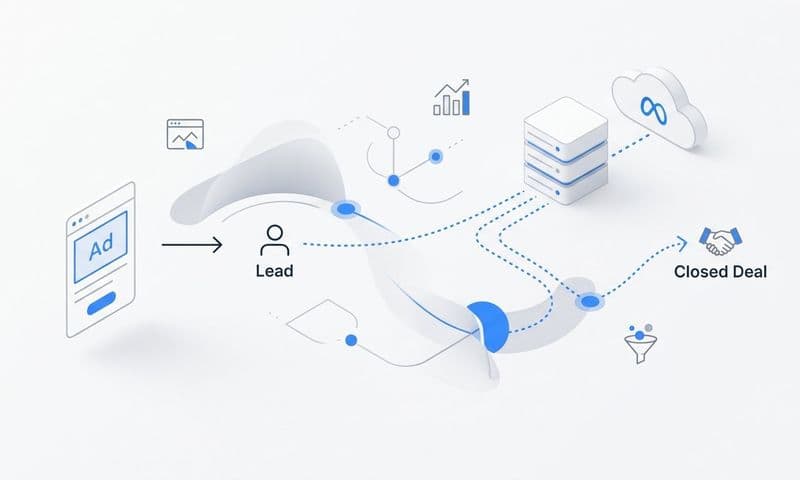
For B2B SaaS teams, the real power of server-side tracking comes from connecting it to CRM data. When a lead submits a form, your server can capture the UTM parameters from that session, store them in the CRM record, and then fire a server-side conversion event with enriched data back to Meta and Google. As that lead progresses through the pipeline, you can fire additional server-side events when they reach key milestones, such as becoming an SQL, entering a trial, or closing as a customer.
This means you are not just attributing form fills. You are attributing pipeline stages and revenue back to the original ad that drove the first click. That is a fundamentally different and more valuable form of attribution than anything cookie-based tracking could produce, and it does not depend on a cookie surviving a six-week sales cycle.
One important operational detail when implementing server-side tracking alongside existing browser-side pixels is event deduplication. Running both simultaneously is recommended because it maximizes coverage, but without deduplication, the same conversion event can be counted twice. Ad platforms handle this through an event ID that must be passed with both the browser event and the server event. When the IDs match, the platform knows to count only one conversion. Getting this right is essential for maintaining clean data and accurate optimization signals.
Attribution Models That Do Not Depend on Cookie Chains
Once you have a first-party data foundation in place, the next question is how to model attribution across the full B2B buying journey. Not all attribution models are equally suited to a cookieless environment, and the model you choose has a direct impact on how accurately credit is assigned across your channels.
Rules-based attribution models like first-touch, last-touch, and linear attribution are simple to implement but depend on having a complete, stitched view of the customer journey. In a cookie-dependent setup, that stitching breaks when cookies expire or get blocked. In a first-party data setup built on UTM capture and CRM records, the journey can be reconstructed without relying on cookie continuity, making these models more reliable than they were in a cookie-dependent environment.
Multi-touch attribution models that draw on first-party event data rather than cookie-stitched sessions are well suited to B2B buying cycles. When every touchpoint is captured as a first-party event tied to a known lead record in your CRM, you can assign credit across the full journey from first ad click to closed deal without any dependency on third-party identifiers. The journey lives in your data, not in a cookie on someone's browser.
Data-driven attribution takes this further by using statistical modeling across aggregated first-party signals to assign credit based on actual conversion patterns in your data. Rather than applying a fixed rule like "split credit equally across all touches," data-driven attribution analyzes which touchpoints are most predictive of conversion and weights them accordingly. This approach requires sufficient conversion volume to produce reliable models, but for B2B teams with meaningful pipeline data, it produces more accurate credit assignment than any rules-based alternative.
UTM parameters deserve specific attention here because they are one of the most underutilized tools in cookieless attribution for B2B. When UTM parameters are appended to every ad URL and captured at the point of lead conversion in the CRM, they create a persistent, cookie-independent attribution record. That record does not expire. It does not get blocked by a browser. It travels with the lead through every stage of the funnel and is available when the deal closes, giving you a direct line from the original traffic source to closed-won revenue.
The key is capturing UTMs at conversion and storing them on the lead record in your CRM, not just in a session cookie that disappears when the browser closes. This single practice significantly improves attribution durability for B2B teams and is a foundational step in any cookieless attribution strategy.
Building a Cookieless Attribution Stack for B2B
Understanding the principles is one thing. Assembling the actual infrastructure is another. A cookieless attribution stack for B2B does not require rebuilding everything from scratch, but it does require connecting components that are often siloed in typical marketing operations setups.
The core components you need are server-side conversion tracking, CRM integration with UTM source capture, and a centralized attribution platform that unifies data from your ad platforms, website events, and CRM records. Each component plays a specific role, and the value of the stack comes from how well they connect.
Server-side conversion tracking: This is the technical layer that bypasses browser restrictions and sends enriched conversion events directly to Meta via CAPI and to Google via Enhanced Conversions. It should be configured to fire events not just at the lead stage but at key pipeline milestones, allowing you to attribute pipeline and revenue back to ad spend.
CRM integration with UTM capture: Every lead that enters your CRM should carry the UTM parameters from the session in which they converted. This requires a form or tracking setup that reads UTMs from the URL, stores them in hidden fields or a session variable, and writes them to the CRM record on submission. This is the persistent attribution layer that survives cookie expiration and browser restrictions.
Event deduplication: If you are running both a browser-side pixel and server-side events, which is the recommended approach for maximum coverage, you must implement deduplication via event IDs. This is a step that is easy to overlook and consequential when missed. Inflated conversion counts corrupt your ad platform optimization signals and make your attribution data unreliable.
Centralized attribution platform: Pulling all of these signals together into a single view requires a platform that can ingest ad spend data, website events, CRM pipeline data, and revenue data simultaneously. This is where the actual attribution analysis happens, where you can compare models, identify which campaigns are driving qualified pipeline, and connect ad spend directly to closed-won revenue.
The most valuable output of this stack is revenue attribution: a clear view of which specific ads, campaigns, and channels generated deals that closed. This requires connecting ad platform data to CRM deal stage data, which is only possible when the attribution platform has direct integrations with both. Without this connection, you are left attributing to leads or MQLs, which is useful but incomplete. Attributing to revenue is the standard that B2B marketing teams should be building toward.
How Cometly Powers Cookieless Attribution for B2B SaaS
Cometly is built specifically for the attribution challenges that B2B SaaS companies face. It captures every touchpoint from the first ad click through to CRM events and closed-won revenue using first-party data and server-side tracking, giving marketing and growth teams a complete customer journey view that does not depend on third-party cookies.
The platform integrates directly with ad platforms via the Conversions API and Enhanced Conversions, sending enriched, conversion-ready events back to Meta and Google with the signal quality needed to improve targeting and campaign optimization. At the same time, it connects to your CRM and revenue data so that pipeline stages and deal outcomes are tied back to the original ad interactions that started each journey.
This means you can see not just which campaigns generated form fills, but which campaigns generated pipeline, which generated trials, and which generated closed revenue. The attribution loop is closed at the revenue level, not the lead level, which is the standard that matters for B2B SaaS companies making decisions about where to allocate budget.
Cometly's AI-powered recommendations surface which ads and channels are actually driving qualified pipeline and revenue across your entire ad mix. Rather than manually cross-referencing ad platform data with CRM reports, the platform does that analysis automatically and tells you where to scale and where to cut based on accurate, cookieless attribution data. For growth teams managing spend across multiple channels, this kind of clear signal is what the difference between efficient scaling and wasted budget looks like in practice.
With over 70 native integrations, Cometly connects to the tools your team already uses, including your ad platforms, CRM, and revenue systems like Stripe. The result is a single source of truth for marketing performance that reflects what is actually happening in your pipeline, not what a degraded cookie-based system approximates.
The New Baseline for B2B Marketing Measurement
Cookieless attribution for B2B is not a trend or an upgrade. It is the new baseline for any team that wants accurate data on what is driving their pipeline and revenue. The structural limitations of cookie-based tracking have been affecting B2B attribution for years, and the browser and platform changes of recent years have made the gap between reported performance and actual performance wider than ever.
The path forward is built on first-party data, server-side tracking, UTM-based source capture in your CRM, and a platform that connects all of these signals to your revenue data. Each of these components is available today. The teams that implement them now will have a durable measurement foundation that improves as privacy standards continue to evolve, while teams that stay on legacy setups will see their attribution data degrade further.
Start by auditing your current setup for cookie-related gaps. Check whether your UTMs are being captured and stored at the lead level in your CRM. Assess whether you have server-side tracking in place for your key conversion events. Identify whether your attribution platform can connect ad spend to closed-won revenue or only to leads.
If you find gaps, Cometly is built to close them. It provides a modern, cookieless attribution foundation designed specifically for B2B SaaS teams who need accurate data to make confident budget decisions. Get your free demo today and start building the attribution infrastructure your pipeline data deserves.