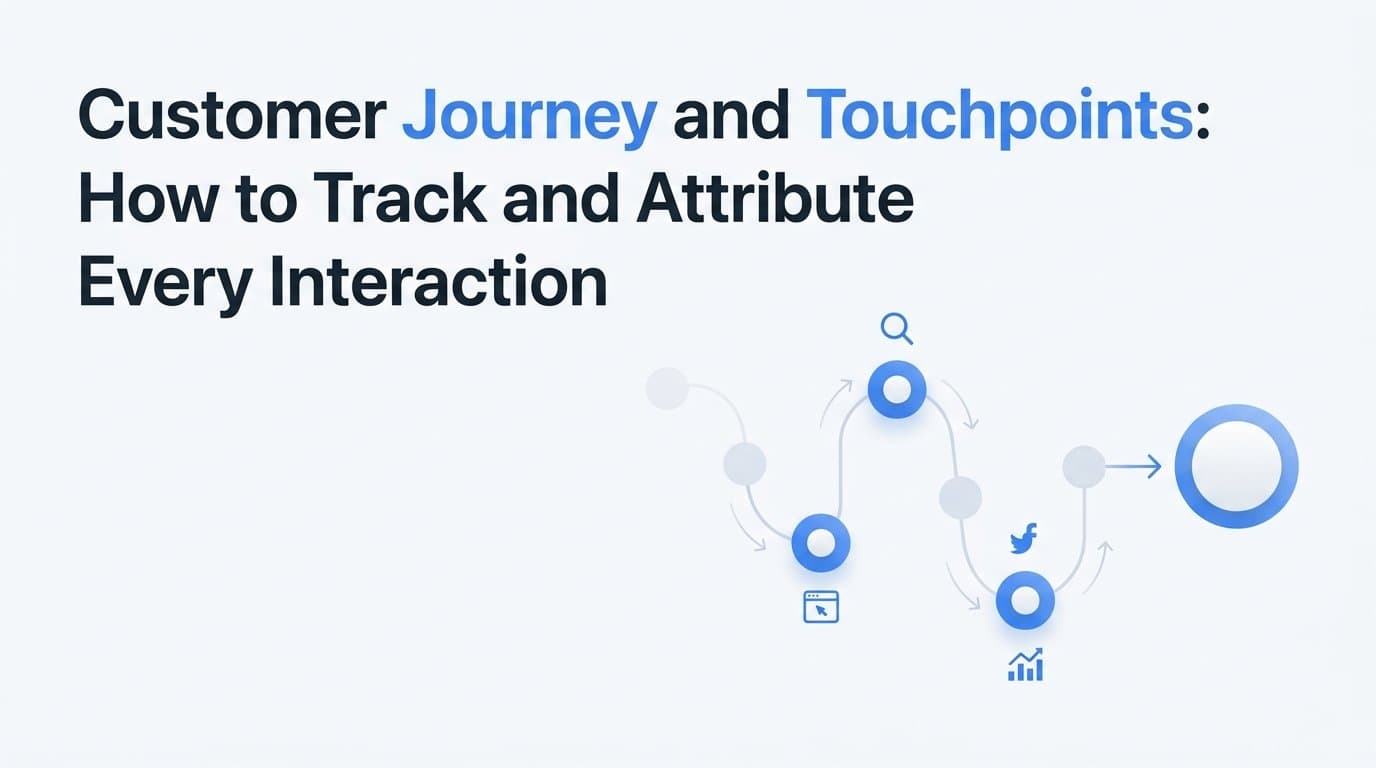
Most B2B SaaS buyers don't convert the first time they encounter your brand. They see a LinkedIn ad, forget about it, stumble across your blog three weeks later, watch a competitor comparison video, attend a webinar, get an SDR email, and then finally request a demo. By the time they're talking to sales, they've touched your brand dozens of times across just as many channels.
This is the reality of modern B2B buying behavior. And it creates a fundamental problem for marketing teams: if you can only see part of the journey, you're making budget decisions based on incomplete information. You end up over-crediting the last thing that happened before the conversion and systematically underfunding the channels that actually started the conversation.
Understanding the customer journey and touchpoints isn't a nice-to-have exercise. It's the foundation of accurate attribution, smarter budget allocation, and sustainable growth. When you can see every interaction a prospect has with your brand, attribute it correctly, and connect it all the way to closed-won revenue, you stop guessing and start compounding your marketing advantage.
This article breaks down exactly how to do that. You'll learn what touchpoints are and why they matter, how to map the B2B customer journey stage by stage, which attribution models apply to complex multi-touch paths, what breaks tracking and how to fix it, and how to turn journey data into decisions that actually move the needle.
Why the Path to Purchase Is Never a Straight Line
In B2B SaaS, the idea of a linear funnel, where a prospect sees an ad, clicks it, and buys, is almost entirely fictional. Real buyers move through awareness, consideration, and decision stages across multiple sessions, devices, and channels. They research on mobile, compare on desktop, loop in colleagues, revisit your pricing page four times, and go dark for two weeks before resurfacing.
Every one of those interactions is a touchpoint. A touchpoint is any moment where a prospect engages with your brand, whether that's clicking a paid search ad, reading an organic blog post, opening a nurture email, joining a webinar, or having a discovery call with an SDR. Each touchpoint carries information about how your prospect is moving through the journey and which channels are influencing their decision.
Here's where most marketing teams run into trouble. When you only track the last interaction before a conversion, you create a distorted picture of what's actually driving growth. Last-click attribution, the default in many analytics setups, hands all the credit to the final touchpoint and assigns zero value to everything that came before it. That means the blog post that introduced your brand, the retargeting ad that brought them back, and the case study that built trust all go uncredited.
The downstream effect is predictable: teams cut top-of-funnel spend because it "doesn't convert," while doubling down on branded search and direct traffic that only look good because they show up last. Demand generation channels get starved. Pipeline dries up. And nobody can quite explain why.
The fix starts with recognizing that attribution weight needs to be distributed across the entire journey, not just the final step. That requires capturing every touchpoint, understanding how they cluster across journey stages, and applying attribution models that reflect the actual complexity of B2B buying behavior. The rest of this article walks you through exactly how to do that.
Mapping the B2B Customer Journey Stage by Stage
Before you can attribute touchpoints accurately, you need a clear mental model of the journey itself. In B2B SaaS, the customer journey typically moves through three core stages: Awareness, Consideration, and Decision. Each stage has a distinct set of touchpoints, different buyer intent, and different implications for how you should track and attribute interactions.
Awareness: First Discovery
This is where prospects first encounter your brand. Awareness touchpoints are often broad and paid: a Google Ads impression, a LinkedIn sponsored post, a Facebook retargeting ad, or a mention in an industry newsletter. The prospect isn't necessarily in buying mode yet. They're becoming aware that a problem exists and that solutions like yours are available.
Awareness touchpoints are critical for pipeline creation, but they're easy to undervalue because they rarely produce direct conversions. Without proper multi-touch tracking, these interactions vanish from your attribution data entirely, making your demand generation channels look ineffective even when they're doing exactly what they should.
Consideration: Research and Evaluation
Once a prospect is aware of your brand, they start evaluating. Consideration touchpoints are typically more intent-driven: organic blog visits, comparison page views, G2 profile clicks, webinar registrations, and email sequence opens. These interactions signal that the buyer is actively researching and weighing options.
This stage is where owned and organic channels do their heaviest lifting. A well-timed nurture email or a detailed feature comparison post can be the difference between staying in the running and getting eliminated. Yet these touchpoints are often the hardest to attribute because they live across multiple platforms with inconsistent tracking.
This is also where micro-conversions become important. Micro-conversions are intermediate actions that signal progression through the funnel before the final conversion event. Think: a content download, a pricing page visit, a free trial signup, or an email click. Tracking micro-conversions gives you leading indicators of pipeline health and helps you understand which touchpoints are moving prospects forward, not just which ones happen to be last.
Decision: High-Signal Actions
Decision-stage touchpoints are direct and high-intent: demo requests, trial activations, sales calls, proposal reviews, and ultimately, closed-won opportunities. These interactions happen close to the conversion event and tend to receive disproportionate attribution credit in last-click models.
The key insight is that decision-stage touchpoints rarely create intent on their own. They capture intent that was built across dozens of earlier interactions. Mapping all three stages together gives you the full picture of how your marketing is actually working.
The Types of Touchpoints That Matter Most in B2B SaaS
Not all touchpoints are created equal, and they don't all live in the same place. Understanding the three main categories of touchpoints helps you build the right tracking infrastructure and avoid the attribution blind spots that distort your data.
Paid Touchpoints: These include Google Ads, Meta (Facebook and Instagram) Ads, LinkedIn Ads, and retargeting campaigns. Paid touchpoints are often the first or last interaction in a journey, and they come with measurable click and impression data that makes them relatively straightforward to track. They're also where most marketing budgets are concentrated, which makes accurate attribution here especially high-stakes. If you're misattributing conversions to the wrong paid channel, you're misallocating budget at scale.
Organic and Owned Touchpoints: These include SEO-driven blog visits, branded search, direct traffic, email sequences, and social media engagement. Organic touchpoints tend to cluster in the consideration phase, where prospects are actively researching. They're often harder to attribute because they span multiple sessions and platforms, and because browser-based tracking limitations mean some of these interactions go unrecorded. Despite being harder to measure, organic and owned touchpoints frequently carry significant influence over final conversion decisions.
CRM and Sales Touchpoints: This is the category most often missing from marketing attribution data. In B2B SaaS, the sales process involves SDR outreach, discovery calls, demo presentations, proposal reviews, and follow-up sequences. These interactions happen in email, on the phone, and in CRM systems like Salesforce or HubSpot. They're rarely connected to the marketing data that preceded them.
When CRM touchpoints are excluded from attribution, you lose visibility into how marketing-sourced leads perform through the sales process. You can't see which campaigns generate leads that actually close, which channels drive deals with shorter sales cycles, or which touchpoint combinations correlate with higher contract values. Connecting CRM data to your attribution infrastructure is what transforms marketing reporting from lead-level metrics to revenue-level insights.
Each of these touchpoint categories requires a different tracking approach, and a complete attribution strategy accounts for all three. Most teams are reasonably good at tracking paid touchpoints and reasonably bad at tracking everything else. Closing that gap is where the biggest attribution improvements tend to come from.
Attribution Models and How They Assign Credit Across the Journey
Once you're capturing touchpoints across the full journey, you need a framework for deciding how much credit each touchpoint deserves. That's what attribution models do. Different models answer different business questions, and understanding their tradeoffs is essential for using journey data effectively.
First-Touch Attribution: This model gives 100% of the credit to the first touchpoint in the journey, typically the channel that introduced the prospect to your brand. First-touch is useful when you're trying to evaluate demand generation effectiveness. Which channels are initiating the most journeys? Which paid campaigns are creating net-new awareness? First-touch answers those questions, but it ignores everything that happened after the initial interaction.
Last-Click Attribution: The default in most ad platforms and analytics tools, last-click gives all the credit to the final touchpoint before conversion. It's simple and easy to implement, but it systematically over-credits bottom-of-funnel channels like branded search and direct traffic. In a B2B SaaS context with long sales cycles, last-click attribution is almost always misleading because it ignores the weeks or months of touchpoints that built the relationship.
Linear Attribution: Linear models distribute credit equally across all touchpoints in the journey. If a prospect had eight interactions before converting, each gets 12.5% of the credit. This is more balanced than single-touch models and gives you a clearer picture of which channels appear consistently across converting journeys. The limitation is that it treats every touchpoint as equally influential, which isn't always accurate.
Data-Driven Attribution: This is the most sophisticated model and generally the most accurate for complex B2B journeys. Data-driven attribution uses algorithmic weighting to assign credit based on observed conversion patterns across your actual data. Instead of applying a fixed rule, it learns which touchpoints and touchpoint combinations are statistically associated with higher conversion rates. Platforms like Google Ads offer a version of this natively, and dedicated attribution tools can apply it across your full channel mix.
The right attribution model depends on what question you're trying to answer. If you're evaluating top-of-funnel channel performance, first-touch gives you relevant signal. If you're trying to understand full-journey influence, multi-touch models like linear or data-driven are more appropriate. If you're optimizing for pipeline close rate, you need CRM-connected attribution that tracks outcomes past the initial conversion event. Most sophisticated marketing teams use multiple models in parallel and compare the outputs to get a complete picture.
What Breaks Journey Tracking and How to Fix It
Understanding the customer journey and touchpoints in theory is one thing. Actually capturing that data reliably is another challenge entirely. Several structural forces are actively degrading the quality of browser-based tracking, and if you haven't addressed them, your attribution data has gaps you may not even be aware of.
The Browser Tracking Problem: Traditional pixel-based tracking relies on JavaScript firing in the user's browser and cookies persisting across sessions. Both of these mechanisms are increasingly unreliable. Ad blockers prevent pixels from firing. Apple's iOS privacy changes restrict cross-app and cross-site tracking. Third-party cookie deprecation is progressively eliminating the identifiers that attribution tools use to stitch sessions together. The result is that a growing share of touchpoints simply go unrecorded, creating attribution gaps that make top-of-funnel channels look less effective than they actually are.
Server-Side Tracking and Conversion APIs: The most effective solution to browser-side tracking limitations is server-side event tracking combined with Conversion API (CAPI) integrations. Instead of relying on a pixel firing in the user's browser, server-side tracking sends event data directly from your server to ad platforms like Meta and Google. This approach bypasses browser restrictions entirely, resulting in more complete event capture and higher event match quality scores on the platforms that use this data for optimization.
Higher event match quality means ad platform algorithms have better data to work with, which improves targeting accuracy, reduces cost per acquisition, and makes your campaigns more efficient over time. Server-side tracking isn't just a data completeness fix. It's a performance lever.
The CRM-Ad Platform Silo: Even with robust browser and server-side tracking in place, most marketing teams still face a critical gap: their CRM data and their ad platform data live in completely separate systems. Marketing sees clicks and leads. Sales sees opportunities and closed deals. Neither team has a unified view of the journey from first ad impression to closed-won revenue.
Bridging this silo requires integrating your CRM with your attribution infrastructure so that deal outcomes can be mapped back to the marketing touchpoints that preceded them. When this integration exists, you can answer questions that most marketing teams can't: Which campaigns generate leads that actually close? Which channels drive deals with shorter sales cycles? Which touchpoint combinations correlate with higher average contract values? These are the insights that separate marketing teams that drive revenue from marketing teams that just drive leads.
Turning Journey Data Into Smarter Marketing Decisions
Tracking every touchpoint and applying the right attribution model is the foundation. But the real value comes from what you do with that data. Complete journey visibility changes how you think about budget allocation, creative strategy, and ad platform optimization.
Identifying Which Channels Initiate and Influence the Most Journeys: With full multi-touch data, you can see not just which channels convert, but which channels start the most journeys and which appear most consistently in paths that end in closed-won revenue. This distinction matters enormously. A channel that rarely gets last-click credit might be present in the majority of your highest-value customer journeys. Without multi-touch attribution, you'd never know, and you might cut the very channel that's quietly driving your best pipeline.
Understanding Deal Velocity by Channel: Journey data also reveals which touchpoint combinations are associated with faster deal cycles. If prospects who engage with a specific content sequence or ad creative combination tend to close in fewer days, that's actionable intelligence. You can prioritize those sequences, adjust your nurture strategy, and design campaigns that accelerate pipeline velocity rather than just filling it.
AI-Powered Pattern Recognition: Standard analytics dashboards show you what happened. AI-powered analysis of journey data helps you understand why and what to do next. By analyzing patterns across thousands of multi-touch paths, AI can surface insights that aren't visible in manual reporting: which ad creative combinations drive paths that close at higher rates, which channel sequences are associated with larger deal sizes, and where in the journey prospects are most likely to drop off.
This is where platforms like Cometly add a distinct advantage. Cometly's AI analyzes your full customer journey data to surface recommendations about which ads and campaigns are performing across every channel, giving you a complete, enriched view of every touchpoint from first ad click to closed-won revenue. Instead of manually piecing together data from multiple dashboards, you get AI-driven recommendations that tell you where to scale and where to pull back.
Feeding Better Data Back to Ad Platforms: Journey insights shouldn't just inform your internal decisions. They should feed back into the ad platforms themselves. When you send enriched, conversion-ready event data back to Meta and Google through server-side integrations, you're giving their optimization algorithms better signal to work with. Better signal means better targeting, better lookalike audiences, and better algorithmic bidding decisions. Over time, this compounds: better data leads to better performance, which generates more data, which improves performance further.
This feedback loop is one of the most underappreciated advantages of investing in complete journey tracking. The teams that get it right don't just measure better. They perform better, because their ad platforms are working with more accurate information than their competitors'.
Putting It All Together
Understanding the customer journey and its touchpoints isn't a reporting exercise. It's a competitive advantage. Marketers who can see every interaction, attribute it accurately, and act on that data will consistently outperform those making decisions based on last-click snapshots and incomplete pipeline visibility.
The path forward is clear: map your journey stages, capture touchpoints across paid, organic, and CRM channels, implement server-side tracking to close the data gaps that browser limitations create, and apply attribution models that reflect the actual complexity of your buyers' paths. Then use that complete picture to allocate budget with confidence, optimize creative strategy, and feed better data back into the platforms driving your growth.
Every touchpoint in your customer journey is a signal. The question is whether you're capturing all of them or just the ones that happen to be easiest to see.
Ready to see every touchpoint across your customer journey and connect your ad spend directly to pipeline and revenue? Get your free demo and discover how Cometly maps every interaction in one place so you can make smarter marketing decisions with complete confidence.