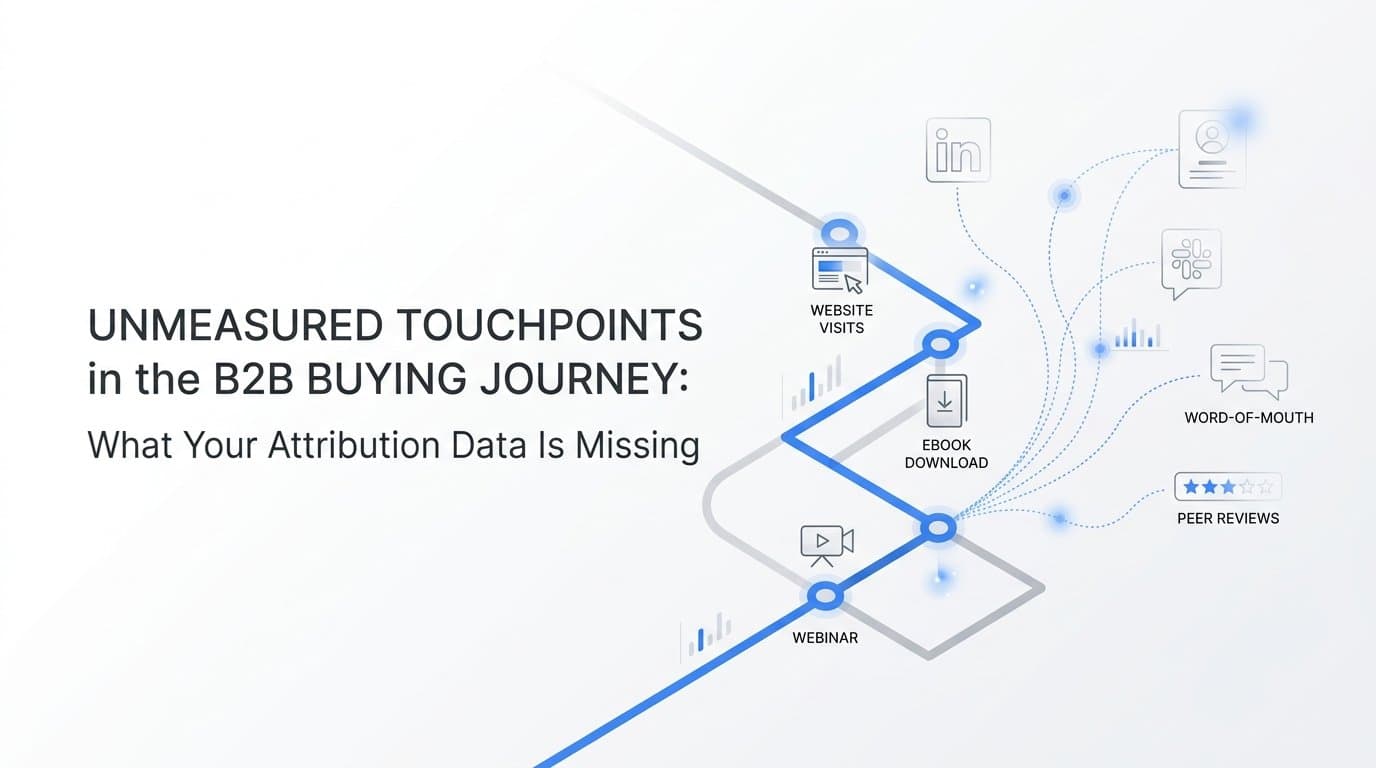
Picture this scenario: a B2B buyer stumbles across your LinkedIn post during their morning scroll, saves it, shares it in their team's Slack channel, attends your webinar two weeks later, asks a colleague for their opinion, reads three competitor reviews on G2, and then finally searches your brand name on Google and converts. What does your attribution tool report? A branded search. One touchpoint. Full credit.
This is the quiet crisis underneath most B2B marketing dashboards. Budget decisions that shape entire quarters are being made on data that captures only a fraction of the actual buyer journey. The channels that sparked awareness, built trust, and generated peer advocacy get zero credit. The last click gets everything.
Unmeasured touchpoints in the B2B buying journey are not a minor data hygiene issue. They are a strategic blind spot that systematically distorts ROI reporting, misallocates budget toward easily measurable but often lower-impact channels, and causes high-influence activities to get cut precisely because they are working in ways that standard tools cannot see. This article breaks down what these invisible touchpoints are, why they exist, and what modern attribution approaches can do to surface them.
The Hidden Complexity of How B2B Buyers Actually Make Decisions
B2B buying is fundamentally different from a consumer purchasing a pair of sneakers. There is no single decision-maker, no impulse buy, and rarely a straight line from awareness to conversion. Most software purchases involve multiple stakeholders across different roles, extended evaluation timelines that can stretch from weeks to many months, and dozens of micro-interactions before anyone fills out a demo request form.
Before a buyer ever engages with your sales team, they have typically already done a significant amount of self-directed research. They have read blog posts and comparison articles, watched product walkthrough videos, browsed review sites like G2 or Capterra, lurked in community forums, and consulted peers who have used similar tools. This self-directed phase is where buying intent is shaped, where preferences are formed, and where many of the most influential touchpoints in the entire journey occur.
Here is the problem: almost none of this activity is visible to standard attribution tools. A buyer reading your blog post without clicking a CTA leaves no tracked signal. A peer recommendation shared in a private Slack workspace generates no UTM parameter. A conversation at an industry conference does not fire a pixel. These interactions are real, they influence decisions, and they are completely absent from your attribution data.
The gap between how buyers actually behave and what attribution tools can observe is not a gap that will be closed by adding more UTM parameters or installing another tracking script. It is a structural measurement problem rooted in the nature of B2B decision-making itself. Buyers move through research phases that are intentionally private, collaborative, and asynchronous. They consult sources that have no relationship with your analytics stack.
What this means in practice is that your attribution model is not showing you the buyer journey. It is showing you a partial, technology-filtered version of it, one that skews heavily toward the moments a buyer chose to interact with a tracked asset in a trackable environment. Every decision you make based on that data carries the hidden cost of everything it cannot see.
What Counts as an Unmeasured Touchpoint
Not all unmeasured touchpoints are the same. Understanding the distinct categories helps clarify both the scale of the problem and the different strategies needed to address each type.
Dark social: This is content and referrals shared through private or untrackable channels. When someone shares your article in a Slack community, forwards your email to a colleague, or pastes your URL into a WhatsApp group, any resulting traffic typically appears as direct in your analytics. The referral source is invisible. In B2B contexts, dark social is particularly significant because peer recommendations and community discussions carry enormous influence. A recommendation from a trusted colleague in a private channel often carries more weight than any paid ad, yet it leaves no trace in your attribution data.
Offline interactions: Industry conferences, sales dinners, word-of-mouth referrals, and phone conversations all shape buying decisions without generating any digital signal. A prospect who heard about your product from a peer at a conference and then searched your brand name weeks later will appear in your data as a branded search, with no record of the offline interaction that actually drove the intent.
Cross-device sessions: B2B buyers research across multiple devices throughout the day. They might discover your product on a work laptop, revisit it on a personal phone, and convert on a tablet. When identity cannot be resolved across these sessions, each device creates a separate, disconnected record. The journey appears fragmented when it is actually continuous.
Browser privacy changes have significantly expanded the unmeasured zone over recent years. Safari's Intelligent Tracking Prevention, Firefox's Enhanced Tracking Protection, and the broader deprecation of third-party cookies have eroded the accuracy of browser-side tracking in ways that compound over time. Ad blockers are also widely used among technical and professional audiences, which overlaps heavily with the B2B software buyer demographic. Touchpoints that were once trackable are increasingly invisible to standard analytics setups.
It is also worth distinguishing between touchpoints that are truly unmeasured and touchpoints that are misattributed. A branded search that gets credited as the acquisition source is not necessarily unmeasured; it is simply misrepresenting what actually drove the conversion. The branded search was the last step of a long, influence-rich journey. The attribution model is technically recording an event. It is just recording the wrong one as the cause. Both problems matter, but they require different solutions.
Why Standard Attribution Models Fall Short
Last-click attribution is still the default in many analytics platforms, and it has a fundamental flaw: it assigns 100% of the credit for a conversion to the final tracked touchpoint before the conversion event. In a B2B context where buyers may interact with your brand across dozens of touchpoints over several months, this approach systematically undervalues everything that happened before the last click.
First-touch attribution flips the problem rather than solving it. It gives all the credit to the first tracked interaction, which overvalues initial awareness channels and ignores everything that moved the buyer through consideration and evaluation. Neither model reflects how buying decisions are actually made.
Multi-touch attribution models, including linear, time-decay, and position-based variants, distribute credit across multiple touchpoints and represent a meaningful improvement. But they share a critical limitation: they can only credit touchpoints that were tracked. Any interaction that did not fire a pixel, submit a form, or generate a UTM-tagged click remains completely invisible in the model. Multi-touch attribution improves the distribution of credit among observed events. It does nothing for unobserved ones.
The downstream effect on channel performance reporting is significant. Channels like LinkedIn, content marketing, and community-driven awareness often look underperforming in attribution dashboards because their influence does not register at the tracked conversion point. A buyer who discovered your product through a LinkedIn thought leadership post and then converted via a Google search three weeks later will show up as a Google-attributed conversion. LinkedIn gets no credit. If this pattern repeats across hundreds of buyers, your reporting will consistently undervalue LinkedIn and overvalue Google, and budget decisions will follow the data.
This is how high-impact channels get cut. Not because they are not working, but because the tools being used to measure performance cannot see how they work. The attribution model is not neutral. It has a built-in bias toward measurable, bottom-of-funnel touchpoints, and that bias shapes every budget conversation that follows.
The Real Business Cost of Attribution Blind Spots
When influential touchpoints go unmeasured, budget allocation follows the data that is available rather than the data that is accurate. This sounds like a measurement problem, but it plays out as a business problem with real financial consequences.
The most common pattern is a gradual shift of spend toward last-touch channels because those are the ones that appear to drive conversions in the data. Paid search, particularly branded search, tends to capture credit for conversions that were actually generated by earlier touchpoints. Over time, this creates a feedback loop: last-touch channels get more budget, they continue to show strong attributed performance, and upper-funnel investments get reduced because they cannot demonstrate equivalent ROI in the same reporting framework.
The irony is that cutting top-of-funnel investment eventually reduces the pool of buyers who are aware of your product and considering it, which means fewer people are reaching the bottom of the funnel in the first place. The last-touch channels that look efficient are only efficient because earlier channels filled the pipeline. Remove the earlier channels, and the last-touch performance degrades too, but the causal link is rarely visible in standard attribution reports.
Sales and marketing alignment also suffers. Marketing teams see conversion data that credits paid channels. Sales teams see pipeline that was sourced through relationships, referrals, and community influence. Both are looking at real but incomplete pictures of how revenue is generated, and the resulting disagreements about which activities deserve investment are difficult to resolve when neither side has access to the full story.
Over time, compounding misattribution erodes marketing ROI as spend concentrates in channels that are measurable rather than channels that are effective. High-influence, harder-to-track activities such as content marketing, community building, and thought leadership get deprioritized not because they stopped working but because the organization lost the ability to see them working.
Modern Strategies to Surface Unmeasured Touchpoints
No single approach eliminates the measurement gap entirely. The goal is to reduce it progressively by combining multiple strategies that each address a different category of unmeasured touchpoints.
Server-side tracking and Conversion API integrations: Browser-side pixels are increasingly unreliable because of privacy restrictions and ad blockers. Server-side tracking moves the conversion data collection from the buyer's browser to your own server, which then sends enriched, first-party data directly to ad platforms like Meta and Google. Meta's Conversion API and Google's Enhanced Conversions are examples of this approach. Because server-side tracking does not depend on the browser environment, it is far more resilient to the privacy changes and ad blockers that create data loss in standard setups. Teams that implement server-side tracking typically recover a meaningful portion of conversion events that were previously going unrecorded.
Self-reported attribution surveys: Post-conversion surveys that ask buyers how they first heard about your product are a low-tech but high-value method for capturing dark social and offline influence. No tracking technology can observe a peer recommendation made in a private Slack channel. But a buyer can tell you about it. A simple one-question survey at the point of conversion, asking where they first encountered your brand, consistently surfaces channels and interactions that never appear in quantitative attribution data. This qualitative signal complements your tracked data and often reveals the channels that are most influential in driving initial awareness.
Unified attribution across CRM, ad platforms, and website behavior: Connecting CRM data to ad platform data and website behavior creates a single view of the customer journey from first ad impression through to closed revenue. This matters enormously in B2B SaaS where sales cycles are long and the gap between a lead converting and a deal closing can span many months. Lead-level attribution tells you which channels generate form fills. Revenue-level attribution tells you which channels generate customers. These are often very different answers, and only the second one is actually useful for making budget decisions.
Platforms like Cometly are built specifically to connect these data sources in real time, giving marketing teams a unified attribution layer that captures more of the journey and feeds enriched conversion data back to ad platforms for better optimization. When your ad platforms receive richer, more accurate conversion signals, their machine learning algorithms can optimize toward the buyers who actually convert to revenue rather than just the ones who fill out forms.
Building Attribution That Reflects Reality
The practical framework for B2B SaaS teams is not about finding a single attribution model that solves everything. It is about building a layered system where multiple data sources work together to reduce blind spots progressively.
Start with server-side event tracking to recover the conversion data that browser-side pixels are missing. Layer in multi-touch attribution to distribute credit more accurately across the touchpoints that are tracked. Add self-reported attribution surveys to capture the dark social and offline influence that no technology can observe directly. Connect your CRM to your ad data so that attribution follows the deal to closed revenue rather than stopping at the lead stage.
Cometly brings these layers together in a single platform. It connects ad platforms, CRM events, and website behavior in real time, giving marketing teams a single source of truth that captures more of the customer journey than standard analytics setups. Its AI-driven analysis identifies patterns across the full journey, surfaces which channels and campaigns are actually driving revenue, and feeds enriched conversion data back to Meta, Google, and other ad platforms to improve targeting and optimization. For B2B SaaS teams managing long sales cycles and complex multi-stakeholder journeys, this kind of connected attribution is not a luxury. It is the foundation of any budget decision that is actually grounded in reality.
The goal is not perfect attribution. Perfect attribution does not exist, and any vendor who claims otherwise is selling something. The goal is progressively better attribution that reduces blind spots over time, improves the accuracy of budget decisions, and aligns marketing spend with actual revenue outcomes rather than with whatever happens to be easiest to measure.
Your Next Steps Start With an Honest Audit
Unmeasured touchpoints in the B2B buying journey are not a niche technical problem for data engineers to solve. They are a core business challenge that affects how every B2B marketing team allocates budget, reports performance, and makes the case for investment in channels that build long-term pipeline.
The first step is an honest audit of your current setup. Ask yourself how many touchpoints in your typical buyer journey are actually being captured. Think through the last several deals your team closed and map out every interaction you know influenced those buyers, not just the ones that appear in your attribution reports. The gap between those two lists is your measurement problem made visible.
From there, the path forward involves combining server-side tracking to recover lost conversion data, multi-touch attribution to distribute credit more accurately, self-reported surveys to capture dark social and offline influence, and CRM-to-ad-platform integration to connect spend to revenue rather than just leads.
Cometly is built to help B2B SaaS teams close exactly this gap. It tracks every touchpoint from ad click to CRM event, connects your ad platforms and revenue data in real time, and uses AI to surface which channels and campaigns are actually driving growth. If your current attribution setup is leaving significant parts of the buyer journey invisible, it is worth seeing what a more complete picture looks like. Get your free demo and start capturing every touchpoint that matters.