Enterprise marketing teams face a unique challenge: turning massive volumes of data from dozens of platforms into clear, revenue-driving decisions. The wrong analytics setup means guessing which campaigns actually work, wasting budget on channels that don't convert, and missing the insights that could 10x your ROI. The right enterprise performance analytics tool doesn't just collect data—it connects every touchpoint, attributes revenue accurately, and surfaces optimization opportunities before your competitors find them.
Here are the top enterprise-grade analytics platforms for 2026, evaluated on their ability to handle complex attribution, scale with your data volume, and deliver actionable insights that drive real business results.
1. Cometly
Best for: Accurate multi-touch attribution and AI-powered ad optimization across all marketing channels
Cometly is a marketing attribution and analytics platform built specifically for enterprise teams managing complex, multi-channel campaigns where accurate revenue attribution makes or breaks budget decisions.
 9 Best Enterprise Performance Analytics Tools in 2026
Where This Tool Shines
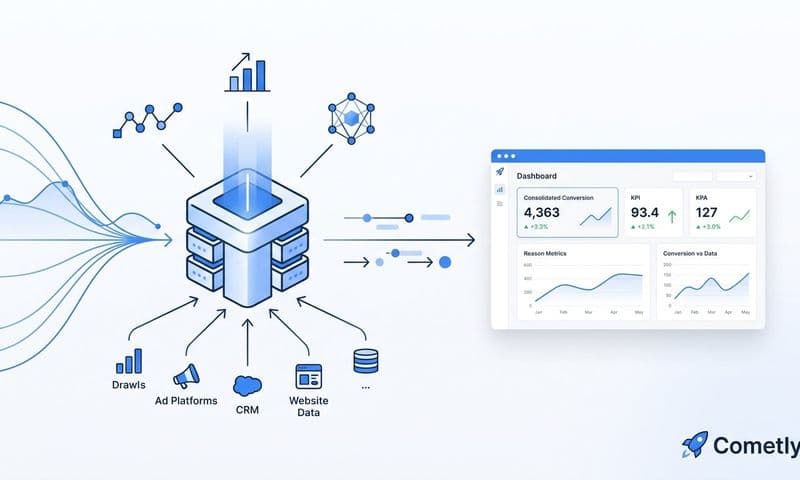
Cometly solves the attribution problem that plagues enterprise marketing: knowing which touchpoints actually drive revenue. By tracking the complete customer journey from first ad click through final conversion, it gives you a complete view of what's working across every channel.
The platform's server-side tracking ensures data accuracy even as browser-based tracking faces increasing restrictions. This means you get reliable attribution data regardless of iOS updates, ad blockers, or privacy changes that break traditional analytics.
Key Features
Multi-Touch Attribution: Track every customer touchpoint across all marketing channels to understand the full journey from awareness to revenue.
AI Ads Manager: Get AI-powered recommendations for budget allocation, campaign optimization, and scaling decisions based on actual conversion data.
Server-Side Tracking: Capture accurate conversion data that bypasses browser limitations and privacy restrictions for reliable attribution.
Conversion Sync: Feed enriched, conversion-ready events back to Meta, Google, and other ad platforms to improve their AI targeting and optimization.
Real-Time Analytics Dashboard: Monitor campaign performance and revenue attribution in real time, enabling faster decision-making at scale.
Best For
Enterprise marketing teams and agencies managing multi-million dollar ad budgets across multiple platforms who need accurate attribution to make confident scaling decisions. Particularly valuable for organizations struggling with iOS tracking limitations or complex customer journeys spanning dozens of touchpoints.
Pricing
Custom enterprise pricing based on data volume and feature requirements. Contact Cometly for a tailored quote and demo.
2. Adobe Analytics
Best for: Deep customer journey analysis with predictive analytics for large enterprises already using Adobe tools
Adobe Analytics is an enterprise-grade analytics platform designed for organizations that need sophisticated segmentation, predictive capabilities, and tight integration with the broader Adobe Experience Cloud ecosystem.
 11 Best Enterprise Marketing Analytics Software Platforms in 2026
Where This Tool Shines
Adobe Analytics excels at handling massive data volumes while enabling deep-dive analysis through its Analysis Workspace. The platform's advanced segmentation capabilities let you compare unlimited segments simultaneously, making it powerful for understanding nuanced customer behavior patterns across complex organizations.
The predictive analytics and anomaly detection features automatically surface unusual patterns in your data, helping enterprise teams spot opportunities or issues before they become obvious in standard reports. For companies already invested in Adobe's ecosystem, the native integrations create a unified view of customer experience.
Key Features
Advanced Segmentation: Create and compare unlimited customer segments with complex logic to understand behavior patterns across your entire customer base.
Predictive Analytics: AI-powered anomaly detection and forecasting identify unusual patterns and predict future trends based on historical data.
Cross-Device Journey Stitching: Connect customer interactions across devices and touchpoints to build complete journey views.
Adobe Experience Cloud Integration: Native connections to Adobe's marketing tools create a unified platform for analytics, personalization, and optimization.
Analysis Workspace: Flexible, drag-and-drop interface for ad-hoc exploration and custom reporting without requiring SQL or technical skills.
Best For
Large enterprises with complex customer journeys, particularly those already using Adobe Experience Cloud tools like Adobe Target or Adobe Campaign. Best suited for organizations with dedicated analytics teams who can leverage the platform's advanced capabilities.
We break down the leading options in our AI ad testing tool guide.
Pricing
Custom enterprise pricing typically starts at $100,000+ annually, varying based on data volume, features, and Adobe Experience Cloud bundle.
3. Google Analytics 360
Best for: Unsampled data analysis and BigQuery integration for Google-centric enterprise marketing stacks
Google Analytics 360 is the enterprise version of Google Analytics, offering unsampled reports, guaranteed data freshness, and advanced attribution modeling for organizations that have outgrown the free GA4 version.
 11 Best Enterprise Marketing Analytics Software Platforms in 2026
Where This Tool Shines
GA360's biggest advantage is unsampled reporting—critical for enterprises analyzing millions of sessions where sampled data creates misleading insights. When you're making budget decisions based on performance data, working with 100% of your data rather than a sample changes the game.
The native BigQuery export opens up unlimited custom analysis possibilities. Enterprise data teams can combine GA360 data with CRM records, offline conversions, and other sources to build sophisticated attribution models that reflect their actual business complexity.
Key Features
Unsampled Reports: Access 100% of your data in reports and explorations, eliminating the sampling that limits free GA4 for high-traffic properties.
BigQuery Export: Automatic daily export to Google BigQuery enables custom analysis, machine learning, and integration with data warehouses.
Data-Driven Attribution: Advanced attribution modeling uses machine learning to assign credit across touchpoints based on actual conversion patterns.
Advanced Google Ads Integration: Deeper integration with Google Ads for bidding optimization and audience creation based on GA360 segments.
Roll-Up Reporting: Combine data from multiple properties into unified reports for enterprise-wide visibility across brands or regions.
Best For
Enterprises heavily invested in Google's advertising and marketing ecosystem, particularly those with high-traffic websites where data sampling in free GA4 creates analysis limitations. Ideal for organizations with data science teams ready to leverage BigQuery integration.
Pricing
Starts at $150,000 annually, with pricing scaling based on monthly hit volume and additional features.
4. Mixpanel
Best for: Event-based product analytics with powerful funnel and retention analysis for SaaS enterprises
Mixpanel is a product analytics platform focused on understanding user behavior through event tracking, enabling data-driven decisions about product development and user engagement strategies.
 8 Best Enterprise Conversion Tracking Tools & Their Pricing in 2026
Where This Tool Shines
Mixpanel's event-based tracking model makes it exceptionally powerful for understanding how users actually interact with your product or platform. Unlike pageview-based analytics, you track specific actions—button clicks, feature usage, workflow completions—giving you granular insight into what drives engagement and conversion.
The platform's funnel analysis capabilities let you identify exactly where users drop off in critical workflows, while cohort analysis reveals how different user segments behave over time. This combination makes it invaluable for product-led growth strategies where user activation and retention drive revenue.
Key Features
Event-Based Tracking: Track any user action as a custom event with unlimited properties, enabling precise analysis of feature usage and behavior patterns.
Funnel Analysis: Visualize conversion rates through multi-step processes and identify drop-off points that need optimization.
Retention Analysis: Measure how different cohorts return over time to understand what drives long-term engagement.
A/B Test Tracking: Monitor experiment results and analyze how different variants impact user behavior and conversion metrics.
Data Governance: Enterprise-grade privacy controls, user permissions, and compliance features for regulated industries.
Best For
SaaS companies and digital product teams who need to understand detailed user behavior patterns to drive product decisions. Particularly valuable for product-led growth organizations focused on activation, engagement, and retention metrics.
Pricing
Enterprise plans start around $24,000 annually, with pricing based on monthly tracked users and data retention requirements.
5. Amplitude
Best for: Behavioral analytics combined with experimentation and customer data platform capabilities
Amplitude is a behavioral analytics platform that combines product analytics, built-in experimentation, and customer data management to help enterprise teams understand and optimize user journeys.
 9 Best Enterprise Performance Analytics Tools in 2026
Where This Tool Shines
Amplitude's behavioral cohort analysis goes beyond basic segmentation to identify groups of users based on the specific actions they take. This lets you understand not just who your users are, but what they actually do—and how those behaviors correlate with retention and revenue.
The platform's built-in experimentation features eliminate the need for separate A/B testing tools. You can design experiments, track results, and analyze impact all within the same platform where you're already doing behavioral analysis, creating a unified workflow for hypothesis-driven optimization.
Key Features
Behavioral Cohorts: Create dynamic user segments based on specific action sequences and behavior patterns, not just demographic attributes.
Built-In Experimentation: Design and analyze A/B tests directly in the platform, with automatic statistical significance calculations.
Customer Journey Mapping: Visualize the paths users take through your product to identify common flows and unexpected patterns.
Cross-Team Collaboration: Share insights, create custom dashboards, and enable self-service analytics across product, marketing, and executive teams.
Data Governance Tools: Centralized data quality monitoring, taxonomy management, and privacy controls for enterprise compliance.
Best For
Enterprise product and growth teams who need both deep behavioral analytics and experimentation capabilities in a single platform. Particularly strong for organizations running continuous optimization programs across complex digital products.
Pricing
Enterprise pricing available on request, typically based on monthly tracked users and feature requirements.
6. Tableau
Best for: Visual analytics and business intelligence across enterprise data sources beyond just marketing
Tableau is a visual analytics and business intelligence platform that connects to virtually any data source, enabling enterprise-wide performance reporting and data exploration through interactive visualizations.
 11 Best Marketing Analytics Tools to Track and Optimize Campaign Performance in 2026
Where This Tool Shines
Tableau's strength lies in its ability to connect marketing analytics with broader business intelligence. While specialized marketing tools focus on campaign performance, Tableau lets you combine marketing data with sales pipelines, financial results, operational metrics, and customer success data to understand the complete business impact.
The drag-and-drop visualization builder makes complex data accessible to non-technical users, democratizing analytics across the organization. This means marketing teams can create their own dashboards without waiting for data teams, while maintaining consistency through centralized data governance.
Key Features
Universal Data Connectivity: Native connectors for hundreds of data sources, from marketing platforms to databases to cloud warehouses.
Drag-and-Drop Visualization: Build interactive dashboards and reports without coding, making analytics accessible to business users.
Embedded Analytics: Integrate Tableau visualizations directly into other applications and portals for seamless access.
Tableau Pulse: AI-powered insights automatically surface notable trends and anomalies in your data.
Enterprise Security: Row-level security, user permissions, and governance controls for regulated industries and sensitive data.
Best For
Enterprises that need to combine marketing performance with broader business intelligence, particularly organizations where marketing teams need to report on ROI alongside financial and operational metrics. Strong choice for companies with diverse data sources requiring unified reporting.
Pricing
Enterprise plans start at $70 per user per month, with volume discounts and custom pricing for large deployments.
7. Heap
Best for: Automatic event capture enabling retroactive analysis without manual tracking implementation
Heap is a digital insights platform that automatically captures every user interaction on your website or app, eliminating the need for manual event tracking while enabling retroactive analysis of historical data.
Where This Tool Shines
Heap's autocapture technology solves a problem that plagues traditional analytics: missing data because someone forgot to add tracking code. By automatically collecting every click, form submission, and page view, you can analyze user behavior retroactively without having implemented specific tracking in advance.
This means when someone asks "how many users clicked that button last quarter?" you can answer the question even if you never explicitly tracked that button. For enterprise teams moving fast, this eliminates the analytics bottleneck where every new question requires engineering work to add tracking.
Key Features
Autocapture: Automatically track every user interaction without manual event instrumentation, ensuring complete data collection.
Retroactive Analysis: Define new events and analyze historical data without requiring re-tagging or waiting for new data collection.
Session Replay: Watch recordings of actual user sessions to understand behavior that quantitative data alone can't explain.
Funnel and Path Analysis: Visualize conversion funnels and user paths through your product to identify optimization opportunities.
Data Science Integration: Export complete event data to data warehouses and machine learning platforms for advanced analysis.
Best For
Enterprise teams that need comprehensive behavioral data without the overhead of maintaining complex tracking implementations. Particularly valuable for fast-moving product organizations where waiting for engineering to add tracking creates bottlenecks.
Pricing
Enterprise pricing available on request, typically based on monthly sessions and data retention requirements.
8. Looker (Google Cloud)
Best for: Semantic modeling layer ensuring consistent metrics across the organization with embedded analytics capabilities
Looker is a business intelligence platform with a unique semantic modeling approach that creates a single source of truth for metrics across the enterprise, enabling both self-service analytics and embedded reporting.
Where This Tool Shines
Looker's LookML modeling language creates a centralized definition layer for all your business metrics. This means "revenue" means exactly the same thing whether marketing, sales, or finance runs the report—eliminating the endless debates about whose numbers are right.
The platform's API-first architecture makes it powerful for embedded analytics use cases. If you need to surface analytics directly in your product, customer portal, or internal tools, Looker's embedding capabilities are among the most flexible in the enterprise BI space.
Key Features
LookML Modeling: Define business logic and metrics in a version-controlled modeling language that ensures consistency across all reports.
Embedded Analytics: Integrate analytics directly into applications with white-label capabilities and granular access controls.
Git-Based Version Control: Track changes to analytics logic, collaborate on model development, and roll back changes when needed.
Multi-Cloud Connectivity: Connect to databases across AWS, Azure, Google Cloud, and on-premise systems from a single platform.
API-First Architecture: Programmatically access all Looker functionality for custom integrations and automated workflows.
Best For
Enterprise organizations that struggle with metric inconsistency across departments, particularly those with technical teams who can leverage LookML modeling. Strong choice for companies needing embedded analytics in customer-facing applications.
Pricing
Custom pricing based on usage, typically calculated by number of users and query volume against connected databases.
9. Pendo
Best for: Product experience combining analytics, in-app guidance, and user feedback for software adoption
Pendo is a product experience platform that combines codeless analytics with in-app guidance and feedback collection to help enterprise software teams drive adoption and improve customer success.
Where This Tool Shines
Pendo bridges the gap between understanding user behavior and actually influencing it. While most analytics tools just show you what users do, Pendo lets you respond directly with in-app guides, tooltips, and walkthroughs—all without engineering work.
This makes it particularly powerful for enterprise software companies where user adoption drives retention and expansion revenue. You can identify users struggling with a feature in your analytics, then immediately deploy a guide to help them succeed—all in the same platform.
Key Features
Codeless Analytics: Track feature usage and user behavior without manual event instrumentation or engineering dependencies.
In-App Guides: Create tooltips, walkthroughs, and onboarding flows that appear contextually based on user behavior and attributes.
NPS and Feedback: Collect user feedback through in-app surveys and NPS measurements tied to specific features or user segments.
Product Engagement Scoring: Automatically calculate adoption scores based on feature usage to identify at-risk accounts and expansion opportunities.
Roadmap Planning: Connect feature requests and feedback directly to product planning to prioritize based on actual user needs.
Best For
Enterprise SaaS companies and software vendors focused on user adoption and customer success metrics. Particularly valuable for product teams who need to both measure and improve the in-product experience without constant engineering support.
Pricing
Enterprise pricing available on request, typically based on monthly active users and feature requirements.
Making the Right Choice
The right enterprise analytics platform depends on what you're actually trying to measure and optimize. Marketing-focused teams running complex, multi-channel campaigns need attribution-first tools like Cometly that connect ad spend directly to revenue. Product teams optimizing user engagement lean toward behavioral platforms like Mixpanel or Amplitude. Organizations needing enterprise-wide business intelligence require broader solutions like Tableau or Looker.
Most enterprises end up using multiple tools for different use cases. A common pattern: Cometly or Adobe Analytics for marketing attribution, Mixpanel or Amplitude for product analytics, and Tableau for executive reporting that combines both. The key is ensuring your tools integrate well—fragmented analytics where insights don't connect across platforms creates more problems than it solves.
When evaluating platforms, prioritize these enterprise requirements: scalability to handle your data volume without performance degradation, integration depth with your existing marketing and data stack, real-time or near-real-time reporting for fast decision-making, and governance features that meet your compliance and security requirements. Don't get distracted by feature lists—focus on whether the platform actually solves your specific attribution and optimization challenges.
The analytics landscape continues evolving rapidly. Server-side tracking is becoming non-negotiable as browser-based tracking faces increasing restrictions. AI-powered recommendations are moving from nice-to-have to competitive necessity. And the platforms that win in 2026 are those that don't just collect data, but actually help you make better decisions faster.
Ready to elevate your marketing game with precision and confidence? Discover how Cometly's AI-driven recommendations can transform your ad strategy—Get your free demo today and start capturing every touchpoint to maximize your conversions.