For B2B SaaS marketing teams, ad spend without accurate conversion tracking is essentially a guessing game. You might know which campaigns generated clicks or impressions, but without reliable conversion data, you cannot confidently answer the question that matters most: which ads are actually driving revenue?
Inaccurate conversion tracking leads to misallocated budgets, underperforming campaigns that stay live too long, and high-performing ones that never get the investment they deserve.
The challenge is that conversion tracking in B2B SaaS is genuinely complex. Buyers research for weeks or months before converting. They interact with multiple ads across multiple channels. They switch devices, clear cookies, and use ad blockers. Browser privacy changes have made pixel-based tracking increasingly unreliable. And the conversion event itself, whether a demo request, a trial signup, or a closed-won deal, often happens far downstream from the first ad click.
This guide walks you through a practical, step-by-step process to build a conversion tracking setup that is accurate, durable, and connected to real revenue outcomes. Whether you are starting from scratch or auditing an existing setup, each step builds on the last to give you a complete picture of how your ads are performing.
By the end, you will have a system that captures every meaningful touchpoint, feeds better data back to your ad platforms, and gives your team the confidence to make smarter budget decisions.
Step 1: Define Your Conversion Events Before Touching Any Tracking Code
Before you write a single line of tracking code or configure a single pixel, you need to know exactly what you are measuring. This sounds obvious, but it is the step most teams skip, and it is the reason so many tracking setups produce data that looks impressive but tells you nothing useful.
Start by identifying the specific actions that represent meaningful progress in your funnel. For B2B SaaS, these typically include form submissions, demo bookings, trial signups, and closed-won deals. Each of these represents a real signal of intent or revenue impact, and each deserves its own conversion event.
From there, distinguish between micro-conversions and macro-conversions. Micro-conversions are earlier-stage actions like content downloads, webinar registrations, or pricing page visits. They indicate interest but not commitment. Macro-conversions are the high-value actions: a qualified lead entering your pipeline, a trial activation, or a deal closing. Both matter, but they should carry different weight in your attribution model.
Map events to funnel stages: Connect each conversion event to a specific stage in your B2B SaaS funnel. A demo request sits at the bottom of the funnel and carries significant weight. A content download sits at the top and signals early awareness. When you know where each event lives in the journey, you can interpret your data in context rather than in isolation.
Document everything before implementation: Before touching any platform, create a conversion event map that includes the event name, the expected value or weight, the page or trigger associated with it, and which ad platforms need to receive the signal. This document becomes your source of truth when something breaks or when a new team member joins.
Here is the pitfall to avoid: tracking vanity events like page views or time-on-site as conversions. These inflate your numbers and corrupt your attribution data. If your ad platform thinks a page view is a conversion, it will optimize toward users who view pages, not users who become customers. Be ruthless about only tracking events that signal genuine funnel progression.
The time you invest in this step pays dividends at every stage that follows. Clean event definitions make implementation faster, validation easier, and optimization more reliable.
Step 2: Set Up First-Party Data Collection and Server-Side Tracking
Once you know what you are measuring, the next question is how to measure it reliably. For most teams, the instinct is to drop a pixel on a thank-you page and call it done. That approach worked reasonably well a few years ago. It does not work well today.
Browser-based pixel tracking has become significantly less reliable. iOS privacy updates, browser-level cookie restrictions like Intelligent Tracking Prevention and Enhanced Tracking Protection, and widespread ad blocker usage all reduce pixel match rates. In practical terms, this means a meaningful portion of your actual conversions are never reported back to your ad platforms.
The solution is server-side tracking. Instead of relying on a browser to fire a pixel after a conversion, server-side tracking sends conversion events directly from your server to the ad platform. The browser never needs to be involved. Ad blockers cannot intercept it. Cookie restrictions do not apply.
Implement the Conversion API for Meta: Meta's Conversion API (CAPI) allows you to send web events directly from your server to Meta's systems. When configured correctly alongside your Meta pixel, CAPI dramatically improves event match rates and gives Meta's algorithm more accurate signals to optimize against.
Use Enhanced Conversions for Google Ads: Google's Enhanced Conversions works similarly, allowing you to pass hashed first-party data like email addresses alongside your conversion events. This improves conversion measurement accuracy, particularly for cross-device journeys where a user clicked an ad on one device and converted on another.
Collect and hash first-party identifiers: At the point of conversion, collect identifiers like email addresses and phone numbers. Hash them before sending them to ad platforms. This improves event matching quality significantly because the platform can match your conversion event to a known user in their system, even if cookie-based tracking failed.
Before moving forward, verify that your server-side events are firing correctly. Meta's Events Manager and Google's Tag Diagnostics both provide tools to confirm that events are being received and matched at acceptable rates. Do not skip this verification step. A misconfigured server-side setup can be harder to diagnose than a broken pixel, and the data gaps it creates will compound over time.
This step is the foundation of accurate conversion tracking. Everything built on top of it, attribution models, optimization signals, budget decisions, is only as reliable as the data flowing through this layer. Skipping or cutting corners here means every downstream analysis will have gaps you cannot fully account for.
Step 3: Implement UTM Parameters and Consistent Campaign Tagging
Server-side tracking tells your ad platforms that a conversion happened. UTM parameters tell your analytics layer where that conversion came from. Both are necessary, and neither replaces the other.
UTM parameters are the query string values appended to your ad URLs that identify the source, medium, campaign, content, and term associated with a click. When a user clicks your ad and converts, those parameters travel with them through your funnel and get recorded alongside the conversion event. Without them, your analytics tool cannot accurately attribute conversions to specific campaigns or creatives.
The most important thing about UTM parameters is consistency. Build a standardized UTM taxonomy and document it so every person on your team follows the same conventions. Define exactly what goes in each field. For example, source might be "google" or "linkedin" or "meta." Medium might be "cpc" or "paid-social." Campaign should follow a naming structure that includes the product, audience, and goal.
Tag every ad URL: Do not just tag campaign-level links. Tag individual ad URLs so you can attribute conversions to specific creatives and ad sets. This granularity is what allows you to identify which ad copy, which image, or which offer is actually driving conversions, rather than just which campaign.
Use auto-tagging alongside manual UTMs: In Google Ads, enable auto-tagging to capture GCLID parameters. These give Google Analytics deeper visibility into Google Ads performance. But do not rely on GCLID alone for your broader attribution layer. GCLID data lives only within Google's ecosystem. Use manual UTMs in parallel so your attribution platform can read the same data regardless of channel.
The most common failure point here is inconsistent naming. "Facebook," "facebook," and "fb" look like three different sources to your analytics tool. A campaign named "Brand-Awareness-Q1" in one place and "brand awareness q1" in another fragments your data and makes cross-campaign analysis unreliable. Create a naming convention document, share it with your team, and enforce it.
Also watch for UTM parameters being dropped during redirects or through third-party tools. Booking tools like Calendly, multi-step forms, and landing page platforms can sometimes strip UTM values before the conversion is recorded. Test your full conversion flow to confirm that parameters survive the entire journey from ad click to confirmation page.
Step 4: Connect Your CRM and Ad Platforms to a Single Attribution Layer
Here is a problem every B2B SaaS marketing team eventually runs into. You open your Meta dashboard and it reports strong ROAS. You open your Google Ads dashboard and it also reports strong ROAS. You open your LinkedIn dashboard and it claims credit for conversions too. Add them all up and the total attributed revenue exceeds what your CRM actually shows. Something is wrong.
The problem is that each ad platform only reports conversions it can claim credit for, and they all use different attribution windows and models. The result is systematic double-counting and inflated performance figures across the board. You cannot make sound budget decisions based on data that has been counted three times.
The solution is a single attribution layer that sits above all your ad platforms and uses one consistent methodology to assign credit. This layer ingests data from your ad channels, your website, and your CRM, then maps the full customer journey from first touchpoint to closed-won deal.
Connect your CRM data: Your CRM holds the ground truth about which leads became customers and how much revenue they generated. When you connect CRM pipeline stages to ad touchpoints, you can see which campaigns influenced deals at each stage of the funnel, not just at the first or last click. This is critical for B2B SaaS where the sales cycle spans multiple weeks and multiple interactions.
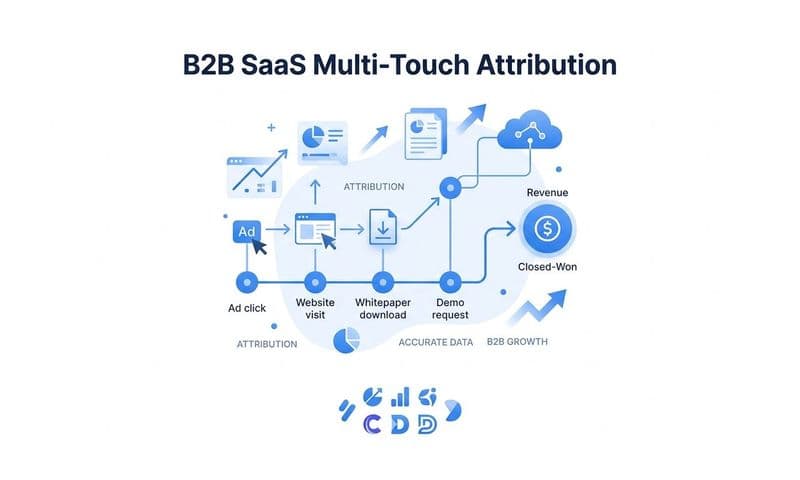
Map pipeline stages to ad touchpoints: A lead that clicked a LinkedIn ad, then a Google retargeting ad, then booked a demo via an email campaign involves three different channels. Without a unified attribution layer, each channel claims that conversion. With one, you can see the full sequence and assign credit based on actual contribution.
This is where Cometly fits into the workflow. Cometly connects your ad platforms, CRM events, and website behavior to track the full customer journey and attribute revenue to the right sources. Rather than reconciling conflicting dashboards manually, you get a single source of truth that shows which ads are actually driving pipeline and revenue.
Verify that your CRM integration is passing deal stage updates back to your attribution layer in real time. Delayed or incomplete syncs create gaps in your data that make it look like certain campaigns are underperforming when they are actually influencing deals that have not yet been recorded. Real-time data flow is what makes your attribution layer actionable rather than historical.
Step 5: Choose and Apply the Right Attribution Model for Your Sales Cycle
Attribution models are the rules that determine how credit for a conversion gets distributed across the touchpoints that preceded it. Choosing the wrong model does not just affect your reporting. It directly shapes where you invest your budget, which channels you scale, and which ones you cut.
Different models tell fundamentally different stories. First-touch attribution gives all the credit to the first interaction a prospect had with your brand. It is useful for understanding what creates awareness and drives new prospects into your funnel. Last-touch attribution gives all the credit to the final interaction before conversion. It is useful for understanding what closes deals, but it systematically undervalues every channel that contributed earlier in the journey.
For B2B SaaS companies with long sales cycles, single-touch models are almost always misleading. A prospect who clicks a top-of-funnel LinkedIn ad, downloads a whitepaper, attends a webinar, clicks a retargeting ad, and then books a demo after a sales email has interacted with five distinct touchpoints. Giving all the credit to the last one ignores the entire journey that made the demo possible.
Linear attribution distributes credit equally across all touchpoints. It is simple and fair, and it works well when you want a baseline view of how channels contribute without overcomplicating the model.
Time-decay attribution gives more credit to touchpoints closer to the conversion. For B2B SaaS, this often makes intuitive sense: the interactions that happened in the final days before a demo booking were probably more influential than something that happened three months earlier.
Data-driven attribution uses your actual conversion patterns to assign credit algorithmically. It is the most accurate option when you have sufficient data volume, because it reflects the real relationships between touchpoints and outcomes in your specific funnel rather than applying a generic rule.
The practical approach is to compare models side by side. Look at how credit distribution changes between first-touch, linear, and data-driven models for the same set of conversions. The differences reveal which channels are being over- or under-credited in your current reporting, and that insight directly informs smarter budget allocation.
Avoid defaulting to last-click attribution for all decisions. It is the most common default, and it systematically undervalues top-of-funnel channels that generate demand. Teams that rely on last-click alone tend to over-invest in bottom-of-funnel channels and starve the awareness channels that fill the top of the pipeline.
Step 6: Validate Your Tracking Setup and Eliminate Data Gaps
You have defined your events, implemented server-side tracking, tagged your campaigns, connected your CRM, and chosen an attribution model. Now you need to verify that everything is actually working before you trust the data for decisions.
Start with a tracking audit. Compare conversion counts across three sources: your ad platforms, your analytics tool, and your CRM. Some discrepancy is normal and expected. Ad platforms use different attribution windows. Analytics tools count sessions differently. But large gaps, say more than 15 to 20 percent, indicate a tracking problem that needs to be resolved before you can trust your data.
Check for event deduplication issues: If you are running both pixel tracking and server-side tracking simultaneously, and you should be, you need deduplication logic to prevent the same conversion from being counted twice. Typically this is handled by passing a unique event ID with both the browser event and the server event. The ad platform uses that ID to recognize duplicates and count only once. Without this, your reported conversion volume will be inflated.
Test your full conversion flow end to end: Click an actual ad, go through your landing page, fill out your form or book a demo, and confirm that the conversion event fires correctly. Check that it appears in your ad platform's event manager, your analytics tool, and your CRM. Do not assume that because something worked last month it still works today. Website updates, form changes, and platform updates can all silently break tracking.
Look for UTM drop-off points: Trace the UTM parameters through your entire conversion flow. Common places where parameters get lost include redirects between domains, third-party booking tools, multi-step forms that load new pages, and checkout flows. If UTMs are being dropped, conversions will be attributed to direct traffic rather than the paid campaign that drove them.
Set up conversion volume alerts: Configure alerts that notify you when conversion volume drops suddenly below a defined threshold. A sudden drop is almost always a broken tracking implementation rather than a genuine performance decline. Without an alert, you might not catch it for days or weeks, during which time you are making budget decisions based on incomplete data.
Step 7: Use Conversion Data to Feed Ad Platform AI and Optimize Campaigns
Accurate conversion data is not just for your internal reporting. It is the fuel that powers the machine learning algorithms ad platforms use for bidding, targeting, and optimization. The quality of your conversion signals directly determines the quality of your ad platform's decisions.
When you send accurate, enriched conversion events back to Meta and Google via CAPI and Enhanced Conversions, you are giving their algorithms better information to work with. Better signals lead to better targeting. Better targeting leads to more efficient spend. This is not a theoretical benefit. It is a direct, measurable improvement in campaign performance that compounds over time as the algorithms accumulate more accurate data.
Pass downstream conversion events: Most teams send only top-of-funnel events like form fills back to ad platforms. This teaches the algorithm to find more people who fill out forms, which is not the same as finding more people who become customers. When you pass downstream events like qualified leads, trial activations, or closed-won deals, you teach the algorithm to optimize toward revenue rather than lead volume. The result is typically higher lead quality, even if raw lead volume decreases.
Use attribution data to shift budget: Your cross-channel attribution data shows you which campaigns, ad sets, and creatives are driving the highest-quality conversions. Use that data to make deliberate budget decisions. Scale what is working. Reduce investment in channels that generate clicks but not revenue. This is the difference between managing campaigns by gut feel and managing them by evidence.
Build a regular review cadence: Conversion data should be reviewed on a consistent schedule, whether weekly or biweekly, to identify trends, catch anomalies, and inform creative testing decisions. Which ad concepts are driving the most qualified leads? Which audience segments convert at the highest rate? Which channels influence deals at the top of the funnel versus the bottom? These questions can only be answered with accurate, consistent conversion data over time.
Cometly's AI recommendations layer analyzes your cross-channel conversion data to surface which ads are performing and where to scale. Rather than manually sifting through platform dashboards to find patterns, you get proactive recommendations grounded in your actual revenue data, so your team can act faster and with more confidence.
Putting It All Together
Accurate ad conversion tracking is not a one-time setup task. It is an ongoing system that requires clean data inputs, the right attribution model, and a reliable way to connect ad spend to actual revenue outcomes.
The seven steps in this guide build on each other. You cannot choose the right attribution model without clean event data. You cannot optimize ad platform AI without sending it accurate conversion signals. You cannot connect ad spend to revenue without a unified attribution layer that includes your CRM.
Start with Step 1 and work through each step systematically. If you already have a tracking setup in place, use Step 6 as your starting point to audit what you have before adding more complexity.
The payoff for getting this right is significant. When your conversion data is accurate, your budget decisions become defensible, your ad platform algorithms improve, and your team stops arguing about which channel deserves credit. You can see the full customer journey from first ad click to closed-won revenue and make confident decisions about where to invest next.
Cometly is built specifically for this workflow. It connects your ad platforms, CRM, and website into a single attribution layer so you always have a clear, accurate picture of what is driving growth. If you are ready to move beyond fragmented tracking and start making data-driven decisions with confidence, Get your free demo today and start capturing every touchpoint to maximize your conversions.