Most real estate professionals have built their lead generation around the same playbook for decades: cold calls, door knocking, referral networks, and paid advertising. These tactics can work, but they share a fundamental limitation. They reach prospects on the agent's timeline, not the buyer's or seller's.
That dynamic has shifted significantly. Today's buyers and sellers spend weeks or months researching properties, neighborhoods, agents, and market conditions before they ever contact anyone. By the time a prospect responds to a cold call or clicks a display ad, they often already have a shortlist of professionals they trust, built entirely through self-directed online research.
Inbound marketing is the strategic response to this shift. Instead of pushing messages at people who may not be ready, inbound marketing creates content and experiences that pull prospects toward you at the exact moment they are looking for answers. For real estate, where trust and demonstrated expertise are the primary drivers of who gets hired, this approach aligns perfectly with how modern buyers and sellers actually make decisions.
This article covers what inbound marketing looks like specifically in the real estate context, the core tactics that generate results, how to convert organic traffic into qualified leads, and how to measure whether any of it is actually moving the needle on revenue. By the end, you will have a clear picture of how to build a lead generation system that works for you around the clock, not just when you are actively spending money.
Why Traditional Real Estate Lead Generation Is Losing Ground
The core problem with outbound-heavy real estate marketing is timing. Cold outreach, whether by phone, direct mail, or paid interruption ads, assumes you can identify a prospect before they have identified you. In a world where buyers and sellers begin their journey with a Google search rather than a phone call, that assumption is increasingly difficult to act on.
By the time a prospect receives a cold call from an agent, they have often already formed opinions about who they want to work with. They have read agent bios, watched market update videos, browsed neighborhood guides, and compared firms. Interrupting that process with an unsolicited pitch does not just fail to convert; it can actively damage credibility. Trust is the currency of real estate transactions, and cold outreach tends to trigger skepticism rather than build confidence.
Permission-based inbound approaches work differently. When a prospect finds your content through a search query, downloads your neighborhood guide, or subscribes to your market report newsletter, they are signaling genuine interest. That initial interaction is fundamentally different from a cold contact because the prospect chose to engage. That choice creates a foundation of credibility that outbound tactics rarely achieve.
There is also an economics argument worth understanding. Paid advertising generates leads as long as you keep spending. The moment your budget runs out or your campaign ends, the leads stop. Inbound assets, on the other hand, compound over time. A well-written neighborhood guide that ranks on page one of Google for a relevant search term will continue attracting prospects for months or years without additional spend. A library of genuinely useful content becomes a durable business asset rather than a recurring line item.
This compounding nature of inbound marketing is particularly valuable in real estate, where the research cycle is long. A prospect who discovers your content today may not be ready to transact for another six months. If your content is the resource they keep returning to throughout that research period, you are the natural first call when they are ready to move forward.
The Core Pillars of Inbound Marketing in Real Estate
Inbound marketing in real estate is built on three interconnected pillars: content that attracts, search optimization that ensures discoverability, and lead capture mechanisms that convert anonymous visitors into identifiable prospects. Each pillar depends on the others, and weaknesses in any one of them will limit the overall system.
Content Marketing: The foundation is creating content that answers the questions buyers and sellers are already searching for. Neighborhood guides that cover school ratings, commute times, local amenities, and price trends attract buyers researching specific areas. Market reports that explain inventory levels, median price shifts, and days-on-market data serve sellers trying to understand timing. Home buying checklists, seller preparation guides, and mortgage explainers capture prospects early in the research phase and position the agent or firm as the most useful resource in the market.
The key is relevance to actual search behavior. Content that addresses real questions earns trust in a way that promotional content never can. A buyer reading a genuinely useful guide on what to look for during a home inspection is developing confidence in the author, not just consuming information.
Search Engine Optimization: Content only generates leads if people can find it. SEO ensures that your content surfaces when buyers search terms like "homes for sale in [city]," "best neighborhoods in [area] for families," or "how to sell my house fast." For real estate, local SEO is especially important. Hyperlocal content targeting specific neighborhoods, zip codes, and city names tends to attract high-intent traffic from people who are actively planning a move rather than casually browsing.
Technical SEO factors like page load speed, mobile optimization, and site structure also matter. A slow, poorly organized website will underperform in search rankings regardless of content quality.
Lead Capture Mechanisms: Traffic without conversion is just noise. Effective inbound programs use gated resources, email newsletter sign-ups, free home valuation tools, and property search integrations to convert anonymous visitors into identifiable leads. The goal is to offer enough value that a visitor willingly exchanges their contact information, creating the permission-based relationship that makes nurture possible.
These three pillars, working together, create a system where content attracts the right audience, SEO ensures that audience can find the content, and lead capture mechanisms turn that audience into a pipeline of prospects that can be developed over time.
Building a Real Estate Content Strategy That Actually Ranks
Publishing content without a strategy is the most common reason real estate inbound programs fail to generate meaningful traffic. A thoughtful content strategy starts with keyword research that reflects how actual buyers and sellers search, not how agents talk about their own services.
Real estate keyword research should target two distinct categories. High-intent transactional terms like "sell my home in [city]" or "buy a condo in [neighborhood]" capture prospects who are close to making a decision and ready to engage. Informational terms like "what is a buyer's agent," "how long does it take to close on a house," or "is now a good time to sell in [market]" capture prospects earlier in the research phase. A content strategy that covers both categories builds visibility across the entire buyer journey rather than just the final stage.
Hyperlocal content is where real estate inbound programs can build a genuine competitive advantage. National real estate portals have massive domain authority and will outrank most individual agents or firms on broad terms. But a neighborhood profile that covers the specific character, price trends, school options, and lifestyle of a particular area can rank well for long-tail local searches that the big portals do not prioritize. This is where local expertise becomes a searchable asset.
Content formats that consistently perform well in real estate include neighborhood and community profiles, local market trend analyses updated quarterly or monthly, video walkthroughs of properties and neighborhoods, FAQ-style posts that directly answer common buyer and seller questions, and process guides that demystify complex transactions. Video content, in particular, adds a dimension of trust-building that text alone cannot replicate. Seeing and hearing an agent explain a market creates a personal connection before any direct contact has occurred.
Consistency matters more than volume. Publishing two genuinely useful, well-researched pieces per month will outperform publishing ten thin, rushed articles. Search engines reward depth and relevance, and readers reward content that actually helps them make decisions. A steady publishing cadence also builds domain authority progressively over time, which compounds the reach of every new piece you publish.
One practical approach: map your content calendar to the real estate calendar. Spring market previews, summer relocation guides, fall seller preparation content, and winter market analysis pieces align with the natural rhythms of buyer and seller behavior and tend to attract timely, high-intent traffic.
Turning Website Visitors Into Qualified Real Estate Leads
Organic traffic is only valuable if it converts. The most common mistake in real estate inbound programs is driving visitors to content with no clear next step. Every piece of content should have a lead capture mechanism that matches the visitor's intent at that moment in their research journey.
Intent matching is the critical concept here. A first-time buyer reading a neighborhood guide is not ready to schedule a showing; they are still orienting themselves. The right offer for that visitor is a free home search tool, a neighborhood comparison guide, or a newsletter that delivers regular market updates. A homeowner reading a market report on rising prices in their zip code is much closer to considering a sale. The right offer for that visitor is a free home valuation or a seller's guide that walks them through the process. Offering the wrong lead magnet to the wrong audience produces low conversion rates regardless of traffic volume.
Email nurture sequences are not optional in real estate; they are essential. The average real estate transaction cycle spans months from initial research to close. A prospect who downloads your buyer's guide in March may not be ready to engage with an agent until July. An automated email sequence that delivers relevant, genuinely useful content throughout that period keeps your brand top of mind without requiring manual follow-up. The goal is to be the most trusted resource in the prospect's inbox so that when they are ready to act, reaching out to you feels like the obvious next step.
Effective nurture sequences in real estate are segmented by intent signals. A prospect who downloaded a seller's guide should receive different content than one who signed up for property alerts. Personalization does not require sophisticated technology; it requires thoughtful segmentation from the start.
CRM integration closes the loop. Every captured lead needs to be tracked, scored, and routed so that no prospect disappears between initial contact and conversion. A lead who opens every email but has not yet requested a consultation is worth a different follow-up approach than one who has been dormant for sixty days. Without CRM visibility, these distinctions are invisible and opportunities are lost.
Measuring What Your Inbound Strategy Is Actually Producing
One of the fastest ways to underinvest in inbound marketing is to measure it with the wrong metrics. Page views, social media followers, and email list size are easy to track, but they do not tell you whether your inbound program is generating revenue. The metrics that matter are lead volume by source, lead-to-client conversion rate, and cost per acquisition by originating channel.
Lead volume by source tells you which content pieces, landing pages, and lead magnets are actually driving pipeline. If your neighborhood guides are generating ten times more leads than your market reports, that is a signal to double down on neighborhood content. If a particular landing page has high traffic but low conversion, the offer or the copy needs work. These are actionable insights that page view data alone cannot provide.
Attribution becomes especially complex in real estate because the buyer journey is long and non-linear. A prospect might discover your brand through a blog post shared on social media, return two weeks later through an organic search, download a seller's guide, receive six email nurtures, and then click a retargeting ad before finally scheduling a consultation. Last-click attribution would credit only the final ad with the conversion, making it appear that your paid retargeting is driving results while your content and organic channels appear to contribute nothing. That misrepresentation leads to budget decisions that underinvest in the assets that are actually building the relationship.
Multi-touch attribution models distribute credit across the touchpoints that contributed to a conversion, giving a more accurate picture of how content, organic search, email, and paid channels work together across the full buyer journey. For a high-consideration purchase like real estate, where the path from first touch to closed transaction can span months and dozens of interactions, multi-touch attribution is not a nice-to-have. It is the difference between making informed investment decisions and optimizing based on incomplete data.
The metrics framework for a real estate inbound program should include organic traffic volume and trend over time, lead capture rate by content piece and landing page, email open and click-through rates as engagement indicators, lead-to-consultation conversion rate, and ultimately cost per closed transaction by originating channel. That last metric connects inbound marketing directly to revenue, which is the only measure that justifies continued investment.
Regular reporting against these metrics, reviewed monthly at minimum, allows the program to improve continuously rather than running on assumptions about what is working.
From Traffic to Closed Transactions: Connecting the Full System
The difference between a real estate inbound program that generates occasional leads and one that drives consistent, scalable pipeline is integration. When content creation, lead capture, email nurture, and CRM tracking operate as isolated activities, the system has gaps where prospects fall through. When they are connected into a single, trackable flow, every touchpoint contributes to a measurable outcome.
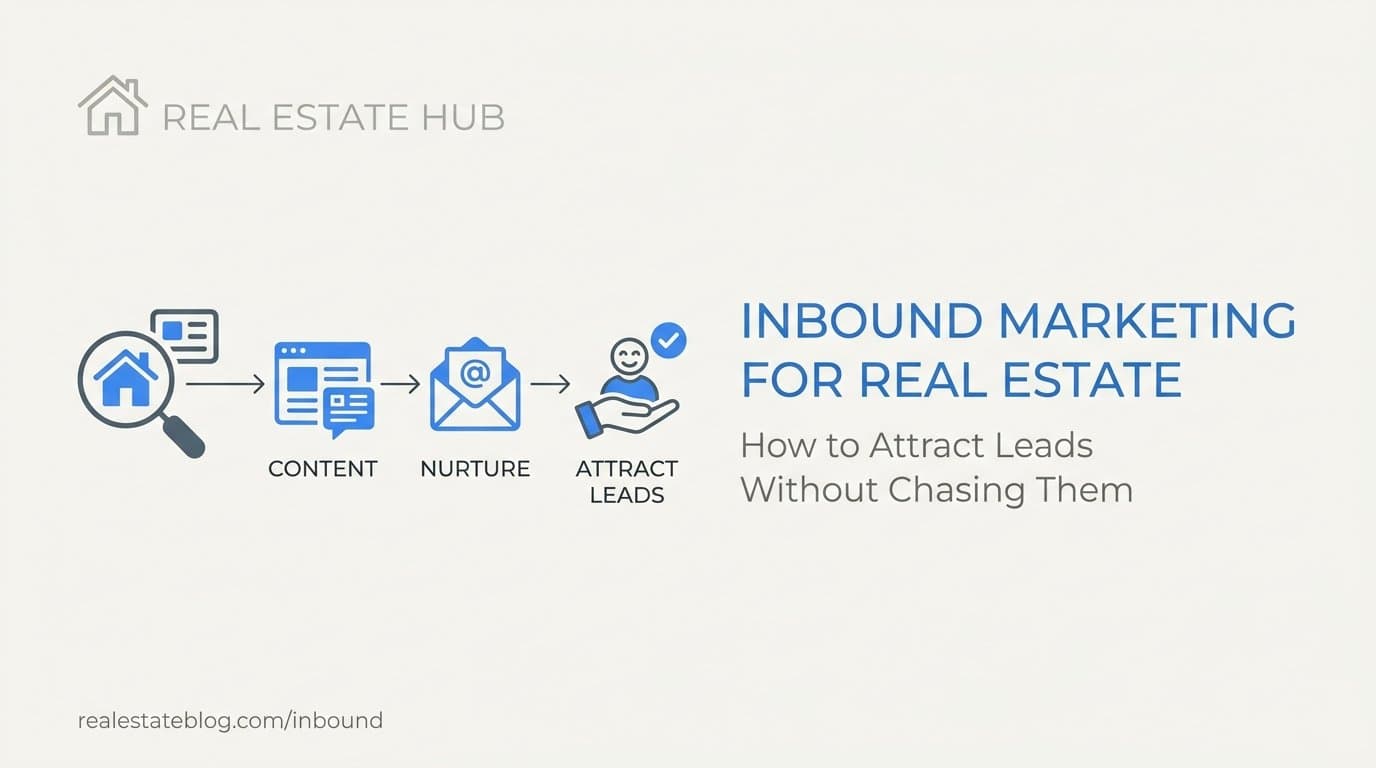
Think of it as a chain: content attracts the right audience through organic search, lead capture mechanisms convert visitors into identifiable prospects, nurture sequences develop those prospects over the weeks and months of their research cycle, and CRM routing ensures that qualified leads reach the right person at the right time. Break any link in that chain and the whole system underperforms.
Regular auditing is what keeps the system improving. Reviewing which content pieces are generating the most qualified leads, which lead magnets have the highest conversion rates, and which nurture sequences are producing the most consultations gives you a clear picture of where to invest next. This is not guesswork; it is optimization based on actual performance data.
Platforms that unify marketing data across channels are particularly valuable here. When organic search, paid ads, email, and direct traffic are all tracked in a single view connected to pipeline outcomes, patterns become visible that siloed reporting would never reveal. You might discover that prospects who first engaged with your neighborhood content convert to clients at a higher rate than those who came in through paid search, which would justify shifting budget toward content production. Or you might find that a specific email sequence dramatically increases the lead-to-consultation rate, which would justify expanding it to more segments.
These kinds of insights are only available when the data is connected end to end, from the first organic search click through to the closed transaction.
The Long Game Pays Off
Inbound marketing in real estate is not a campaign. It is an asset-building strategy that compounds over time. The agents and firms winning online today are not the ones who ran the best ad last quarter; they are the ones who spent the last two years publishing genuinely useful content, earning search visibility, and building trust with an audience that was not yet ready to transact.
The shift from interruption to attraction is not just a tactical preference. It reflects a fundamental change in how buyers and sellers make decisions. Professionals who align their marketing with that reality, by being the most helpful resource in the market rather than the loudest voice, are building a durable competitive advantage that paid media alone cannot replicate.
The content you publish today will still be attracting leads six months from now. The email nurture sequences you build this quarter will keep your brand visible through every research cycle your prospects go through. The trust you earn through consistent, expert content is the reason a prospect calls you instead of your competitor when they are finally ready to move.
For teams running inbound programs at scale, knowing exactly which content pieces, channels, and touchpoints are driving leads and revenue is what separates scaling from guessing. Cometly connects every touchpoint across your buyer journey to actual pipeline and revenue, giving you the multi-touch attribution visibility to see how your blog content, organic search traffic, paid ads, and email nurture work together across the long real estate decision cycle. Instead of optimizing based on last-click data that misrepresents your content's contribution, you get a complete picture of what is actually driving closed transactions.
If you are ready to turn your inbound marketing from an experiment into a predictable growth engine, start by getting clear on what your data is actually telling you. Get your free demo and see how Cometly gives real estate marketing teams the attribution clarity to invest with confidence.