Digital advertising has not been the same since Apple introduced App Tracking Transparency. What used to be a relatively straightforward loop of ad click, pixel fire, and conversion attribution has become something far more complicated. For many advertisers, the result has been a slow erosion of confidence in their own reporting numbers.
The problem is not just technical. It is strategic. When your attribution data is incomplete, every budget decision you make is built on a shaky foundation. You might be pausing campaigns that are actually driving pipeline. You might be scaling channels that look good on paper but are benefiting from misattributed credit. Either way, you are flying partially blind.
This article is for marketers who want to understand exactly what iOS tracking limitations mean for their advertising programs, why the damage runs deeper than most realize, and what a modern, resilient tracking strategy actually looks like. Whether you run paid social for a B2B SaaS company or manage a portfolio of campaigns across multiple channels, the principles here apply directly to your situation.
We will cover how Apple's privacy framework changed the rules, what specific data disappears when iOS users opt out, why attribution models break under these conditions, and how server-side tracking and Conversion APIs have emerged as the most effective response. We will also walk through what a durable attribution stack looks like for B2B SaaS companies and why the advertisers who adapt fastest are actually gaining a competitive edge.
iOS tracking limitations for advertisers are not a temporary inconvenience. They represent a permanent shift in how digital advertising infrastructure works. The sooner you build your strategy around that reality, the better your decisions will be.
How Apple's Privacy Framework Changed the Rules for Advertisers
Before iOS 14.5, the default state of mobile advertising was opt-out. Apps could access a device's IDFA, the Identifier for Advertisers, without explicitly asking users for permission. Advertisers and ad platforms used this identifier to track user behavior across apps and websites, build audience profiles, and measure whether ads led to conversions.
Apple flipped that model entirely with the introduction of App Tracking Transparency. Under ATT, apps must display a prompt asking users whether they want to allow tracking across other companies' apps and websites. If a user declines, the app receives no IDFA. The identifier is either zeroed out or unavailable entirely, depending on the iOS version.
The practical impact was immediate. Opt-in rates for tracking permission have been consistently low across the industry, with many estimates suggesting the majority of iOS users decline when prompted. This means the pool of trackable iOS users shrank dramatically almost overnight. Ad platforms that had built their optimization engines on dense behavioral data suddenly found themselves working with far thinner signal.
Meta was among the most visibly affected because its advertising model historically depended on cross-app and cross-site behavioral data to power audience targeting and conversion optimization. When iOS users stopped sharing IDFA data, Meta's ability to attribute conversions, optimize delivery, and build lookalike audiences from iOS users degraded significantly. Google Ads and other platforms were also affected, though Google's ownership of high-intent surfaces like Search and YouTube provided some degree of insulation.
Apple introduced SKAdNetwork as its privacy-preserving attribution alternative. The framework provides aggregated conversion data back to advertisers without exposing individual user identifiers. But it comes with real constraints. Conversion windows are limited, granularity is low, and data arrives with a delay that makes real-time campaign optimization difficult. For most performance marketers, SKAdNetwork data is better than nothing, but it is not a replacement for the signal quality they previously had.
It is worth being precise about what iOS actually blocks versus what remains observable. ATT restricts device-level identification and cross-app behavioral tracking. It does not prevent advertisers from collecting first-party data through their own websites, CRMs, or server-side infrastructure. This distinction is critical. The data that iOS removes is third-party, device-level data. The data that remains available, if you build the infrastructure to capture it, is first-party data that originates from your own systems. That difference is the foundation of every modern tracking strategy worth building.
What Data Actually Goes Missing When iOS Users Opt Out
Understanding what specifically disappears helps you assess the real scope of the problem. It is not just that you lose a single data point. The loss cascades through your entire measurement and optimization stack.
The most direct loss is IDFA. Without this identifier, ad platforms cannot link an ad impression or click from an iOS app to a downstream conversion event at the device level. The thread that connected "this user saw this ad" to "this user completed a purchase or signed up" is cut.
Cross-app behavioral data also disappears. Ad platforms previously used behavioral signals from across their app ecosystems to build detailed interest and intent profiles. When iOS users opt out, those behavioral signals stop flowing. This affects not just attribution but also audience targeting and lookalike modeling. The audiences you build from iOS users who have opted out are less rich and less accurate.
Device-level conversion events that ad platforms use for optimization are also impacted. Platforms like Meta rely on conversion signals to train their delivery algorithms. When a significant portion of conversions from iOS users goes unreported, the algorithm receives a distorted picture of which ads and audiences are actually driving results. It optimizes toward an incomplete dataset, which means campaign performance can degrade even if the underlying ads and targeting are strong.
For B2B SaaS companies, this problem is compounded by the nature of the buying journey. A typical B2B SaaS buyer does not see one ad and convert immediately. They might encounter a LinkedIn ad, then a retargeting ad on Instagram, then search for the product directly, read a review, and finally sign up for a trial weeks later. That journey spans multiple sessions, multiple devices, and often multiple channels.
When iOS restrictions remove touchpoints from that journey, you are not just losing one data point. You are losing visibility into entire segments of the consideration process. A buyer who first engaged with your brand through an iOS app and later converted through a desktop browser may look like a direct or organic conversion in your reporting, when in reality they were influenced by paid channels you can no longer see.
The downstream consequence is budget misallocation. Ad platforms operating on incomplete conversion data may reduce delivery or increase cost estimates for campaigns that are actually performing well. You might look at a campaign's reported cost-per-lead, conclude it is underperforming, and cut spend, when the campaign was actually driving a significant number of conversions that simply were not being reported back. iOS tracking limitations for advertisers do not just create reporting gaps. They actively distort the decisions you make with your budget.
Why Attribution Models Break Down Without Complete Signal Data
Attribution models are only as good as the data flowing into them. When that data has systematic gaps, every model built on top of it produces distorted outputs. The severity of the distortion depends on which model you use and how much of your audience is on iOS.
Last-click attribution suffers the most visibly. This model assigns full credit to the final touchpoint before a conversion. If that final touchpoint involved an iOS user whose journey was not fully tracked, the conversion may be attributed to a different channel entirely, or not attributed at all. The result is that channels which frequently serve as the last touch before conversion, often paid social or retargeting, appear to underperform relative to their actual contribution.
Multi-touch attribution is theoretically more resilient because it distributes credit across multiple touchpoints. But it still breaks down when a significant portion of those touchpoints are invisible. If an iOS user clicked a Meta ad, then a Google ad, then converted through a direct visit, and only the direct visit is tracked, your multi-touch model sees a one-touch journey instead of a three-touch journey. The credit distribution across channels becomes inaccurate, not because the model logic is wrong, but because the input data is incomplete.
The practical business impact of this breakdown is significant. When attribution models undercount conversions from specific channels, cost-per-acquisition figures for those channels appear inflated. A campaign that is actually generating pipeline at an acceptable cost looks expensive on paper because only a fraction of its conversions are being reported. Marketers who trust those numbers cut spend on channels that deserve more investment.
Return on ad spend figures are similarly distorted. If your reported conversions are lower than your actual conversions, your ROAS calculation will be lower than reality. This creates a situation where campaigns are being judged against a benchmark that does not reflect what is actually happening. Scaling decisions, channel mix decisions, and creative testing decisions all become less reliable when the underlying attribution data has these structural gaps.
For B2B SaaS specifically, where average deal sizes are higher and sales cycles are longer, a single misattributed or missing conversion can represent a significant amount of pipeline. The margin for error in attribution is lower when each conversion carries more weight. This is why B2B SaaS marketing teams tend to feel the impact of iOS tracking limitations more acutely than high-volume consumer brands where the law of large numbers can partially smooth over attribution noise.
Server-Side Tracking and Conversion APIs: The Modern Signal Recovery Strategy
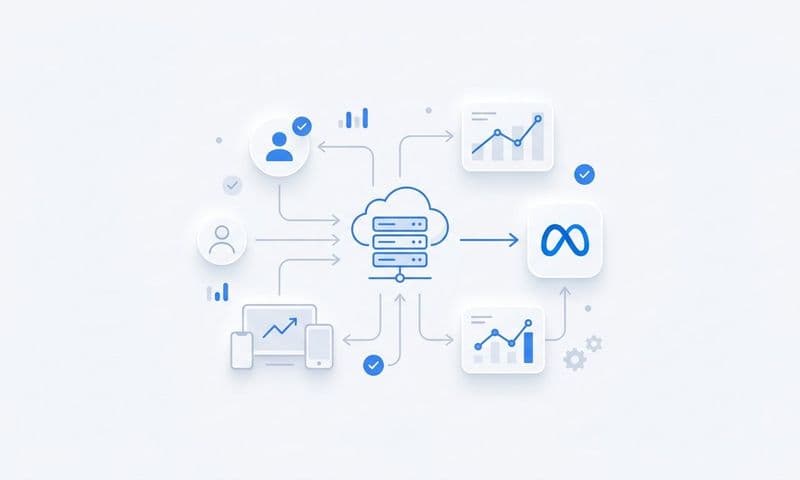
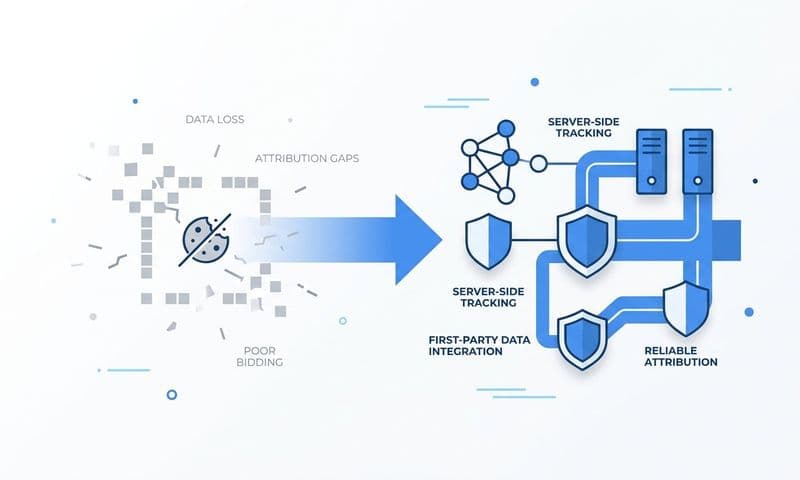
The most effective response to iOS tracking limitations is to move your conversion tracking infrastructure off the browser and device, and onto your own server. This is what server-side tracking and Conversion APIs accomplish, and it has become the standard approach for serious performance marketers.
Here is the core logic. Browser-based pixels work by firing a tracking script from the user's browser when a conversion event occurs. That script is subject to browser privacy settings, ad blockers, and critically, the device-level restrictions that iOS enforces. When any of those barriers are present, the pixel either does not fire or fires without the identifiers needed to connect the event back to an ad impression.
Server-side tracking bypasses this entirely. Instead of relying on a script in the browser to report a conversion, your own server sends the conversion event data directly to the ad platform's API. The data originates from your infrastructure, not the user's device. It is not subject to ATT restrictions because it is not coming from a third-party tracker on the device. It is your own first-party data being transmitted through a direct server-to-server connection.
Meta's Conversions API, commonly called CAPI, is the most widely adopted implementation of this approach for paid social. Google's Enhanced Conversions serves a similar function for Google Ads. Both allow advertisers to send conversion events from their servers, including customer data like hashed email addresses, that can be matched back to ad interactions even when browser-based tracking fails. Understanding the full benefits of server-side tracking is essential before building out your implementation.
The matching process is important to understand. When a user clicks an ad and provides their email address during a signup or purchase, that email can be hashed and sent to the ad platform alongside the conversion event. The platform matches that hashed email against its own user records to attribute the conversion to the correct ad campaign. This matching process works even when the user is on iOS and has opted out of IDFA tracking, because it relies on a first-party identifier you collected directly rather than a device identifier Apple controls.
Event deduplication is a critical technical consideration when running both pixel tracking and server-side tracking simultaneously. Because you are sending conversion data through two channels, there is a risk that the same conversion gets counted twice in your ad platform reporting. Both Meta CAPI and Google Enhanced Conversions have deduplication mechanisms that use event IDs to identify and remove duplicate events. Setting this up correctly is essential. Without proper deduplication, your reported conversion numbers will be inflated, which creates its own set of misleading signals for optimization.
Running pixel and server-side tracking in parallel is actually the recommended approach. The pixel captures what it can from browsers where tracking is permitted. The server-side layer captures events that the pixel misses. Together, they provide more complete coverage than either approach alone, and the deduplication layer ensures you are not double-counting.
Building an iOS-Resilient Attribution Stack for B2B SaaS
Implementing server-side tracking is an important step, but it is one component of a larger attribution infrastructure. For B2B SaaS companies with complex, multi-touch buying journeys, the goal is to build a complete attribution stack that connects ad spend to pipeline and closed revenue, regardless of what any single tracking mechanism can or cannot observe.
The foundation of this stack is first-party data collection. Every interaction a prospect has with your website, your product, and your sales process should be captured in a system you control. This means properly instrumenting your website for event tracking, integrating your CRM so that lead and opportunity data flows into your attribution system, and capturing form submissions, trial signups, and demo requests as structured conversion events rather than relying on ad platform pixels alone.
CRM integration is particularly important for B2B SaaS attribution. The conversion events that matter most, qualified leads, opportunities created, and closed-won deals, happen in your CRM, not in your ad platform. If your attribution system cannot connect ad interactions to CRM outcomes, you are measuring the wrong thing. You might be optimizing toward form fills when the campaigns that are actually driving revenue are generating a different type of lead that converts further down the funnel. Building a proper attribution tracking setup ensures these CRM signals flow correctly into your measurement system.
Server-side event sending connects your first-party data collection to the ad platforms that need conversion signals to optimize delivery. When you send enriched, first-party conversion events back to Meta, Google, and other platforms, you are not just recovering lost signal. You are sending higher-quality signal than the pixel alone ever provided, because you can include first-party identifiers and CRM-enriched data that the browser pixel never had access to.
The final layer is an independent attribution platform that sits above all of these data sources and provides a unified view of campaign performance. Relying solely on native ad platform reporting is no longer sufficient for several reasons. Each platform reports conversions using its own attribution logic, its own conversion windows, and its own data. When you look at Meta reporting and Google reporting side by side, the numbers often do not reconcile because both platforms are claiming credit for the same conversions.
An independent attribution layer gives you a source of truth that is not distorted by platform self-reporting bias or iOS data loss. It ingests signals from your ad platforms, your CRM, your website, and your server-side event stream, and reconstructs the customer journey using all available data. The best marketing attribution platforms are specifically designed to unify these fragmented data sources into a single, reliable performance view.
This is exactly the problem Cometly is built to solve. Cometly connects your ad platforms, CRM events, and server-side signals to give B2B SaaS marketing teams a complete view of which campaigns are driving pipeline and revenue. Rather than relying on fragmented platform reports, you get a single, accurate picture of performance that accounts for the full customer journey, even when iOS limits what individual platforms can observe on their own.
Turning iOS Limitations Into a Competitive Advantage
Here is a perspective shift worth considering. iOS tracking limitations are not just a problem to manage. For advertisers who respond correctly, they are an opportunity to pull ahead of competitors who are still operating on degraded data.
Most advertisers have not fully implemented server-side tracking and Conversion API integrations. Many are still relying primarily on browser pixels, accepting the signal loss, and making budget decisions based on incomplete attribution. Their ad platform optimization algorithms are running on thin, noisy data. Their reported ROAS figures are distorted. Their scaling decisions are less reliable than they could be.
Advertisers who invest in first-party data infrastructure and server-side tracking send richer, more complete conversion signals back to ad platforms. Those platforms use conversion signals to train their machine learning models for audience targeting and delivery optimization. When your signals are more complete and more accurate than your competitors', your campaigns benefit from better algorithmic optimization over time. The quality gap in signal data compounds into a performance gap in campaign results.
There is also a strategic advantage in having an attribution system that you trust. When your numbers are accurate, you make better decisions faster. You can identify which campaigns are actually driving pipeline, scale them with confidence, and cut spend on channels that are not contributing, without second-guessing whether your data is telling you the truth. Improving ad tracking accuracy is one of the highest-leverage investments a performance marketing team can make.
The strategic mindset shift is this: stop trying to recover what iOS removed and instead build an attribution foundation that does not depend on third-party device identifiers in the first place. First-party data, server-side tracking, and CRM-connected attribution are not workarounds. They are simply better infrastructure. The advertisers who build this foundation now are not just adapting to iOS restrictions. They are building a more durable, more accurate measurement capability that will serve them well regardless of what privacy changes come next.
The Bottom Line on iOS Attribution
iOS tracking limitations for advertisers are not going away. Apple has shown consistent commitment to expanding its privacy framework with each new iOS release, and the broader industry trend toward privacy-first data practices reinforces that direction. Waiting for the environment to revert to how it worked before iOS 14.5 is not a strategy. It is a way to fall further behind.
The path forward is clear. Build first-party data collection that does not depend on third-party device identifiers. Implement server-side tracking and Conversion API integrations to recover signal quality and feed ad platform algorithms with accurate conversion data. Connect your CRM to your attribution system so you are measuring pipeline and revenue, not just surface-level events. And use an independent attribution platform to get a source of truth that is not distorted by platform self-reporting or iOS data loss.
Each of these steps individually improves your measurement accuracy. Together, they create an attribution infrastructure that is resilient to iOS restrictions and any future privacy changes that follow the same direction.
B2B SaaS marketing teams have more to gain from getting this right than almost any other category of advertiser. Longer sales cycles, higher deal values, and multi-touch buying journeys make accurate attribution both harder and more valuable. Every decision you make about where to invest your ad budget should be grounded in data you can trust.
Cometly is built specifically for this challenge. It connects your ad platforms, CRM, and server-side event data to give you a complete, accurate view of which campaigns are driving revenue, so you can scale what works and stop wasting budget on what does not. Get your free demo today and start building the attribution foundation your B2B SaaS growth strategy deserves.