
If you ran paid ads in the months after Apple rolled out iOS 14.5, you probably remember the feeling. ROAS numbers that used to make sense suddenly looked wrong. Campaigns that had been reliable started underperforming on paper, but your sales team wasn't reporting a slowdown. Something was off, and the culprit wasn't your creative or your targeting. It was the data pipeline itself.
Apple's App Tracking Transparency framework didn't just tweak how ad measurement worked. It severed the connection between ad clicks and downstream conversions for a large portion of iOS users. And because ad platforms depend on that signal to optimize campaigns, the ripple effects hit budgets, bidding strategies, and executive confidence in marketing data all at once.
This is not a problem that resolved itself. Subsequent iOS releases have continued tightening privacy enforcement, which means the gap between what ad platforms report and what's actually happening in your pipeline has grown wider over time. Understanding why this happens, what it means for your attribution, and how modern tracking infrastructure closes the gap is now a core competency for any growth-focused marketing team. That's exactly what this article covers.
Why iOS Updates Cut Off Your Conversion Data
Before iOS 14.5, ad platforms had a reliable mechanism for connecting ad impressions and clicks to real-world conversions: the IDFA, or Identifier for Advertisers. Think of it like a fingerprint that Apple assigned to each device. Meta, Google, and other platforms could read that fingerprint, match it across apps and websites, and confidently say, "This person saw your ad, clicked it, and then completed a purchase three days later."
Apple's App Tracking Transparency framework, introduced in April 2021, made that fingerprint off-limits by default. Under ATT, apps must explicitly ask users for permission to track their activity across other apps and websites. The prompt is blunt and clear, and the majority of users, when given the choice, decline. When a user opts out, the IDFA is replaced with a string of zeros. It's essentially a blank identifier that tells ad platforms nothing.
The practical result is that for a large portion of your iOS audience, ad platforms can no longer connect the dots between an ad click and a conversion event. The click happens. The conversion happens. But the thread linking them is gone.
What makes this particularly challenging is the progressive nature of Apple's privacy enforcement. iOS 14.5 introduced the ATT prompt, but subsequent updates have continued closing gaps. iOS 15 brought Mail Privacy Protection, which disrupted email open-rate tracking and affected retargeting audiences built from email engagement. Later releases tightened enforcement around ATT policies further, reducing the workarounds that some ad platforms had leaned on in the interim.
Each update compounds the problem. Marketers who adapted after iOS 14.5 and thought they had reached a stable baseline found themselves adjusting again after each subsequent release. The direction of travel is clear: Apple is systematically reducing the amount of cross-app, cross-site behavioral data that can flow from iOS devices to third-party advertising systems. Understanding how iOS 14 changed digital advertising permanently is essential context for any marketer still navigating these restrictions.
This is not a technical glitch waiting to be patched. It is a deliberate architectural decision by Apple, and it reflects a broader industry shift toward user-controlled data privacy. The browser pixels and device-level identifiers that ad measurement was built on for the better part of a decade were never designed for a privacy-first environment. iOS updates simply made that fragility visible.
For B2B SaaS teams running campaigns on Meta, Google, or LinkedIn, the consequence is a growing blind spot in the middle and bottom of the funnel, precisely where high-value actions like demo requests, trial signups, and qualified lead submissions occur. Those are the conversions that matter most, and they're the ones most likely to be missed when iOS tracking restrictions apply. The full scope of pixel tracking problems on iOS explains exactly why these signals disappear and what it costs your campaigns.
How the Data Gap Distorts Your Attribution and Ad Decisions
Here's where losing conversion data ios updates becomes more than a measurement inconvenience. When ad platforms receive fewer conversion signals, their algorithms don't know what's actually working. And algorithms that operate on incomplete data make predictably bad decisions.
Automated bidding strategies on Meta and Google are built to optimize toward conversions. When a campaign generates real conversions that the platform can't see, the algorithm interprets that campaign as underperforming. It pulls budget away. Meanwhile, a campaign that happens to convert users who opted into ATT looks stronger than it is, so it receives more spend. The result is a systematic misallocation of budget driven entirely by data gaps, not actual performance differences.
Last-click and pixel-based attribution models are the most vulnerable to this dynamic. These models rely on reading device identifiers and cookies at the moment of conversion. When those identifiers are unavailable because a user declined ATT, the attribution chain breaks. The click is recorded, but the conversion is never matched back to it. Your platform reports a click with no outcome, and your cost-per-click metrics look fine while your cost-per-conversion looks inflated.
Multi-touch attribution across channels becomes equally unreliable. If a prospect clicks a Meta ad on their iPhone, later engages with a Google Search ad on their laptop, and then converts through a direct visit, a pixel-dependent attribution model may only capture the final touch. The iOS click that initiated the journey is invisible. You end up with a distorted picture of which channels deserve credit for driving pipeline. Exploring multi-touch attribution models in depth reveals how to assign credit more accurately when device-level signals are missing.
The downstream effects on B2B SaaS marketing teams are significant and compounding. Pipeline reports look weaker than reality because attributed conversions are undercounted. Cost-per-lead figures appear inflated because the denominator of actual leads is larger than what's being reported. When leadership reviews these numbers, confidence in marketing data as a reliable input for growth decisions erodes.
This creates a second-order problem that's just as damaging as the first. Teams start making decisions based on incomplete data, and because they know the data is incomplete, they lose trust in the reporting entirely. Some revert to gut-feel decisions. Others over-invest in channels that happen to be more trackable, not necessarily more effective. Neither outcome serves the business.
The core issue is that pixel-based attribution was always a proxy for actual customer behavior. iOS updates didn't create a new problem so much as they exposed how much of the old model depended on signals that users never explicitly consented to share. The teams that recognize this shift and rebuild their measurement infrastructure accordingly will make better decisions than those still trying to interpret incomplete pixel data as if it were complete. Learning how to fix attribution discrepancies is a practical starting point for closing that gap.
Server-Side Tracking and Conversion APIs: The Infrastructure Fix
The most direct technical response to iOS-driven data loss is server-side tracking. Understanding why it works requires understanding why browser pixels fail in the first place.
A browser pixel, like the Meta Pixel or Google Tag, runs as JavaScript code in the user's browser. When a conversion event occurs, the pixel fires and sends data back to the ad platform. That data includes device identifiers, cookies, and behavioral signals that the platform uses to match the event to a specific user and their ad interactions. On iOS devices where ATT consent has not been granted, those identifiers are either blocked or unavailable. The pixel fires, but the data it sends is too thin to be useful for attribution.
Server-side tracking moves the conversion measurement logic off the device entirely. Instead of relying on the browser to send conversion data, your own server captures the event and sends it directly to the ad platform's API. Because the data originates from your server rather than from the iOS device, Apple's ATT restrictions do not apply. The conversion signal travels from your system to the ad platform without ever touching the device's restricted tracking layer.
Meta's Conversions API, commonly called CAPI, is the primary mechanism for this on the Meta side. When a lead submits a form, books a demo, or completes a trial signup, your server sends that event directly to Meta's API along with any first-party identifiers you have, such as hashed email addresses or phone numbers. Meta uses those identifiers to match the event to a user in its system, recovering attribution that the pixel alone would have missed. A detailed Conversion API implementation tutorial walks through exactly how to set this up and recover lost attribution data.
Google's Enhanced Conversions works on a similar principle for Google Ads. Hashed first-party data collected at the point of conversion is sent to Google's servers, where it's used to improve match rates and recover conversions that standard tag-based tracking couldn't capture.
One critical technical detail: if you're running both a browser pixel and a server-side API simultaneously, you must implement event deduplication. Without it, the same conversion is reported twice: once by the pixel and once by the server. This inflates your reported conversion numbers, which distorts your bidding algorithms and makes your campaigns look more efficient than they are. Proper deduplication uses a consistent event ID to tell the ad platform that two incoming signals represent the same conversion, so only one is counted.
Getting server-side tracking right requires more technical investment than dropping a pixel on a page. But the payoff is substantial. You recover a meaningful portion of the conversion signal that iOS restrictions removed, and you feed ad platform algorithms cleaner, more complete data. Better data means better optimization decisions, which translates directly to more efficient ad spend. Following best practices for tracking conversions accurately ensures your implementation holds up as privacy policies continue to evolve.
First-Party Data Enrichment: Building a Signal That iOS Cannot Touch
Server-side tracking solves the transmission problem. First-party data enrichment solves the quality problem. These two approaches work best together.
First-party data is information collected directly from your own users through your website, product, and CRM. Because it's collected by you with user consent and doesn't involve cross-app or cross-site tracking by a third party, it is entirely outside the scope of ATT restrictions. Apple's privacy framework targets third-party tracking. Your own data is yours.
The enrichment piece is about adding context to conversion events before you send them to ad platforms. A raw conversion signal might tell Meta that a form was submitted. An enriched conversion signal tells Meta that a form was submitted by a user whose email matches a known contact, who is in the mid-market segment, who came from a specific campaign, and who has already been qualified as a sales-accepted lead in your CRM. That additional context dramatically improves the platform's ability to match the event to the right user and optimize toward the right audience. Building a robust first-party data strategy is the foundation that makes this level of enrichment possible.
For B2B SaaS companies, this is where the real leverage exists. The customer journey from first ad click to closed revenue is long and multi-touch. Standard pixel tracking, even when it works perfectly, only captures surface-level events. It can tell you that someone visited your pricing page, but it can't tell you that they became a qualified opportunity or that the deal closed at a specific contract value.
When you connect CRM events back to ad platform signals, you create a feedback loop that transforms how your campaigns optimize. Instead of training Meta's algorithm to find people who submit forms, you can train it to find people who submit forms and convert to paying customers. Instead of optimizing Google campaigns toward trial signups, you can optimize toward trial signups that result in expansion revenue. This is a fundamentally different level of signal quality, and it's only possible through first-party data enrichment.
The practical steps involve integrating your CRM with your server-side event pipeline so that downstream events like "demo booked," "trial started," "opportunity created," and "deal closed" are automatically sent back to ad platforms as conversion signals. Each of these events carries more predictive value than a top-of-funnel form submission, and none of them are subject to iOS tracking restrictions because they originate from your own systems. First-party data activation turns these CRM-connected signals into a continuous optimization engine for your ad platforms.
This approach also future-proofs your measurement infrastructure. As privacy regulations and platform policies continue evolving, the businesses with rich first-party data pipelines will be the ones that can adapt quickly. You're not dependent on any third-party tracking mechanism that could be restricted or deprecated.
Choosing the Right Attribution Model in a Privacy-First World
Even with server-side tracking and first-party data enrichment in place, you still need to decide how to assign credit across the customer journey. The attribution model you choose has a significant impact on how you interpret results and where you allocate budget.
Single-touch models, specifically first-touch and last-click, were already imperfect before iOS changes. In a post-ATT environment, they become actively misleading. First-touch attribution depends on correctly identifying the very first interaction a user had with your brand, which is increasingly difficult when iOS blocks the device-level signals that would have captured that touch. Last-click attribution over-credits the final interaction before conversion and ignores everything that came before it, which means channels that do the heavy lifting in the middle of the funnel appear undervalued.
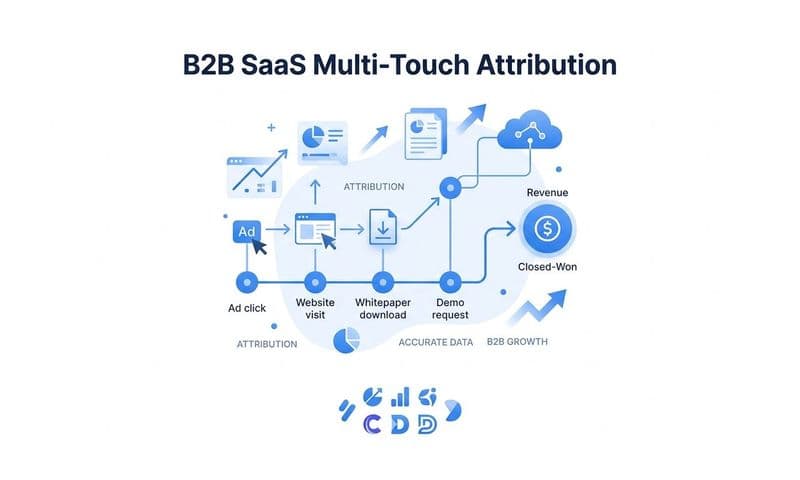
Multi-touch attribution models distribute credit across multiple interactions throughout the customer journey. When those interactions are captured via server-side events, UTM parameters, and CRM data rather than device-level identifiers, they remain relatively intact even when iOS tracking is incomplete. A prospect who clicks a Meta ad on their iPhone, later engages with a LinkedIn post, and then converts through a Google Search ad can still be attributed across all three touches if your tracking infrastructure captures each event at the session or user level rather than the device level.
UTM parameters deserve specific mention here because they are one of the most iOS-agnostic tracking mechanisms available. When someone clicks an ad, UTM parameters appended to the destination URL are captured in your analytics system as part of the session data. They don't rely on device identifiers or cookies in the same way that pixels do. They're not a complete attribution solution on their own, but they provide a reliable session-level signal that survives iOS restrictions and can be combined with other data sources to build a more complete picture. Understanding how iOS 17 link tracking protection affects URL parameters helps you prepare your UTM strategy for continued privacy tightening.
Data-driven attribution models that use probabilistic matching and aggregated signals have become more relevant in the post-ATT environment. These models use statistical inference to estimate attribution when deterministic signals are unavailable. Rather than requiring a direct device-level match between an ad click and a conversion, they analyze patterns across aggregated data to assign credit. They're not perfect, but they degrade more gracefully than rule-based models when some signals are missing. Data-driven attribution approaches are specifically designed to handle the partial-signal environment that iOS restrictions create.
The key principle for choosing an attribution model today is resilience under partial data. A model that produces reasonable, actionable results with 70% of the signal is more valuable than a theoretically perfect model that produces garbage results when 30% of the signal is missing. Evaluate your attribution approach not just on how it performs in ideal conditions, but on how it behaves when iOS restrictions remove a portion of your conversion data.
Rebuilding Reliable Conversion Tracking With a Modern Attribution Stack
Solving the problem of losing conversion data from iOS updates is not about restoring what existed before April 2021. The old pixel-dependent model was always more fragile than it appeared. The goal is to build something better: an attribution stack that is accurate, privacy-compliant, and connected from first ad click to closed-won revenue.
A modern attribution stack has several interconnected components. Server-side event tracking captures conversion signals at the source and sends them to ad platform APIs without depending on device-level identifiers. First-party data collection through your website, product, and CRM creates a rich signal layer that iOS restrictions cannot touch. CRM integration connects downstream revenue events back to the campaigns and channels that initiated them. And a unified reporting layer brings all of this data together into a single source of truth that marketing, sales, and leadership can trust.
This architecture is designed to work within Apple's privacy framework rather than around it. There's no reliance on workarounds or loopholes that could be closed by the next iOS update. The data flows are based on first-party relationships and server-to-server communication, both of which are durable regardless of what changes Apple makes to device-level tracking.
For B2B SaaS teams specifically, the most valuable capability this stack enables is connecting ad spend to pipeline and revenue. When your attribution platform can see that a specific Google Search campaign generated leads that converted to opportunities at a certain rate, and that those opportunities closed at a specific average contract value, you can calculate true return on ad spend with confidence. That number is not distorted by iOS tracking gaps because it's built on CRM data and server-side events, not pixel-reported conversions.
Cometly is built for exactly this use case. It connects ad spend data from Meta, Google, and other channels to CRM and revenue data, giving B2B SaaS teams a complete view of which campaigns drive pipeline and closed revenue. By integrating with your ad platforms through server-side APIs and connecting to your CRM for downstream revenue signals, Cometly creates the kind of attribution picture that pixel-based tracking could never provide, even before iOS changes made that tracking unreliable.
The platform also sends enriched conversion data back to ad platforms, which improves the quality of the signal those algorithms use to optimize campaigns. When Meta and Google receive better data about which conversions actually matter, their bidding algorithms make smarter decisions. You get more efficient spend, better audience targeting, and clearer visibility into what's actually driving growth.
The Bottom Line on iOS Data Loss and What to Do About It
iOS updates didn't just reduce the volume of conversion data marketers receive. They exposed how much of the old measurement model depended on tracking mechanisms that users never explicitly agreed to. The fragility was always there. Apple's privacy framework just made it impossible to ignore.
The teams that respond by building server-side infrastructure, first-party data pipelines, and CRM-connected attribution will have a durable advantage. They'll make budget decisions based on accurate data. Their ad platform algorithms will optimize toward conversions that actually matter. And their leadership teams will have marketing reports they can trust.
The teams that don't respond will continue making decisions based on incomplete pixel data, misallocating budget toward campaigns that look good in a broken reporting environment, and losing confidence in marketing as a growth lever.
The path forward is clear, and it starts with the right attribution infrastructure. Get your free demo today and see how Cometly captures every touchpoint across your customer journey, sends enriched conversion data back to your ad platforms, and gives your team the accurate, complete attribution picture it needs to make confident, data-driven decisions regardless of iOS restrictions.