If your ad spend keeps climbing but your conversion numbers stay flat, you likely have a tracking gap rather than a performance problem. Lost conversions not tracking is one of the most common and costly issues facing B2B SaaS marketing teams today, and it is often invisible until the damage is already done.
When conversions go unrecorded, your attribution data becomes unreliable. Your ad platforms optimize against incomplete signals. Your team makes budget decisions based on a distorted picture of reality. The result is wasted spend, missed revenue opportunities, and a growing disconnect between marketing effort and business outcomes.
Here is what makes this problem especially frustrating: your campaigns might actually be working. Leads could be coming in, trials could be converting, and deals could be closing. But if your tracking infrastructure is broken, none of that activity gets attributed correctly. You end up cutting budgets on channels that are genuinely driving revenue, simply because the data does not show it.
This guide walks you through a systematic process for diagnosing why your conversions are not tracking, identifying where the data is breaking down, and implementing fixes that restore accuracy across your entire funnel. Whether the issue stems from a misconfigured pixel, browser-side data loss, a broken server event, or a gap in your CRM integration, each step below gives you a concrete action to take.
By the end, you will have a reliable framework for auditing your tracking setup, validating conversion data, and building a more resilient measurement infrastructure using first-party data and server-side tracking. This is not about chasing vanity metrics. It is about making sure every lead, trial signup, and closed deal gets attributed to the right source so your team can scale what works.
Step 1: Audit Your Current Conversion Events and Expected Data Flow
Before you can fix a tracking gap, you need to know exactly what you are supposed to be tracking. Most teams discover they have never fully documented this, which is often the root cause of the problem in the first place.
Start by listing every conversion event you expect to track. For a typical B2B SaaS funnel, this includes form submissions, trial signups, demo requests, free-to-paid upgrades, and CRM stage changes such as lead-to-opportunity and opportunity-to-closed-won. Do not stop at your primary conversion event. Secondary micro-conversions like content downloads, pricing page visits, and webinar registrations also feed your attribution models and deserve their own audit.
For each event, map the full data flow by answering three questions:
Where does it originate? Is this event triggered on your website, inside your application, or within your CRM? Each origin point has different tracking requirements and different failure modes.
How is it captured? Is the event fired by a browser-side pixel, a server-side API call, a tag manager trigger, or a CRM workflow? Understanding the capture method tells you where to look when data goes missing.
Where should it appear? Every event should have a defined destination: your ad platform's event manager, your analytics dashboard, your attribution platform, or all three. If you cannot name the destination, the event is almost certainly not being tracked reliably.
Once your map is complete, compare expected event volume against reported event volume in each platform. Pull data for the same time period across your ad platforms, analytics tools, and CRM. If your form submission tool logged 200 submissions last month but your ad platform only recorded 80 conversion events, you have a gap of 120 conversions that need to be investigated.
Flag any conversion event that shows zero data, inconsistent data, or data that stopped recording after a specific date. A sudden drop in event volume on a specific date often points to a website code change, a tag manager update, or an API credential expiration that broke the integration. Understanding how to apply best practices for tracking conversions accurately from the start helps prevent these gaps from forming in the first place.
Common pitfall: Teams often audit only their primary conversion event and miss the secondary micro-conversions that feed multi-touch attribution models. If those micro-conversions are not tracking, your attribution model is working with a partial view of the customer journey.
Success indicator: You have a written map of every conversion event, its source, its capture method, and its current reporting status. This document becomes the foundation for every diagnostic step that follows.
Step 2: Diagnose Browser-Side Tracking Failures
Browser-side pixels were the backbone of digital marketing tracking for years. They still play a role, but they have become structurally less reliable, and understanding why is essential to diagnosing your lost conversions.
The core problem is that browser-side tracking depends on the user's browser executing your JavaScript correctly and without interference. Ad blockers prevent pixel scripts from loading entirely. iOS privacy changes limit the data that can be passed from mobile browsers. Cookie restrictions in Chrome, Firefox, and Safari reduce the window of time that tracking data can be stored and matched. Any one of these factors can silently drop conversions from your data.
To diagnose browser-side failures, open your browser's developer tools and navigate to the Network tab. Trigger the conversion event you want to test, such as submitting a form or clicking a signup button, and watch for the pixel request to fire. If you see the request go out with a 200 status code, the pixel fired successfully. If you see an error, a blocked request, or no request at all, you have found a failure point.
Check for duplicate pixel installations, which are more common than you might expect. When multiple team members add tracking scripts independently, or when a tag manager container has been modified without proper documentation, you can end up with the same pixel firing twice. This inflates some event counts while causing deduplication logic to cancel out others, creating data that looks plausible but is actually wrong. If you are running Meta campaigns, reviewing how Facebook pixel tracking data loss occurs can help you identify these failure patterns faster.
Pay close attention to dynamic pages, single-page applications, and multi-step forms. These are frequent failure points because standard page-view-based triggers do not fire on virtual page changes. If your trial signup flow is a multi-step form within a single-page application, a trigger set to fire on page load will never capture the completion event correctly.
Review your tag manager setup carefully. Check that triggers are firing under the right conditions, that variable values are populated correctly, and that no recent container publish has inadvertently paused or deleted an existing tag. Tag manager changes are a leading cause of sudden tracking drops, especially in teams where multiple people have publish access.
Tip: iOS privacy updates and browser restrictions have made browser-side-only tracking structurally unreliable for B2B SaaS funnels with longer consideration cycles. If your average sales cycle spans multiple sessions and devices, the probability that browser-side data captures the full journey is low. This is not a reason to abandon browser-side tracking, but it is a strong reason to pair it with server-side tracking as a redundant layer.
Success indicator: You can confirm in real time which events fire and which do not using developer tools or a tag diagnostics extension, and you have ruled out duplicate installations and trigger misconfigurations.
Step 3: Identify Server-Side and Conversion API Gaps
Server-side tracking exists specifically to address the limitations uncovered in Step 2. Instead of relying on the browser to fire a pixel, server-side tracking sends conversion data directly from your server or application to the ad platform. This means ad blockers cannot intercept it, cookie restrictions do not apply, and the data arrives with higher fidelity user information for matching purposes.
For Meta advertising, this means the Conversions API (CAPI). For Google Ads, this means Enhanced Conversions. Both allow you to send conversion events server-to-server, and both are considered standard infrastructure for any B2B SaaS team running paid campaigns at scale. If you do not have these active, you are almost certainly losing a meaningful portion of your conversion data. The benefits of server-side tracking go well beyond simply recovering lost events — they fundamentally improve the quality of signals your ad platforms receive.
Start by checking whether your CAPI integration for Meta is active and sending events. Navigate to your Meta Events Manager, select your pixel, and look at the event match quality score and the event volume for server events versus browser events. If you see browser events but no corresponding server events, your CAPI integration is either not configured or not firing correctly.
For Google Enhanced Conversions, check your Google Ads conversion tracking actions and confirm that enhanced conversion data is being sent alongside your standard conversion tags. Enhanced conversions use hashed first-party data such as email addresses to improve match rates, which is especially valuable for B2B SaaS where the conversion path often spans multiple devices and sessions.
Deduplication is where many server-side implementations break down, and it is worth spending extra time here. When both a browser pixel and a server event fire for the same conversion, the ad platform needs a way to recognize that these represent a single event rather than two separate conversions. This is handled through a shared event ID that must be identical between the browser event and the server event.
If the event ID is missing from either the browser or server event, or if the IDs do not match, the platform cannot deduplicate correctly. The result is either double-counting, which inflates your conversion numbers, or dropped conversions, which is the more common outcome and directly contributes to lost conversions not tracking accurately.
Also verify that your server events include all required parameters: event time, event source URL, user data fields for matching such as hashed email and phone number, and any custom data fields tied to conversion value. Missing parameters reduce match rates and lower the quality of the signal you are sending back to the ad platform.
Tip: A missing or mismatched event ID between browser and server events is one of the most common causes of deduplication failure. Before assuming your server-side integration is working correctly, verify the event ID specifically rather than just confirming that events are being sent.
Success indicator: Your server events are confirmed active in your ad platform's event manager, show a healthy match rate for user data, and are properly deduplicated against your browser-side events.
Step 4: Trace the CRM and Pipeline Attribution Disconnect
Even if your browser and server-side tracking is working correctly, you can still have a significant attribution gap if your CRM is not connected to your marketing data. For B2B SaaS companies, this is often where the most valuable conversion data gets lost.
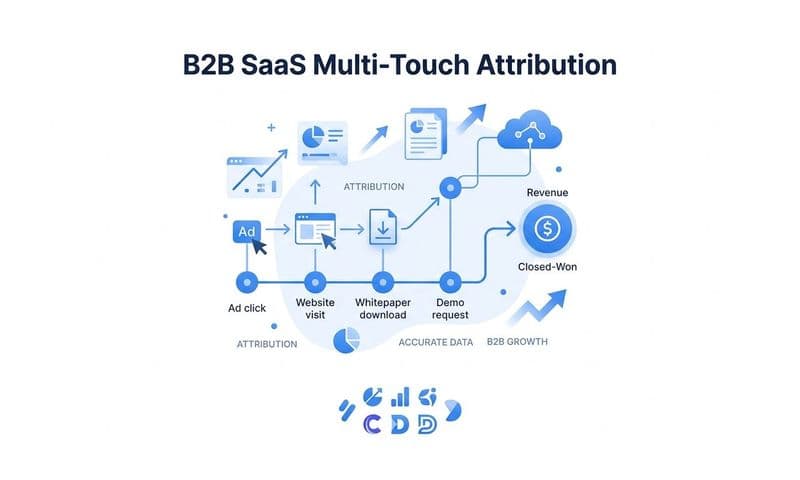
The typical scenario looks like this: a prospect clicks an ad, fills out a demo request form, and becomes a lead in your CRM. The form submission is tracked correctly. But three months later, when that lead becomes a closed-won deal worth significant revenue, there is no connection back to the original ad campaign that started the journey. Your team has no idea which campaign drove the revenue, and your ad platforms have no signal to optimize against.
Start by checking whether your CRM is capturing and storing UTM parameters when contacts are created. When a visitor arrives from a paid ad and submits a form, the UTM parameters in the URL should be captured by your tracking script and stored on the contact record in your CRM. If this is not happening, you lose the source attribution at the very first step.
Next, verify that UTM data is not being overwritten by subsequent touches. In many CRM configurations, every new form submission or page visit updates the lead source field, replacing the original first-touch data with the most recent interaction. This is a configuration choice, not a default behavior, but it is surprisingly common and it destroys first-touch attribution data.
Check whether your CRM integration with your attribution platform is syncing deal stage changes, closed-won events, and revenue data back to the correct campaign and channel. This sync needs to happen bidirectionally: marketing data flows into the CRM when leads are created, and CRM pipeline data flows back into your attribution platform as deals progress. Properly tracking closed won revenue back to its originating campaign is what separates teams that scale efficiently from those that waste budget on underperforming channels.
Offline conversion imports are the mechanism that closes this loop for ad platforms. When a deal closes in your CRM, that closed-won event should be imported back into Google Ads and Meta as an offline conversion so that the platforms can attribute the revenue to the original ad click and use it to improve bidding optimization.
Tip: If your sales cycle is longer than 30 days, standard ad platform attribution windows will miss most of your downstream conversions unless you use offline conversion imports or server-side revenue events. Google Ads and Meta both support attribution windows up to 90 days for click-based conversions, but you need to configure this explicitly rather than relying on the default settings.
Success indicator: A closed-won deal in your CRM can be traced back to its originating ad campaign, ad set, and creative in your attribution platform, with the revenue value attached to the correct source.
Step 5: Validate Data Accuracy With a Cross-Platform Comparison
At this point in the process, you have audited your event map, diagnosed browser-side failures, reviewed your server-side setup, and traced your CRM attribution chain. Now it is time to validate whether your fixes are actually working by comparing conversion data across multiple sources.
Pull conversion data from three sources for the same time period: your ad platform, your analytics tool, and your CRM or backend database. Use a 30-day window that is recent enough to reflect your current setup but long enough to have statistically meaningful volume.
Document the variance for each conversion event across all three sources. You are looking for patterns, not just individual discrepancies. If your analytics tool consistently shows higher conversion volume than your ad platform for every event, the issue is likely an attribution window or tracking method difference. If your CRM shows dramatically lower lead volume than your analytics tool, you may have form spam inflating your analytics numbers, or your CRM integration may be failing to create records for some submissions.
Use your CRM as the ground truth for lead and revenue volume. Unlike ad platforms, which estimate and model some conversions, your CRM records actual business outcomes: real people who filled out real forms and became real leads. If your ad platform is reporting significantly more conversions than your CRM has leads, investigate your attribution window settings, view-through attribution configurations, and whether self-attributing networks are over-counting their contribution. Reviewing how fixing conversion tracking gaps affects cross-platform data alignment will help you interpret these discrepancies more accurately.
If your ad platform numbers are significantly lower than your CRM records, the issue is under-reporting caused by the tracking gaps identified in the earlier steps. This is the direction that most B2B SaaS teams find themselves in, and it means your campaigns are performing better than your data suggests.
Some variance between data sources is expected and normal. Browser-side analytics will always differ slightly from server-side data due to timing differences and deduplication logic. The goal is not perfect alignment across all three sources. The goal is to ensure that discrepancies are small enough to be explainable by known attribution model differences rather than by missing data.
Success indicator: Conversion volumes across all three data sources are within an acceptable range, and any remaining discrepancies can be explained by known attribution model differences rather than unexplained data loss.
Step 6: Implement a Resilient First-Party Tracking Infrastructure
The steps above help you diagnose and fix existing tracking gaps. This step is about building an infrastructure that prevents those gaps from recurring. The foundation of that infrastructure is first-party data collected and transmitted through server-side integrations.
Moving away from sole reliance on third-party pixels is not optional for B2B SaaS teams that want accurate attribution. As browsers continue to restrict third-party cookies and users increasingly adopt privacy tools, browser-side-only tracking will capture a shrinking percentage of actual conversions. A cookieless tracking solution built on first-party data, collected directly from your application and users and sent through server-side channels, is structurally more reliable because it does not depend on browser behavior.
Implement server-side tracking for all critical conversion events so data flows directly from your application or CRM to your attribution platform. This means instrumenting your application backend to fire conversion events when key actions occur: a user completes a trial signup, a lead is created in your CRM, a deal stage changes, or a subscription is activated. These server-side events are not subject to ad blockers or browser restrictions because they never touch the browser at all.
Consolidate your data into a single attribution platform rather than trying to reconcile multiple disconnected tools. When your ad platform data, CRM data, and website event data live in separate systems, you spend more time manually reconciling numbers than acting on insights. A unified attribution platform gives you one source of truth where every touchpoint in the customer journey is visible in context.
Enrich your conversion events with as much data as possible. Pass user identifiers, lead scores, deal values, and funnel stage information alongside conversion events. This enriched data improves match rates when events are sent back to ad platforms, which in turn improves the quality of the optimization signals those platforms use for bidding and targeting. Better signals mean better ad performance, which means your budget works harder.
Set up automated alerts that notify your team when conversion event volume drops below expected thresholds. Tracking failures rarely announce themselves. They degrade silently until someone notices that conversion numbers look wrong, often weeks after the failure began. An automated alert that triggers when a key event drops by a significant percentage compared to the prior week catches problems early, before they compound into major data loss.
Platforms like Cometly are built for exactly this kind of end-to-end visibility. Cometly connects your ad spend, website events, and CRM data in real time, so you can see which campaigns are actually driving pipeline and revenue without manual reconciliation. Its server-side tracking capabilities and native integrations with ad platforms and CRMs give you the first-party data foundation that modern B2B SaaS attribution requires.
Success indicator: Your attribution platform shows a complete customer journey from first ad click through closed-won revenue, with no unexplained gaps in the data and enriched event information at every stage.
Step 7: Establish an Ongoing Tracking Health Monitoring Process
Fixing your tracking setup is not a one-time project. It is an ongoing operational responsibility. Ad platform APIs update and change their requirements. Website code changes break existing tags. New conversion events get added by product or engineering teams without notifying marketing. Without a regular monitoring process, tracking gaps will return.
Create a weekly tracking health checklist that your team runs every Monday before reviewing campaign performance. The checklist should include: confirming that event volumes for all key conversion events are within expected ranges, checking for new error flags or warnings in your ad platform's event manager, verifying that your CRM sync is active and up to date, and reviewing any recent website changes that might have affected tracking scripts. Using dedicated marketing campaign tracking software makes it significantly easier to automate these health checks and surface anomalies before they compound.
Assign clear ownership of tracking health to a specific person or team. This is the step that most organizations skip, and it is why tracking problems persist. When tracking is everyone's responsibility, it is effectively no one's responsibility. Designate a marketing operations lead or analytics owner who is accountable for the health of your conversion tracking and empowered to work with engineering when fixes are needed.
Maintain a shared tracking specification document that records every conversion event, its configuration details, the platforms it sends data to, and the date it was last verified. This document serves as the source of truth when diagnosing new issues and as an onboarding resource when new team members join.
Run a full tracking audit quarterly, or any time a major change occurs: a website redesign, a CRM migration, a new ad platform integration, or a significant change to your product's conversion flow. These are the moments when tracking setups are most likely to break, and a proactive audit immediately after the change catches problems before they affect your data for an extended period.
Success indicator: Your team has a documented monitoring process, a designated owner, a maintained tracking specification document, and a regular audit cadence that catches tracking failures before they compound into significant data loss.
Putting It All Together
Fixing lost conversions not tracking is not a single action. It is a systematic process of auditing your event map, diagnosing browser and server-side failures, closing CRM attribution gaps, validating data accuracy, and building a tracking infrastructure that holds up over time.
When your conversion data is accurate and complete, everything downstream improves. Your ad platforms optimize against real signals. Your attribution models reflect actual customer journeys. Your team makes budget decisions with confidence rather than guesswork. The difference between a team that scales efficiently and one that wastes budget on underperforming channels often comes down to the quality of their tracking data.
Start with the audit in Step 1 to understand where your gaps are, then work through each diagnostic step before implementing the infrastructure changes in Steps 6 and 7. Each step builds on the previous one, so skipping ahead tends to create more confusion rather than faster results.
Use this checklist to confirm you have covered the full process: conversion event map documented, browser-side pixel validation complete, server-side CAPI events active and deduplicated, CRM attribution sync verified, cross-platform data comparison completed, first-party tracking infrastructure in place, and ongoing monitoring process assigned and scheduled.
Platforms like Cometly are built to support exactly this kind of end-to-end visibility, connecting your ad spend, website events, and CRM data into a single source of truth so you can stop guessing and start scaling based on what is actually working. Ready to close the gap between your ad spend and your revenue data? Get your free demo today and start capturing every touchpoint to maximize your conversions.