Running campaigns across paid search, social, email, and display is one thing. Knowing exactly which of those channels moved a prospect from first click to closed deal is another challenge entirely. Most marketing teams are sitting on fragmented data spread across ad platforms, website analytics tools, and CRMs, making it genuinely difficult to connect top-of-funnel activity to bottom-of-funnel revenue.
That's where marketing funnel analytics tools come in. The right platform gives you a clear, connected view of every stage, from the first ad impression to the final conversion, so you can make smarter decisions about where to invest your budget.
To build this list, we evaluated tools based on their ability to track across funnel stages, depth of integrations, attribution modeling capabilities, ease of use for paid advertising teams, and overall value. Whether you're a lean growth team or a large marketing organization, there's a tool here built for your needs.
1. Cometly
Best for: Paid advertising teams that need accurate, full-funnel attribution tied to real revenue.
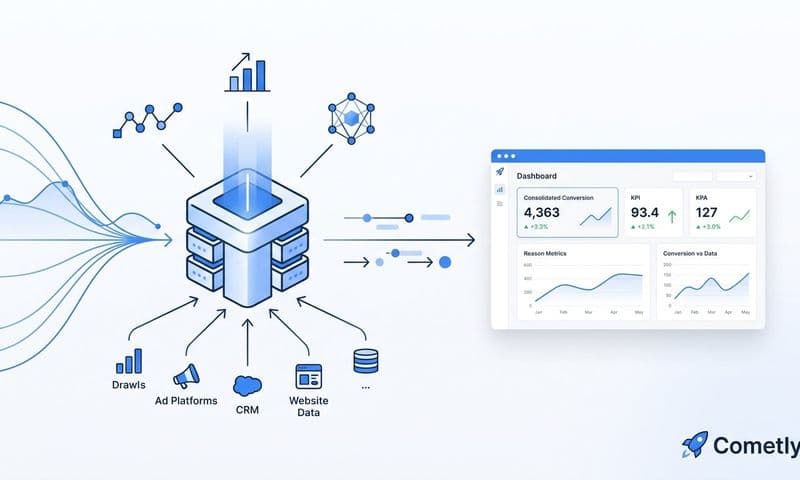
Cometly is an AI-powered marketing attribution platform that tracks the complete customer journey from ad click to closed revenue, with server-side tracking and conversion sync built in.
 9 Best Marketing Funnel Analytics Tools to Track Every Stage in 2026
Where This Tool Shines
Cometly is built specifically for the challenge that paid advertising teams face most: knowing which ads actually drive revenue, not just clicks or form fills. Its server-side tracking architecture addresses the data gaps created by iOS privacy changes and browser-based tracking limitations, giving you a more complete and accurate picture of what's working.
What separates Cometly from general analytics platforms is its conversion sync feature, which sends enriched first-party event data back to Meta, Google, and other ad platforms. This feeds better signals to ad platform algorithms, improving targeting and optimization over time. The result is a tighter feedback loop between your attribution data and your actual campaign performance.
Key Features
Multi-Touch Attribution: Tracks every touchpoint across all ad platforms and marketing channels so you can see the full path to conversion, not just the last click.
Server-Side Tracking: Captures conversion data that browser-based tracking misses, overcoming the accuracy issues caused by iOS updates and ad blockers.
AI-Powered Recommendations: Identifies top-performing ads and campaigns across every channel and surfaces actionable insights to help you scale what's working.
Conversion Sync: Sends enriched, conversion-ready event data back to Meta, Google, and other platforms to improve ad platform targeting and algorithm performance.
AI Chat for Data Analysis: Lets you ask natural language questions about your funnel data and get instant insights without needing to build manual reports.
Best For
Cometly is the right fit for digital marketers, growth teams, and agencies managing paid advertising across multiple platforms who need accurate attribution data tied to actual revenue. It's especially valuable for teams dealing with iOS tracking gaps or those looking to improve the quality of data they send back to ad platforms.
Pricing
Custom pricing based on ad spend and business needs. A demo is available on request directly through the Cometly website.
2. Google Analytics 4
Best for: Businesses that want free, flexible funnel tracking tightly integrated with Google Ads.
Google Analytics 4 is Google's event-based analytics platform with built-in funnel exploration reports, predictive metrics, and native Google Ads integration.
 11 Best Marketing Analytics Tools to Track and Optimize Campaign Performance in 2026
Where This Tool Shines
GA4's event-based data model gives marketers far more flexibility than its predecessor. You can build funnel reports around almost any combination of user actions, whether that's page views, button clicks, form submissions, or purchases, without being locked into a rigid session-based structure.
The native integration with Google Ads is a genuine strength. Campaign-level funnel data flows directly into GA4, making it easy to see which keywords, audiences, and ad groups are driving users through each stage of the funnel. For teams heavily invested in Google's ecosystem, this connectivity is hard to beat.
Key Features
Event-Based Data Model: Tracks virtually any user interaction as an event, enabling highly flexible funnel configuration.
Funnel Exploration Reports: Supports both open and closed funnel analysis with visual breakdowns of conversion and drop-off at each step.
Predictive Audiences: Machine learning models surface users likely to convert or churn, enabling smarter remarketing and audience segmentation.
Google Ads Integration: Connects campaign performance directly to funnel stages for campaign-level attribution analysis.
Free Tier: Provides generous data limits that cover the needs of most small to mid-sized businesses at no cost.
Best For
GA4 is ideal for businesses of all sizes running Google Ads campaigns who want a free, capable analytics foundation. It works especially well for teams already using other Google products like Search Console, Looker Studio, or BigQuery.
Pricing
Free for most users. GA4 360, the enterprise version, starts at approximately $50,000 per year and includes higher data limits, SLA guarantees, and advanced features.
3. HubSpot Marketing Hub
Best for: Inbound marketing teams that want funnel analytics tied directly to CRM contacts and revenue.
HubSpot Marketing Hub is an all-in-one inbound marketing platform with built-in analytics that connects marketing funnel data directly to the sales pipeline.
 9 Best Attribution Software for B2B SaaS in 2026
Where This Tool Shines
HubSpot's biggest advantage is that marketing and sales data live in the same system. When a lead moves through your funnel, you can trace their journey from the first marketing touch all the way through to a closed deal without exporting data or stitching together separate platforms. This makes it particularly powerful for B2B teams where the sales cycle spans weeks or months.
The lifecycle stage tracking feature lets you see how contacts move between stages like subscriber, lead, marketing qualified lead, and customer over time. Combined with campaign analytics, you get a clear picture of which marketing activities are actually moving people forward in the funnel.
Key Features
CRM Integration: Connects marketing funnel data directly to sales pipeline stages and revenue, providing true closed-loop reporting.
Multi-Touch Revenue Attribution: Available on the Enterprise tier, this feature assigns revenue credit across multiple marketing touchpoints in the customer journey.
Lifecycle Stage Tracking: Monitors how contacts progress through each defined funnel stage over time.
Custom Funnel Reports: Build tailored dashboards that reflect your specific funnel structure and business metrics.
Unified Campaign Analytics: Tracks performance across email, ads, landing pages, and social from a single dashboard.
Best For
HubSpot Marketing Hub is best suited for B2B companies and inbound marketing teams that want their funnel analytics and CRM data in one place. It's especially valuable for organizations where marketing and sales alignment is a priority.
Pricing
Free tier available. Starter plans from $20/month. Professional from $890/month. Enterprise from $3,600/month, which includes advanced attribution reporting.
4. Mixpanel
Best for: Product and growth teams that need deep funnel visualization and cohort-level conversion analysis.
Mixpanel is a product analytics platform built around user behavior tracking, with powerful funnel reports, cohort analysis, and conversion breakdowns at its core.
 9 Best Marketing Funnel Analytics Tools to Track Every Stage in 2026
Where This Tool Shines
Mixpanel's funnel analysis goes deeper than most tools. You can break down conversion and drop-off by any property, compare how different user segments move through the funnel, and identify exactly where and why users are abandoning. The drag-and-drop funnel builder makes it easy to explore hypotheses without needing an analyst to pull reports.
Real-time data is another meaningful advantage. You can see how a product change or campaign launch is affecting funnel conversion within minutes, which is valuable for fast-moving growth teams running continuous experiments.
Key Features
Advanced Funnel Analysis: Visualizes conversion and drop-off at every funnel step with breakdowns by user properties and segments.
Cohort Segmentation: Compares funnel performance across different user groups to identify what drives higher conversion rates.
Real-Time Data: Reflects user activity almost immediately, enabling fast iteration on campaigns and product changes.
Interactive Report Builder: Drag-and-drop interface for building custom funnel reports without SQL or engineering support.
Data Warehouse Integrations: Connects with Snowflake, BigQuery, and major CDPs for teams with more complex data infrastructure.
Best For
Mixpanel is a strong fit for product teams, growth marketers, and SaaS companies that need granular visibility into how users move through digital products and conversion flows. It's particularly well-suited for teams that run frequent experiments.
Pricing
Free tier supports up to 20 million events per month. Growth plans start from $28/month. Enterprise pricing is available on request.
5. Amplitude
Best for: Teams that want to map full user journeys, run A/B tests, and apply predictive analytics to funnel optimization.
Amplitude is a behavioral analytics platform that combines funnel analysis, journey mapping, experimentation, and predictive insights in a single platform.
 9 Best Marketing Funnel Analytics Tools to Track Every Stage in 2026
Where This Tool Shines
Amplitude's Journeys feature stands out by showing you not just where users drop off in a defined funnel, but all the different paths users take before and after key conversion points. This exploratory approach often surfaces unexpected patterns that a rigid funnel report would miss entirely.
The built-in experimentation capabilities mean you can run A/B tests and see the impact on funnel conversion directly within the same platform, without needing a separate testing tool. For teams that want to tie behavioral data, experimentation, and predictive modeling together, Amplitude provides a cohesive environment to do all three.
Key Features
Journeys Feature: Visualizes the actual paths users take through the funnel, including unexpected routes and drop-off patterns.
Behavioral Cohort Analysis: Groups users by specific behaviors to understand what actions correlate with higher conversion rates.
Built-In Experimentation: Runs A/B tests and measures their impact on funnel metrics without leaving the platform.
Predictive Analytics: Identifies users who are likely to convert or churn based on behavioral signals.
Warehouse-Native Architecture: Works directly with your existing data warehouse so teams with mature data infrastructure can use their own data models.
Best For
Amplitude is ideal for product-led growth companies, SaaS teams, and data-mature organizations that want to combine funnel analysis, experimentation, and predictive insights in one platform.
Pricing
Free Starter plan available with core features. Growth and Enterprise plans are priced on request based on data volume and team needs.
6. Funnel.io
Best for: Marketing teams that need to unify data from dozens of ad platforms and tools before building funnel reports.
Funnel.io is a marketing data hub that connects more than 500 data sources to centralize ad spend, impressions, clicks, and conversions into a single, clean dataset for reporting.
 9 Best Marketing Funnel Analytics Tools to Track Every Stage in 2026
Where This Tool Shines
Funnel.io solves the data aggregation problem that sits upstream of most funnel reporting challenges. Before you can analyze your funnel, you need all your data in one place, and Funnel.io does that job extremely well. It connects to virtually every ad platform, CRM, and analytics tool, then normalizes the data so you can compare performance across channels without manual reconciliation.
The automated data transformation capabilities are a significant time saver for teams managing campaigns across many platforms. Rather than exporting CSVs and building complex spreadsheet models, Funnel.io handles the data pipeline so analysts can focus on actual insights.
Key Features
500+ Native Connectors: Pulls data from ad platforms, CRMs, analytics tools, and more into a single unified dataset.
Automated Data Transformation: Maps and normalizes data from different sources without requiring custom code.
Flexible Export Options: Sends clean data to dashboards, spreadsheets, and data warehouses for downstream reporting.
Cross-Platform Normalization: Standardizes metrics like spend, clicks, and conversions across platforms that define them differently.
Historical Data Backfill: Imports historical data from connected sources to support trend analysis and year-over-year comparisons.
Best For
Funnel.io is best for mid-to-large marketing teams and agencies managing campaigns across many platforms who need a reliable data pipeline before building funnel dashboards in tools like Looker, Tableau, or Google Sheets.
Pricing
Essentials plan from $380/month. Plus plan from $1,050/month. Enterprise pricing is available on request.
7. Heap
Best for: Teams that want to analyze funnels retroactively without having pre-instrumented every event in advance.
Heap is a digital insights platform that automatically captures every user interaction, enabling retroactive funnel analysis on historical data without manual event tagging.
Where This Tool Shines
Heap's autocapture approach flips the traditional analytics model. Instead of deciding in advance which events to track and then waiting to accumulate data, Heap captures everything automatically from day one. This means you can go back and build funnel reports on user behavior that happened months ago, even if you didn't know you'd need that data at the time.
The integration of session replay with funnel drop-off data is particularly useful for identifying friction points. When you see that users are abandoning at a specific funnel step, you can immediately watch session recordings from those users to understand exactly what's causing the problem.
Key Features
Autocapture: Records every click, tap, form submission, and page view automatically without requiring manual event instrumentation.
Retroactive Funnel Analysis: Lets you define and analyze funnels on historical data, even for events you didn't explicitly track in advance.
Session Replay Integration: Links session recordings directly to funnel drop-off points for qualitative investigation.
Effort Analysis: Identifies areas of friction in conversion paths by analyzing interaction patterns and hesitation signals.
Ad Platform and CDP Integrations: Connects with major ad platforms and customer data platforms for cross-channel funnel analysis.
Best For
Heap is a strong choice for product and UX teams, conversion rate optimization specialists, and growth marketers who want to investigate funnel friction without waiting on engineering to instrument new tracking events.
Pricing
Free tier available with core autocapture features. Growth and Pro plans are priced on request based on session volume and feature needs.
8. Kissmetrics
Best for: E-commerce and SaaS businesses that want to tie funnel activity to individual users and revenue outcomes.
Kissmetrics is a person-level analytics platform that connects funnel activity to individual users, enabling revenue-focused analysis across acquisition channels and cohorts.
Where This Tool Shines
Where many analytics tools focus on aggregate session or event data, Kissmetrics builds its entire model around the individual user. Every funnel interaction is tied to a specific person, which means you can follow a user's journey across multiple sessions, devices, and time periods without losing the thread of their story.
This person-level approach makes revenue attribution much more meaningful. You can see not just which channels drive conversions, but which channels drive customers with higher lifetime value, lower churn rates, or faster time-to-purchase. For SaaS and e-commerce businesses where customer quality matters as much as volume, that distinction is significant.
Key Features
Person-Level Tracking: Follows individual users across sessions, devices, and time to build a complete funnel history for each person.
Revenue Reporting: Ties revenue outcomes directly to funnel paths and acquisition channels at the individual user level.
Cohort Analysis: Measures retention and lifetime value by funnel segment and acquisition source.
A/B Test Tracking: Integrates A/B test results directly with funnel reports to measure the revenue impact of experiments.
Pre-Built Templates: Includes SaaS and e-commerce funnel report templates to accelerate setup and time-to-insight.
Best For
Kissmetrics is well-suited for e-commerce brands and SaaS companies that want to connect funnel analytics to individual customer revenue, retention, and lifetime value rather than just conversion rates.
Pricing
Silver plan from $299/month. Gold plan from $499/month. Custom Enterprise pricing is available for larger organizations.
9. Adobe Analytics
Best for: Large enterprises that need advanced segmentation, custom attribution models, and highly tailored funnel reporting at scale.
Adobe Analytics is an enterprise analytics suite with Analysis Workspace, advanced segmentation, and custom attribution modeling for complex, large-scale funnel analysis.
Where This Tool Shines
Adobe Analytics is built for organizations with complex data environments and sophisticated reporting requirements. Analysis Workspace gives analysts a flexible, drag-and-drop environment for building highly customized funnel reports that can incorporate dozens of segments, custom metrics, and calculated fields. The level of control available is genuinely difficult to match with most other tools.
The advanced segmentation engine is a standout capability. You can create granular audience segments based on virtually any combination of behavioral, demographic, and campaign data, then apply those segments to funnel reports to understand how different user groups move through the conversion path differently.
Key Features
Analysis Workspace: Drag-and-drop environment for building custom funnel visualizations, flow reports, and cohort tables.
Advanced Segmentation: Creates highly granular audience segments that can be applied across any funnel report for deep breakdowns.
Custom Attribution Models: Supports multiple attribution approaches including algorithmic attribution for advanced revenue analysis.
Real-Time Data Processing: Handles large-scale traffic volumes with real-time data availability for enterprise reporting needs.
Adobe Experience Cloud Integration: Connects with Adobe's broader marketing ecosystem including Target, Campaign, and Audience Manager for cross-channel orchestration.
Best For
Adobe Analytics is designed for large enterprises with dedicated analytics teams, complex multi-brand environments, or organizations already invested in the Adobe Experience Cloud ecosystem.
Pricing
Custom enterprise pricing. Engagements typically start in the mid-five-figure range annually, reflecting the platform's enterprise positioning.
Which Tool Is Right for Your Funnel?
The best marketing funnel analytics tool depends on what you're trying to measure and where your biggest data gaps are right now.
If you're running paid advertising across multiple platforms and need accurate attribution tied to actual revenue, Cometly is the strongest choice. Its server-side tracking, multi-touch attribution, and conversion sync work together to give you a complete, accurate picture of what's driving results, and to feed better data back to the ad platforms you're already using.
For teams that need free, flexible web analytics with strong Google Ads integration, GA4 is the natural starting point. If your funnel runs through a CRM and you need closed-loop marketing and sales reporting, HubSpot Marketing Hub brings everything together in one system.
Product and growth teams building digital products will find Mixpanel and Amplitude the most powerful options for deep behavioral funnel analysis and experimentation. If your challenge is data fragmentation across dozens of ad platforms before you can even start reporting, Funnel.io solves that upstream problem cleanly.
Heap is the right call when your team needs retroactive funnel analysis without waiting on engineering. Kissmetrics shines for e-commerce and SaaS businesses focused on individual-level revenue attribution. And Adobe Analytics is the enterprise-grade choice when scale, customization, and deep segmentation are non-negotiable requirements.
The common thread across all of these tools is that better funnel data leads to better decisions. The sooner you close the gap between your marketing activity and your revenue outcomes, the more confidently you can allocate budget and scale what's working.
Ready to see exactly which ads and channels are driving your revenue? Get your free demo of Cometly and start capturing every touchpoint across your full marketing funnel today.