Hiring fast without a clear structure is one of the most common and costly mistakes in SaaS marketing. You bring on a paid media specialist, then a content writer, then someone to own email, and before long you have a team of people working hard in different directions with no unified view of what is actually driving pipeline. Goals get duplicated, budget gets wasted, and when leadership asks what marketing contributed to revenue last quarter, nobody has a clean answer.
This is where the marketing team org chart becomes a strategic decision, not just an HR formality. The way you structure your marketing team determines whether your people can actually measure what is working. It shapes how data flows between channels, how attribution gets assigned, and whether your team can connect ad spend to closed-won revenue in a way that holds up to scrutiny.
For B2B SaaS companies specifically, getting the org structure right matters more than in almost any other business model. You are dealing with long sales cycles, multiple buyer touchpoints, and a subscription revenue model that requires marketing to own both acquisition and retention. A well-designed org chart creates clarity, accountability, and the measurement infrastructure you need to scale intelligently. A poorly designed one creates silos, internal politics, and a team that cannot justify its own budget.
This article breaks down how to structure your SaaS marketing team at every stage of growth, which roles matter most, and how to build a team that is measurement-first from day one.
Why SaaS Marketing Operates Differently Than Other Industries
Most marketing org charts are built around channels: someone owns social, someone owns email, someone owns paid. That model can work for transactional e-commerce businesses where the buyer journey is short and attribution is relatively straightforward. In B2B SaaS, it falls apart quickly.
SaaS buyers rarely convert on the first touchpoint. A prospect might see a LinkedIn ad, read a blog post two weeks later, attend a webinar, get a retargeted display ad, and then finally book a demo after a colleague mentions the product. That is a multi-touch journey spanning weeks or months, and every stage requires a different kind of marketing expertise. Demand generation, product marketing, content, and performance marketing are not interchangeable functions. They require specialized skills and distinct ownership.
The subscription revenue model adds another layer of complexity. In SaaS, the sale is not the finish line. Marketing must contribute to retention, expansion, and reducing churn, which means the org chart has to account for post-acquisition marketing as well as top-of-funnel acquisition. Customer marketing, lifecycle marketing, and product marketing all play a role in revenue that extends beyond the initial conversion.
Perhaps the most important structural reality in SaaS is that marketing headcount tends to scale with ARR. Early-stage companies with limited revenue need generalists who can cover multiple functions. As ARR grows, specialization becomes necessary. The org chart that works at a $1M ARR company will create bottlenecks and gaps at $10M ARR, and will be completely inadequate at $30M ARR and beyond.
This is why the SaaS marketing org chart is a living document. It should evolve in response to revenue milestones, not just headcount targets. The goal at every stage is to build a structure that supports the measurement and attribution capabilities the business needs to make smart decisions about where to invest next.
The Core Roles Every SaaS Marketing Team Needs
Before thinking about team structure, it helps to understand the foundational roles and what each one actually owns. These are not just job titles. Each role represents a distinct set of responsibilities tied to specific funnel stages and measurable outcomes.
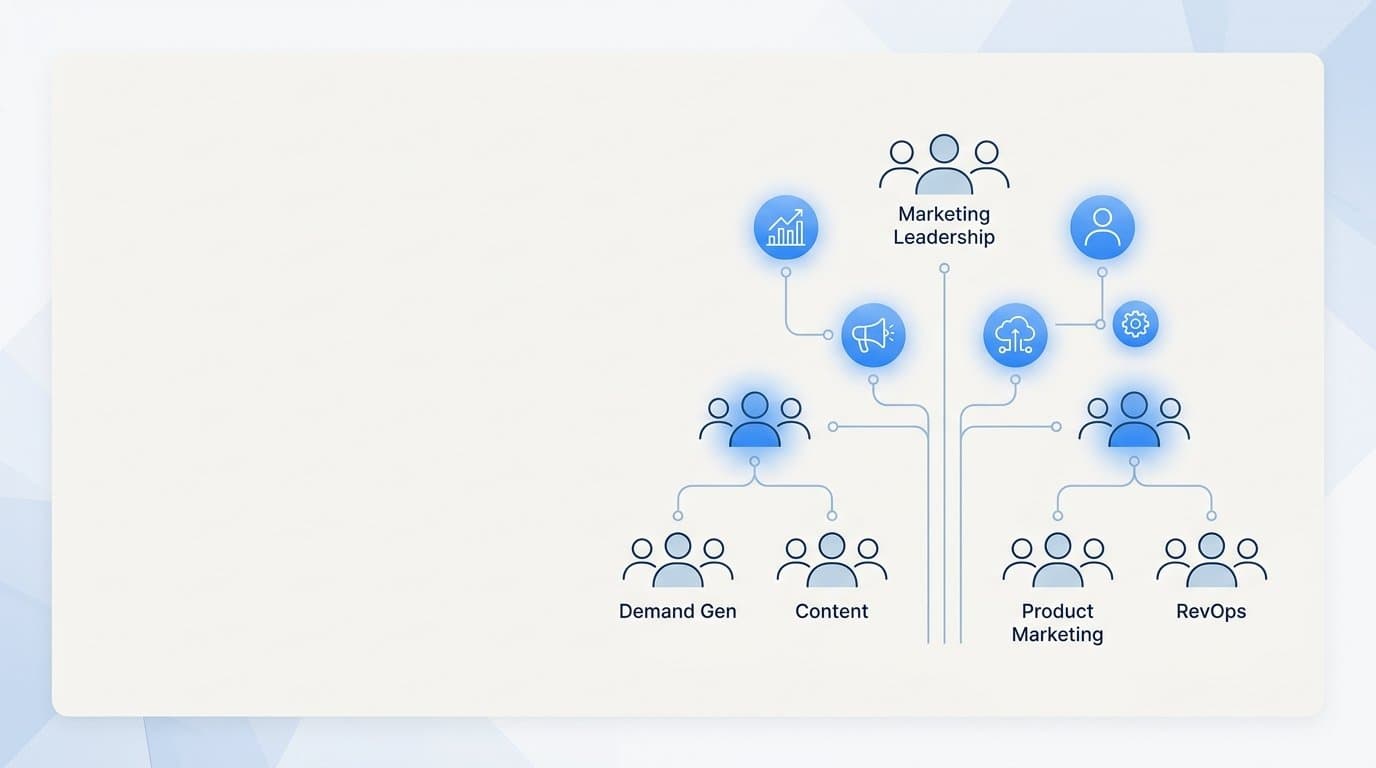
CMO or VP of Marketing: This person owns the overall marketing strategy, budget allocation, and the relationship between marketing and the rest of the executive team. Their KPIs are typically pipeline contribution, revenue influenced, and marketing-sourced ARR. They are responsible for ensuring the team has the right structure and tools to measure its own impact.
Demand Generation Manager: Demand gen owns top-of-funnel acquisition. They are responsible for driving qualified leads and pipeline through paid channels, campaigns, and programs. Their metrics include marketing-qualified leads, cost per lead, pipeline generated, and conversion rates from lead to opportunity. This role sits at the intersection of paid media, marketing operations, and sales alignment.
Product Marketing Manager: Product marketing owns positioning, messaging, and competitive intelligence. They are the bridge between the product team and the market, and they enable sales with the content and frameworks needed to close deals. Their KPIs often include win rates, sales cycle length, and the quality of pipeline, not just volume.
Content Marketing Manager: Content owns organic growth, thought leadership, and the editorial strategy that supports every other function. They drive SEO, build the content library that nurtures prospects through the funnel, and create assets that demand gen and product marketing can use across campaigns. Their metrics include organic traffic, content-influenced pipeline, and engagement rates.
Growth or Performance Marketing Manager: This role focuses on paid acquisition at scale, including paid search, paid social, and performance-driven experiments. They own the efficiency of paid spend and are accountable for return on ad spend and customer acquisition cost. They work closely with demand gen and marketing ops to ensure conversion data is accurate and feeding back into the ad platforms correctly.
These roles do not operate in isolation. Demand gen needs content assets. Product marketing needs data from sales. Performance marketing needs clean conversion tracking from ops. The org chart only works when these roles are connected through shared data, shared attribution models, and a clear feedback loop between marketing, sales, and product.
How the Structure Evolves from Seed Stage to Series B
The biggest mistake early-stage SaaS founders make is trying to build a mature org chart before the business is ready for it. Structure should follow revenue, not precede it.
At the seed stage, most SaaS companies do not need a formal marketing org chart at all. Marketing is typically founder-led, with one generalist marketer supporting campaigns, content, and outbound efforts simultaneously. The priority at this stage is learning: which channels generate interest, which messages resonate, and which customer segments convert. Specialization would be premature and expensive. What matters is speed and experimentation.
At Series A, the first specialist hires start to make sense. Companies at this stage typically have enough product-market fit to invest in specific channels and need dedicated ownership to scale them. The most common first hires are a demand generation manager to own paid acquisition and a content marketer to build the organic engine. These two roles represent the core of most B2B SaaS acquisition strategies: paid and organic working in parallel, with clear ownership over each.
This is also the stage where marketing operations starts to matter. As the tech stack grows to include a CRM, marketing automation, and ad platforms, someone needs to own the integrations and data flows that connect them. Without this, the demand gen and content teams are flying blind, unable to connect their activities to pipeline outcomes.
At Series B, the team expands significantly. Sub-teams start to form around specific functions. Performance marketing becomes its own discipline, separate from broader demand gen strategy. Product marketing scales to support a more complex product and a more sophisticated sales team. Marketing operations becomes a dedicated function with responsibility for attribution, reporting, and the analytics infrastructure that the entire team depends on.
By Series B, the org chart is no longer just about who does what. It is about how data flows between teams and whether the measurement infrastructure can keep up with the pace of growth. Companies that invest in attribution and analytics at this stage are able to make confident budget decisions. Those that do not find themselves making guesses.
Marketing Operations: The Connective Tissue of the Org Chart
Marketing operations is one of the most undervalued functions in early-stage SaaS marketing teams, and one of the most critical in mature ones. It is the connective tissue that holds the org chart together.
The marketing ops function owns the tech stack, including the CRM, marketing automation platform, ad integrations, and analytics tools. More importantly, it owns the data pipelines that connect these systems and make attribution possible. Without marketing ops, every other team is working with incomplete or unreliable data.
Think about what happens when marketing ops is missing or under-resourced. The demand gen team runs campaigns but cannot trace which campaigns actually influenced closed deals. The content team publishes consistently but has no way to know which pieces of content are driving pipeline. The performance marketing team optimizes for clicks and leads but cannot connect those leads to revenue. Every team is busy, but nobody can prove impact.
This is the core problem that attribution tools solve, and it is why the ops function needs to own the attribution infrastructure. When marketing ops has the right tools in place, the entire team gains visibility into the customer journey from first touch to closed-won revenue.
Cometly fits directly into this layer of the org. It gives marketing teams a single source of truth for campaign performance, connecting ad spend data from platforms like Meta and Google with CRM events, website behavior, and revenue outcomes. Instead of every team reporting on their own siloed metrics, the entire org can look at the same data and understand how each channel and touchpoint contributed to pipeline and revenue. Marketing ops can also use Cometly to feed enriched conversion data back to the ad platforms, improving targeting and optimization across every paid channel.
As the team scales, the ops and analytics function becomes the foundation everything else is built on. New hires, new channels, and new campaigns are only measurable if the infrastructure exists to track them. Investing in this function early pays dividends at every subsequent stage of growth.
Structural Mistakes That Undermine SaaS Marketing Teams
Even well-intentioned org charts can create problems if they are built without a clear understanding of how data and measurement need to flow. Here are the most common structural mistakes SaaS marketing teams make.
Hiring channel specialists before the ops foundation is in place: Bringing on a paid social specialist or an SEO manager before you have a marketing ops or analytics function means those specialists will generate activity without accountability. You will have channel-level metrics but no way to connect them to pipeline or revenue. The result is siloed data and internal disagreements about what is actually working.
Separating brand and performance marketing under different leadership without shared attribution models: This is a structural mistake that leads to one of the most common internal conflicts in marketing teams. Brand argues that their work builds the pipeline that performance converts. Performance argues that their campaigns are generating the leads. Without a shared attribution model that both teams agree on, this debate never gets resolved, and budget decisions become political rather than data-driven.
Neglecting the feedback loop between marketing and sales: The org chart can look perfectly clean on paper, with clear role definitions and reporting lines, but if there is no structured process for marketing and sales to share data and align on pipeline quality, the whole thing breaks down in practice. Marketing optimizes for leads that sales does not consider qualified. Sales blames marketing for poor pipeline. Marketing argues the leads are fine. This loop only closes when both teams are looking at the same attribution data and agreeing on definitions.
Scaling headcount without scaling measurement: Adding people to a team that cannot measure its own impact just amplifies the problem. Every new hire added to a measurement-poor environment becomes another source of activity that cannot be connected to outcomes. Before scaling headcount, make sure the attribution infrastructure can account for what each person is doing.
Designing a Measurement-First Marketing Team
The most effective SaaS marketing org charts are not designed around job titles or reporting lines. They are designed around data ownership. Every role in the org knows which metrics they own, how those metrics are tracked, and how their work connects to revenue. This is what separates marketing teams that can scale from those that plateau.
Building a measurement-first team starts with defining the metrics hierarchy before you make your first hire. What does the company need from marketing in terms of pipeline contribution? What are the leading indicators that predict pipeline? Which channels and activities will be tracked, and who owns the tracking? These questions should shape the org chart, not the other way around.
Multi-touch attribution is a particularly important capability to build into the team structure from early on. In B2B SaaS, where buyers interact with multiple channels before converting, single-touch attribution models give a distorted view of what is driving growth. A prospect who converted after seeing a LinkedIn ad, reading three blog posts, and attending a webinar cannot be credited entirely to the last touchpoint. Every team, from demand gen to content to paid, needs to understand how their work contributes to the full journey.
This means multi-touch attribution should not be siloed in the analytics team. It should be a shared capability that demand gen managers, content leads, and performance marketers all understand and use in their day-to-day decision-making. When every team member can see how their channel contributes to revenue across the full customer journey, they make better decisions about where to invest time and budget.
Connecting the org chart to an attribution platform like Cometly ensures that as the team grows, every new hire and every new channel is immediately measurable and accountable. The AI-driven insights in Cometly help teams identify which ads and campaigns are performing across every channel, so demand gen and performance teams can scale what is working with confidence. And because Cometly captures every touchpoint from first ad click to closed-won revenue, the entire org operates from a single, trusted view of what marketing is actually contributing.
The goal is a team where nobody is guessing. Every role has clear ownership of specific metrics, every channel is tracked through a shared attribution model, and every budget decision is grounded in data that connects spend to revenue.
Building the Org Chart That Scales With Your Business
The marketing team org chart is not a one-time decision. It is a living document that should reflect both the current stage of your business and the measurement infrastructure you have in place. A structure that works at Series A will need to evolve at Series B. A team built for acquisition will need to expand to include retention and lifecycle marketing as the customer base grows.
The frameworks covered here give you a foundation for thinking about structure at every stage: start with generalists, hire specialists as revenue grows, invest in marketing ops before you need it, and design every role around data ownership and attribution accountability.
Take a moment to audit your current structure against these principles. Do you have clear ownership of metrics across every role? Does your team have a shared attribution model that connects marketing activity to pipeline and revenue? Is there a dedicated ops or analytics function ensuring data flows correctly between your ad platforms, CRM, and reporting tools?
If any of those answers are unclear, the org chart is not the problem. The measurement infrastructure is. And that is exactly where Cometly comes in. Cometly gives your entire marketing team a single source of truth for campaign performance, customer journey data, and revenue attribution, so every role in your org is accountable and every budget decision is backed by data.
Ready to make your marketing team measurable at every level? Get your free demo today and see how Cometly connects every touchpoint to revenue, giving your org chart the attribution layer it needs to scale with confidence.