Pipeline acceleration is one of the most critical challenges facing B2B SaaS marketing and sales teams today. Generating leads is only half the battle. The real competitive advantage comes from knowing how to move qualified opportunities through your funnel faster, with less friction and more precision.
For growth leaders, the pressure is constant: shorten sales cycles, increase conversion rates, and tie every marketing dollar to closed revenue. But without the right data infrastructure, acceleration efforts become guesswork. You end up spending more on channels that feel productive rather than channels that are proven to convert.
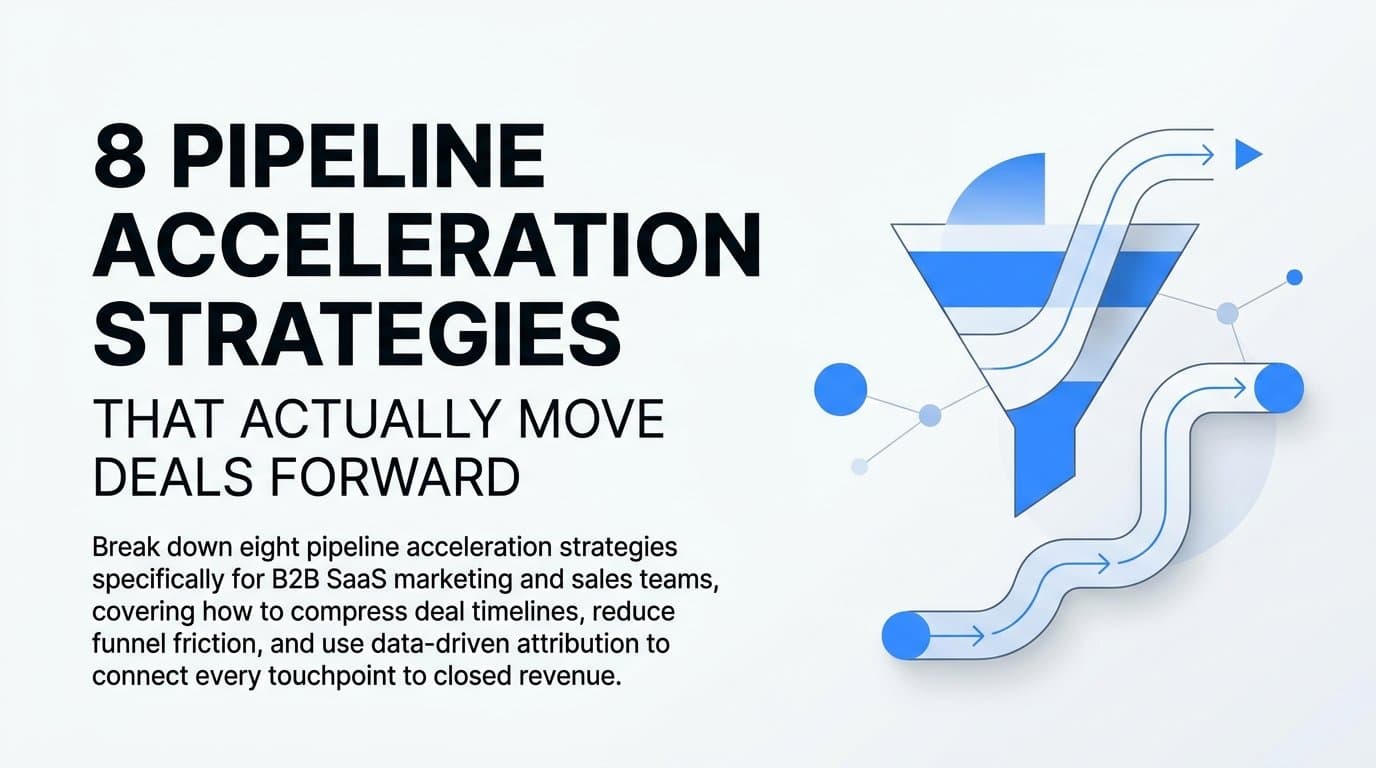
This article breaks down eight pipeline acceleration strategies built specifically for B2B SaaS companies. Each strategy focuses on a distinct lever you can pull to compress deal timelines, improve handoffs between marketing and sales, and make smarter decisions about where to invest. Whether you are running paid acquisition, nurturing mid-funnel leads, or trying to understand which touchpoints actually influence closed-won deals, these strategies will give you a clear path forward.
The common thread across all eight is data. Specifically, accurate attribution data that connects your ad spend, CRM activity, and revenue outcomes into a single, trustworthy view of your pipeline.
1. Map Your Customer Journey Before Optimizing Anything
The Challenge It Solves
Most B2B SaaS sales cycles involve multiple touchpoints spread across weeks or even months. Without a clear map of that journey, optimization efforts tend to cluster around the first or last touch, completely missing the middle of the funnel where deals most commonly stall. You end up investing in what is visible rather than what is actually influential.
The Strategy Explained
Multi-touch attribution gives you the foundation you need to see the full picture. Instead of crediting a single touchpoint for a conversion, models like linear, time decay, and data-driven attribution distribute credit across every interaction that contributed to a deal progressing. This reveals patterns you simply cannot see with last-touch or first-touch models alone.
Think of it like reviewing game film before changing your playbook. You need to know what actually happened before you can make smart adjustments. Journey mapping with multi-touch attribution shows you where prospects are engaging, where they are going quiet, and which touchpoints consistently appear before a deal moves forward. That intelligence becomes the foundation for every other strategy on this list.
Platforms like Cometly are built specifically for this kind of visibility, connecting your ad platforms, CRM, and website into a unified attribution layer so you can trace every touchpoint from first ad click to closed-won revenue.
Implementation Steps
1. Audit your current tracking setup to confirm you are capturing touchpoints across all major channels, including paid ads, organic, email, and direct.
2. Select an attribution model that reflects your sales cycle length. Longer cycles often benefit from time decay or data-driven models that weight recent touchpoints more heavily.
3. Identify the stages in your CRM where deals most commonly stall, then cross-reference those stages with your touchpoint data to find the gaps.
4. Use your journey map as a baseline before making any channel or budget changes, so you can measure the impact of future optimizations against a real starting point.
Pro Tips
Do not try to optimize everything at once after mapping your journey. Focus first on the single stage where deals stall most frequently. One targeted intervention at the right moment in the funnel will outperform scattered improvements across multiple stages. Build from the bottleneck outward.
2. Score and Prioritize Leads Using Behavioral Signals
The Challenge It Solves
Traditional lead scoring models rely heavily on firmographic data: company size, industry, job title. While that information matters, it tells you who a prospect is, not how ready they are to buy. Sales teams end up chasing leads that look good on paper but show no real purchase intent, while genuinely interested prospects slip through because their score does not reflect their behavior.
The Strategy Explained
Behavioral signals are far stronger predictors of purchase intent than demographics alone. When a prospect clicks on a retargeting ad, visits your pricing page three times in a week, downloads a comparison guide, or activates a product trial feature, those actions tell a story that firmographic data simply cannot.
The key is aligning your scoring model with what actually happens before deals close. Pull your closed-won data and look for behavioral patterns that consistently appeared in the weeks before a deal was signed. Those patterns become your scoring criteria. Leads that match those behaviors get prioritized. Leads that only match demographic criteria get nurtured until their behavior signals readiness.
With Cometly's customer journey analytics, you can connect ad engagement data directly to CRM records, giving you a richer behavioral profile for every lead in your pipeline.
Implementation Steps
1. Export your closed-won deals from the past six to twelve months and identify the behavioral touchpoints that appeared most frequently before a deal closed.
2. Assign weighted scores to high-intent behaviors: pricing page visits, demo requests, product trial engagement, and ad click sequences that indicate evaluation-stage activity.
3. Build a scoring threshold that triggers a sales alert or queue prioritization when a lead crosses into high-intent territory based on behavioral data.
4. Review and recalibrate your scoring model quarterly by comparing predicted scores against actual conversion outcomes.
Pro Tips
Avoid over-indexing on a single behavior. A prospect who visits your pricing page once is interesting. A prospect who visits your pricing page, clicks a retargeting ad, and requests a comparison guide within the same week is a genuine signal. Behavioral scoring works best when it rewards patterns, not isolated actions.
3. Align Marketing and Sales Around a Shared Attribution Model
The Challenge It Solves
One of the most common and costly friction points in B2B SaaS pipeline management is the attribution credit war between marketing and sales. Marketing points to the top-of-funnel campaign that generated the lead. Sales credits the outbound sequence or demo that closed it. Without a shared model, both teams are operating from different realities, making it nearly impossible to make coordinated investment decisions.
The Strategy Explained
A unified attribution model gives both teams a single, transparent view of what drove a deal. It does not declare one team the winner. Instead, it distributes credit across the full journey so everyone can see how marketing touchpoints and sales activities worked together to move a deal forward.
This shared view changes the conversation. Instead of debating who gets credit, marketing and sales can focus on which touchpoints at which stages are most influential, and then collaborate on strengthening those moments. That shift from competition to coordination is one of the most powerful acceleration levers available to a B2B SaaS team.
A platform like Cometly serves as the single source of truth here, connecting ad platform data, CRM activity, and revenue outcomes so both teams are working from the same dataset.
Implementation Steps
1. Facilitate a joint session between marketing and sales leadership to agree on which attribution model best reflects how your deals actually progress.
2. Implement the agreed model in your attribution platform and ensure both teams have access to the same dashboard and reporting views.
3. Define shared pipeline metrics that both teams are accountable for, such as marketing-qualified pipeline value, stage conversion rates, and average sales cycle length.
4. Review attribution data together in a monthly revenue meeting to identify where touchpoints are working and where gaps exist.
Pro Tips
The goal of attribution alignment is not perfect credit allocation. It is shared understanding. Even an imperfect model that both teams trust and use consistently will outperform a technically superior model that only one team believes in. Buy-in matters as much as accuracy.
4. Use Retargeting to Re-Engage High-Intent Prospects
The Challenge It Solves
Prospects in a B2B pipeline frequently go dark between touchpoints. They get busy, priorities shift, or they are evaluating multiple vendors simultaneously. Without proactive re-engagement, deals that were progressing can quietly stall for weeks. By the time a sales rep follows up, the prospect has moved on or lost momentum.
The Strategy Explained
Stage-aware retargeting keeps your brand present and relevant during the gaps between direct sales contact. The key word is stage-aware. A prospect in the awareness stage needs different messaging than a prospect who has already attended a demo and is now comparing vendors. Generic retargeting treats everyone the same. Strategic retargeting delivers messaging that matches where a prospect is in their decision process.
For mid-funnel and late-funnel prospects, retargeting ads might highlight ROI proof points, address common objections, or create urgency around a time-sensitive offer. The goal is not just visibility. It is relevance at the right moment.
Connecting your retargeting data back to CRM stage progression is what separates this from spray-and-pray advertising. When you can see that a prospect clicked a retargeting ad and then re-engaged with sales within the same week, you have evidence that your retargeting is actually accelerating deals rather than just generating impressions.
Implementation Steps
1. Segment your pipeline by deal stage and create separate retargeting audiences for each stage using CRM data synced to your ad platforms.
2. Develop stage-specific ad creative: awareness messaging for early-stage prospects, comparison and proof-point content for mid-funnel, and urgency-driven offers for late-stage deals.
3. Set frequency caps to avoid over-saturating prospects, particularly in late-stage deals where too many ads can feel intrusive rather than helpful.
4. Track retargeting engagement in your attribution platform and monitor whether ad clicks correlate with CRM stage progression to validate impact.
Pro Tips
Coordinate retargeting timing with your sales outreach cadence. When a sales rep is planning to follow up with a prospect, having a relevant retargeting ad appear in the days before that call can warm the conversation considerably. Marketing and sales coordination here is a genuine force multiplier.
5. Accelerate Mid-Funnel Deals With Conversion-Focused Content
The Challenge It Solves
Top-of-funnel content is good at generating awareness and initial interest. But it rarely moves a prospect from evaluation to decision. Mid-funnel deals stall because prospects have specific objections, unanswered questions, and competing priorities. If your content library is heavy on awareness-stage assets and light on decision-stage resources, you are leaving deals stuck in neutral.
The Strategy Explained
Conversion-focused content is built to address the exact questions and objections that arise during the evaluation and decision stages. This includes assets like ROI calculators that help prospects justify the investment internally, comparison guides that position your solution against alternatives, detailed product walkthroughs that reduce technical uncertainty, and content that speaks directly to the concerns of economic buyers rather than just end users.
The distribution of this content matters as much as the content itself. Mid-funnel assets should be delivered through channels where your prospects are already active during the evaluation phase: sales follow-up emails, retargeting campaigns, and personalized outreach sequences.
Tracking which assets are consumed before a deal advances gives you a feedback loop that improves your content investment over time. When you can see in your attribution data that prospects who engaged with a specific asset converted at a higher rate, you know exactly where to invest next.
Implementation Steps
1. Audit your existing content library and categorize each asset by funnel stage. Identify gaps in the evaluation and decision stages.
2. Build or prioritize two to three high-impact mid-funnel assets: an ROI calculator, a competitive comparison guide, or a detailed use-case walkthrough relevant to your primary buyer persona.
3. Integrate content consumption tracking into your CRM and attribution platform so you can connect asset engagement to deal stage progression.
4. Share content engagement data with your sales team so reps know which assets a prospect has already consumed before they make contact.
Pro Tips
Do not build mid-funnel content in isolation from your sales team. Your reps hear the same objections every day. Ask them to list the top five questions that come up most often during evaluation calls, and then build content that directly answers those questions. That alignment between content creation and sales reality will produce assets that actually move deals.
6. Improve Sales Handoffs With First-Party Conversion Data
The Challenge It Solves
When a lead arrives in a sales rep's queue with nothing more than a name, email, and company, the rep starts every conversation cold. They have no context about which ads the prospect engaged with, which pages they visited, or what content they consumed before requesting a demo. That missing context leads to generic outreach, slower follow-up, and deals that take longer to progress because the rep is rebuilding context that should have been available from the start.
The Strategy Explained
First-party conversion data solves this problem by enriching lead records with full touchpoint history before they ever reach a sales rep. Server-side tracking and Conversion API integrations capture conversion events directly from your server rather than relying on browser-based pixels, which are increasingly unreliable due to tracking restrictions and cookie deprecation.
The result is a more complete and accurate picture of every lead's journey. When that data flows into your CRM, sales reps can see exactly which ad campaign generated the lead, which pages they visited, which content they downloaded, and how long they have been in your ecosystem. That context transforms the first sales conversation from a cold introduction to a warm, informed discussion.
Cometly's server-side conversion tracking and Conversion API integration are built to capture this data reliably, ensuring that lead records are enriched with accurate touchpoint history that sales teams can actually use.
Implementation Steps
1. Audit your current tracking infrastructure to identify gaps caused by browser-level restrictions or pixel-based tracking limitations.
2. Implement server-side tracking and Conversion API integrations for your primary ad platforms to improve data accuracy and signal completeness.
3. Configure your CRM to receive and display enriched lead data, including ad source, campaign, and touchpoint history, in a format that is immediately useful to sales reps.
4. Establish a lead handoff protocol that requires sales reps to review touchpoint history before making first contact, and measure whether this practice improves response rates or deal progression speed.
Pro Tips
First-party data enrichment also benefits your ad platforms. When you send accurate, enriched conversion events back to Meta, Google, and other platforms through their Conversion APIs, you improve the quality of the signals those platforms use for targeting and optimization. Better data in means better targeting out, which improves the quality of leads entering your pipeline in the first place.
7. Double Down on Channels Proven to Drive Pipeline
The Challenge It Solves
Spreading budget evenly across many channels without attribution data is one of the most common and expensive mistakes in B2B SaaS marketing. It feels balanced and defensible, but it dilutes impact and funds underperforming channels at the expense of proven ones. Without revenue attribution connecting ad spend to actual pipeline and closed-won deals, budget decisions are based on surface metrics like clicks and impressions rather than business outcomes.
The Strategy Explained
Revenue attribution changes the question you ask about your channels. Instead of "which channel generates the most leads?" you ask "which channel generates the most qualified pipeline and closed revenue?" Those two questions often produce very different answers.
A channel might generate a high volume of leads that rarely convert to qualified opportunities. Another channel might generate fewer leads but at a significantly higher pipeline conversion rate. Without attribution data connecting ad spend to pipeline and revenue, you have no way to see this distinction. You end up optimizing for volume when you should be optimizing for quality.
Once you identify which channels are genuinely driving pipeline, the strategic move is to concentrate budget there. This does not mean abandoning every other channel. It means being deliberate about where you invest the majority of your growth budget based on evidence rather than assumption.
Cometly connects ad spend data directly to pipeline and revenue outcomes, giving you the channel-level attribution clarity needed to make these concentration decisions with confidence.
Implementation Steps
1. Pull a channel-level attribution report that shows pipeline generated and closed-won revenue by source, not just lead volume or click-through rate.
2. Calculate a pipeline-to-spend ratio for each channel to identify which investments are generating the highest return in terms of qualified opportunities.
3. Identify the top two or three channels with the strongest pipeline attribution and model the impact of shifting a meaningful portion of budget toward those channels.
4. Set a review cadence of sixty to ninety days after any budget reallocation to measure whether pipeline quality and velocity improve as expected.
Pro Tips
Resist the temptation to cut underperforming channels entirely based on a single reporting period. Attribution data is most reliable when reviewed over a longer window that reflects your full sales cycle length. A channel that looks weak in a thirty-day view might show stronger pipeline contribution when you extend the window to ninety or one hundred twenty days.
8. Measure Pipeline Velocity as a Core Marketing Metric
The Challenge It Solves
Most marketing teams measure success through lead volume, cost per lead, or top-of-funnel engagement metrics. These numbers are easy to track but they do not capture the full impact of marketing on revenue. A team can generate record lead volume while pipeline velocity slows, win rates drop, and sales cycles lengthen. Without a composite metric that reflects the true health of the pipeline, it is difficult to see the cumulative effect of your optimization efforts.
The Strategy Explained
Pipeline velocity is a composite metric that reflects the speed and efficiency of your entire revenue engine. The formula is straightforward: multiply the number of deals in your pipeline by your average deal value and your win rate, then divide by your average sales cycle length. The result tells you how much revenue your pipeline generates per unit of time.
What makes this metric powerful for marketing teams is that marketing can influence all four components. Better targeting improves the quality and quantity of deals entering the pipeline. More relevant content and stronger nurturing sequences improve win rates. Faster follow-up enabled by first-party data and behavioral scoring reduces cycle length. Each strategy in this article connects to at least one component of pipeline velocity.
When you adopt pipeline velocity as a core marketing metric, you shift from measuring activity to measuring business impact. That shift changes how you prioritize your work, how you present results to leadership, and how you collaborate with sales on shared revenue goals.
Implementation Steps
1. Establish your baseline pipeline velocity calculation using current CRM data: deal count, average deal value, win rate, and average sales cycle length.
2. Identify which component of the formula represents your biggest opportunity for improvement. Is it deal volume, win rate, or cycle length?
3. Map each of your marketing initiatives to the pipeline velocity component it is designed to improve, so you can attribute velocity changes to specific programs.
4. Report pipeline velocity alongside traditional marketing metrics in your monthly and quarterly reviews to demonstrate the revenue impact of your team's work.
Pro Tips
Track pipeline velocity by segment, not just in aggregate. Velocity often varies significantly by company size, industry, or acquisition channel. Understanding which segments have the fastest velocity helps you prioritize where to concentrate growth investment for the highest return on effort.
Putting It All Together: Your Pipeline Acceleration Roadmap
Implementing all eight strategies at once is not realistic or necessary. The most effective approach is sequential, starting with the foundation that every other strategy depends on: accurate attribution data.
Begin by mapping your customer journey and aligning your marketing and sales teams around a shared attribution model. These two steps create the data clarity you need to make every subsequent decision with confidence rather than guesswork. From there, layer in behavioral lead scoring and first-party conversion data to improve the quality of leads reaching your sales team and the context those reps have when they follow up.
Once your foundation is solid, introduce stage-aware retargeting and conversion-focused mid-funnel content to compress deal timelines and reduce the friction that causes opportunities to stall. Then use revenue attribution to identify your highest-performing channels and concentrate budget where it is proven to drive qualified pipeline.
Finally, adopt pipeline velocity as your north star metric. It gives you a single number that reflects the combined impact of every optimization you make, and it connects marketing activity directly to the revenue outcomes that matter most to your business.
Cometly is built to support this entire process. It connects your ad platforms, CRM, and website into a single attribution layer that shows exactly which touchpoints influence pipeline and revenue. With multi-touch attribution, server-side conversion tracking, and AI-powered campaign insights, Cometly gives B2B SaaS marketing teams the data clarity they need to accelerate deals with confidence.
If you are ready to build a pipeline engine backed by real attribution data, Get your free demo today and start capturing every touchpoint to maximize your conversions.