The digital advertising ecosystem was built on a simple premise: follow the user, track the click, attribute the conversion. For years, that system worked well enough. Marketers could drop a pixel on a landing page, connect it to their ad account, and get a reasonably accurate picture of what was driving results. That foundation is now actively being dismantled, and the pace of change is accelerating.
Three distinct forces are reshaping how tracking works: browser-level privacy protections that restrict or eliminate cookie functionality, operating system changes that require explicit user consent before any cross-app tracking can occur, and regulatory pressure that has pushed ad platforms to fundamentally rearchitect how they receive and process conversion data. None of these forces are temporary. Each one represents a structural shift in how the web handles user data.
For B2B SaaS marketing teams, the stakes are particularly high. You are running paid campaigns with real budget, justifying spend to leadership based on attribution data, and making scaling decisions based on what the numbers tell you. When that data becomes unreliable, you are not just flying blind on one campaign. You are making compounding errors across every budget allocation decision. This article breaks down exactly what has changed, how it breaks your attribution data, and what modern solutions actually look like in practice.
The Forces Dismantling Traditional Ad Tracking
Understanding the problem starts with understanding the three layers where privacy changes affecting tracking are happening simultaneously. These are not isolated incidents. They are coordinated shifts across browsers, operating systems, and regulatory environments that together fundamentally alter the data infrastructure marketers have relied on for over a decade.
Browser-Level Restrictions: Safari's Intelligent Tracking Prevention, introduced by Apple's WebKit team starting in 2017 and updated progressively since, uses machine learning to identify and limit cross-site tracking. It restricts third-party cookies outright and caps the lifespan of first-party cookies set via JavaScript to as little as seven days in some scenarios. Firefox's Enhanced Tracking Protection follows a similar approach. These protections mean that the cookies your pixel depends on to match a user across sessions and touchpoints are either blocked or expire before many B2B buyers ever convert.
OS-Level Changes: Apple's App Tracking Transparency framework, introduced with iOS 14.5 in April 2021, requires apps to explicitly request user permission before tracking activity across other companies' apps and websites. This single change fundamentally altered mobile ad attribution. When users decline tracking, the data pipeline that ad platforms use to match ad exposures to downstream conversions is severed. Many advertisers reported significant drops in attributed conversions on mobile campaigns following this rollout, and ad platforms like Meta openly acknowledged the impact on their measurement capabilities. Teams looking for privacy-compliant tracking alternatives have had to rethink their entire measurement stack as a result.
Platform and Regulatory Pressure: Google has been working toward deprecating third-party cookies in Chrome through ongoing efforts that have shifted timeline multiple times. While the exact schedule continues to evolve, the direction is clear: third-party cookies are being phased out. Global privacy regulations have added further pressure, pushing ad platforms to build privacy-preserving alternatives to the data collection methods they previously relied on. The result is that Meta, Google, and others have had to redesign how they receive conversion signals from advertisers, which is precisely why server-side APIs now exist. A cookieless tracking solution is no longer optional for teams that want reliable attribution going forward.
Each of these changes compounds the others. A B2B buyer who clicks a LinkedIn ad on their iPhone, visits your site in Safari, and converts three weeks later during a sales call represents a journey that legacy pixel-based tracking simply cannot follow end to end anymore.
How Broken Tracking Distorts Your Attribution Data
Knowing that tracking is degraded is one thing. Understanding exactly how it distorts your data is what allows you to respond strategically rather than just accepting the noise.
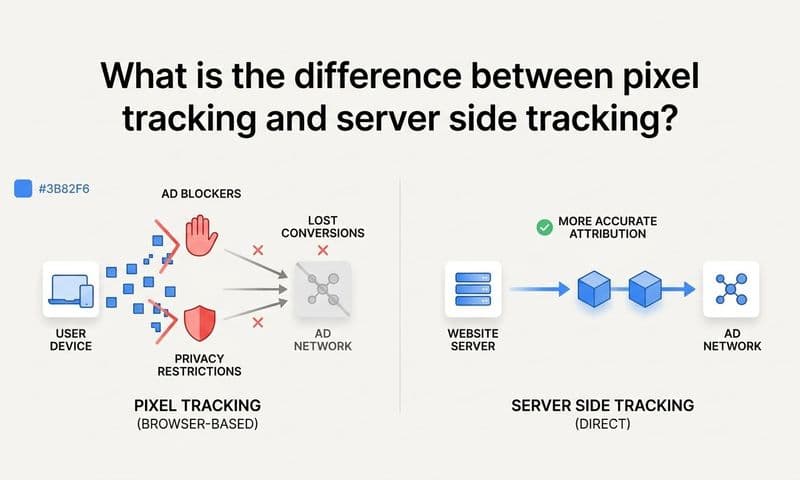
Pixel Degradation: Client-side pixels like the Meta Pixel or Google Tag rely entirely on the browser to fire and pass data. When cookies are blocked or stripped by ITP, the pixel loses its ability to match a conversion back to the original ad click. The event may still fire, but without a valid cookie to connect it to a user session, the platform cannot attribute it correctly. Understanding what a tracking pixel is and how it works makes it clear why client-side methods are so vulnerable to these restrictions. This creates systematic underreporting of conversions, not random noise but directional bias that makes your campaigns look less effective than they actually are.
Shortened Attribution Windows and Long Sales Cycles: ITP's cookie restrictions are particularly damaging for B2B SaaS companies. A prospect who clicks your Google ad today but does not sign up for a trial until four weeks later, after multiple touchpoints and internal discussions, may never be attributed to that original click. The cookie that would have connected those two events expired long before the conversion happened. For B2C companies with short purchase cycles, this might be a minor issue. For B2B SaaS teams with sales cycles that span weeks or months, it is a fundamental measurement problem. Fixing conversion tracking gaps caused by expired cookies requires moving beyond browser-dependent methods entirely.
Audience Signal Loss: This is where the damage extends beyond just your reporting. When conversion data flowing back to ad platforms becomes incomplete, their machine learning models have less signal to work with. Automated bidding strategies that optimize toward conversions, lookalike audience models built from your customer data, and campaign optimization algorithms all depend on a steady, accurate stream of conversion events. Degraded data means degraded optimization, which over time increases your cost per acquisition and reduces the efficiency of campaigns that previously performed well.
The compounding effect is significant. You are not just seeing inaccurate reports. You are also feeding bad signals back to ad platforms, which causes them to optimize toward the wrong outcomes, which further degrades performance, which makes your attribution data even harder to interpret. Breaking this cycle requires addressing the data collection problem at its source.
Server-Side Tracking and Conversion APIs: The Technical Fix
The most direct technical response to browser-level tracking restrictions is moving data collection off the browser entirely. Server-side tracking does exactly that, and it is now the standard approach for any serious paid media operation.
What Server-Side Tracking Does Differently: Instead of relying on the user's browser to fire a pixel and pass data to an ad platform, server-side tracking sends conversion events directly from your server to the ad platform's API. The browser never enters the equation. Ad blockers cannot intercept it. ITP cannot strip the cookies. Safari's restrictions are irrelevant because the data transfer happens at the infrastructure level, not the client level. This means that when a lead submits a form, completes a trial signup, or triggers any other conversion event, that data can be reliably captured and sent to your ad platforms regardless of the user's browser settings or device privacy controls. The benefits of server-side tracking extend well beyond just surviving privacy restrictions — they actively improve data quality across the board.
Conversion APIs in Practice: Meta's Conversion API (CAPI) and Google's Enhanced Conversions are the two most widely used implementations of this approach. Meta's CAPI allows advertisers to send web events directly from their server to Meta, including hashed first-party data like email addresses and phone numbers. This hashed data allows Meta to match the conversion event to a user in their system without exposing personally identifiable information. Google's Enhanced Conversions works similarly, supplementing existing conversion tags with hashed first-party data sent directly to Google in a privacy-safe way. Both are documented thoroughly in their respective developer resources and represent the direction these platforms are actively pushing advertisers toward. Reviewing the top server-side tracking tools available today can help teams choose the right implementation path.
Event Deduplication: One practical complexity when implementing server-side tracking is that many teams run both a client-side pixel and a server-side integration simultaneously, which is actually recommended during the transition period to maximize coverage. The challenge is that the same conversion event can be captured by both systems, leading to double-counting in your ad platform reports. Proper deduplication, typically handled by passing a consistent event ID through both the pixel and the API, ensures the platform recognizes and discards the duplicate. This keeps your reported conversion numbers accurate and ensures that the optimization signals you are sending to the ad platform reflect reality rather than inflated counts.
Server-side tracking is not a complete solution on its own, but it is the critical foundation. Without it, every other optimization effort is built on a data layer that browser privacy changes will continue to erode.
First-Party Data as the New Tracking Foundation
Server-side tracking solves the data transmission problem. First-party data strategy solves the data ownership problem. These two approaches work together, and for B2B SaaS companies, building a robust first-party data foundation is now a core marketing infrastructure requirement.
Why First-Party Data Is the Strategic Asset: Data collected directly from your own website, CRM, product, and customer interactions is not subject to third-party cookie restrictions. It belongs to you, it is collected with user consent through your own properties, and it is not going away regardless of what browsers or operating systems do next. The companies that invested early in building clean, structured first-party data sets are now operating with a durable advantage over competitors still dependent on third-party data sources that are being progressively restricted.
Connecting CRM Events to Ad Performance: For B2B SaaS companies, the most powerful first-party data connection is between your CRM and your ad platforms. When a lead that originated from a Google ad eventually becomes a qualified opportunity or a closed deal, that information lives in your CRM, not in Google's attribution system. Browser-based tracking cannot reliably close that loop, especially across a sales cycle that spans multiple weeks. But if you sync CRM pipeline events, such as opportunity created, demo scheduled, or deal closed, back to your ad platforms and attribution tools, you can attribute revenue to the campaigns that actually generated it. Tracking closed-won revenue back to specific ad campaigns is the difference between optimizing toward lead volume and optimizing toward revenue.
Data Enrichment for Better Matching: The effectiveness of server-side integrations depends heavily on match rates: how accurately the platform can connect your conversion event to a known user in their system. Enriching your conversion events with additional identifiers before sending them improves these match rates significantly. Hashed email addresses, phone numbers, and customer IDs give platforms more signals to work with, which strengthens the quality of the optimization signal you are sending back. Better match rates mean better lookalike audiences, more accurate automated bidding, and stronger overall campaign performance. First-party data is not just about protecting your attribution from privacy changes. It is about actively improving the quality of the data you send back to ad platforms to make their AI work harder for you.
Rethinking Attribution Models for a Privacy-First World
Even with server-side tracking and first-party data in place, your attribution model determines how you interpret the data you do have. Privacy changes affecting tracking have exposed the weaknesses of legacy attribution approaches and made the case for more sophisticated models more urgent.
Why Last-Click Attribution Fails Harder Now: Last-click attribution was already a flawed model before privacy changes. It ignores every touchpoint except the final one before conversion, which systematically under-credits brand awareness campaigns, content, and early-funnel paid efforts. Privacy changes make this worse. When early touchpoints go untracked because cookies expired or were blocked, last-click does not just under-credit those touchpoints. It attributes the conversion entirely to whatever touchpoint happened to fire correctly, often a branded search click or a direct session that was never actually the first or most influential interaction. Budget decisions made on last-click data in a privacy-restricted environment are likely to be significantly distorted.
Multi-Touch Attribution as a More Resilient Approach: Attribution models that distribute credit across multiple touchpoints are inherently more robust in a privacy-constrained environment because they are not catastrophically dependent on any single data point being perfectly captured. If one touchpoint is missing due to cookie restrictions, the model still has other signals to work with. More importantly, multi-touch models reflect how B2B buyers actually make decisions. A prospect who sees a LinkedIn ad, reads a blog post, attends a webinar, and then converts after a sales call was influenced by all of those touchpoints. Crediting only the last one produces systematically wrong conclusions about where budget should go. Choosing the right marketing attribution software is essential for implementing these more resilient models effectively.
The Role of Attribution Software in Unifying Fragmented Data: Modern attribution platforms address the fragmentation problem directly by pulling data from ad platforms, CRMs, server-side events, and other sources into a single unified view. No single data source can provide complete attribution in the current environment. Ad platforms see only their own slice of the customer journey. Your CRM sees pipeline and revenue but not ad exposure. Your website analytics sees sessions but loses cross-device connections. An attribution platform that connects all of these sources can compensate for the gaps that each individual source creates, giving you a more complete picture of what is actually driving revenue even as individual tracking methods become less reliable. Reviewing the best marketing attribution platforms for revenue tracking can help teams identify which solution fits their data infrastructure needs.
Building a Tracking Strategy That Survives Future Privacy Changes
The privacy changes affecting tracking that have already occurred are not the end of this shift. They are the beginning. Building a tracking strategy that is durable means designing for continued change rather than optimizing for the current state.
Audit Your Current Tracking Setup: The first step is understanding where your current data gaps actually exist. Map every conversion event that matters to your business, from form submissions and trial signups to demo requests and revenue events, and identify which ones are still relying solely on client-side pixels. These are your highest-priority migration targets. For each one, evaluate whether a server-side implementation exists and what it would take to deploy it. Many teams discover during this audit that a significant portion of their most important conversion events have no server-side fallback, meaning they are entirely dependent on browser behavior that is actively being restricted. Following best practices for tracking conversions accurately during this audit process ensures you prioritize the right fixes first.
Invest in Platform-Level Integrations: The most durable tracking infrastructure connects your attribution tool directly to your CRM, ad platforms, and billing system. When your attribution platform can pull closed-won revenue data from your CRM and match it against ad spend data from Meta and Google, you are no longer dependent on browser cookies to close the attribution loop. If you use Stripe for billing, connecting Stripe revenue data to your attribution system means you can see actual revenue attributed to specific campaigns, not just lead volume or trial starts. This kind of integration creates a data flow that does not depend on browser behavior at any point in the chain.
Use Attribution Data to Feed Ad Platform AI: The final piece of a durable tracking strategy is using your clean, enriched attribution data to actively improve ad platform performance. When you send accurate, enriched conversion events back to Meta, Google, and other platforms through their server-side APIs, you are not just fixing your own reporting. You are improving the quality of the signal those platforms use to optimize your campaigns. Better conversion signals lead to better automated bidding, more accurate lookalike audiences, and stronger campaign performance over time. This creates a compounding advantage: the teams with better data get better optimization, which produces better results, which generates more data to work with. In a privacy-restricted environment, the quality of your data infrastructure is increasingly the determinant of your competitive position in paid media.
Moving Forward in a Privacy-First Advertising World
Privacy changes affecting tracking are not a temporary inconvenience that will resolve itself when the industry agrees on a new standard. They represent a permanent restructuring of how digital advertising data flows, driven by forces that are only going to intensify over time. Browser vendors, operating system developers, and regulators are all moving in the same direction, and the pace is not slowing down.
The marketers and growth teams who adapt now by implementing server-side tracking, building first-party data infrastructure, connecting CRM revenue data to ad performance, and adopting multi-touch attribution models will maintain accurate visibility into what drives revenue. Those still relying on legacy pixel setups will face growing blind spots that compound with every new privacy update, making it progressively harder to justify spend or make confident scaling decisions.
Cometly is built specifically for B2B SaaS teams navigating this shift. It connects your ad platforms, CRM data, and server-side events into a single attribution source, giving you a complete view of the customer journey from first ad click to closed-won revenue. With support for multi-touch attribution, Conversion API integration, and AI-driven recommendations that identify which campaigns are actually driving pipeline, Cometly gives you the data infrastructure to operate confidently in a privacy-first world.
If your current attribution setup has gaps you cannot fully explain, now is the right time to address them. Get your free demo today and start capturing every touchpoint to maximize your conversions.