For years, third party cookies were the backbone of digital advertising. They powered retargeting campaigns, cross-site tracking, and audience segmentation across the open web. But that era is effectively over.
Browser restrictions from Safari and Firefox, Apple's iOS privacy changes, and growing regulatory pressure have steadily eroded cookie-based tracking. Marketers who still rely on third party cookies are working with incomplete, unreliable data and making budget decisions on a broken foundation.
The good news is that the shift away from third party cookies does not mean the end of effective ad tracking. It means upgrading to smarter, more durable methods that actually perform better in a privacy-first world.
This guide breaks down the seven most effective third party cookie alternatives available to marketers today. Whether you run paid search, social ads, or multi-channel campaigns, these strategies will help you maintain visibility into what is driving conversions, feed better data to ad platform algorithms, and make confident decisions about where to invest your budget.
The goal is not just to survive the cookieless transition. It is to build a tracking infrastructure that is more accurate and more actionable than what cookies ever provided.
1. Server-Side Tracking
The Challenge It Solves
Traditional browser-based tracking is fragile. Ad blockers intercept pixel requests, Safari's Intelligent Tracking Prevention (ITP) aggressively limits cookie lifespans, and Firefox blocks third party cookies by default. The result is a growing gap between the conversions you are actually generating and the conversions your tracking tools are reporting. That gap directly distorts your optimization decisions.
The Strategy Explained
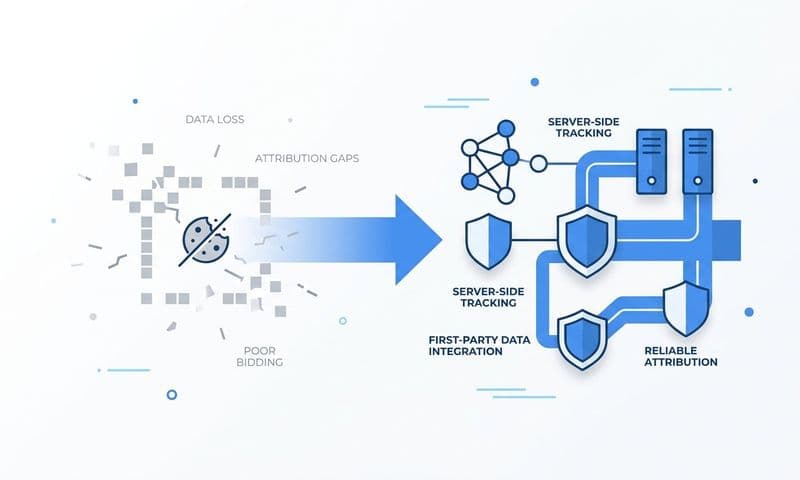
Server-side tracking moves event capture from the user's browser to your web server. Instead of relying on a JavaScript pixel firing in the browser and hoping it gets through, your server captures the event and sends it to your analytics and ad platforms directly. This bypasses ad blockers, browser cookie restrictions, and the various ITP limitations that degrade client-side data quality.
Because the data originates from your server rather than the user's browser, it is far less susceptible to the environmental noise that corrupts browser-based tracking. You also gain more control over what data is collected, how it is processed, and where it is sent.
Implementation Steps
1. Audit your current tracking setup to identify which conversion events are being lost due to ad blockers or browser restrictions. Look for discrepancies between your ad platform reported conversions and your CRM or backend data.
2. Set up a server-side tagging container using a solution like Google Tag Manager's server-side container or a dedicated tracking infrastructure. Route your key conversion events through the server rather than the browser.
3. Connect your server-side tracking layer to your ad platforms via their respective APIs, including Meta's Conversions API and Google's Enhanced Conversions, so that recovered event data flows back into your campaign optimization.
Pro Tips
Run server-side and client-side tracking in parallel during your initial rollout so you can compare data and validate accuracy before fully transitioning. Pay particular attention to purchase and lead events since these have the highest impact on your ad platform's bidding algorithms. Cometly's server-side tracking is built to handle this out of the box, capturing events that browser-based pixels routinely miss.
2. First Party Data Collection
The Challenge It Solves
Third party cookies created a dependency on data collected by someone else, on someone else's platform, under terms you did not control. As those cookies disappear, marketers who built their audience strategies on rented data are left with shrinking retargeting pools and degraded lookalike audiences. The fix is building your own data asset that no browser update or platform policy change can take away.
The Strategy Explained
First party data is information collected directly from your customers and prospects through your own channels: your website, your email list, your CRM, your product, and your customer service interactions. Because you own this data and collected it with consent, it is durable, accurate, and compliant by design.
The strategic shift here is treating every customer interaction as an opportunity to collect and enrich a profile. Email sign-ups, purchase histories, on-site behavior, survey responses, and CRM records all become inputs into a first party data asset that you can use for targeting, segmentation, and personalization without relying on any third party identifier.
Implementation Steps
1. Identify every touchpoint where you can collect first party data with explicit consent: lead forms, checkout flows, account creation, newsletter sign-ups, and gated content downloads.
2. Implement a CRM or customer data platform to centralize and organize the data you collect, ensuring that profiles are enriched over time as customers interact with your brand across channels.
3. Create value exchanges that incentivize data sharing, such as exclusive content, personalized recommendations, loyalty programs, or early access offers that give customers a reason to identify themselves.
Pro Tips
The quality of your first party data matters more than the volume. A smaller list of well-enriched profiles with verified emails and known purchase intent will outperform a large list of cold, unverified contacts. Focus on depth over breadth, and regularly clean and validate your data to maintain its usefulness for audience matching and campaign targeting.
3. Conversion APIs and Direct Platform Integrations
The Challenge It Solves
Ad platforms like Meta and Google depend on conversion signals to optimize their bidding algorithms. When iOS 14.5 introduced Apple's App Tracking Transparency framework and required explicit opt-in for cross-app tracking, the signal quality flowing into Meta's algorithm dropped significantly. Meta publicly acknowledged this impact in investor communications. Browser-based pixels face similar signal loss from cookie deprecation, which starves your campaigns of the data they need to find and convert the right audiences.
The Strategy Explained
Conversion APIs allow you to send event data directly from your server to ad platforms, bypassing the browser entirely. Meta's Conversions API (CAPI), Google's Enhanced Conversions, and TikTok's Events API all work on this principle. Instead of waiting for a browser pixel to fire and hoping it gets through, your server sends the event data directly to the platform's API with matched customer information like hashed emails or phone numbers.
This direct integration improves event match quality, which is the platform's measure of how confidently it can attribute an event to a specific user. Higher match quality means better optimization, better lookalike audiences, and more efficient ad spend.
Implementation Steps
1. Set up Meta's Conversions API by connecting your server to Meta's API endpoint and sending key events like purchases, leads, and add-to-cart actions alongside hashed customer identifiers for matching.
2. Implement Google Enhanced Conversions by sending hashed first party customer data alongside your standard conversion tags, allowing Google to match conversions to signed-in users even when cookies are unavailable.
3. Deduplicate events between your browser pixel and your server-side API to avoid double-counting, using event IDs that allow each platform to recognize and discard duplicate signals.
Pro Tips
Prioritize sending as many customer data fields as possible with each event, including hashed email, phone number, and name. More matching signals give the platform more opportunities to connect the event to a user, which directly improves match quality scores. Cometly's Conversion Sync feature is designed to automate exactly this process, feeding enriched, conversion-ready events back to ad platforms to improve algorithmic performance.
4. Multi-Touch Attribution Modeling
The Challenge It Solves
Last-click attribution has always been a distortion of reality. It gives all the credit to the final touchpoint before conversion and ignores every channel that influenced the decision. When third party cookies were available, even last-click attribution provided a reasonably complete picture. Without them, even that incomplete picture gets blurry. You end up making channel investment decisions based on who got the last click rather than who actually drove the purchase.
The Strategy Explained
Multi-touch attribution assigns credit across all the touchpoints that contributed to a conversion, giving you a more honest view of how your channels work together. Rather than crediting a single click, it distributes value across the full customer journey: the awareness ad that introduced the prospect, the retargeting campaign that brought them back, and the search ad they clicked before converting.
Modern multi-touch attribution relies on first party signals rather than third party cookies, using server-side event data, CRM records, and authenticated user identifiers to reconstruct customer journeys. Google Ads uses data-driven attribution (DDA) as its default model, which is publicly documented and uses machine learning to assign fractional credit based on actual conversion path data.
Implementation Steps
1. Ensure your tracking captures touchpoints across all channels, including paid search, paid social, email, organic, and direct, so that your attribution model has complete journey data to work with.
2. Move away from last-click attribution in your ad platforms and analytics tools. Switch to data-driven attribution in Google Ads and explore linear or time-decay models in your analytics platform to understand how different models affect channel credit.
3. Connect your attribution data to your budget allocation process so that channels receiving more credit in multi-touch models actually receive proportional investment, rather than over-investing in last-click winners.
Pro Tips
Multi-touch attribution is most powerful when it is connected to a single source of truth that spans all your channels. Cometly's multi-touch attribution gives you a complete view of the customer journey across every ad platform, so you can compare attribution models and make budget decisions based on what is actually driving revenue rather than what happens to get the last click.
5. Identity Resolution and Customer Data Platforms
The Challenge It Solves
Without third party cookies, the same person browsing your website on their laptop, clicking an ad on their phone, and opening your email on their tablet looks like three different users to your tracking systems. This fragmentation makes it nearly impossible to build accurate audience profiles, measure true reach and frequency, or understand how customers move across devices before converting.
For a deeper dive, see our guide to ad tracking without third party cookies.
The Strategy Explained
Identity resolution uses authenticated identifiers, primarily hashed emails and phone numbers, to stitch together fragmented signals into a unified customer profile. When a user provides their email through a form, login, or checkout, that email becomes a persistent identifier that can link their behavior across sessions, devices, and channels without relying on any cookie.
Customer Data Platforms (CDPs) are purpose-built to centralize this process. They ingest data from your website, CRM, ad platforms, and other sources, then resolve identities across those inputs to create unified customer profiles. These profiles can then be used for audience segmentation, lookalike modeling, and personalization at a level of accuracy that cookie-based tracking rarely achieved.
Hashed email matching is also the mechanism behind Meta Custom Audiences and Google Customer Match, allowing you to upload your first party customer lists and match them against platform users for highly targeted campaigns.
Implementation Steps
1. Implement a consistent email capture strategy across your website and marketing channels so that you are building a growing pool of authenticated identifiers to use for identity resolution.
2. Evaluate a CDP or identity resolution platform that can ingest data from your key sources and unify profiles across devices and sessions using deterministic matching on hashed emails and phone numbers.
3. Upload your resolved customer lists to Meta Custom Audiences and Google Customer Match regularly, using SHA-256 hashed emails to match your customers to platform users for retargeting and lookalike audience creation.
Pro Tips
Deterministic matching, where you match on a known identifier like a hashed email, is far more reliable than probabilistic matching, which infers identity from behavioral signals. Prioritize strategies that increase your authenticated identifier pool. Even a modest increase in the percentage of identified users can meaningfully improve your audience quality and ad targeting precision.
6. Contextual Targeting
The Challenge It Solves
Most cookie-based ad targeting was behavioral: you visited a product page, got added to an audience, and started seeing ads for that product everywhere you went. That approach is increasingly unavailable. But there is a different targeting philosophy that has been around since before cookies existed and is experiencing a significant resurgence: targeting based on where the ad appears rather than who is seeing it.
The Strategy Explained
Contextual targeting places ads based on the content and context of the page rather than on behavioral data about the user. A running shoe brand advertises on pages about marathon training. A B2B software company targets pages covering enterprise productivity. The relevance comes from content alignment rather than user profiling, which means no cross-site tracking is required at all.
Companies like Integral Ad Science and DoubleVerify have publicly discussed the resurgence of contextual targeting as privacy restrictions have tightened. Modern contextual targeting has also become more sophisticated, using natural language processing and semantic analysis to understand page content at a deeper level than simple keyword matching, enabling more nuanced and brand-safe placements.
Implementation Steps
1. Map your target audience's interests and intent signals to the types of content they are likely consuming. Build a list of relevant topics, keywords, and content categories that align with your offer and your buyer's mindset at different stages of the funnel.
2. Use contextual targeting options within your display and programmatic ad platforms to target placements based on content categories and keywords rather than audience segments. Google Display Network, for example, offers topic and keyword-based contextual targeting.
3. Test contextual placements against your behavioral audience campaigns and measure performance on a cost-per-conversion basis to understand where contextual targeting delivers competitive efficiency for your specific offers.
Pro Tips
Contextual targeting tends to perform best for upper-funnel awareness and mid-funnel consideration campaigns where intent signals are broader. Pair it with strong first party retargeting for lower-funnel conversion campaigns. Think of contextual as your reach strategy and first party data as your conversion strategy, and let them work together rather than treating either as a complete solution on its own. Explore privacy-compliant tracking alternatives that complement contextual approaches for a well-rounded cookieless strategy.
7. Unified Analytics and AI-Powered Insights
The Challenge It Solves
Even if you implement server-side tracking, Conversion APIs, and multi-touch attribution, you still face a practical problem: the data lives in different places. Your Meta data is in Meta, your Google data is in Google, your CRM data is in your CRM, and your website analytics are somewhere else. Without a unified view, you are making decisions based on partial information and spending significant time manually reconciling reports that were never designed to talk to each other.
The Strategy Explained
Unified analytics platforms connect all your marketing data sources into a single dashboard, normalizing data across channels so you can compare performance apples-to-apples. When you layer AI on top of that unified data, you get something even more valuable: automated analysis that surfaces optimization opportunities you might not have found on your own.
AI-powered insights can identify which campaigns and ad creatives are driving the highest quality conversions, flag budget inefficiencies across channels, and recommend where to reallocate spend based on actual attribution data rather than platform-reported metrics. This is especially powerful in a cookieless environment where the signal-to-noise ratio in cookieless environments has declined.
Implementation Steps
1. Audit your current data sources and identify all the platforms and tools that hold marketing performance data: ad platforms, CRM, analytics tools, email platforms, and your website backend. Map where data is siloed and where gaps exist.
2. Connect all your data sources to a unified analytics platform that can ingest, normalize, and display cross-channel performance in a single interface. Prioritize platforms that offer native integrations with your key ad channels and CRM.
3. Use AI-powered features to move beyond reporting and into optimization. Look for tools that surface actionable recommendations: which ads to scale, which campaigns to pause, and where budget reallocation would improve overall return.
Pro Tips
The value of unified analytics compounds over time as more data accumulates and the AI has more signal to work with. Start by connecting your highest-spend channels first to get immediate visibility into your most important budget decisions. Cometly is built specifically for this challenge: it connects your ad platforms, CRM, and website data in one place, uses AI to surface optimization recommendations, and gives you a complete, real-time view of what is actually driving revenue across every channel.
Putting It All Together
Implementing a single third party cookie alternative is not enough. The marketers who will thrive in a cookieless world are those who layer multiple strategies together: server-side tracking for data accuracy, first party data for audience building, Conversion APIs for feeding ad algorithms, and multi-touch attribution for understanding the full customer journey.
Start by auditing your current tracking setup to identify where data is being lost. Then prioritize server-side tracking and Conversion API integration as your foundation, since these have the most direct impact on ad performance and budget decisions.
From there, build your first party data infrastructure and connect it to a unified analytics platform that gives you a complete view of what is actually driving revenue. Add contextual targeting and identity resolution as your audience strategy matures, and let AI surface the optimization opportunities buried in your cross-channel data.
The shift away from third party cookies is not a setback. It is an opportunity to build a more accurate, more reliable marketing data foundation than cookies ever allowed. Marketers who make this transition deliberately will end up with better data, better decisions, and better results than they had before.
Cometly is built for exactly this challenge. It captures every touchpoint from ad click to CRM event, connects all your ad platforms and data sources in one place, and uses AI to surface the insights that help you scale what works. Ready to build the tracking infrastructure your campaigns deserve? Get your free demo today and start capturing every touchpoint to maximize your conversions.