
Running paid campaigns across multiple countries introduces a layer of complexity that most attribution setups are simply not built to handle. Currency differences, regional ad platforms, time zone gaps, and fragmented data pipelines can make it nearly impossible to know which markets are actually driving pipeline and revenue.
For B2B SaaS marketing teams scaling globally, this is not a minor inconvenience. It is a strategic blind spot that leads to wasted ad spend and misallocated budgets. You might be pouring budget into a region that looks productive on the surface, only to discover later that the leads never converted into pipeline.
The good news is that tracking for international campaigns does not have to be a guessing game. With the right architecture in place, you can get a unified, accurate view of performance across every region you operate in.
This guide walks you through exactly how to build that foundation. You will learn how to audit your existing setup for global readiness, structure your campaigns and data for cross-border clarity, configure server-side conversion tracking, apply attribution models suited to multi-region B2B funnels, and use enriched regional data to improve ad platform optimization over time.
Whether you are expanding into a second market or managing campaigns across a dozen countries, these six steps will help you build a tracking infrastructure that gives you the confidence to scale.
Step 1: Audit Your Current Tracking Setup Before Going Global
Before you add international complexity to your tracking stack, you need to understand exactly what your current setup does and does not capture. Skipping this step is one of the most common mistakes growth teams make when expanding globally. They layer new markets on top of a foundation that already has cracks, and those cracks become chasms at scale.
Start by auditing your pixel and server-side tracking across every conversion event in your funnel. Check whether each event fires correctly on your primary domain, and then test whether it behaves the same way on any regional subdomains or country-specific landing pages you plan to use. A tracking setup that works perfectly on your main .com domain may silently fail on a /de or /fr subdirectory or a country-code top-level domain.
Next, look at your CRM and ad platform data to confirm that region and country information is being captured at the event level. This matters because attribution without geographic context is nearly useless for international reporting. If your lead records do not carry a country field that maps back to your ad campaigns, you will not be able to connect spend in a specific market to the revenue it generates.
Audit your UTM parameter consistency across all active campaigns. Redirects are a common source of UTM stripping, especially when regional landing pages involve multiple hops or third-party tools. Trace a few test clicks through your entire funnel and confirm that the original source, medium, and campaign values arrive intact in your analytics and CRM.
Finally, flag any single-market assumptions baked into your current infrastructure. These often include a hardcoded single currency in your reporting, a single time zone in your analytics view, or a URL structure that does not account for language variants. Each of these will cause problems when you start comparing performance across regions.
What to document: Create a simple tracking map that lists every conversion event, the method used to track it (pixel, server-side, or both), whether country data is captured, and whether it fires correctly on all regional domains you plan to use.
Success indicator: You have a clear picture of what is tracked, what is missing, and what will break when you add new markets. This document becomes your baseline for everything that follows.
Step 2: Establish a Consistent Campaign Naming Convention Across All Regions
Here is a step that teams consistently underestimate until they are six months into a global expansion and their reporting is a mess. Consistent campaign naming is the connective tissue that makes international attribution possible. Without it, you cannot aggregate, filter, or compare regional data in any meaningful way.
The goal is to build a naming structure that encodes the most important segmentation dimensions directly into the campaign name. At minimum, your convention should include the region or country code, the language, the campaign objective, and the channel. A well-named campaign might look something like: US-EN-DemandGen-Paid-Social or DE-DE-Retargeting-Paid-Search.
Apply this convention consistently across every platform you use internationally, including Meta, Google, LinkedIn, and any regional platforms relevant to your target markets. When all platforms use the same naming logic, you can filter and segment inside your attribution platform without relying on manual tagging after the fact.
The naming convention should also align with your CRM fields. When a lead comes in from a campaign, the source data that flows into your CRM should map cleanly to the same taxonomy you use in your ad platforms. This alignment is what allows you to trace a closed deal back to the specific regional campaign that first touched that buyer.
A practical naming framework to consider:
Country Code: Use ISO two-letter codes (US, DE, GB, AU) so data can be filtered programmatically across platforms.
Language: Separate from country code because some markets require multiple language variants targeting different audience segments.
Funnel Stage or Objective: Awareness, consideration, retargeting, or conversion so you can aggregate by funnel stage across all regions.
Channel: Paid-Social, Paid-Search, Display, or Programmatic to enable cross-channel comparison within a single market.
The common pitfall here is inconsistency. One team member uses "United States" while another uses "US" and a third uses "USA." Your campaign tracking platform cannot reconcile these automatically, so every variation becomes a separate segment in your reports. Lock down the convention in a shared document before you launch any international campaigns and enforce it as a standard across your entire marketing team.
Success indicator: Any team member can look at a campaign name and immediately know the region, channel, objective, and audience segment without needing to open the campaign settings.
Step 3: Configure Server-Side Tracking and Conversion APIs for Each Region
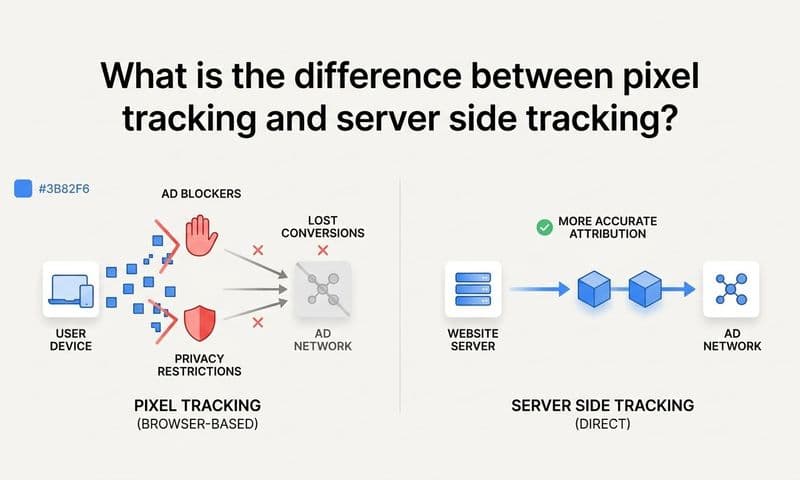
Browser-based pixel tracking has become increasingly unreliable, and this problem is amplified in international markets. Ad blocker adoption varies significantly by country, and cookie consent requirements differ across regions. The result is that client-side pixels miss a meaningful portion of conversion events in many international markets, which skews your data and undermines your attribution.
Server-side tracking via Conversion APIs is now the standard approach for maintaining data quality in cross-border campaigns. Instead of relying on a browser to fire a pixel, server-side tracking sends conversion events directly from your server to the ad platform's API. This bypasses ad blockers, cookie restrictions, and browser-level limitations entirely.
For most B2B SaaS teams, this means implementing the Meta Conversion API and Google Enhanced Conversions at minimum. If LinkedIn is a significant channel for your international campaigns, LinkedIn's Conversions API should be on your list as well. Each implementation should be configured to include region-specific parameters, particularly country code and currency, so your attribution platform can segment conversion data by market.
When mapping your conversion events for international funnels, think beyond the initial form fill. In B2B SaaS, the journey from first touch to closed revenue often includes multiple meaningful events: a content download, a demo booking, a trial start, a product qualified lead designation in your CRM, and eventually a closed-won opportunity. Each of these stages should be tracked as a distinct conversion event, and each event should carry the geographic context needed to attribute it to the right regional campaign.
One critical technical consideration is deduplication. When you run both client-side pixels and server-side Conversion API tracking simultaneously, which is the recommended approach for maximum coverage, you must implement event deduplication to prevent double-counting. This is handled by passing a consistent event ID in both the pixel event and the server-side event. Your ad platform then uses this ID to recognize that both signals represent the same conversion and counts it only once.
Test your deduplication logic carefully across each region before scaling. A double-counted conversion in one market can distort your ROAS calculations and send your ad platform's algorithm chasing the wrong signals.
Success indicator: Your Conversion API is sending enriched events with country, currency, and lead data back to your ad platforms, and your event match rates are strong. A match rate above 80 percent is a good benchmark to target, as higher match rates lead to better audience targeting and algorithmic optimization in each regional market.
Step 4: Choose the Right Attribution Model for Multi-Region B2B Funnels
Attribution model selection is where many international campaigns go wrong in ways that are hard to detect. The default choice for most teams is last-click attribution, and in international B2B campaigns, this is especially misleading.
Think about what a typical B2B buying journey looks like in a new market. A buyer might first encounter your brand through a LinkedIn thought leadership post, then research you through organic search, then click a retargeting ad, and finally respond to a direct email before booking a demo. Last-click attribution gives 100 percent of the credit to that final email or retargeting ad and assigns zero value to the LinkedIn content and search activity that built the intent in the first place. In international markets where you are investing heavily in awareness to build brand recognition from scratch, this systematically under-credits the channels doing the most important work.
Multi-touch attribution models distribute credit across every interaction in the journey, which is far more accurate for B2B funnels and critical when buyers in different regions engage through different channel mixes. The right attribution model depends on the characteristics of each market.
Linear attribution distributes credit equally across all touchpoints. This works well in markets with longer sales cycles where multiple interactions genuinely contribute to the decision.
Time-decay attribution gives more credit to touchpoints closer to conversion. This can be useful in markets where the final stages of the sales process are particularly intensive.
Position-based attribution weights the first and last touches most heavily, with the middle interactions sharing the remainder. This suits markets with a clear awareness phase followed by a direct conversion path.
Data-driven attribution uses machine learning to assign credit based on actual conversion patterns in your data. This is the most accurate model, but it requires sufficient conversion volume to produce statistically meaningful results. For newer or smaller regional markets, you may need to use a rule-based model until you accumulate enough data.
Critically, your attribution model should connect to pipeline and revenue data, not just lead counts. A campaign that generates many leads in a region but produces no closed deals is not performing well, even if the cost per lead looks attractive. Connecting your attribution to CRM stage progressions and closed-won revenue gives you the full picture.
Success indicator: Your attribution reports show which channels and campaigns in each region are contributing to pipeline at every stage of the funnel, not just at the top.
Step 5: Build Region-Specific Dashboards With Unified Cross-Market Reporting
Once your tracking and attribution are configured correctly, the next challenge is making the data accessible and actionable for everyone who needs it. International campaign data has two distinct audiences with different needs: regional marketers who need to optimize local performance, and growth leaders who need to allocate budget across markets based on comparative ROI.
The solution is a two-layer reporting structure. Build separate dashboard views for each target region so regional marketers can monitor local performance without noise from other markets. These regional views should include the metrics most relevant to that market's stage and objectives: cost per qualified lead, pipeline generated, conversion rate by funnel stage, and channel performance breakdown.
At the same time, build a unified global dashboard that aggregates performance across all regions using a single currency baseline. This is essential for accurate spend and revenue comparisons. When you are evaluating whether to increase budget in the UK versus Germany, you need both markets expressed in the same currency. Many attribution platforms support currency normalization natively, which automates this conversion and keeps your global view current as exchange rates shift.
The metrics that matter most for your global view include cost per qualified lead by region, pipeline attributed by market, revenue influenced by channel per country, and return on ad spend normalized to a single currency. These are the numbers that drive budget allocation decisions at the leadership level.
Set up automated alerts for anomalies in regional conversion rates or cost per acquisition. A sudden drop in conversion rate in a specific market often signals a tracking issue rather than a genuine performance change. Catching this early prevents you from making budget decisions based on corrupted data.
Use your attribution platform to compare attribution models side by side across regions. This reveals where your default model may be systematically under-crediting certain channels in specific markets, which is a common source of budget misallocation in international campaigns.
Success indicator: You can answer the question of which region delivers the best return on ad spend within 60 seconds of opening your dashboard, without needing to pull data from multiple sources or perform manual calculations.
Step 6: Feed Enriched Regional Data Back to Ad Platforms to Improve Optimization
Most teams think of tracking as a one-way flow: data comes from the ad platform into your attribution system. But the most sophisticated international campaigns treat it as a two-way exchange. The conversion signals you send back to ad platforms directly influence how their algorithms optimize your campaigns, and the quality of those signals determines the quality of your targeting in every market.
Ad platform algorithms optimize based on the conversion events you define. If you are only sending top-of-funnel signals like form fills, the algorithm will optimize for lead volume rather than lead quality. In international markets where lead quality varies significantly by region, this can lead to campaigns that generate high volumes of poor-fit leads while missing the high-value buyers you actually want.
Use your Conversion API integration to send offline conversion events back to Meta and Google. This includes CRM stage updates as leads progress through your pipeline, and ideally closed-won revenue data when deals close. When the algorithm sees that certain audience segments in a specific region consistently progress to closed revenue, it learns to find more of those buyers.
Segment your conversion feeds by region so that each country's ad campaigns are optimized against that region's actual conversion patterns rather than a blended global average. A buyer profile that converts well in the US may look quite different from a high-value buyer in Germany or Singapore. Regional segmentation allows the algorithm to develop a more accurate model for each market independently.
Include lead quality signals in your conversion events where possible. Company size, industry, and estimated deal value are attributes that can be passed back through your Conversion API to help ad platforms identify higher-value prospects in each market. This is where connecting your CRM data to your ad platform signals becomes genuinely powerful.
Regularly audit the match rate and event quality score for each regional feed inside your ad platform accounts. Match rates can degrade over time as data changes, and catching degradation early prevents it from silently undermining your campaign optimization.
Success indicator: Your regional campaigns show improving conversion rates over time as ad platform algorithms learn from the enriched data you are sending back. This improvement is gradual but measurable, typically becoming visible after several weeks of consistent signal quality.
Putting It All Together: Your International Campaign Tracking Checklist
Building accurate tracking for international campaigns is not a one-time project. It is an ongoing practice that requires regular auditing as your markets evolve, new platforms emerge, and your funnel matures. But starting with a solid foundation makes everything else easier.
Here is a quick reference checklist before you launch any new international campaign:
1. Audit your existing tracking setup for gaps in geographic data capture, UTM consistency, and cross-domain event firing.
2. Establish and enforce a standardized campaign naming convention that encodes region, language, objective, and channel into every campaign name across all platforms.
3. Configure server-side tracking and Conversion APIs for each region, including deduplication logic and region-specific parameters in every event.
4. Select attribution models appropriate to each market's funnel structure and volume, and connect attribution to pipeline and revenue data rather than just leads.
5. Build both regional dashboards for local optimization and a unified global view with normalized currency for cross-market budget decisions.
6. Feed enriched, region-segmented conversion data back to your ad platforms to improve algorithmic optimization in each market over time.
The biggest risk in global campaigns is not poor creative or the wrong channel mix. It is broken or incomplete tracking that makes every other decision unreliable. When your data is wrong, your budget allocation is wrong, your optimization signals are wrong, and your growth strategy is built on a flawed foundation.
Cometly is built to eliminate that risk. It connects your ad platforms, CRM, server-side tracking, and revenue data into a single source of truth, so you can see exactly which campaigns and channels are driving pipeline and revenue in every market you operate in. With multi-touch attribution, AI-powered insights, and 70+ native integrations, Cometly gives B2B SaaS marketing teams the clarity they need to scale international campaigns with confidence.
Ready to get full visibility into your international campaign performance? Get your free demo and start capturing every touchpoint across every market to maximize your conversions.