You check your Google Ads dashboard and see a handful of conversions. You check your CRM and see a pipeline full of leads, demos booked, and deals moving toward close. The numbers don't match, and the gap is bigger than you'd expect from normal rounding errors. If this scenario sounds familiar, you're dealing with one of the most frustrating and costly problems in B2B SaaS marketing: underreported conversions in Google Ads.
This isn't a minor data discrepancy you can shrug off. When your ad platform is missing conversions, it's not just an analytics problem. It's a bidding problem, a budget problem, and ultimately a revenue problem. The algorithms that control how your money gets spent are making decisions based on incomplete information, and the gap between what Google Ads sees and what your CRM records can quietly drain your marketing ROI over time.
The good news is that this problem is solvable. Understanding why it happens is the first step, and from there, there's a clear path toward building a tracking stack that gives you accurate, actionable data. This article walks through the root causes of conversion gaps, the real costs they create, and the technical and strategic fixes that B2B SaaS teams can implement to get their Google Ads data aligned with reality.
Why Google Ads Misses More Conversions Than You Think
Google Ads conversion tracking was built around a relatively simple model: a user clicks an ad, lands on your site, and a pixel fires when they reach a confirmation or thank-you page. For straightforward e-commerce transactions, this works reasonably well. For B2B SaaS companies with complex, multi-touch buying journeys, it falls short in ways that are both predictable and significant.
The core issue is that Google Ads relies primarily on pixel-based, client-side tracking. That means a JavaScript tag has to fire correctly in the user's browser at exactly the right moment. Any disruption in that chain, whether it's a slow page load, a browser setting, or a script conflict, means the conversion goes unrecorded. The platform never knows it happened.
Browser-level privacy changes have made this problem considerably worse over recent years. Apple's Intelligent Tracking Prevention in Safari limits the lifespan of cookies used for attribution. Firefox's Enhanced Tracking Protection blocks many third-party tracking scripts by default. Ad blockers, which are widely used among the tech-savvy B2B audience that many SaaS companies target, can prevent conversion tags from firing entirely. The cumulative effect is a systematic reduction in the reliability of client-side tracking that affects virtually every Google Ads account.
Multi-session and multi-device journeys compound the problem further. Think about how a typical B2B buyer actually behaves. They might see a Google Ad on their phone during a commute, save the link, and come back to it on their work laptop two days later. They research competitors, read reviews, and eventually fill out a demo request form a week after that initial click. Standard pixel tracking, which depends on cookies persisting across sessions on the same device, often fails to connect that final conversion back to the original ad click.
For B2B SaaS companies specifically, this is especially damaging. Your buyers are researchers. They compare solutions carefully, involve multiple stakeholders, and rarely convert on a first visit. The longer and more complex the journey, the more opportunities there are for the tracking chain to break. What Google Ads ends up seeing is a fraction of the conversions your campaigns are actually generating, and the platform treats that fraction as the complete picture.
Industry practitioners widely recognize that the gap between actual conversions and platform-reported conversions has grown as privacy protections have expanded. The problem isn't going away on its own, and hoping the pixel catches everything is no longer a viable strategy for teams that need accurate data to make good decisions. Understanding the full scope of Google Ads conversion tracking limitations is essential before you can build a reliable fix.
The Hidden Costs of Incomplete Conversion Data
When conversion data is incomplete, the damage doesn't stay contained to your reporting dashboard. It ripples outward into every decision your campaigns make, often in ways that are hard to detect until significant budget has already been misallocated.
Google's Smart Bidding strategies, including Target CPA, Target ROAS, and Maximize Conversions, are entirely dependent on the quality and volume of conversion signals the platform receives. These algorithms are sophisticated, but they can only optimize toward what they can see. When underreported conversions in Google Ads mean the platform is working with a partial dataset, Smart Bidding effectively optimizes toward a distorted version of reality.
The practical consequence is that campaigns driving real pipeline activity may appear to underperform because their conversions aren't being fully captured. Smart Bidding may reduce spend on those campaigns, shift budget toward campaigns with better-looking but equally incomplete data, or simply fail to find the bidding patterns that would maximize your actual return. You're essentially paying a sophisticated algorithm to make decisions based on bad inputs.
Cost-per-acquisition calculations are similarly distorted. If a campaign is generating twice as many conversions as Google Ads is recording, your reported CPA looks twice as high as it actually is. A campaign that appears expensive and inefficient may actually be one of your best performers. Teams that rely on platform-reported CPA to make pause and scale decisions are routinely making those calls on flawed data, and the result is often pausing campaigns that should be scaled and scaling campaigns that don't deserve the budget.
For B2B SaaS companies with longer sales cycles, the damage compounds over time in a particularly insidious way. The gap between an ad click and a closed-won deal can span weeks or months. During that time, pipeline and revenue attribution become increasingly unreliable as the tracking chain accumulates more opportunities to break. By the time a deal closes, the connection back to the originating ad campaign may have been lost entirely. This mirrors the same challenge documented in Google Analytics missing conversions, where attribution gaps silently distort performance data.
This creates a real problem when it comes to justifying ad spend to leadership. If you can't accurately connect Google Ads campaigns to pipeline and revenue, you're left making qualitative arguments for budget that should be supported by hard data. Teams that fix their conversion tracking gain a significant advantage here: they can speak confidently about which campaigns are driving revenue and defend their budget decisions with numbers that hold up to scrutiny.
The Most Common Causes of Conversion Gaps in Google Ads
Tag firing failures: Conversion tags that depend on a user reaching a specific thank-you page URL are fragile by design. When page structures change, URL patterns shift, or the page loads slowly enough that the tag doesn't fire before the user navigates away, the conversion is silently lost. These failures often go undetected for weeks because there's no obvious error signal. Your campaigns keep running, your budget keeps spending, and the conversion data quietly degrades.
Cross-domain tracking breaks: Many B2B SaaS companies operate across multiple domains or subdomains. A prospect might start on your marketing site, move to an app subdomain to start a trial, or pass through a third-party scheduling tool to book a demo. Each domain transition creates an opportunity for the tracking chain to break. Without explicit cross-domain tracking configuration, Google Ads loses the thread of the user journey at each handoff, and conversions that happen on a different domain than the one where the ad click landed are often never attributed.
Missing offline and CRM-level events: This is arguably the most significant gap for B2B SaaS teams. Default Google Ads conversion tracking captures events that happen in the browser, typically form submissions and page views. But the conversions that actually matter for B2B companies, qualified lead status, demo completions, trial activations, and closed-won deals, happen in your CRM, not in a browser window. These events are almost never captured by standard pixel tracking, which means Google Ads is optimizing toward form fills rather than revenue. Learning how to track sales leads through your CRM and feed those signals back to your ad platform is critical for closing this gap.
Ad blocker interference: The B2B tech audience skews heavily toward users who run ad blockers. When a conversion tag can't fire because a browser extension is blocking it, that conversion disappears from your data entirely. This is a client-side tracking problem with no client-side solution.
iOS and browser privacy restrictions: Safari's Intelligent Tracking Prevention limits cookie persistence to as little as 24 hours in some configurations. For B2B buyers who research over multiple days before converting, this means the attribution window closes before the conversion happens. The click is forgotten, and the conversion gets attributed to direct traffic or another source entirely. Understanding how direct traffic in Google Analytics absorbs misattributed conversions helps illustrate how significant this problem can be.
Each of these failure modes contributes to the overall gap between what Google Ads reports and what your CRM actually shows. In most B2B SaaS accounts, the combination of all these factors means a meaningful portion of real conversions are simply invisible to the platform.
Server-Side Tracking and Google Enhanced Conversions: The Technical Fix
The good news is that Google has built tools specifically designed to address signal loss, and the broader industry has developed server-side tracking approaches that eliminate many of the vulnerabilities inherent in client-side setups. Using these tools together creates a significantly more reliable foundation for conversion data.
Google Enhanced Conversions is a feature built directly into Google Ads that improves measurement accuracy by using hashed first-party customer data. When a conversion occurs, Enhanced Conversions sends a privacy-safe, hashed version of customer data such as an email address or phone number alongside the conversion event. Google can then use that data to match the conversion to a user in its ecosystem, even if the original cookie was lost or blocked. A thorough understanding of Enhanced Conversions in Google Ads is essential for any team serious about recovering lost attribution signals. This is particularly effective for recovering conversions that would otherwise fall through the cracks due to browser restrictions or cross-device journeys.
Implementing Enhanced Conversions requires that you capture first-party data at the point of conversion, which most B2B SaaS companies already do through form submissions. The setup involves passing that hashed data through your Google tag or Google Tag Manager configuration. It's a meaningful improvement over standard pixel tracking and is officially supported and documented by Google as a direct response to signal loss challenges.
Server-side tracking takes a more fundamental approach by moving the conversion event firing from the user's browser to a secure server environment. Instead of relying on a JavaScript tag to fire correctly in whatever browser state the user happens to be in, server-side tracking processes the conversion on your own infrastructure and sends it directly to Google's servers. Ad blockers can't interfere because there's no client-side script to block. Browser privacy settings become irrelevant because the data never passes through the browser in the first place.
Google Tag Manager supports server-side container configurations, which provides a structured way to implement this approach without building entirely custom infrastructure. However, setting up server-side tracking properly requires connecting your backend systems to the tagging environment, which is where many teams encounter friction. You need your web application or CRM to send events to your server-side container, which then forwards them to Google Ads with the correct attribution data attached.
The combination of Enhanced Conversions and server-side tracking addresses most of the browser-level and device-level causes of underreported conversions. But it still doesn't solve the problem of CRM-level events that never touch the browser at all. For that, you need a different approach.
Connecting CRM Data to Google Ads for Full-Funnel Visibility
The most valuable conversion signals for B2B SaaS companies live in your CRM, not in your browser. Qualified leads, demo completions, trial activations, pipeline stage progressions, and closed-won deals are the events that actually predict and represent revenue. Getting these signals into Google Ads is what separates a basic tracking setup from a full-funnel attribution strategy.
Google Ads natively supports offline conversion imports, which allow you to send CRM-level events back to the platform via CSV upload or API. The process works by matching the Google Click ID (GCLID) that was captured when the user first clicked your ad against the conversion event recorded in your CRM. When the match is found, Google Ads credits the original ad click with that conversion, even if it happened weeks after the initial click.
This capability is genuinely powerful and significantly underutilized by B2B advertisers. Many teams are tracking form fills as their primary conversion action when they could be importing qualified lead status, demo scheduled, demo completed, and opportunity created as separate conversion actions with different values assigned to each. This gives Smart Bidding a much richer signal to work with, and it gives you a much more accurate picture of which campaigns are driving meaningful pipeline activity versus just generating top-of-funnel form submissions that may never progress. Leveraging paid ads analytics that incorporate CRM data is what makes this level of insight possible.
Mapping CRM milestones to Google Ads conversion actions is a strategic decision as much as a technical one. You need to think carefully about which events actually predict revenue for your business and assign conversion values that reflect their relative importance. A demo completed event might be worth significantly more than a content download, and Smart Bidding should know the difference. When the algorithm understands what actually matters, it can optimize toward the right outcomes rather than treating all conversions as equivalent.
For B2B SaaS teams using subscription billing, connecting Stripe or similar revenue data to your ad attribution closes the final gap in the funnel. This is where you move from optimizing toward proxy metrics like demo requests to optimizing toward actual revenue events. When Google Ads can see that a specific campaign generated paying customers with a certain average contract value, Smart Bidding has the highest-quality signal possible for making bidding decisions.
The challenge is that maintaining these connections manually, through regular CSV uploads or custom API integrations, is operationally intensive and prone to gaps. The GCLID that connects the ad click to the CRM record needs to be captured and stored correctly at every step of the journey, and any break in that chain means the conversion import fails silently. Teams that rely on ad tracking tools built for accurate data can automate much of this process and reduce the risk of silent failures.
How a Dedicated Attribution Platform Closes the Gap
Building and maintaining the technical infrastructure to solve underreported conversions in Google Ads is achievable, but it requires ongoing effort and expertise that many marketing teams don't have in-house. A purpose-built attribution platform addresses this by handling the complexity of multi-touch tracking, CRM integration, and conversion signal enrichment in a unified system.
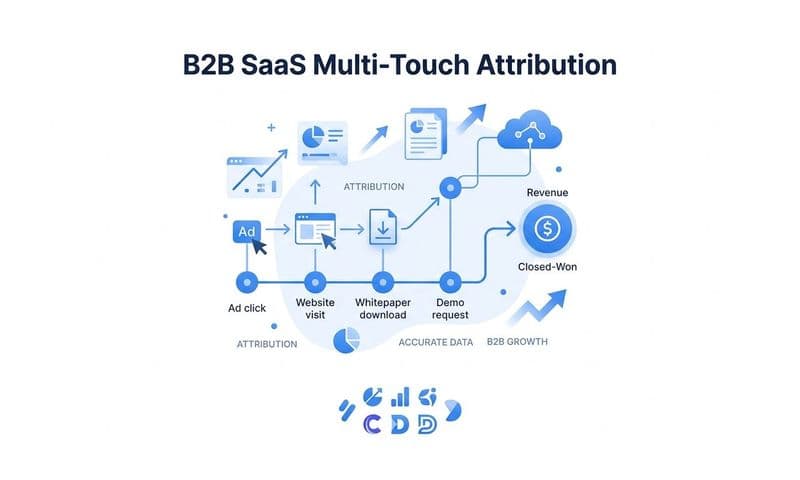
The fundamental advantage of a dedicated attribution platform is that it doesn't depend on any single tracking mechanism. Rather than relying solely on the Google Ads pixel, it captures touchpoints across the entire customer journey using multiple data collection methods. Ad clicks, CRM events, revenue milestones, and behavioral signals are all brought together into a single view of the customer journey. This means that even when individual tracking methods fail, the overall picture remains intact.
By acting as a single source of truth, attribution software reconciles what Google Ads reports against what your CRM records. This reconciliation is where the real value becomes visible. You can see not just the conversions Google Ads claims credit for, but the full volume of conversions and revenue that can be traced back to your campaigns through multiple attribution paths. The gap between platform-reported data and CRM reality becomes measurable and manageable rather than a persistent source of uncertainty. The same principle applies across channels, as teams dealing with Facebook Ads reporting discrepancies face an identical challenge of reconciling platform data against actual business outcomes.
Platforms like Cometly are built specifically for this challenge in the B2B SaaS context. Cometly connects your ad platforms, CRM, and billing systems to track the entire customer journey in real time, from the first ad click through to closed-won revenue. It captures every touchpoint and sends enriched, conversion-ready events back to Google Ads, improving the quality of data the platform receives and enabling smarter bidding decisions based on real revenue signals rather than incomplete pixel data.
This matters for Smart Bidding in a direct and practical way. When Google Ads receives enriched conversion signals that include downstream CRM events and revenue data, its algorithms have a more accurate model of what a valuable conversion actually looks like. The result is bidding that optimizes toward the customers most likely to generate revenue, not just the users most likely to fill out a form.
For B2B SaaS marketing teams and growth leaders who need to justify ad spend with accurate pipeline and revenue data, this level of attribution visibility is the difference between making decisions based on guesswork and making decisions based on evidence. The ability to connect every ad dollar to its downstream revenue impact is what makes scaling profitable campaigns possible with confidence.
Building a Reliable Conversion Tracking Stack
Fixing underreported conversions in Google Ads isn't a single action. It's a layered strategy that addresses different failure modes at different levels of your tracking architecture.
Think of it in three layers. The baseline layer is your pixel tracking, properly configured with Enhanced Conversions enabled and cross-domain tracking set up correctly. This handles the browser-level conversions that client-side tracking can capture reliably. The reliability layer is server-side tracking, which removes the dependency on browser behavior and eliminates the vulnerability to ad blockers and privacy restrictions. Together, these two layers handle the majority of the technical causes of conversion gaps.
The full-funnel signal layer is where B2B SaaS companies differentiate themselves. This is the CRM and revenue data that standard tracking never touches: qualified leads, demo completions, pipeline stages, and closed-won revenue. Connecting these signals to Google Ads, whether through offline conversion imports, API integrations, or a dedicated attribution platform, is what transforms your conversion data from a proxy metric into a genuine revenue signal.
It's worth emphasizing that this is a strategic investment, not just a technical one. When your Google Ads conversion data accurately reflects revenue reality, every downstream decision improves. Bidding becomes more efficient. Budget allocation becomes defensible. Campaign performance becomes comparable on a like-for-like basis. The ability to scale profitable campaigns with confidence depends on having data you can trust.
The teams that address underreported conversions systematically gain a real competitive advantage. Their algorithms are better informed. Their budgets are better allocated. And their ability to connect ad spend to revenue gives them a foundation for growth that teams still relying on incomplete pixel data simply don't have.
If you're ready to stop guessing and start seeing the full picture of what your Google Ads campaigns are actually driving, explore how Cometly connects ad platforms, CRM data, and revenue events to give B2B SaaS teams accurate, actionable attribution data. Get your free demo today and start capturing every touchpoint to maximize your conversions.