You run a display campaign for six weeks. Users see your ads, scroll past them, and never click. Then, three weeks later, a wave of demo requests comes in. Were those ads responsible? How would you even know?
This is the exact tension that view through conversions tracking was built to address. It sits at the intersection of brand influence and measurable action, trying to answer one of the hardest questions in digital advertising: did an ad that nobody clicked actually do anything?
For B2B SaaS marketing teams running multi-channel campaigns, this question carries real weight. Your buyers don't convert on a first impression. They research, compare, revisit, and deliberate over weeks or months. During that time, they might see a dozen of your ads without clicking a single one. Dismissing those impressions entirely leaves a gap in your understanding of what actually drove the conversion. Trusting them completely inflates your numbers and distorts your budget decisions.
The answer, as with most things in attribution, is somewhere in the middle. This article will walk you through exactly how view through conversions work, where the data lives across platforms, how to compare it against click-based attribution, and how to use it responsibly as part of a broader multi-touch strategy. By the end, you'll have a clear framework for making view through data work for you rather than against you.
The Invisible Influence: How View Through Conversions Actually Work
A view through conversion is recorded when a user sees an ad impression without clicking on it, and then completes a conversion action within a defined lookback window. The key distinction from a click through conversion is that no click is involved at any point. The user saw the ad, moved on, and later converted through some other path, whether that was an organic search, a direct visit, or a referral.
The mechanics work like this: when a user is served an ad impression, the ad platform records that event and associates it with the user's identity, typically through a browser cookie, a device identifier, or probabilistic fingerprinting. If that same user completes a conversion event within the lookback window on the same device, the platform attributes that conversion to the impression. No click required.
This is fundamentally different from click through attribution, where there's a clear, traceable path: user clicks ad, lands on your site, completes a form. With view through attribution, the connection is inferred. The platform is saying, "this user saw your ad and later converted, so we're giving your ad some credit." Whether that credit is deserved depends heavily on context.
The lookback window is one of the most important variables in this entire framework. It defines how long after an impression a conversion can still be attributed to that impression. Common windows range from one day to thirty days depending on the platform and campaign type. A one-day window means that only conversions happening within twenty-four hours of the impression count. A thirty-day window casts a much wider net.
Longer windows capture more conversions, which sounds appealing until you realize they also capture far more noise. A user who saw your ad twenty-eight days ago and converted today may have been influenced by a dozen other touchpoints in the interim. Attributing that conversion to the original impression overstates its impact. Shorter windows are more conservative and more defensible, especially in B2B contexts where the sales cycle extends well beyond any reasonable lookback period. Understanding what view through conversions actually measure is the foundation for using them responsibly.
Understanding these mechanics is the foundation. Once you know how view through conversions are recorded, you can start evaluating whether the data you're seeing from each platform is actually telling you something useful.
Where View Through Data Lives: Platform Differences You Need to Know
Here's where things get complicated fast. Meta Ads, Google Ads, and LinkedIn Ads all handle view through attribution differently, and those differences have real consequences for how you interpret your data.
Meta Ads Manager defaults to a seven-day click and one-day view attribution window. This means Meta will attribute a conversion to your ad if the user clicked within seven days or viewed within one day. You can adjust this to a one-day click, seven-day click, one-day view, or seven-day view window, but the default is what most advertisers are working with unless they've actively changed it. Meta's own attribution settings documentation outlines these options clearly.
Google Ads treats view through conversions separately from click-based conversions for Display and YouTube campaigns. By default, Google defines a view through conversion as one that occurs within thirty days of a viewable impression, though this window is configurable. Importantly, Google reports these separately in the interface, which is actually helpful for analysis. You can see click-based conversions and view through conversions as distinct columns rather than having them blended together.
LinkedIn Ads tracks view through conversions for Sponsored Content and other ad formats, with a default seven-day view window. If you're running LinkedIn campaigns as part of your B2B strategy, this data is available but often underexamined.
Now here's the problem that emerges when you look across all three platforms at once. Suppose a user sees a Meta ad on Monday, sees a Google Display ad on Wednesday, and then converts via organic search on Friday. Meta may claim a view through conversion. Google may claim a view through conversion. Both platforms are technically correct within their own attribution logic, but the actual conversion happened once. This is the double-counting problem, and it's one of the most well-documented challenges in tracking conversions across multiple ad platforms.
When you add up reported conversions across your ad platforms, the total almost always exceeds your actual conversion count. View through attribution amplifies this problem because it widens the net of what each platform can claim credit for.
The reliability of this data has also been eroded by privacy changes. iOS 14 and subsequent Apple privacy updates significantly reduced the effectiveness of pixel-based tracking, including impression tracking. When users opt out of tracking, ad platforms lose visibility into whether that user later converted. This is documented extensively by Meta, Google, and industry analysts, and it means view through data is increasingly incomplete for audiences using Apple devices or privacy-focused browsers.
Server-side tracking and Conversion APIs were developed in part to address this degradation. Meta's Conversions API and Google's Enhanced Conversions allow advertisers to send first-party event data directly from their servers to the ad platforms, bypassing browser-level limitations. This improves the accuracy of all conversion data, including view through attribution, by reducing the gap created by cookie blocking and opt-outs. Understanding tracking conversions after iOS updates is essential for any team relying on impression-level data.
View Through vs. Click Through: Choosing the Right Attribution Lens
Not all campaigns benefit equally from view through attribution. Understanding when it's genuinely useful versus when it overstates ad impact is what separates a rigorous attribution strategy from one that simply makes your numbers look better.
View through attribution is most defensible in two scenarios. The first is high-funnel brand awareness campaigns, where the goal is to build recognition and familiarity over time rather than drive immediate action. In these campaigns, users are not expected to click. The impression itself is the delivery mechanism. Measuring only click-based conversions would systematically undervalue these campaigns.
The second strong use case is retargeting campaigns targeting warm audiences. If someone has already visited your site, engaged with your content, or interacted with your brand, a display ad reinforcing that message may genuinely influence their decision to convert even without a direct click. Here, the view through signal carries more credibility because you're dealing with an audience that already has some intent.
Where view through attribution becomes more problematic is in lower-funnel campaigns targeting cold audiences with direct response objectives. If you're running ads to drive trial signups or demo requests from a cold audience, attributing conversions to impressions without clicks inflates your results and makes it harder to evaluate true campaign efficiency.
This is where multi-touch attribution becomes the more useful framework. Rather than choosing between view through and click through attribution, a multi-touch model incorporates both as inputs and distributes credit across the full customer journey. For B2B SaaS buyers with long sales cycles, this matters enormously. A prospect might see a display ad, later click a LinkedIn ad, read a case study, and then convert after a Google search. Each touchpoint played a role. A model that only credits the final click misses the full picture, and a model that over-credits impressions distorts it in the opposite direction.
The concept of weighting is central to making this work. In most attribution frameworks, view through conversions should carry less weight than click through conversions. A click is an active signal of intent. An impression is a passive exposure. Weighting them equally would overstate the influence of ads that users never engaged with directly.
How you set those weights shapes how you evaluate campaign ROI and make budget allocation decisions. A campaign that looks strong on view through data alone may look very different when view through conversions are appropriately downweighted relative to clicks. This is why reporting them separately, and being deliberate about how they're factored into your models, is so important.
The B2B SaaS Challenge: Long Sales Cycles and Multi-Touch Reality
B2B SaaS buying cycles are fundamentally different from B2C purchases. Buyers research for weeks or months, involve multiple stakeholders, and rarely convert on a first exposure to your brand. This is a widely accepted characteristic of the B2B market, and it has direct implications for how view through tracking should be applied.
A display ad seen by a VP of Marketing in week one of their research process may genuinely influence a demo booking that happens six weeks later. The impression created awareness, established brand familiarity, and may have been one of several factors that kept your product on the shortlist. Dismissing that impression entirely because no click occurred misses a real part of the buyer journey.
At the same time, a thirty-day lookback window in a B2B context is almost certainly too short to capture the full influence of early-funnel impressions, while simultaneously being long enough to introduce significant attribution noise. This is the core tension: the sales cycles that make view through data most relevant are also the ones that make it hardest to attribute accurately.
The deeper challenge is that pipeline attribution and revenue attribution require connecting marketing touchpoints to CRM events, not just website conversion events. A website conversion, like a form fill or a trial signup, is one step in a longer journey. The actual revenue event, a closed-won deal, may happen weeks or months later and involve sales activity, product demos, and multiple decision-makers. Tracking SaaS trial to paid conversions is where view through data must ultimately connect to be meaningful for B2B teams.
This means connecting impression data to CRM records, linking ad platform events to opportunity stages, and ultimately tying marketing activity to pipeline and closed revenue. When view through data stays siloed at the ad platform level and never connects to downstream revenue outcomes, it's impossible to evaluate its true contribution to the business.
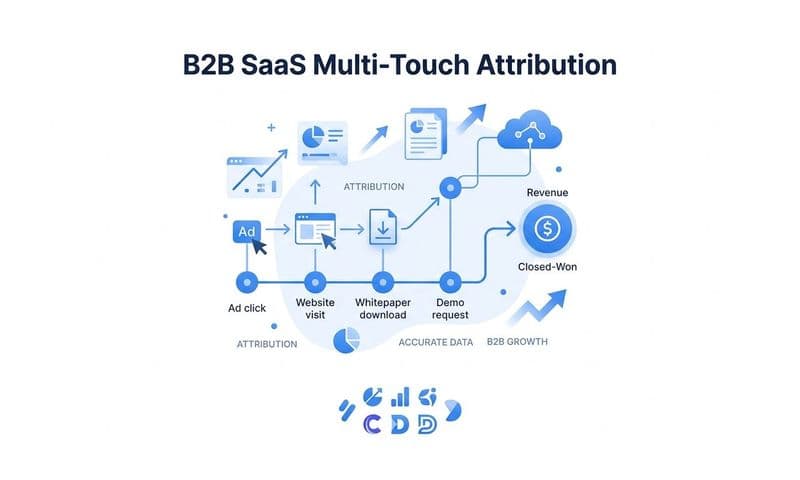
Consider a typical B2B SaaS journey: a prospect sees a LinkedIn Sponsored Content ad, attends a webinar two weeks later, and then books a demo after a Google search. The LinkedIn impression may have been the first touchpoint that introduced your brand. The webinar deepened engagement. The Google search was the final conversion trigger. Understanding that full sequence requires more than pixel-level impression data. It requires connecting every touchpoint across channels and mapping them to the revenue outcome.
This is where many B2B SaaS teams hit a wall. Their ad platforms report view through conversions, their CRM tracks deals, and their website analytics captures clicks, but these systems don't talk to each other. The result is fragmented data that makes it impossible to evaluate the real contribution of any single touchpoint, including view through impressions. A proper touchpoint attribution tracking strategy is what bridges this gap.
Making View Through Data Trustworthy: Tracking Best Practices
If you want view through data to be useful rather than misleading, it requires deliberate configuration and disciplined reporting. There are several practices that make the difference between data you can act on and data that just inflates your numbers.
Use shorter, more conservative lookback windows. A one-day view window is more defensible than a thirty-day window for most B2B campaigns. The longer the window, the more likely it is that other touchpoints influenced the conversion, and the weaker the case for attributing it to the original impression. Start conservative and adjust based on what you learn about your actual buyer behavior.
Implement server-side tracking and Conversion APIs. Browser-based impression tracking is increasingly unreliable due to cookie blocking, iOS privacy changes, and browser restrictions. Sending enriched first-party data directly from your server to ad platforms through Meta's Conversions API or Google's Enhanced Conversions improves the accuracy of all your conversion data, including view through attribution. It reduces the gap created by users who opt out of tracking at the browser level and gives ad platform algorithms better data to optimize against. Learn more about why server-side tracking is more accurate for attribution use cases like this.
Report view through conversions separately from click through conversions. This is one of the most important practices and one of the most commonly ignored. When view through and click through conversions are blended into a single reported number, you lose the ability to evaluate each independently. Your dashboard should show them as distinct metrics so you can understand the incremental contribution of each rather than a combined total that obscures true performance.
Avoid using view through conversions as your primary optimization signal. Ad platforms will optimize toward whatever conversion event you define as success. If you include view through conversions in your primary conversion metric, you risk training your campaigns to generate impressions that look like conversions without actually driving meaningful business outcomes. Use click-based conversions or downstream CRM events as your primary signal, and treat view through data as supplementary context.
Audit for double-counting regularly. Cross-reference your total reported conversions across platforms against your actual conversion count from your CRM or analytics platform. If the sum of platform-reported conversions significantly exceeds your actual conversions, view through attribution is likely a major contributor. This audit helps you calibrate how much weight to give platform-reported numbers when making budget decisions. Teams struggling with inaccurate ad tracking often find view through double-counting is a primary culprit.
Putting It All Together: Building a Smarter Attribution Strategy
View through conversions are a signal, not a definitive measure of ROI. This is the most important framing to carry into any conversation about how to use this data. They tell you that an impression occurred and that a conversion followed, but they don't prove causation. The degree to which the impression influenced the conversion depends on the campaign type, the audience, the timing, and what else happened in between.
The right approach is to use view through data as one input in a broader multi-touch attribution model rather than as standalone proof of campaign performance. When combined with click data, CRM events, and revenue outcomes, view through impressions can add genuine context to your understanding of the customer journey. When used in isolation, they tend to inflate results and mislead budget decisions.
This is precisely where having a unified attribution platform makes the difference. Cometly connects ad impression data, click data, CRM events, and revenue in one place, giving B2B SaaS teams a complete view of the customer journey from first touchpoint to closed-won deal. Rather than relying on platform-reported metrics that each tell a partial story, Cometly gives you a single source of truth that connects every touchpoint to actual business outcomes.
With Cometly, you can apply the right attribution model for your business, whether that's first touch, last touch, linear, time decay, or a custom multi-touch model, and see how view through impressions fit into that framework alongside clicks, form fills, pipeline stages, and revenue. You can also send enriched conversion data back to your ad platforms through server-side integrations, improving the quality of your campaigns' optimization signals.
The result is attribution data you can actually trust and act on. Not inflated platform numbers, not siloed channel reports, but a coherent picture of what's driving your pipeline and where your budget is generating real returns.
If your current setup leaves you guessing about whether your display and video impressions are contributing to revenue, it's worth exploring what a proper attribution infrastructure can do. Get your free demo and see how Cometly helps you move beyond platform-reported metrics and build a single source of truth for all your conversion data.