
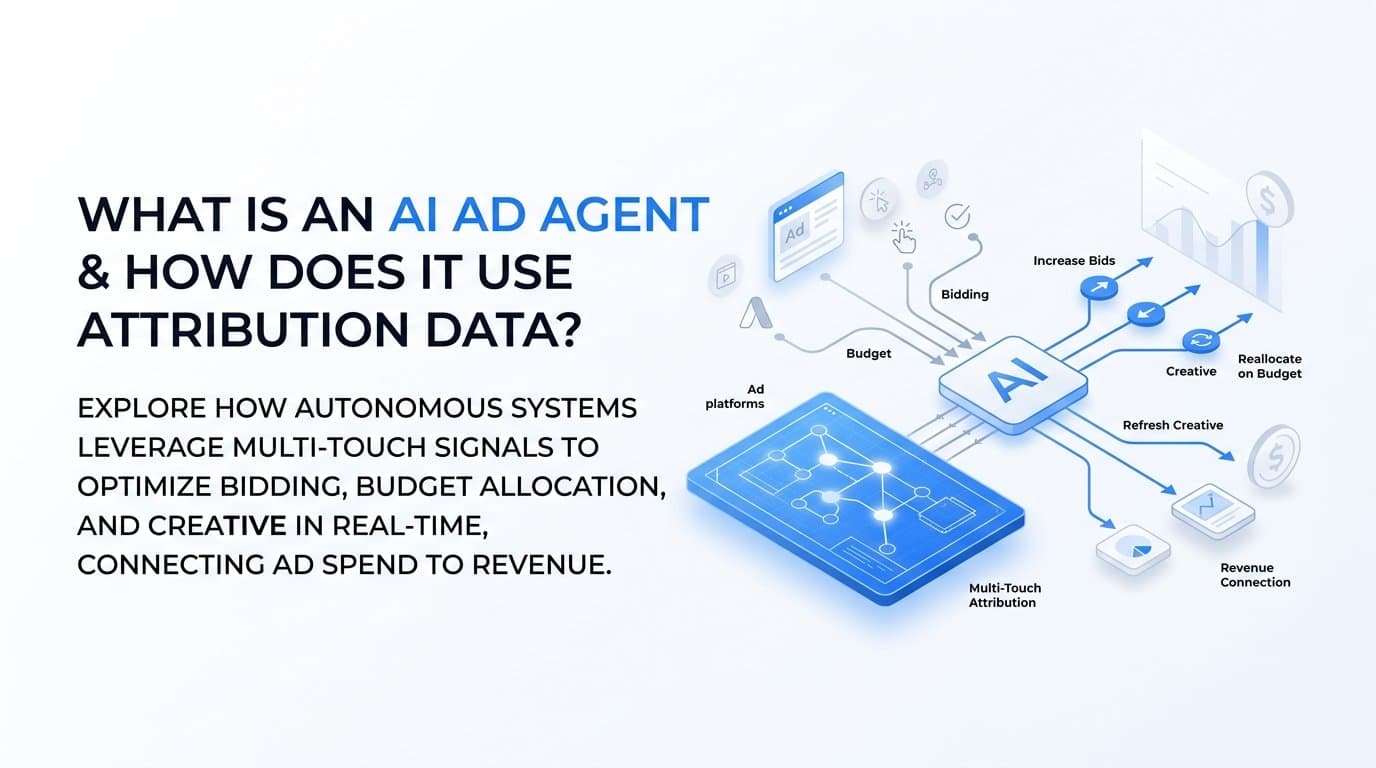
An AI ad agent is an autonomous software system that analyzes attribution data to make real-time decisions about ad bidding, budget allocation, creative rotation, and campaign optimization without requiring constant manual intervention. It connects attribution signals, specifically which touchpoints drove conversions, to automated actions across platforms like Meta and Google.
For B2B SaaS marketing teams running campaigns across multiple channels, manual optimization simply cannot process the volume of signals needed to act fast enough. By the time a human analyst identifies a budget inefficiency or a creative that is burning spend, the opportunity cost has already accumulated.
Cometly's AI ads manager is built specifically for this challenge. It ingests multi-touch attribution data, identifies which ads and audiences are driving pipeline, and surfaces recommendations your team can act on immediately. Rather than guessing where to scale or cut, you get decisions grounded in the full customer journey from first ad click to closed-won revenue.
This article breaks down exactly how AI ad agents work, how they consume attribution data, what makes them accurate or flawed, and what to look for when evaluating one for your B2B SaaS growth stack.
1. What an AI Ad Agent Actually Does
The Challenge It Solves
Traditional rules-based automation executes fixed conditions: if cost-per-click exceeds a threshold, pause the ad. This works for simple scenarios but cannot adapt to the complex, multi-variable reality of B2B SaaS campaigns where audience quality, funnel stage, and revenue impact all interact simultaneously.
The Strategy Explained
An AI ad agent operates on a continuous input-output loop. It ingests performance data, attribution signals, audience behavior, and conversion events, then uses machine learning to identify patterns and take or recommend actions. Unlike rules-based systems, it learns from outcomes rather than executing predetermined logic.
The core functions of an AI ad agent include bid adjustments at the keyword or audience level, budget reallocation across campaigns and channels, creative rotation based on engagement and conversion performance, and audience expansion or suppression based on conversion likelihood. The agent does not just react to what happened. It anticipates what is likely to happen based on historical patterns.
Think of it like the difference between a thermostat and a smart HVAC system. A thermostat follows a rule: if temperature drops below 68 degrees, turn on the heat. A smart system learns your schedule, predicts when you will be home, accounts for weather forecasts, and optimizes energy use accordingly. AI ad agents operate on the same principle, applied to campaign performance.
Implementation Steps
1. Define what conversion events the agent should optimize toward, whether that is form fills, demo requests, or closed-won revenue.
2. Connect your attribution platform so the agent receives complete, accurate conversion signals rather than platform-native data alone.
3. Set guardrails such as budget caps and minimum spend thresholds so the agent operates within defined parameters while still learning.
Pro Tips
The quality of an AI ad agent's decisions is entirely determined by the quality of data feeding it. Before configuring any optimization logic, audit your conversion tracking setup. An agent optimizing toward incomplete or inaccurate signals will confidently make the wrong decisions at scale.
2. How Attribution Data Powers AI Ad Agent Decisions
The Challenge It Solves
Ad platforms like Meta and Google have their own native attribution systems, but these are siloed, self-serving, and often in conflict with each other. Without an independent attribution layer, an AI agent is working from a distorted view of which channels and touchpoints are actually driving revenue.
The Strategy Explained
Attribution data tells an AI agent which touchpoints contributed to a conversion and how much credit each one deserves. This directly shapes every automated decision the agent makes. If the attribution model says a LinkedIn ad drove the first touch and a Google search ad drove the last touch before a demo request, the agent can weigh budget accordingly across both channels.
The attribution model you choose changes agent behavior significantly. Last-click attribution tells the agent that only the final touchpoint matters, which causes it to over-invest in bottom-funnel channels and starve awareness campaigns. Linear or time-decay models distribute credit more broadly, giving the agent a more complete picture of what is working across the full funnel.
Server-side and first-party data improve signal quality substantially. When Cometly sends enriched conversion events back to Meta via Conversion API and to Google via Enhanced Conversions, the ad platform AI receives cleaner, deduplicated, and more complete data. This directly improves how those platforms optimize targeting and bidding on your behalf.
Implementation Steps
1. Choose an attribution model that reflects your actual sales cycle. For most B2B SaaS companies, this means moving beyond last-click to a multi-touch model.
2. Connect your attribution platform to your ad channels so conversion events flow back to Meta, Google, and other platforms in real time.
3. Audit your event match quality scores in Meta Events Manager and Google's conversion tracking diagnostics to confirm signal completeness.
Pro Tips
Do not let ad platforms define attribution for you. Meta and Google will always report results in a way that favors their own channel. An independent attribution platform like Cometly gives you a single source of truth that is not biased toward any one platform's reporting.
3. The Role of Multi-Touch Attribution in Agent Accuracy
The Challenge It Solves
B2B SaaS deals rarely close after a single touchpoint. A prospect might discover your product through a LinkedIn ad, read three blog posts, attend a webinar, click a retargeting ad, and then convert on a branded search. Single-touch attribution collapses all of that into one moment, causing AI agents to systematically misallocate budget toward the final touchpoint and away from everything that built the relationship.
The Strategy Explained
Multi-touch attribution distributes conversion credit across every touchpoint in the customer journey. This gives an AI agent a realistic picture of how different channels and campaigns contribute at different stages of the funnel, from awareness through consideration to decision.
For B2B SaaS companies with sales cycles measured in weeks or months, this matters enormously. An agent running on last-click data will conclude that branded search and retargeting are your best-performing channels because they appear at the end of every converted journey. It will then shift budget toward those channels, reducing investment in the awareness campaigns that were actually initiating those journeys in the first place. Over time, the pipeline dries up because the top of the funnel was defunded.
Multi-touch attribution corrects this by crediting the LinkedIn ad that generated the first click, the content that drove the second visit, and the retargeting ad that closed the loop. The agent then optimizes across the entire journey rather than just the final step. Cometly's customer journey analytics is designed to surface exactly this kind of full-funnel visibility.
Implementation Steps
1. Map your typical B2B SaaS customer journey, including the number of touchpoints and the average time from first touch to conversion.
2. Select a multi-touch attribution model, such as linear, time-decay, or data-driven, that reflects how influence is distributed across your specific journey.
3. Validate the model by comparing attributed revenue across channels against your CRM data to confirm the model reflects reality.
Pro Tips
If your AI agent is consistently recommending cuts to top-of-funnel campaigns while bottom-funnel performance looks strong, that is a signal your attribution model may be single-touch. The agent is not wrong given the data it has. The data itself is the problem.
4. Server-Side Tracking and Conversion API Integration
The Challenge It Solves
Browser-based pixel tracking has become increasingly unreliable due to ad blockers, iOS privacy changes, and third-party cookie restrictions. When pixels fail to fire, conversion events go unrecorded. An AI agent working from incomplete event data will under-report performance, misallocate budget, and optimize toward a distorted version of reality.
The Strategy Explained
Server-side tracking and Conversion API integrations solve the data gap problem by sending conversion events directly from your server to the ad platform, bypassing the browser entirely. Because the event originates server-side, it is not affected by ad blockers or browser privacy settings. The result is a more complete, accurate, and deduplicated stream of conversion data.
Meta's Conversion API and Google's Enhanced Conversions are the primary implementations of this approach. When you send enriched events through these integrations, including first-party data like hashed email addresses, the ad platform AI can match conversions to users with higher accuracy. This directly improves the quality of signals the AI agent uses for bidding and targeting decisions.
Cometly's server-side conversion tracking and Conversion API integration are built to handle this automatically. Rather than managing separate CAPI setups for each platform, Cometly sends enriched, deduplicated conversion events across your connected ad channels from a single configuration.
Implementation Steps
1. Audit your current pixel-based tracking to identify how many conversion events are being missed. Compare pixel-reported conversions against CRM-recorded leads to find the gap.
2. Implement server-side tracking through your attribution platform or directly via Meta CAPI and Google Enhanced Conversions.
3. Enable deduplication logic to prevent double-counting events that are captured by both browser pixels and server-side tracking simultaneously.
Pro Tips
Check your Meta Events Manager for Event Match Quality scores. A low score indicates the platform is struggling to match your conversion events to users, which directly limits how well Meta's AI can optimize your campaigns. Server-side tracking with enriched first-party data is the most reliable way to improve this score.
5. How AI Ad Agents Use Customer Journey Data to Scale Campaigns
The Challenge It Solves
Scaling a B2B SaaS campaign is not just about increasing budget. Pouring more spend into a campaign that is working at a small scale does not guarantee it will continue working at a larger scale, especially if the agent does not understand which audience segments, creative messages, or funnel stages are driving the highest-quality pipeline.
The Strategy Explained
Customer journey data, from first ad click through to closed-won revenue, gives an AI agent the context it needs to make smarter scaling decisions. Rather than scaling based on cost-per-lead, the agent can identify which campaigns are generating leads that actually convert to pipeline and revenue, then prioritize those for increased investment.
Journey-level data also guides audience expansion. If the agent can see that a specific audience segment consistently converts through a particular sequence of touchpoints, it can identify lookalike audiences that match that pattern and expand reach without sacrificing quality. Similarly, creative rotation decisions become more precise when the agent knows which ad formats and messages perform at each stage of the funnel rather than just which ones generate clicks.
Cometly's customer journey analytics connects every touchpoint from the first ad impression to the CRM event that marks a deal as closed-won. This gives the AI agent a complete picture of what good pipeline looks like, so it can optimize toward revenue rather than surface-level conversion metrics.
Implementation Steps
1. Connect your CRM to your attribution platform so that deal stage and revenue data flow back to the campaign level.
2. Identify your highest-value audience segments by filtering attributed revenue by campaign, audience, and creative to find the combinations that generate the best pipeline quality.
3. Use those patterns to guide audience expansion and creative testing, letting the agent scale what is proven rather than experimenting blindly with increased budget.
Pro Tips
Pipeline attribution is more valuable than lead attribution for B2B SaaS scaling decisions. If your agent is optimizing toward form fills but your sales team is closing only a fraction of those leads, you are scaling a leaky funnel. Connect revenue data before scaling any campaign significantly.
6. What to Look for in an AI Ad Agent for B2B SaaS
The Challenge It Solves
Not all AI ad agents are built for B2B SaaS. Many are designed for e-commerce, where the purchase happens in a single session and attribution is relatively straightforward. B2B SaaS requires an agent that understands long sales cycles, multi-stakeholder journeys, and the distinction between a lead and a revenue-generating customer.
The Strategy Explained
When evaluating an AI ad agent for B2B SaaS, there are several capabilities that separate purpose-built solutions from general-purpose tools.
Revenue-level attribution: The agent should be able to optimize toward pipeline and closed-won revenue, not just leads or demo requests. This requires a CRM integration that passes deal stage and revenue data back to the attribution layer.
CRM and Stripe integration: For SaaS businesses, connecting subscription revenue data to ad performance is essential. An agent that can see which campaigns are driving paying customers, not just trials, will make fundamentally better budget decisions.
Cross-channel coverage: B2B SaaS buyers move across LinkedIn, Google, Meta, and organic channels. The agent needs to track and optimize across all of them from a single attribution view rather than managing each channel in isolation.
Server-side and Conversion API support: As discussed, data quality is everything. The agent's underlying platform should support server-side tracking and CAPI integrations to ensure complete, accurate conversion signals.
An AI recommendation layer: The best agents do not just automate. They surface insights your team can evaluate and act on, creating a collaborative loop between machine intelligence and human judgment.
Cometly is built specifically for this use case. With multi-touch attribution, pipeline and revenue attribution, Stripe integration, and 70+ native integrations, it gives B2B SaaS teams the attribution foundation their AI ad agent needs to make accurate, revenue-aligned decisions.
Implementation Steps
1. List your current tech stack including your CRM, ad platforms, payment processor, and analytics tools, then verify that any agent you evaluate has native integrations with each.
2. Request a demo that specifically shows revenue-level attribution, not just lead-level reporting, to confirm the platform can connect ad spend to closed-won deals.
3. Evaluate the AI recommendation layer by asking how the platform surfaces insights and whether recommendations are explainable rather than black-box outputs.
Pro Tips
Ask vendors how their platform handles attribution across anonymous first touches and identified CRM contacts. This identity resolution problem is one of the hardest in B2B attribution, and how a platform solves it will determine whether your agent's decisions are grounded in complete data or a fragmented view of the customer journey.
7. Related Questions About AI Ad Agents and Attribution
What is the difference between an AI ad agent and smart bidding?
Smart bidding, such as Google's Target CPA or Target ROAS, is a platform-native feature that adjusts bids within a single ad platform using that platform's own conversion data. An AI ad agent is an independent system that operates across multiple platforms, uses your own first-party attribution data rather than platform-reported data, and can take or recommend actions beyond bid adjustments, including budget reallocation, creative rotation, and audience strategy.
Can AI ad agents work without first-party data?
Technically yes, but the quality of decisions degrades significantly. AI ad agents rely on conversion signals to learn which campaigns, audiences, and creatives drive results. Without first-party data, the agent depends entirely on platform-reported conversions, which are often incomplete due to ad blockers, iOS restrictions, and cross-channel gaps. First-party data sent via server-side tracking and CAPI is what separates agents that optimize accurately from those that optimize confidently toward the wrong outcomes.
How do AI ad agents handle multi-channel attribution?
A well-built AI ad agent ingests attribution data from an independent attribution platform that tracks conversions across all channels, then uses that unified view to make cross-channel budget and bidding decisions. Without this independent layer, the agent can only see each channel's self-reported performance, which leads to double-counting and channel bias. Platforms like Cometly serve as the attribution backbone that gives the agent an accurate, deduplicated view across Meta, Google, LinkedIn, and other channels simultaneously.
What attribution model works best for AI ad agents?
For B2B SaaS, data-driven or time-decay multi-touch attribution models tend to give AI agents the most accurate signals because they reflect the reality of long, multi-touchpoint sales cycles. Last-click models cause agents to systematically over-invest in bottom-funnel channels and starve awareness campaigns. The best model for your specific business depends on your average sales cycle length and the number of touchpoints in a typical customer journey, which is why starting with multi-touch attribution and then refining based on CRM data is the recommended approach.
Are AI ad agents the same as autonomous campaign management?
Not always. Some AI ad agents are fully autonomous, meaning they execute changes automatically without human approval. Others operate in a recommendation mode, surfacing insights and suggested actions for a human to approve before implementation. For most B2B SaaS teams, a hybrid approach works best: let the agent handle high-frequency, low-risk decisions like bid adjustments automatically, while routing larger budget reallocation decisions through a human review step.
Putting It All Together
The effectiveness of any AI ad agent depends entirely on the quality of attribution data feeding it. An agent working from last-click or pixel-only data will make systematically flawed decisions: over-crediting bottom-funnel channels, under-investing in awareness, and optimizing for leads that never convert to revenue.
For B2B SaaS teams, the fix starts with building a clean attribution foundation. That means server-side tracking, Conversion API integration, and multi-touch attribution that connects ad spend to pipeline and closed-won revenue. Without that foundation, even the most sophisticated AI agent is working from an incomplete map.
Here is a prioritized path forward. Start by auditing your current conversion tracking to identify gaps between pixel-reported events and CRM-recorded leads. Then implement server-side tracking and CAPI integrations to close those gaps. From there, move to a multi-touch attribution model that reflects your actual sales cycle. Finally, connect your CRM and revenue data so your agent can optimize toward what actually matters: paying customers, not just form fills.
Cometly is built to be that attribution foundation. It captures every touchpoint from first ad click to CRM event, sends enriched conversion signals back to Meta and Google, and surfaces AI-driven recommendations so your team knows exactly where to scale and where to cut. With 70+ native integrations, Stripe revenue data connected to ad performance, and full-funnel customer journey analytics, it gives your AI ad agent the data quality it needs to make decisions you can trust.
If you are evaluating an AI ad agent or trying to improve the one you already use, start with your attribution data quality. Every automated decision your agent makes will only be as good as the signals it receives. Get your free demo today and start capturing every touchpoint to maximize your conversions.