
You're staring at your dashboard again. Ad spend is up, clicks are flowing, engagement looks solid. But when your CFO asks which campaigns actually drove revenue last quarter, you're piecing together data from five different platforms, trying to connect dots that refuse to form a clear picture. Sound familiar?
This is the reality for countless marketing teams today. The tools have multiplied, the data has exploded, but the fundamental question remains frustratingly unclear: what's actually working?
The shift from intuition-based marketing to data-driven decision making isn't just about having more numbers. It's about fundamentally transforming how companies understand their customers, allocate resources, and drive growth. When marketing teams can see the complete journey from first ad impression to final purchase, they stop guessing and start scaling with confidence. This clarity doesn't just change marketing tactics—it reshapes entire business operations, influences product development, and proves marketing's direct contribution to revenue.
From Gut Feelings to Revenue Clarity: The Data Transformation
Ten years ago, marketing decisions often came down to experience and educated guesses. You ran campaigns based on what worked last year, what your competitor seemed to be doing, or what felt right given your understanding of the market. If something seemed successful, you did more of it. If results disappointed, you pivoted. The feedback loop was slow, incomplete, and heavily influenced by whoever had the loudest voice in the room.
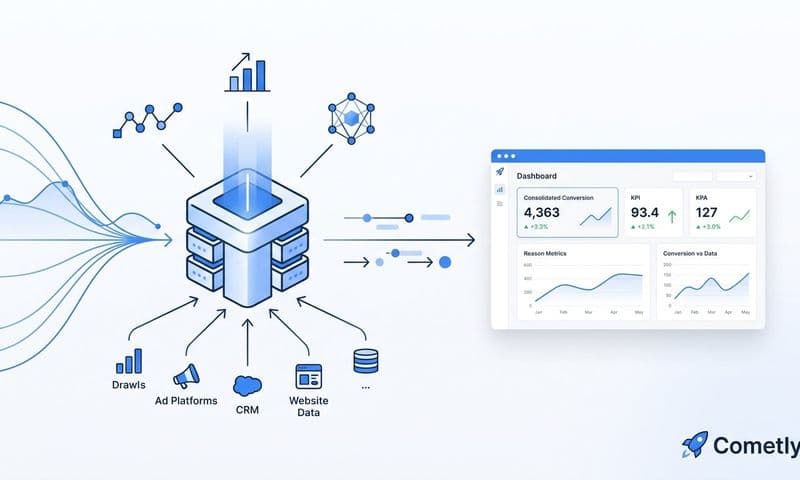
Today's marketing landscape demands a different approach entirely. Every click, view, and conversion generates data that tells a story about customer behavior. The challenge isn't accessing this data—it's making sense of it when it's scattered across Facebook Ads Manager, Google Analytics, your CRM, email platform, and a dozen other tools.
This fragmentation creates dangerous blind spots. You might see that your Facebook campaigns generated 500 clicks and 50 conversions. Your Google Ads dashboard shows similar numbers. But here's what you don't see: how many customers touched both channels before converting? Which ad actually introduced them to your brand? Did they click your Facebook ad, research you on Google, sign up for your email list, then convert three days later through a retargeting campaign?
Without connecting these touchpoints, you're flying blind. You might be over-investing in channels that look good in isolation but rarely drive the first meaningful interaction. Or you could be cutting budgets from channels that play a crucial supporting role in customer journeys, even if they don't get credit for the final conversion. Understanding data-driven vs data-informed approaches helps teams navigate these complex decisions more effectively.
The transformation happens when marketing teams can see the complete picture. Instead of asking "How many conversions did this campaign generate?" they can ask "What role does this campaign play in our customer acquisition strategy?" This shift from isolated metrics to connected insights changes everything about strategic planning.
Think of it like assembling a puzzle. Each platform gives you a handful of pieces, but they're all from different parts of the image. You can see fragments—a bit of sky here, part of a tree there—but you can't understand what you're looking at until you connect them. Data infrastructure that tracks the entire customer journey is what connects those pieces, revealing the complete picture of how your marketing actually works.
When a marketing team makes this transition, decision-making fundamentally changes. Budget allocation moves from "this feels right" to "this channel drives 30% of our assisted conversions and has the lowest cost per acquisition when we factor in its role across the full journey." Campaign planning shifts from replicating past successes to identifying patterns in what actually converts customers. Testing becomes more sophisticated because you're measuring impact across the entire funnel, not just immediate results.
How Data Reshapes Campaign Performance and Budget Allocation
Here's where most marketing teams get stuck: they're optimizing for metrics that don't actually matter. Impressions, clicks, and even conversion counts tell you what happened, but they don't tell you what's driving revenue. A campaign might generate hundreds of conversions while contributing minimally to your bottom line. Another might show modest conversion numbers but consistently attract high-value customers who stick around.
The difference comes down to attribution—understanding which touchpoints actually influence purchase decisions. Last-click attribution, where the final interaction gets all the credit, has been the default for years because it's simple. But it's also wildly misleading. If a customer discovers your brand through a Facebook ad, researches you via Google search, reads your blog content, joins your email list, and then converts through a retargeting campaign, should that retargeting ad get 100% of the credit?
Multi-touch attribution models distribute credit across all the interactions that contributed to a conversion. Suddenly, you can see which channels are driving awareness, which are nurturing consideration, and which are closing deals. This visibility completely changes how you allocate budget.
Let's say your data shows that blog content consistently appears early in high-value customer journeys, even though it rarely gets last-click credit. Without attribution data, you might view content marketing as a soft brand play with unclear ROI. With proper attribution, you see it's actually a critical driver of your most profitable customers. That insight shifts budget allocation, content strategy, and how you measure success.
Real-time data takes this further by enabling faster optimization decisions. Instead of waiting until the end of the month to review campaign performance, you can spot patterns as they emerge. If a new ad creative is outperforming others, you can shift budget toward it immediately. If a channel that usually converts well starts showing declining performance, you can investigate and adjust before wasting significant spend.
This speed matters more than most marketers realize. Ad platforms change constantly—algorithms update, audience behaviors shift, competitive dynamics evolve. The faster you can identify what's working and what's not, the less money you waste on underperforming campaigns and the more you can invest in what's actually driving results.
Consider budget allocation across channels. Without comprehensive data, most teams distribute budget based on rough guidelines: maybe 40% to Facebook, 30% to Google, 20% to other channels, 10% to testing. These percentages come from industry benchmarks, past experience, or what feels balanced.
Data-driven budget allocation looks completely different. You might discover that increasing Facebook spend by 20% would drive disproportionate returns because your best-performing audience segments aren't reaching frequency caps yet. Or you might find that Google Search campaigns have maxed out their efficient scale—you're already capturing everyone searching for your solution, and spending more would just drive up costs without increasing conversions.
These insights let you allocate budget dynamically based on actual performance rather than static percentages. Some months you might invest heavily in channels showing strong efficiency. Other times you might pull back and redirect resources toward testing new audiences or platforms. The key is having data that shows you where each dollar will drive the most impact. Learning how marketers use data to evaluate results provides a framework for making these decisions consistently.
The Ripple Effect: Data's Influence Beyond the Marketing Team
Marketing data doesn't just improve marketing decisions—it influences how entire companies operate. When leadership can see which channels drive revenue, which customer segments are most valuable, and what the full cost of customer acquisition looks like, strategic planning becomes more precise.
Sales teams benefit enormously from marketing attribution data. Instead of treating all leads equally, they can prioritize based on how prospects engaged with marketing touchpoints. A lead who clicked one ad and filled out a form might need more nurturing than someone who engaged with multiple pieces of content, watched product videos, and attended a webinar before requesting a demo. Marketing data reveals these patterns, helping sales teams focus their energy where it's most likely to convert.
Product development teams gain valuable insights from marketing data too. Which features do customers research most before purchasing? What pain points appear repeatedly in the content that drives conversions? What questions do high-intent prospects ask? This information helps product teams prioritize development roadmaps based on what actually influences purchase decisions.
Customer success teams can use marketing data to understand customer expectations and preferences. If someone converted after engaging heavily with content about a specific use case, the customer success team knows to orient onboarding around that use case. If a customer came through a price-focused campaign, they might need different support than someone who converted based on advanced features.
Perhaps most importantly, comprehensive marketing data breaks down the traditional silos between departments. When everyone works from the same data foundation, conversations shift from "marketing says this, sales says that" to "here's what the data shows." Disagreements become easier to resolve because you're debating interpretations of shared information rather than arguing from completely different starting points. Exploring the impact of marketing and analytics on business success reveals just how transformative this alignment can be.
This shared visibility also helps marketing demonstrate its value to leadership. Instead of reporting on activities—emails sent, ads run, content published—marketing teams can show direct connections between their work and revenue. When a CFO questions marketing budget, you can show exactly which campaigns drove which revenue, what the ROI looks like across different channels, and where additional investment would drive growth.
The companies that excel at this create feedback loops between departments. Marketing insights inform sales strategy, sales feedback shapes marketing messaging, customer success data reveals opportunities for expansion campaigns, and product updates create new marketing angles. Data becomes the common language that aligns everyone around shared goals.
Navigating Data Challenges in a Privacy-First World
Just as marketers were getting comfortable with sophisticated tracking and attribution, the rules changed. Apple's iOS updates starting with iOS 14.5 fundamentally altered how apps can track user behavior. The impending deprecation of third-party cookies will reshape web tracking. Privacy regulations like GDPR and CCPA add legal complexity to data collection. These changes aren't temporary disruptions—they represent a permanent shift toward privacy-first digital ecosystems.
The impact on marketing data has been significant. Traditional tracking methods that relied on third-party cookies and cross-app identifiers have become less reliable. Many marketers suddenly found their attribution data showing large percentages of "unknown" or "direct" traffic as tracking capabilities degraded. Ad platforms lost visibility into conversion events, making their optimization algorithms less effective. Understanding how companies are losing attribution data from privacy updates helps teams prepare for these challenges.
This is where server-side tracking becomes essential. Instead of relying on browser-based tracking that users can block or that platforms restrict, server-side tracking captures conversion events directly from your server and sends them to ad platforms. This approach provides more reliable data while respecting user privacy choices because you're tracking actions on your own properties, not following users across the web.
Server-side tracking also solves another critical problem: ad blockers and browser privacy settings that prevent client-side tracking pixels from firing. When a conversion happens on your website but your tracking pixel doesn't fire, the ad platform never learns about it. Its algorithm can't optimize toward that conversion, and you can't attribute it back to the campaign that drove it. Server-side tracking ensures conversion data reaches ad platforms reliably, improving both attribution accuracy and campaign optimization.
The privacy-first shift also demands more thoughtful approaches to data collection. Rather than trying to capture everything possible, smart marketing teams focus on collecting data that's genuinely useful and that users understand they're sharing. This means being transparent about what you track, why you track it, and how it benefits the user experience.
Many marketers initially viewed privacy changes as obstacles to overcome. The more productive perspective is seeing them as drivers of better practices. When you can't rely on invasive tracking, you're forced to build direct relationships with customers. When you can't follow users across the entire internet, you focus on making your own properties valuable enough that people willingly share information. When tracking becomes more limited, you prioritize data quality over quantity.
The marketing teams thriving in this environment are those who invested in first-party data tracking—systems for tracking customer interactions on their own properties, capturing meaningful engagement data, and using that information to improve both marketing performance and customer experience. They're not trying to recreate the tracking capabilities of 2019; they're building something better suited to the current landscape.
Building a Data Infrastructure That Drives Growth
Having data isn't enough—you need infrastructure that makes it useful. The most effective marketing data stacks have three core components: comprehensive tracking across all customer touchpoints, attribution modeling that reveals how channels work together, and analytics capabilities that surface actionable insights.
Comprehensive tracking means capturing every meaningful interaction a customer has with your brand. This includes ad clicks and impressions, website visits and page views, form submissions and content downloads, email opens and link clicks, CRM events like sales calls and deal stages, and purchase data including revenue and customer lifetime value. When all these touchpoints connect to individual customer journeys, you can see the complete path from awareness to conversion.
Attribution modeling takes this tracking data and assigns value to different touchpoints based on their role in driving conversions. Different models serve different purposes. First-touch attribution shows which channels are best at generating awareness. Last-touch reveals what's closing deals. Linear attribution distributes credit equally across all touchpoints. Time-decay models give more credit to interactions closer to conversion. Position-based models emphasize both the first and last touch. Understanding marketing attribution models and why they are important helps teams choose the right approach for their specific goals.
Analytics capabilities turn raw data into insights you can act on. This means dashboards that show campaign performance across channels, reports that reveal customer journey patterns, tools for comparing different attribution models, and systems that identify trends and anomalies automatically. The goal isn't just having data—it's making that data accessible and understandable for everyone who needs it.
One often-overlooked component of modern data infrastructure is the ability to feed conversion data back to ad platforms. When you send enriched conversion events to Facebook, Google, and other platforms through their server-side APIs, you're not just improving your own attribution—you're making the ad platforms' algorithms smarter. They can optimize more effectively toward the conversions that matter most to your business, improving targeting, bidding, and creative delivery.
This creates a powerful feedback loop. Better data leads to better ad platform optimization, which drives better campaign performance, which generates more data to analyze, which reveals new optimization opportunities. Companies that master this loop gain compounding advantages over competitors still working with fragmented, incomplete data.
The infrastructure doesn't need to be complex to be effective. Many marketing teams overcomplicate their data stack, adding tools for every possible use case until they're drowning in platforms that don't talk to each other. The better approach is starting with a foundation that tracks customer journeys end-to-end, then building additional capabilities as specific needs arise. For teams ready to implement, a first-party data tracking setup guide can accelerate the process significantly.
Putting Data to Work: Practical Steps for Marketing Teams
Understanding why data matters is one thing. Actually putting it to work is another. The marketing teams seeing real impact from data investments share several common practices that make insights actionable rather than just interesting.
First, they prioritize data quality over quantity. It's tempting to track everything possible, but more data points don't necessarily lead to better decisions. Focus on capturing the interactions that actually influence customer behavior and business outcomes. A smaller set of reliable, meaningful metrics beats a massive dashboard of questionable numbers that no one trusts.
Second, they establish clear metrics that align marketing activities with business outcomes. Instead of reporting on vanity metrics like impressions or clicks, they focus on metrics that leadership cares about: customer acquisition cost, return on ad spend, customer lifetime value, revenue attributed to marketing channels, and contribution to pipeline for B2B companies. When marketing metrics directly connect to business results, conversations with leadership become easier and budget justification becomes straightforward.
Third, they create regular rhythms for reviewing data and making decisions. This might mean weekly performance reviews where the team analyzes campaign results and adjusts strategy, monthly deep dives into attribution data to understand channel dynamics, and quarterly planning sessions that use historical data to set targets and allocate resources. The key is making data review a consistent habit rather than something that happens only when campaigns underperform. Mastering marketing analytics and reporting transforms raw numbers into revenue-driving decisions.
Fourth, they leverage AI and automation to surface insights from complex data sets. When you're tracking thousands of customer journeys across dozens of campaigns and multiple channels, patterns aren't always obvious. AI can identify which audience segments are performing best, which ad creatives drive the highest-quality conversions, which times of day show peak efficiency, and which channel combinations work most effectively together. These insights help marketing teams focus their attention on optimizations that will actually move the needle.
Finally, successful data-driven marketing teams maintain healthy skepticism about their data. They regularly audit tracking implementation, verify that attribution models reflect actual customer behavior, and test assumptions rather than accepting them as fact. This discipline prevents the common trap of making confident decisions based on flawed data.
Moving Forward with Confidence
The transformation from intuition-based marketing to data-driven growth isn't just about having better numbers—it's about fundamentally changing how companies understand their customers, allocate resources, and drive revenue. When marketing teams can see the complete customer journey, connect every touchpoint to business outcomes, and use that visibility to optimize continuously, they stop being a cost center and become a predictable revenue driver.
The companies gaining competitive advantage today are those treating data infrastructure as a strategic priority rather than a technical afterthought. They're investing in systems that capture comprehensive customer journey data, implementing attribution models that reveal true campaign performance, and building feedback loops between data insights and campaign execution. They're navigating privacy changes not as obstacles but as opportunities to build more sustainable, permission-based relationships with customers.
This shift requires more than just implementing new tools—it demands a cultural change in how marketing teams operate. It means moving from defending marketing spend based on activities to demonstrating ROI based on revenue. It means breaking down silos between marketing, sales, and leadership through shared data visibility. It means making decisions faster because you have real-time insights rather than waiting for monthly reports.
The marketing landscape will continue evolving. Ad platforms will update their algorithms, privacy regulations will expand, customer behaviors will shift, and new channels will emerge. But the fundamental principle remains constant: companies that can accurately measure what's working, understand why it's working, and quickly adapt to what they learn will outperform those still making decisions based on incomplete information and educated guesses.
For marketing teams ready to make this transition, the path forward is clear. Start with comprehensive tracking that captures every meaningful customer interaction. Implement attribution models that reveal how channels work together rather than competing for last-click credit. Build analytics capabilities that make data accessible and actionable for everyone who needs it. Create feedback loops that continuously improve both campaign performance and data quality. And most importantly, commit to making data-driven decisions even when they challenge conventional wisdom or comfortable assumptions.
The marketers scaling with confidence in 2026 are those who've moved beyond fragmented dashboards and disconnected metrics to build complete visibility into what's actually driving their growth. They're not just running campaigns—they're operating growth engines powered by data, optimized by AI, and aligned with clear business outcomes.
Ready to elevate your marketing game with precision and confidence? Discover how Cometly's AI-driven recommendations can transform your ad strategy—Get your free demo today and start capturing every touchpoint to maximize your conversions.