
You open Facebook Ads Manager expecting to see the results of a campaign you know has been working. Your CRM tells one story. Your payment processor tells another. And Facebook reports something else entirely, with a number that seems far too low to be real. If this sounds familiar, you are not alone, and you are not imagining it.
Facebook ad underreporting is one of the most common and costly problems in paid social advertising today. Marketers second-guess their best campaigns, cut budgets on ads that are actually driving pipeline, and lose confidence in data that should be their most valuable decision-making tool. The frustration is real, and the consequences compound over time.
Here is the important thing to understand: underreporting is not a glitch, and it is not Facebook being dishonest. It is a structural problem rooted in how Facebook tracks, attributes, and reports conversions. Several forces are working against accurate measurement simultaneously, including browser privacy changes, pixel architecture limitations, attribution window mismatches, and incomplete event data. Each one chips away at the numbers you see in Ads Manager.
The good news is that this is a solvable problem. Understanding why your Facebook ads are underreporting is the first step toward fixing it. This article breaks down each root cause and maps out a concrete path to getting accurate, trustworthy data so you can make budget decisions based on reality rather than incomplete signals.
The Tracking Gap: How Facebook Loses Sight of Your Conversions
The Facebook pixel is a client-side JavaScript tag. That means it lives in the user's browser and depends entirely on the browser to load, execute, and fire the event correctly. When everything works perfectly, the pixel captures the conversion and sends it to Facebook. But a lot can go wrong between a user completing an action and Facebook receiving that signal.
Think of the pixel like a sensor that only works if someone turns the lights on first. If anything interrupts the process before the lights come on, the event disappears without a trace.
Ad blockers and privacy browsers: A significant portion of web users run ad blockers or privacy-focused browsers that suppress third-party scripts entirely. When a user with an ad blocker completes a purchase or fills out a lead form, the pixel never fires. The conversion is real, but Facebook has no record of it.
Apple's App Tracking Transparency (ATT): Starting with iOS 14.5, Apple required apps to ask users for explicit permission before tracking them across apps and websites. Most users opted out. This dramatically reduced the volume of mobile conversion signals that Facebook receives, particularly for campaigns targeting iOS users. The effect is well-documented and ongoing.
Browser-level Intelligent Tracking Prevention: Safari's ITP and similar features in Firefox limit the lifespan of third-party cookies. This means the window in which the pixel can attribute a conversion is compressed. A user who clicks an ad on Monday but converts on Friday may fall outside the window Safari allows, and that conversion goes unattributed even if the pixel fires correctly.
Page load interruptions: The pixel fires when a specific page or event loads in the browser. If a user completes a checkout and closes the tab before the confirmation page fully loads, the pixel event never executes. This is a silent failure. No error is logged anywhere. The conversion just disappears from Facebook's view.
Taken together, these vulnerabilities create a systematic gap between what actually happens and what Facebook can see. For B2B SaaS companies with longer sales cycles and multiple touchpoints, the gap widens further because there are more opportunities for the tracking chain to break down before a conversion is recorded.
This is why many marketers searching for answers to the question of why their Facebook ads are underreporting find that the pixel itself is a significant part of the problem. It was built for a simpler web, and the web has changed dramatically around it. Understanding the full scope of Facebook ads reporting discrepancies is essential before attempting any fix.
Attribution Windows and Why Your Numbers Never Match
Even when the pixel fires correctly, the numbers in Facebook Ads Manager may still not match what you see in your CRM or payment processor. Attribution windows are a major reason why, and this is one of the most misunderstood sources of apparent underreporting.
An attribution window defines how long after an ad interaction Facebook will credit a conversion to that ad. If a user clicks your ad and converts within the window, Facebook counts it. If they convert outside the window, Facebook does not count it, even if the ad was the reason they came back.
Facebook offers several window options: 1-day click, 7-day click, 1-day view, and 7-day view. Each produces dramatically different reported conversion numbers. A campaign might show 30 conversions on a 1-day click window and 90 conversions on a 7-day click window. Neither number is wrong exactly, but they are measuring different things, and comparing them without understanding this leads to confusion.
For B2B SaaS companies, the problem is especially pronounced. Your sales cycle might span two to four weeks. A prospect clicks a Facebook ad, enters your funnel, attends a demo, and signs up twelve days later. Under a 7-day click window, Facebook misses that conversion entirely. Your CRM shows the deal. Facebook shows nothing. That gap is not underreporting in the traditional sense; it is a window mismatch. A deeper look at Facebook ads attribution reveals how these window differences systematically distort campaign performance data.
The view-through attribution problem: View-through attribution credits Facebook when a user sees an ad but does not click it, then converts later through another channel. This inflates Facebook's reported numbers in some cases while simultaneously creating discrepancies with other platforms that do not use view attribution. When your CRM shows fewer conversions than Facebook, view attribution is often involved. When Facebook shows fewer, window misalignment is usually the culprit.
Each platform counts differently: Your CRM typically records a conversion at the moment a lead is created or a deal closes. Your payment processor records it at the moment of payment. Facebook records it based on when the attribution window opens and whether the pixel fires. These three systems are measuring the same event from different vantage points, at different moments in time, using different logic. Expecting them to agree without reconciliation is unrealistic.
The practical implication for marketers is that you need to standardize how you compare data across platforms. Decide which attribution window aligns most closely with your actual sales cycle, document it, and apply it consistently. Then build a reconciliation process that accounts for the structural differences between platforms rather than treating every discrepancy as an error.
Server-Side Tracking and the Conversion API: What You Are Missing
If the pixel is the problem, the Meta Conversion API is a large part of the solution. Understanding how it works, and why so many companies have not implemented it properly, is critical to fixing Facebook ad underreporting.
The Meta Conversion API, often called CAPI, sends conversion events directly from your server to Facebook rather than from the user's browser. Because the event originates on your server, it bypasses all of the browser-level vulnerabilities that cause pixel data loss. Ad blockers cannot suppress it. Safari's ITP cannot shorten its attribution window. A user closing a tab before the page loads cannot prevent it from firing.
Think of it this way: the pixel is a message sent by the user's device, which can be intercepted or lost along the way. The Conversion API is a message sent directly from your system to Facebook's system, with no browser in between.
Meta's own documentation recommends using both the pixel and the Conversion API together. The pixel captures real-time browser signals, and CAPI provides the server-side backup. Together, they create redundancy that significantly increases the completeness of your conversion data. Learning how to sync conversion data to Facebook ads properly is one of the most impactful technical steps you can take to close the reporting gap.
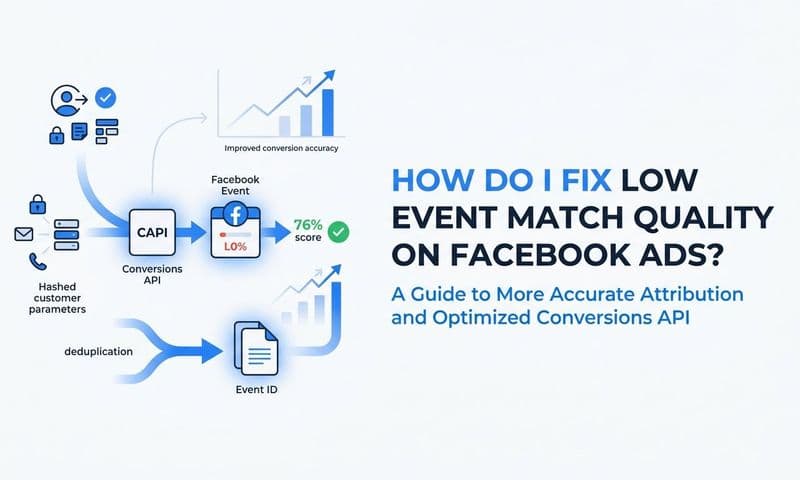
Deduplication is non-negotiable: When both the pixel and CAPI fire for the same conversion, Facebook can receive two signals for one event. Without deduplication logic, this results in double-counting, which creates a different kind of reporting problem. Proper deduplication requires assigning a unique event ID to each conversion and passing that ID through both the pixel and the CAPI event. Facebook uses this ID to recognize that both signals represent the same action and counts it only once.
What happens without CAPI: B2B SaaS companies that rely solely on the pixel are feeding Facebook's algorithm an incomplete and increasingly degraded data signal. This matters beyond just reporting. Facebook's ad optimization engine uses conversion signals to find more users who are likely to convert. When those signals are incomplete, the algorithm makes worse decisions, targeting degrades, and campaign performance suffers in ways that compound over time.
Implementing the Conversion API is not optional anymore if you want accurate data. It is the technical foundation that everything else in your measurement stack depends on. Without it, you are operating with a structural blind spot that no amount of creative optimization can fully compensate for.
First-Party Data and the Role of Event Enrichment
Implementing CAPI is necessary, but it is not sufficient on its own. The quality of the data you send through CAPI matters as much as the fact that you are sending it. This is where event enrichment becomes a critical lever for reducing underreporting.
When Facebook receives a conversion event, it tries to match that event to a real user in its system. The more identifying information you include with the event, the more likely Facebook is to make a successful match. Meta provides an Event Match Quality (EMQ) score in Events Manager that rates how effectively your event data is matching to Meta user profiles.
A low EMQ score means Facebook is receiving conversion signals but cannot reliably connect them to the users who triggered them. Those conversions exist in the data but do not get attributed to campaigns, which is a direct cause of underreporting at the campaign level. This is a core reason why robust Facebook conversion tracking requires more than just installing a pixel and hoping for the best.
What first-party data to include: The most impactful identifiers are hashed email addresses, phone numbers, and customer IDs. When a user fills out a form or completes a purchase, you have access to this data on your server. Hashing it before sending it to Facebook protects user privacy while still allowing Facebook to match the event to a profile. Including multiple identifiers increases match probability significantly.
The bare-minimum problem: Many companies send only a page URL and an event name to Facebook, which gives the matching algorithm almost nothing to work with. A conversion sent without any user identifiers has a very low chance of being matched and attributed. Enriching your events with available first-party data is one of the highest-leverage improvements you can make without changing anything else in your setup.
Offline and delayed conversions: For B2B SaaS companies, some of the most important conversions happen long after the initial ad interaction. A prospect clicks a Facebook ad, enters a trial, and converts to a paying customer six weeks later after a sales conversation. Connecting your CRM data to your ad platform through offline conversion uploads or CRM integrations allows those delayed conversions to be credited back to the original campaign. Without this, your Facebook data reflects only the top-of-funnel activity while the revenue impact goes untracked.
Event enrichment is the difference between Facebook seeing a shadow of your conversion activity and seeing a clear, complete picture. The more context you provide, the better the match rate, and the more accurately your campaigns are credited for the results they are actually driving.
Building a Single Source of Truth for Ad Performance
Even with a perfect pixel implementation, CAPI running with deduplication, and enriched first-party data, there is still a fundamental limitation to relying on Facebook Ads Manager as your primary performance measurement tool. Facebook can only report on what Facebook can see. It cannot tell you what happened across your entire customer journey.
This is not a criticism of Facebook as a platform. It is simply the reality of in-platform reporting. Every ad platform has an inherent incentive to show its contribution to your results, and its measurement tools are built around its own data. That does not make the data wrong, but it does make it incomplete. This is precisely why dedicated Facebook ads measurement tools that operate independently of the platform itself have become essential for serious marketers.
The channel attribution problem: A prospect might click a Facebook ad, then come back through an organic Google search, then convert after clicking a retargeting ad on LinkedIn. Facebook will credit the conversion to the Facebook ad if it falls within the attribution window. Google might credit it to the organic search. LinkedIn might credit it to the retargeting ad. Add up the claimed conversions across all three platforms and you will likely get a number larger than your actual conversion count.
This is why a third-party attribution platform is not a luxury for serious B2B SaaS marketers. It is a necessity. A neutral measurement layer that aggregates data from your ad platforms, CRM, and website can reconcile these discrepancies and show you what actually drove the conversion across the full journey.
Multi-touch attribution reveals the full picture: Multi-touch attribution models distribute credit across all the touchpoints in a customer journey rather than assigning it entirely to one interaction. This prevents you from cutting campaigns that are contributing meaningfully to conversions even when they are not the last touch. Many B2B marketers have paused Facebook campaigns that were generating strong top-of-funnel awareness, not realizing those campaigns were a consistent first touchpoint for customers who eventually converted through other channels. Exploring digital marketing attribution software options is a practical next step for teams ready to move beyond in-platform reporting.
Pipeline and revenue as the real metric: The most important question is not how many conversions Facebook reported. It is how much pipeline and revenue can be traced back to Facebook ad spend. Connecting your CRM data to your attribution platform so that closed-won deals are mapped back to their originating ad interactions gives you the data you need to make confident budget decisions. This is the level of visibility that separates teams that scale efficiently from teams that are perpetually guessing.
Fixing Underreporting: A Practical Action Plan for Marketers
Understanding the causes of Facebook ad underreporting is valuable, but the goal is to fix it. Here is a structured approach to working through the problem systematically, from the technical foundation up to the measurement layer.
Step 1: Audit your current pixel implementation. Start in Facebook's Events Manager. Review your event match quality scores for each conversion event. Look for firing errors, duplicate events, and missing parameters. The Events Manager diagnostics tool will surface issues that may have been silently affecting your data for months. Pay particular attention to whether your key conversion events (lead, purchase, trial start) are firing consistently and with the right parameters attached. Dedicated tracking Facebook ads tools can make this audit process significantly more efficient by surfacing data gaps that are invisible inside Ads Manager.
Step 2: Implement the Meta Conversion API with deduplication. If you are not already running CAPI alongside your pixel, this is the highest-priority fix. Work with your development team or use a CAPI partner integration to set up server-side event sending. Assign unique event IDs to every conversion and pass those IDs through both the pixel and the CAPI event so Facebook can deduplicate correctly. Once CAPI is live, monitor your event match quality scores to confirm they improve.
Step 3: Enrich your events with first-party identifiers. Review what data you are currently sending with each conversion event. If you are not including hashed email, phone number, or customer ID, add them. This single change can meaningfully improve your EMQ scores and increase the percentage of conversions that get attributed to campaigns. For B2B SaaS companies, also set up offline conversion uploads or CRM integrations to capture delayed conversions that happen after the initial ad interaction.
Step 4: Standardize your attribution window. Decide which attribution window best reflects your actual sales cycle and apply it consistently across all campaigns. Document this decision so that when you compare Facebook data against CRM data, you are accounting for the window difference rather than treating it as an error. For most B2B SaaS companies, a 7-day click window is a reasonable starting point, but your specific cycle may warrant a different approach.
Step 5: Connect an independent attribution platform. Use a third-party attribution tool to cross-reference Facebook-reported conversions against your actual pipeline and revenue data. This gives you a neutral view that is not subject to platform bias and allows you to see how Facebook ads contribute to conversions across multi-touch journeys. When you can connect ad spend directly to closed-won revenue, you are making budget decisions based on reality rather than platform-reported approximations.
This is not a one-time fix. Tracking accuracy requires ongoing maintenance as privacy regulations evolve, browser behavior changes, and your tech stack grows. Build a regular audit cadence into your operations so that data quality stays high over time.
Putting It All Together
Facebook ad underreporting is not something you have to accept as an inherent limitation of paid social advertising. It is a solvable problem with a clear, layered solution: fix the technical tracking foundation with server-side events, enrich your data with first-party signals, and validate everything through an independent attribution platform.
The marketers who solve this problem gain a significant advantage. They stop cutting campaigns that are actually working. They stop over-investing in channels that only look good because of attribution bias. They make budget decisions based on what is actually driving pipeline and revenue, and they scale with confidence instead of guessing.
Cometly is built specifically for this challenge. It connects your ad platforms, CRM, and website to track the entire customer journey in real time, giving you a single source of truth that is not dependent on any one platform's reporting. With Cometly, you can see which ads are driving leads and revenue, compare attribution models side by side, and feed enriched conversion signals back to Facebook and other ad platforms to improve targeting and optimization. Every touchpoint is captured, from the first ad click to the closed-won deal, so you can stop second-guessing your data and start scaling what works.
If your Facebook data does not match your CRM, the answer is not to pick one and ignore the other. The answer is to build the infrastructure that reconciles both and shows you the complete picture. Get your free demo today and see how Cometly can help you restore accurate tracking and make every marketing dollar accountable.