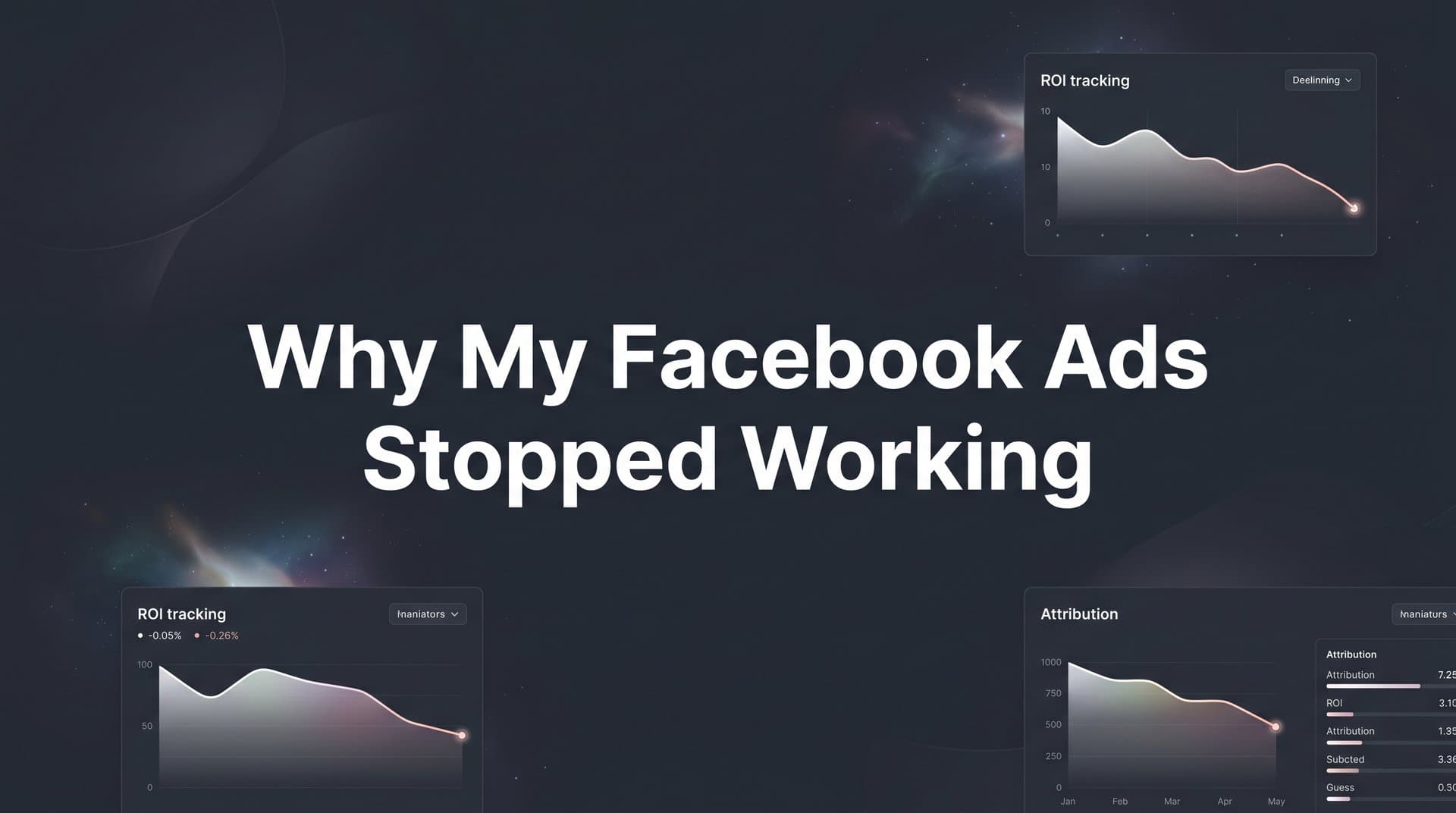
There are few things more frustrating in paid media than watching a campaign that was working beautifully suddenly fall flat. The leads dry up, the cost per acquisition climbs, and the dashboard that once delivered good news starts feeling like a source of dread. If you have found yourself searching "why my Facebook ads stopped working," you are in good company. This is one of the most common and costly problems marketers face, and it rarely has a single, obvious cause.
The temptation is to panic and make sweeping changes. Pause the campaign. Slash the budget. Rebuild from scratch. But that instinct often makes things worse. The smarter move is to slow down, think diagnostically, and trace the problem back to its actual source.
Facebook ad performance declines typically fall into a handful of categories: creative fatigue, algorithm disruption, broken tracking, offer misalignment, or some combination of all four. This article will walk you through each one, give you a framework for diagnosing what is actually happening in your account, and show you how to rebuild performance on a foundation of clean data and real attribution.
The Hidden Culprit: Ad Fatigue and Audience Saturation
Ad fatigue is one of the most common reasons Facebook ads stop working, and it is also one of the easiest to overlook because it happens gradually. The concept is straightforward: when the same audience sees the same creative repeatedly, engagement drops. People scroll past. They stop clicking. And Facebook's algorithm, which is constantly reading engagement signals to decide how aggressively to deliver your ad, responds by pulling back on distribution and increasing your CPMs.
Think of it like this. The first time someone sees your ad, it is new and relevant. The third time, it is familiar. The sixth time, it is noise. Facebook sees the declining engagement, interprets it as a signal that your ad is less valuable, and begins allocating your budget less efficiently as a result.
Frequency is the metric to watch here. As your frequency score climbs, you can typically expect to see click-through rates fall and conversion rates follow. This is not a platform bug. It is the algorithm doing exactly what it is designed to do: prioritize ads that users find relevant and engaging.
For B2B SaaS companies, this problem is especially acute. Your target audience is inherently limited. You might be targeting specific job titles, company sizes, or industries, which means your addressable pool on Facebook is often far smaller than what a B2C brand would work with. A small audience saturates faster. What might take a B2C campaign months to experience, a B2B SaaS campaign can hit in a matter of weeks.
The solution is not to wait until performance collapses before refreshing your creative. The most effective advertisers treat creative refresh cycles as a standing operational habit. Set a cadence for introducing new ad variations: new headlines, new visual formats, new angles on the same core offer. Test different hooks. Rotate between video and static. Speak to different pain points. Understanding Facebook ads performance metrics at each stage helps you recognize fatigue signals before they compound.
Audience expansion is the other lever. Broadening your targeting parameters, testing lookalike audiences built from your highest-value customers, or layering in interest-based segments can introduce your ads to fresh eyes and extend the effective lifespan of a campaign. Neither of these is a one-time fix. They are ongoing disciplines that separate advertisers who sustain performance from those who are constantly wondering why their campaigns stopped working.
Algorithm Shifts and Auction Dynamics You Cannot Ignore
Sometimes your Facebook ads stop working and you did not change a single thing. No new creative, no budget adjustments, no audience edits. The campaign just quietly deteriorates. When this happens, the culprit is often the auction itself.
Facebook's ad delivery operates through a real-time auction. Every time there is an opportunity to show an ad, Facebook evaluates competing bids and determines which ad gets delivered based on a combination of bid amount, estimated action rates, and ad quality. This auction is not static. It shifts constantly based on who else is competing for the same audience, what time of year it is, and how the platform's broader algorithm is evolving.
Seasonality is a major driver of auction volatility. When more advertisers are competing for the same inventory, CPMs rise and your budget goes less far. This happens predictably around major retail periods, but it also happens in subtler ways throughout the year as category-level competition fluctuates. A campaign that was profitable at a certain CPM can become unprofitable when that CPM rises due to increased auction competition, even if your ad quality has not changed at all.
Platform-wide algorithm updates are another factor. Meta periodically adjusts how its delivery system evaluates and ranks ads. These updates can shift which creative formats, campaign objectives, or audience configurations perform best, sometimes overnight. Advertisers who were optimized for the previous version of the algorithm can find their performance disrupted without any obvious cause.
Your own campaign settings also interact with the auction in ways that are easy to get wrong. Bid strategy mismatches, where your bid cap is set too low for current auction conditions, can cause your ads to stop delivering almost entirely. Campaign objective choices matter too: optimizing for link clicks when you actually want purchases sends the wrong signal to the algorithm and attracts the wrong kind of traffic.
One of the most common self-inflicted wounds in this category is triggering unnecessary learning phase resets. Meta's documentation confirms that when you make significant edits to a campaign, including changing budgets substantially, swapping audiences, or adjusting creative, the campaign re-enters the learning phase. During this period, delivery is unstable and performance is often erratic as the algorithm recalibrates. Marketers who make frequent edits in response to short-term fluctuations can trap themselves in a perpetual learning phase, never allowing the algorithm to stabilize and optimize effectively. Reviewing your delivery status in Ads Manager is a practical first step when diagnosing these disruptions.
The practical takeaway: give campaigns time to breathe before making changes. Evaluate performance over meaningful time windows rather than reacting to daily variance. And when you do need to make changes, make them thoughtfully rather than incrementally, to minimize how often you force a learning phase reset.
Broken Tracking Is Silently Killing Your Campaigns
Here is a scenario that plays out more often than most marketers realize. A campaign is delivering. Impressions are healthy, click-through rates are reasonable, and Facebook Ads Manager is reporting conversions. But actual leads are not showing up in the CRM, and pipeline is not growing. The campaign looks fine on the surface, but something is fundamentally broken underneath.
That something is almost always tracking.
Facebook's ad delivery optimization depends entirely on conversion signals. When someone clicks your ad and completes a desired action, the pixel fires an event back to Meta, which uses that signal to understand what kind of user converted. Over time, the algorithm builds a model of your ideal customer and prioritizes showing your ad to users who resemble that profile. This feedback loop is the engine of performance optimization.
When that feedback loop breaks, the engine stalls. If your pixel events are misconfigured, firing on the wrong pages, or not firing at all, Facebook loses the signal it needs to optimize delivery. Without accurate conversion data, the algorithm begins misallocating budget, spending on users who are unlikely to convert because it no longer has reliable information about who actually does.
The iOS privacy changes that Apple introduced with iOS 14.5 made this problem significantly more widespread. Apple's App Tracking Transparency framework restricted the ability of third-party pixels to track user behavior across apps and websites. For browser-side pixel tracking, this meant a meaningful portion of conversion events were simply never recorded. Meta acknowledged this publicly and developed the Conversions API as the recommended server-side solution.
Unlike browser-side pixel tracking, which depends on a user's browser to fire the event, the Meta Conversions API sends conversion data directly from your server to Meta. It bypasses browser restrictions and ad blockers, resulting in more complete and accurate signal delivery. For B2B SaaS companies where every conversion matters and audiences are small, the difference between partial and complete Facebook conversion tracking is not a minor detail. It is the difference between an algorithm that is optimizing effectively and one that is flying blind.
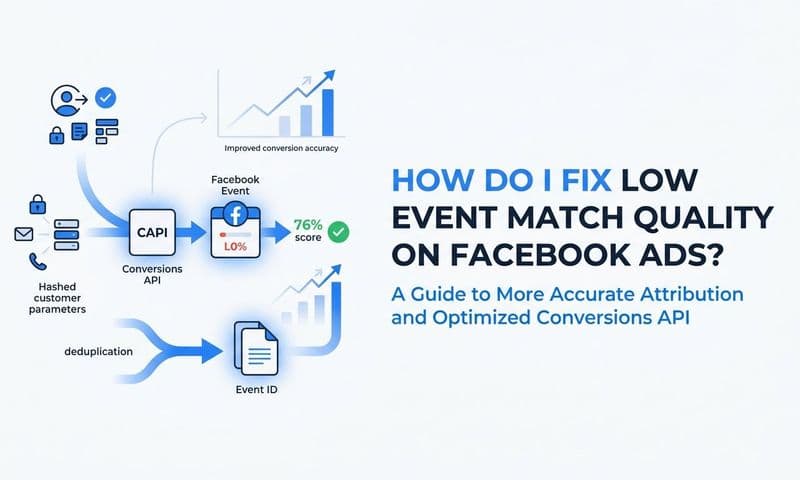
There is another layer to this: event deduplication. When you run both browser-side pixel tracking and server-side Conversions API tracking simultaneously, which is the recommended setup, there is a risk of the same conversion event being reported twice. Meta has deduplication mechanisms to handle this, but they require proper configuration. If deduplication is not set up correctly, you end up with inflated conversion counts in Ads Manager. The algorithm then optimizes based on those inflated signals, which distorts its model of who your best customers are and degrades campaign performance over time. Monitoring Facebook event match quality is one of the most reliable ways to catch these configuration issues before they compound.
Tracking integrity is not glamorous work, but it is foundational. Before you touch creative, budgets, or audiences, confirm that your conversion events are firing correctly, that your Conversions API is properly implemented, and that deduplication is configured. A campaign with broken tracking cannot be fixed by better creative. It can only be fixed by fixing the tracking.
Offer and Landing Page Misalignment: The Conversion Gap
Imagine your ad is delivering well. Frequency is reasonable, click-through rates are solid, and Facebook is spending your budget efficiently. But conversions are not materializing. The problem in this scenario is often not the ad at all. It is what happens after the click.
Ad creative and landing page content need to tell a coherent, continuous story. When someone clicks an ad promising a specific outcome, they arrive at the landing page with a specific expectation. If the page does not immediately deliver on that expectation, the mental contract is broken. Visitors bounce. Conversion rates collapse. And from inside Facebook Ads Manager, it looks like the campaign stopped working, even though the ad itself is performing its job.
This misalignment is surprisingly common in B2B SaaS marketing because the people managing ads and the people managing the website are often different teams with different priorities and different update cycles. A landing page gets redesigned. A form gets changed. An offer gets updated. None of these changes trigger any alerts inside Facebook Ads Manager, but all of them can silently break campaign performance. Learning how to create a successful Facebook ad that maintains message continuity from click to conversion is a skill that pays dividends across every campaign.
The same dynamic applies to offer relevance over time. An offer that resonated six months ago may no longer match where your target audience is in their buying journey or what competitive alternatives they are now aware of. If the market has shifted and your landing page message has not kept pace, you will see conversion rates erode even as ad delivery remains stable.
This is why tracking the full customer journey beyond the ad click is so important. The click is not the outcome. The conversion is not even the outcome. For B2B SaaS companies, the outcome is pipeline and closed revenue. If you are only measuring performance at the ad click or lead submission level, you are missing the data that would tell you whether the traffic you are driving actually converts into customers.
Understanding where in the funnel the real drop-off is happening changes everything about how you diagnose and respond to a performance problem. Is the issue in the ad creative? The landing page? The qualification of leads? The sales process? Without visibility into the full journey, you are guessing. And guessing is expensive.
How to Diagnose the Real Problem Using Attribution Data
When your Facebook ads stop working, the worst thing you can do is make random changes and hope something sticks. The best thing you can do is follow a structured diagnostic process that isolates the actual source of the breakdown.
Start with delivery metrics. Are your ads actually being shown? Check impressions, reach, and frequency. If impressions have dropped significantly, the issue is likely in delivery, which points toward auction dynamics, learning phase disruption, or audience exhaustion. If impressions are stable but performance has declined, the problem is downstream.
Move to engagement metrics next. What is happening with click-through rate and CPM? A rising CPM with stable CTR suggests increased auction competition. A falling CTR with stable CPM suggests creative fatigue or audience saturation. These two patterns point to very different solutions.
Then examine conversion metrics. Is your conversion rate from click to lead declining? Is your cost per acquisition rising? This layer of the diagnostic tells you whether the issue is in the ad experience itself or in what happens after the click. If CTR is healthy but CVR is low, the landing page or offer is the likely culprit.
Finally, look at revenue attribution. This is where most Facebook advertisers stop short, and it is also where the most important insights live. Are the leads being generated actually converting into pipeline? Are they closing into revenue? If lead volume looks acceptable but downstream revenue is not materializing, the problem may be in lead quality, audience targeting, or the sales process, none of which will be visible inside Facebook Ads Manager.
This brings up a critical limitation of relying solely on Facebook's native reporting. Ads Manager defaults to reporting conversions using attribution windows that include view-through conversions. This means a conversion can be credited to a Facebook ad even if the user only saw the ad and never clicked it. The result is often significant over-attribution, where Facebook claims credit for conversions that were actually driven by other channels or by direct intent. These Facebook ads reporting discrepancies are one of the most common sources of misallocated budget in paid media.
When you cross-reference Ads Manager data with an independent attribution platform, the picture often looks very different. Campaigns that appeared highly efficient based on Facebook's reported CPA may look far less efficient when measured against actual pipeline and revenue data. Conversely, campaigns that look modest in Ads Manager may be driving outsized downstream value that the platform is not capturing.
A multi-touch attribution platform gives you a source-of-truth view across the entire funnel, connecting ad clicks to lead submissions, pipeline stages, and closed revenue. This kind of visibility is what allows you to identify whether your performance problem is in the ad, the landing page, the lead quality, or somewhere in the sales process. Without it, you are diagnosing a complex problem with incomplete information.
Rebuilding Campaign Performance with Better Data and Strategy
Once you have diagnosed where the breakdown is happening, you can rebuild with intention rather than guesswork. The sequence matters here. Jumping straight to creative refresh before fixing tracking integrity is like repainting a car with a broken engine. Start with the foundation.
The first step is always a tracking audit. Verify that your pixel events are firing correctly on the right pages. Confirm that your Meta Conversions API is implemented and sending events server-side. Check that deduplication is configured properly so you are not inflating conversion counts. If your tracking is broken, no other optimization will be effective because the algorithm is working from bad data. A structured approach to syncing conversion data to Facebook Ads ensures the algorithm receives the accurate signals it needs to perform.
With clean tracking in place, turn to creative. Audit your existing ads for frequency and engagement trends. Identify which creatives are fatigued and develop new variations that approach your offer from different angles. Test new formats, new hooks, and new messaging frameworks. Give the algorithm fresh material to work with and enough time to exit the learning phase before drawing conclusions.
Reassess your audience definitions. Are you targeting too narrowly and saturating a small pool? Could you expand to lookalike audiences built from your best customers? Are there adjacent segments worth testing? Audience strategy and creative strategy are most powerful when they evolve together.
Then realign your budget to campaigns with verified downstream revenue impact. This is where attribution data becomes a competitive advantage. If you know which campaigns are generating not just leads but actual closed revenue, you can concentrate spend on what is genuinely working and cut what only appears to be working based on platform-reported metrics. The principles behind Facebook ads optimization are most powerful when they are grounded in full-funnel revenue data rather than surface-level platform metrics.
Feeding enriched, first-party conversion data back to Facebook via the Conversions API is one of the highest-leverage things you can do to improve algorithmic performance. Meta's documentation confirms that higher-quality conversion signals, including matched email addresses, phone numbers, and purchase values, help the algorithm identify and target users who are more likely to convert at high value. By sending richer signals, you are effectively retraining the delivery system to find better prospects, which improves performance over time.
Sustainable Facebook ad performance is not something you set and forget. It requires ongoing measurement that goes beyond the platform itself, connecting ad spend to pipeline and revenue so you always know what is actually working. That connection is what allows you to make confident scaling decisions rather than reactive ones.
Putting It All Together
Facebook ads rarely stop working for just one reason. What looks like a sudden performance collapse is usually the result of multiple factors converging: creative that has run its course, tracking gaps that have silently degraded signal quality, auction dynamics that shifted, or a disconnect between the ad experience and what happens after the click.
The marketers who recover fastest are not the ones who make the most changes. They are the ones who diagnose accurately before acting. They have clean data infrastructure, reliable conversion tracking, and visibility into the full customer journey from ad click to closed revenue. That foundation is what separates reactive advertisers from those who can identify problems quickly and fix them with precision.
If your Facebook ads have stopped working, the answer is not to abandon the channel. It is to build the measurement infrastructure that lets you understand exactly what is happening at every stage of the funnel, so you can make decisions based on real outcomes rather than platform-reported metrics.
Cometly is built for exactly this. It connects your ad platforms, CRM, and website to give you a complete view of every customer journey in real time, so you can see which ads are driving pipeline and revenue, not just clicks and leads. With multi-touch attribution, server-side conversion tracking, and AI-driven recommendations, Cometly helps you diagnose performance problems faster and scale what actually works with confidence. Get your free demo and start building the attribution foundation your campaigns need.