
Most B2B SaaS marketing teams know the frustration well. You run broad-based campaigns, generate a healthy volume of leads, and watch your MQL numbers climb. Then the sales team looks at the pipeline and asks the uncomfortable question: where are the accounts that actually matter?
That gap between lead volume and revenue impact is exactly why account based marketing has become one of the most widely adopted strategies among B2B SaaS teams. Instead of casting a wide net and hoping the right accounts show up, ABM flips the model. You start with the accounts you want, then build campaigns designed specifically to engage them.
The concept sounds straightforward, but execution is where most teams struggle. ABM involves coordinating marketing and sales around a shared account list, personalizing outreach at scale, tracking engagement across multiple stakeholders and channels, and measuring success in ways that traditional demand generation tools were never designed to handle.
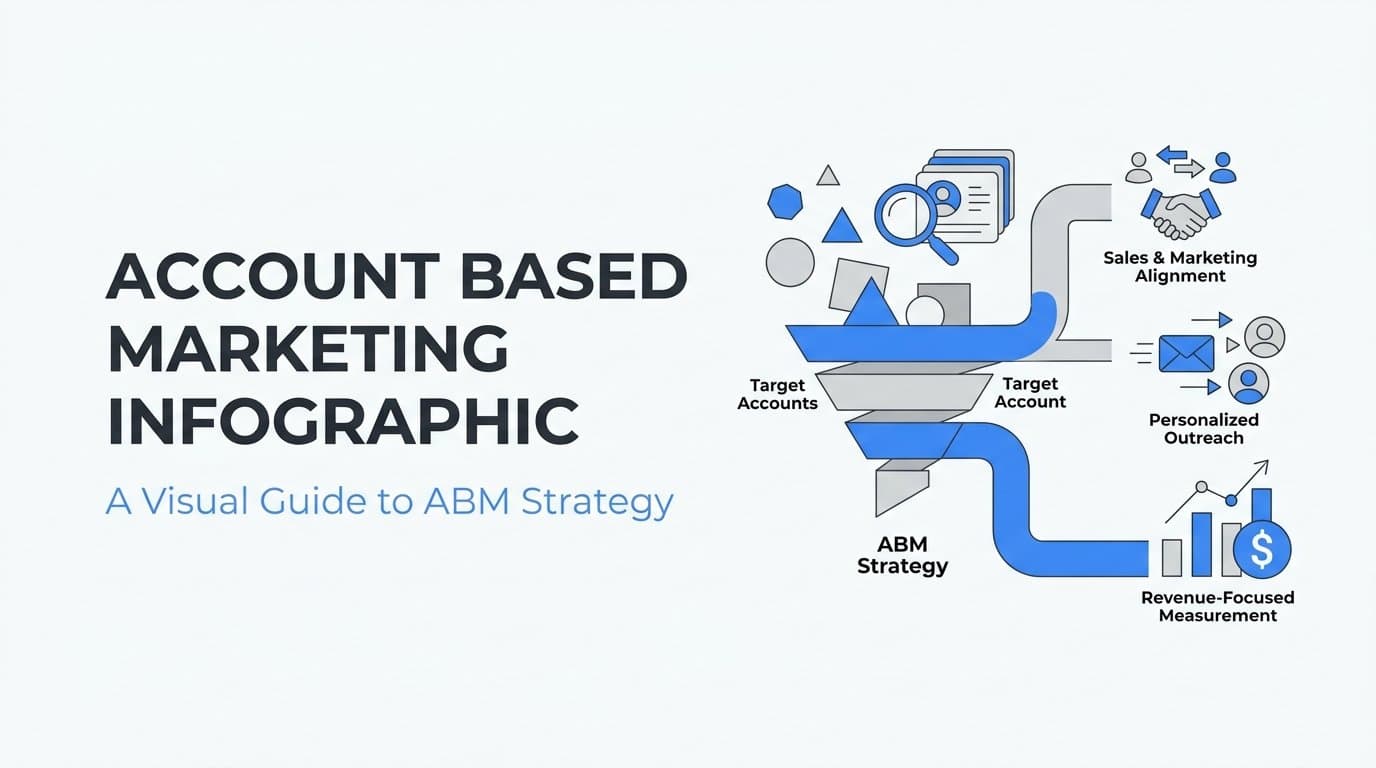
This is where visual frameworks become genuinely useful. An account based marketing infographic does more than simplify a complex strategy for a slide deck. It maps the moving parts of an ABM program in a way that creates alignment across teams, clarifies what stage each account is in, and shows the full journey from selection to closed revenue.
This article breaks down the ABM framework visually and conceptually. You will learn how ABM is structured, what the key stages look like in practice, how to measure what is actually working, and what data infrastructure you need to connect campaign activity to real pipeline outcomes. Whether you are building your first ABM program or trying to sharpen one that is already running, this guide gives you the full picture.
The Core Framework Behind Account Based Marketing
Account based marketing is a B2B strategy where marketing and sales teams coordinate their efforts around a defined set of target accounts rather than pursuing a broad pool of leads. Instead of generating volume at the top of the funnel and hoping qualified buyers emerge, ABM starts with the end in mind: which companies do we want as customers, and how do we engage them specifically?
This distinction matters more than it might seem. Traditional demand generation treats the funnel as a filtering mechanism. You attract a wide audience, score leads, and pass the best ones to sales. ABM inverts this logic. The target accounts are identified first, and every campaign, piece of content, and outreach sequence is built around engaging those specific companies.
For B2B SaaS teams, this approach aligns naturally with the realities of the sales environment. Enterprise and mid-market SaaS deals typically involve multiple stakeholders, extended evaluation timelines, and high contract values. Spending ad budget and sales resources on accounts that are a poor fit is expensive. ABM concentrates effort where the probability of conversion and expansion is highest.
Understanding the Three Tiers of ABM
ABM is not a single execution model. It operates across three tiers, and most mature programs use all three depending on account priority.
One-to-one ABM: This tier targets a small number of named strategic accounts with fully personalized campaigns. Think custom landing pages, dedicated content, and coordinated outreach built around a specific company's challenges and stakeholders. This approach is resource-intensive but appropriate for accounts with the highest potential contract value.
One-to-few ABM: Here, accounts are clustered by shared characteristics such as industry vertical, company size, or use case. Campaigns are personalized at the segment level rather than the individual account level. This tier balances personalization with scalability and works well when you have a clear ICP with identifiable clusters.
One-to-many ABM: Also called programmatic ABM, this tier applies account-level targeting at scale using ad platforms and intent data. You can target hundreds or thousands of accounts simultaneously through LinkedIn's company targeting or Google's audience tools, delivering relevant messaging without the manual effort of one-to-one campaigns.
The Foundational Metric Shift
One of the most significant changes ABM requires is not strategic. It is operational. ABM demands a shift from volume-based metrics like MQLs and lead counts to account-level engagement signals and pipeline influence.
When your success metric is leads generated, you optimize for volume. When your success metric is account engagement and pipeline progression, you optimize for quality and relevance. This shift changes how you evaluate campaigns, how you define success for the marketing team, and how you report to leadership.
Making that shift stick requires a different data infrastructure, which is something we will cover in detail later. But the framework itself starts here: define the accounts, align the teams, and measure at the account level from day one.
Reading an ABM Infographic: What the Visual Elements Tell You
An account based marketing infographic is not just a simplified diagram for presentations. When built well, it functions as a working map of your ABM program, showing where accounts are in the journey, what engagement has happened, and what needs to happen next.
Understanding what these visual elements represent helps you use them more effectively for both internal alignment and strategic planning.
The Account Selection Funnel
Most ABM infographics open with an account selection layer. This is typically shown as a filtering funnel or a tiered list that narrows a broad universe of potential companies down to a prioritized target account list. The visual represents the ICP scoring process: firmographic filters (company size, industry, geography), technographic signals (the tools and platforms they use), and intent data (behavioral signals that suggest active buying interest).
This section of the infographic is often overlooked, but it is foundational. The quality of your ABM program depends almost entirely on the quality of your target account list. A visual framework that makes this selection process explicit helps teams avoid the common mistake of treating ABM as just a different delivery mechanism for the same broad audience.
Engagement Layers and Stakeholder Mapping
Where ABM infographics diverge most clearly from traditional funnel diagrams is in how they represent the buyer journey. A standard demand generation funnel shows a single buyer moving through awareness, consideration, and decision stages. An ABM infographic shows multiple stakeholders within a single target account moving through those stages simultaneously and at different paces.
You might see an economic buyer engaging with thought leadership content at the awareness stage while a technical evaluator is already in a product trial. A champion inside the account may be actively sharing content internally while procurement is not yet involved. The visual captures this complexity in a way that a simple funnel cannot.
This multi-stakeholder view is particularly important for B2B SaaS teams because it reflects how enterprise deals actually work. Recognizing where each stakeholder sits in the journey allows marketing and sales to tailor their outreach accordingly rather than sending the same message to everyone at the account.
Sales-Marketing Handoff Points
Effective ABM infographics also mark the points where marketing hands off to sales and where sales feeds information back to marketing. These handoff moments are critical because they represent the coordination points that make ABM work as a unified strategy rather than two separate functions running parallel campaigns.
When these handoff points are clearly mapped, both teams know what triggers a transition, what information needs to be passed along, and what follow-up actions are expected. This clarity reduces the friction that typically causes accounts to fall through the cracks between marketing engagement and sales outreach.
The Five Stages of an ABM Campaign
A well-structured ABM campaign moves through five distinct stages. Understanding each stage helps teams build programs that are systematic rather than reactive, and measurable rather than anecdotal.
Stage 1: Build and Validate Your Target Account List
Before any campaign launches, you need a list of accounts that meet your ideal customer profile. This means applying firmographic filters such as company size, industry, and revenue range, combined with technographic data to identify companies using relevant tools or platforms. Intent data adds another layer by surfacing accounts that are actively researching solutions in your category.
The validation step is often skipped, but it matters. Cross-referencing your target list with your existing CRM data, win-loss history, and sales team input ensures you are not targeting accounts that are already in progress, previously churned, or outside your addressable market.
Stage 2: Prioritize and Tier Your Accounts
Not all target accounts deserve the same level of investment. Once your list is built, scoring accounts by fit and intent signals allows you to assign them to the appropriate ABM tier. High-fit, high-intent accounts move into one-to-one programs. Moderate-fit clusters move into one-to-few campaigns. The broader list feeds programmatic ABM efforts.
This tiering decision directly affects budget allocation, content requirements, and sales involvement. Getting it right at this stage prevents the common problem of over-investing in accounts that are unlikely to convert.
Stage 3: Develop Personalized Content and Messaging
With accounts prioritized, the next stage is building the content and messaging that will drive engagement. For one-to-one accounts, this might mean custom landing pages, personalized video outreach, or industry-specific case studies. For one-to-few clusters, it means segment-level content that speaks to shared pain points. For programmatic ABM, it means ad creative and copy that resonates with the audience characteristics of your target accounts.
The key principle here is relevance over volume. A single piece of content that directly addresses a target account's specific challenge will outperform a high volume of generic messaging every time.
Stage 4: Activate Across Multiple Channels
ABM is inherently multi-channel. Effective programs typically combine LinkedIn ads targeting by company and job title, Google ads based on intent keywords, personalized email sequences, direct outreach from sales development representatives, and retargeting campaigns that keep your brand visible as accounts move through evaluation.
The goal is not to be everywhere. The goal is to be present at the right moments, on the channels where your target stakeholders are active, with messaging that matches their stage in the journey.
Stage 5: Measure Account Engagement and Pipeline Progression
The final stage is where most ABM programs either prove their value or lose credibility. Measuring success means tracking which accounts engaged with your campaigns, how deeply they engaged, and whether that engagement translated into pipeline movement and ultimately closed revenue. This is a fundamentally different measurement model than tracking top-of-funnel lead volume, and it requires different tools and data connections to execute properly.
Tracking ABM Performance Across Every Touchpoint
Here is the measurement problem that undermines a lot of ABM programs. A target account sees your LinkedIn ad on Monday. A decision-maker at that company reads your blog post on Wednesday. The technical evaluator attends your webinar on Friday. A sales rep sends a personalized email the following week. Then the account requests a demo.
If your attribution model is last-click, only the demo request gets credit. Every other interaction that built familiarity, established credibility, and moved the account toward that decision is invisible in your reporting.
Why Last-Click Attribution Fails ABM
Last-click attribution was designed for shorter, simpler buyer journeys. When a single person clicks an ad and converts in the same session, last-click tells a reasonably accurate story. But ABM deals involve multiple stakeholders, extended timelines, and interactions across many channels. In this environment, last-click attribution systematically undervalues the channels and content that do the early and middle work of building account engagement.
The practical consequence is that teams cut the channels that are actually influencing accounts because those channels do not show up as converters in last-click reports. This is one of the most common and costly mistakes in ABM measurement.
Multi-Touch Attribution as the Right Model for ABM
Multi-touch attribution distributes credit across all the interactions that contributed to moving an account through the pipeline. Instead of giving all the credit to the last touchpoint, it recognizes that the LinkedIn ad, the webinar, the blog content, and the sales email each played a role in the account's progression.
For ABM specifically, multi-touch attribution provides a much more accurate picture of which channels and campaigns are actually influencing target accounts. This allows teams to make informed decisions about where to invest, which content formats are driving engagement, and which outreach sequences are accelerating pipeline velocity.
Connecting Ad Data to CRM Events
The practical challenge with multi-touch attribution in ABM is data connectivity. Your LinkedIn ad data lives in LinkedIn's platform. Your email engagement data lives in your marketing automation tool. Your deal progression data lives in your CRM. Without a system that connects these data sources at the account level, you are looking at fragmented signals rather than a coherent picture of account engagement.
Connecting ad platform data to CRM events is what allows marketing teams to see which campaigns are actually influencing target accounts versus generating impressions and clicks that never translate to pipeline. This connection is not optional in ABM. It is the foundation of any measurement approach that can actually inform strategic decisions.
Key Metrics That Belong in Every ABM Dashboard
ABM requires a different set of KPIs than traditional demand generation. The metrics that matter in ABM reflect account-level engagement and pipeline impact rather than the volume signals that dominate conventional marketing dashboards.
The Three Core ABM Metrics
Account engagement rate: This metric measures how actively target accounts are interacting with your campaigns, content, and outreach. It aggregates signals across channels including ad clicks, content views, email opens, webinar attendance, and website visits from account IP ranges. A rising engagement rate among target accounts indicates that your campaigns are reaching the right people with relevant messaging.
Pipeline influence: Pipeline influence measures the percentage of your sales pipeline that has been touched by marketing activity. For ABM, this means tracking which target accounts in the pipeline have interacted with at least one marketing touchpoint and attributing a portion of that pipeline value to marketing's contribution. This metric directly connects marketing activity to revenue outcomes and is one of the clearest ways to demonstrate ABM's business impact.
Deal velocity: Deal velocity tracks how quickly accounts move through the pipeline stages. In ABM, the hypothesis is that personalized, coordinated engagement accelerates the sales cycle compared to accounts that receive generic outreach. Tracking velocity by account tier and campaign type allows teams to identify which ABM programs are actually shortening the time from first engagement to closed revenue.
Revenue Attribution at the Account Level
Beyond the three core metrics, revenue attribution at the account level gives teams the clearest possible view of which channels and campaigns contributed to closed-won deals. When you can trace a specific LinkedIn campaign or email sequence back to a closed account, you have the data needed to double down on what works and cut what does not.
This level of attribution requires connecting your ad platforms, CRM, and revenue data into a unified system. For B2B SaaS companies tracking subscription revenue, this means being able to see which campaigns influenced accounts that became paying customers and what their lifetime value looks like over time.
The Single Source of Truth for ABM Data
A unified marketing dashboard that pulls data from ad platforms, CRM, and website analytics gives teams the single source of truth they need to optimize ABM spend in real time. Without this unified view, teams spend significant time reconciling data from multiple sources, which slows decision-making and introduces errors that distort the picture.
When your ABM dashboard shows account engagement, pipeline stage, and revenue attribution in one place, your team can act on insights quickly rather than waiting for a weekly data pull to understand what is happening across your target account list.
Putting ABM Data to Work With Smarter Attribution
The ABM framework only delivers its full value when the measurement infrastructure can track every account touchpoint from the first ad impression to closed revenue. Without that infrastructure, teams are making decisions based on incomplete information, which means they are likely optimizing for the wrong things.
Consider what happens when attribution is missing or broken in an ABM program. A LinkedIn campaign generates strong engagement among target accounts but shows no direct conversions in the ad platform. Without multi-touch attribution connecting that engagement to downstream pipeline, the campaign looks like a failure. The team cuts the budget. Account engagement drops. Pipeline slows. The real cause of the problem, which is a measurement gap, never gets identified.
This is not a hypothetical scenario. It is one of the most common ways ABM programs lose momentum and budget before they have a chance to prove their value.
Proper attribution infrastructure changes this dynamic. When every touchpoint is tracked and connected to account progression and revenue outcomes, teams can see exactly which ABM channels and tactics are moving accounts through the pipeline. They can identify which content formats drive engagement at specific stages, which outreach sequences accelerate velocity, and which campaigns contribute most to closed revenue.
This is where Cometly directly addresses the measurement gap that holds ABM programs back. Cometly connects ad spend from platforms like Meta and Google to CRM events and revenue outcomes, giving B2B SaaS teams a complete view of how their ABM campaigns are performing across the entire account journey. Its multi-touch attribution model captures credit across every interaction rather than collapsing the story into a single last-click event. Customer journey analytics show how target accounts move through touchpoints over time. Pipeline and revenue attribution connect campaign activity directly to deal progression and closed-won revenue.
For SaaS teams tracking subscription revenue, Cometly's Stripe integration adds another layer of precision, allowing teams to see which specific campaigns influenced accounts that converted to paying customers and what revenue those accounts represent. This closes the loop between ad spend and actual business outcomes in a way that most attribution tools cannot.
Your Next Steps in ABM Measurement
Account based marketing is not just a strategy shift. It is a measurement shift. Teams that adopt ABM without upgrading their attribution infrastructure will find themselves unable to prove ROI, unable to optimize spend effectively, and unable to build the internal credibility needed to sustain and grow the program over time.
The good news is that the measurement infrastructure required for ABM is not out of reach. It requires connecting your ad platforms, CRM, and revenue data into a unified view, adopting a multi-touch attribution model that reflects how ABM actually works, and tracking the right metrics: account engagement, pipeline influence, deal velocity, and revenue attribution by channel.
Start by auditing your current tracking setup. Ask the honest questions. Can you see which campaigns are influencing your target accounts? Can you connect ad spend to pipeline and closed revenue at the account level? Can you identify which channels are driving engagement among your highest-priority accounts?
If the answer to any of those questions is no, you have a measurement gap that will limit what your ABM program can achieve regardless of how well the strategy is designed.
Cometly is built to close that gap. It gives B2B SaaS marketing teams the attribution layer that connects every ABM touchpoint to real revenue outcomes, so you can see exactly what is working, optimize with confidence, and scale the programs that actually drive pipeline.
Ready to see which channels are actually driving your ABM pipeline? Get your free demo and start connecting every touchpoint to real revenue outcomes today.