

Mobile traffic represents a substantial portion of web visits for most B2B SaaS companies, yet mobile conversions remain one of the most misattributed data points in digital marketing. The problem is not that mobile users do not convert. The problem is that standard tracking setups were built for desktop-first environments, and they break down when users switch devices, block cookies, or browse in-app.
The result is a gap between what your ad platforms report and what actually happened. That gap leads to misallocated budget, undervalued campaigns, and poor decisions about where to scale.
Accurate mobile conversion tracking closes that gap. It gives your team a reliable picture of which ads, channels, and touchpoints are driving real results on mobile, so you can optimize with confidence rather than guessing.
This guide walks you through the exact steps to set up mobile conversion tracking that holds up against modern privacy restrictions, cross-device behavior, and the limitations of pixel-based measurement. Whether you are running paid search, paid social, or multi-channel campaigns, these steps will help you capture mobile conversions accurately and feed that data back to your ad platforms and attribution tools.
By the end, you will have a tracking setup that connects mobile ad clicks to actual pipeline and revenue, not just last-click surface metrics.
Step 1: Audit Your Current Mobile Tracking Gaps
Before building anything new, you need to understand what is already broken. Most teams assume their tracking is working because data is flowing into their dashboards. But data flowing in does not mean the right data is flowing in, especially on mobile.
Start by pulling a side-by-side comparison. Look at the conversion numbers your ad platforms are reporting for mobile traffic and compare them against your CRM records and your analytics platform. If the numbers diverge significantly, that is your first signal of a conversion tracking gap that needs immediate attention.
Next, dig into the specific failure points that are most common in mobile setups:
Missing UTM parameters: Check whether UTM parameters are passing through correctly on your mobile landing pages. Open a real mobile device, click an ad, and inspect the URL that loads. If the parameters are stripped or malformed, your source attribution is broken from the very first touch.
Broken pixel fires: Mobile browsers, slower connections, and in-app environments can prevent JavaScript-based pixels from firing completely. Look at your pixel event logs and check for gaps in mobile event volume compared to desktop.
In-app browser interference: When users click a Meta or TikTok ad, they are often taken into an in-app browser rather than their native mobile browser. These in-app browsers handle cookies and JavaScript differently, which can strip UTM parameters and block standard pixel events entirely.
Form submission events: Check whether your form submission conversion events are firing correctly on mobile. A form that works perfectly on desktop may behave differently on a mobile keyboard layout, and the conversion event may never trigger.
Also review your analytics platform for mobile sessions that show unusually high bounce rates or zero conversions compared to desktop. This pattern often indicates that mobile users are arriving but your tracking infrastructure is not capturing what they do next.
Finally, document every conversion event that matters to your business: form fills, demo requests, free trial signups, and any CRM stage changes that indicate real buying intent. For each event, note the current tracking method and whether it has been verified to work on mobile.
Success indicator: You have a written list of every conversion event, the current tracking method for each, and a clear record of which ones are confirmed broken or unverified on mobile. This list becomes your roadmap for the steps that follow.
Step 2: Implement Server-Side Tracking to Replace Pixel Dependency
Client-side pixels are the weakest link in mobile conversion tracking. They depend entirely on the browser executing JavaScript correctly, and mobile environments make that increasingly unreliable. Ad blockers, browser privacy settings, slow connections, and in-app browser restrictions all create conditions where pixels fail silently.
Server-side tracking solves this at the architectural level. Instead of relying on the browser to send conversion data, your server sends that data directly to the ad platform's API. Browser restrictions become irrelevant because the communication never passes through the browser at all.
This is especially important for iOS users. Apple's App Tracking Transparency framework requires explicit user opt-in for cross-app tracking, which has significantly reduced the effectiveness of pixel-based attribution on iOS devices. Server-side tracking through the Conversion API bypasses this limitation because it operates at the server level, not the device level.
Here is what to implement:
Meta Conversion API (CAPI): Set up CAPI to send conversion events directly from your server to Meta. This should run in parallel with your Meta pixel initially, not replace it. CAPI events should include first-party identifiers such as hashed email addresses, phone numbers, and client IP addresses. These signals improve Meta's ability to match your events to real users, which directly affects how well their algorithm can optimize your mobile campaigns.
Google Enhanced Conversions: Configure Google Enhanced Conversions to send hashed customer data alongside your conversion events. This improves match rates for conversions that happen on mobile after a Google Ads click, particularly in cases where cookies are not available.
Event deduplication: When you run both a pixel and a server-side integration simultaneously, you must configure deduplication. Both signals may fire for the same conversion event, and without deduplication keys, your ad platforms will count the same conversion twice. Each event should carry a unique event ID that both the pixel and the server-side event share, so the platform knows to count them as one. A proper Conversion API implementation covers this deduplication logic in detail.
Platforms like Cometly handle server-side event routing and deduplication natively. Rather than building custom engineering to connect your CRM and form data to each ad platform's API, Cometly manages those integrations directly, including the deduplication logic that prevents double-counting.
Success indicator: Your CAPI event match quality score in Meta Events Manager shows a strong match rate, and your server-side events are appearing consistently in your event logs without duplication errors.
Step 3: Configure UTM Parameters and First-Party Tracking for Mobile Campaigns
UTM parameters are the foundation of source attribution, but they break in specific mobile scenarios that most teams never think to test. Getting this right requires more than just adding parameters to your ad URLs.
Start by verifying that auto-tagging from Google Ads and UTM parameters from Meta are passing through correctly on mobile. Auto-tagging behavior can differ on mobile redirects, and what works on desktop may not survive a mobile URL redirect chain. The only way to confirm this is to test it on an actual mobile device, not a browser emulator.
Watch out for these common mobile-specific UTM failure points:
URL shorteners and redirect chains: If you use URL shorteners in SMS campaigns or bio link tools on social profiles, those redirects can strip UTM parameters on mobile, particularly on iOS. Always test the full redirect chain and verify the final URL retains your parameters. Understanding how UTM tracking works across different environments is essential before troubleshooting these failures.
Safari's Intelligent Tracking Prevention (ITP): Safari's ITP limits the lifespan of script-set first-party cookies to seven days. For B2B SaaS companies where sales cycles often run weeks or months, a seven-day attribution window means you will lose credit for mobile ad interactions that influenced deals that closed later. The fix is to set first-party cookies server-side rather than through JavaScript, which extends the cookie lifespan significantly beyond what ITP allows for client-side cookies.
CRM-level UTM capture: Your UTM data needs to survive not just the initial visit but the entire journey from anonymous visitor to closed deal. Implement hidden form fields that capture UTM parameters from the URL and store them alongside every lead record submitted through your forms. When a mobile visitor clicks an ad, browses your site, and converts weeks later, the original mobile source should be preserved in the CRM record.
This is critical for B2B attribution. Without CRM-level UTM capture, you lose the connection between the mobile ad that started the journey and the revenue that eventually resulted from it.
Also verify that your attribution platform is reading UTM data from CRM records, not just from session cookies. Session-based attribution will miss the mobile-to-desktop conversion path that is common in B2B buying behavior.
Success indicator: Open a mobile browser, click one of your ads, complete a form submission, and then check the resulting lead record in your CRM. The record should display the correct UTM source, medium, and campaign from the ad you clicked. If it does, your UTM capture chain is working correctly on mobile.
Step 4: Set Up Cross-Device Tracking to Connect the Full Mobile Journey
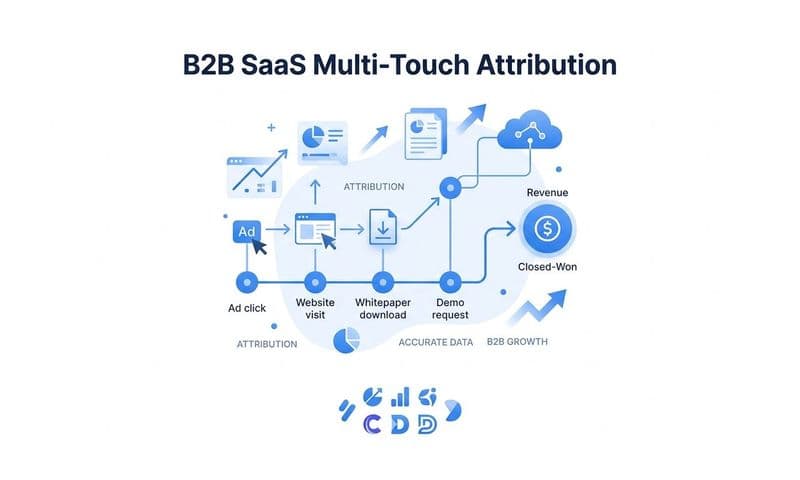
Here is a pattern that plays out constantly in B2B SaaS: a buyer sees your ad on their phone during their commute, clicks through to read about your product, and then a week later opens their laptop, searches for your brand, and signs up for a demo. Last-click attribution gives all the credit to the branded search. The mobile ad that started the journey gets nothing.
This is why last-click attribution systematically undercounts mobile's contribution to pipeline. Understanding mobile marketing attribution is what fixes it, and cross-device tracking is the mechanism that makes it possible.
Cross-device tracking works through two methods. Deterministic matching uses authenticated user identity, meaning a logged-in user ID that is consistent across devices. Probabilistic matching uses signals like IP address and device fingerprinting to infer that two sessions likely belong to the same person. Deterministic is more accurate, and for SaaS products with login flows, you have the data to make it work.
Here is how to implement it properly:
Authenticated user ID tracking: The moment a user logs into your product on any device, pass a consistent user ID to your analytics and attribution platform. This user ID should be the same regardless of whether the user is on mobile or desktop. When your attribution platform sees the same user ID appear in both a mobile session and a desktop session, it can stitch those sessions into a single customer journey.
Custom conversion event parameters: Pass the user ID as a custom parameter in your conversion events so your attribution platform can merge the pre-login mobile session with the post-login desktop session. This requires some coordination between your product team and your marketing stack, but it is the most reliable way to connect cross-device journeys.
Pre-login cross-device matching: For traffic that has not yet authenticated, rely on first-party cookie matching and hashed email matching through CAPI and Enhanced Conversions. When a user provides their email address in a form on mobile, that hashed email can be used to match their subsequent activity on desktop.
When cross-device data is connected, cross-channel tracking becomes significantly more accurate. You can see that a mobile ad click was the first touch that initiated a journey that eventually closed on desktop, and you can allocate budget accordingly.
Cometly's customer journey analytics are designed to handle exactly this scenario, mapping touchpoints across devices and channels to show the true path to conversion rather than a fragmented view split across devices.
Success indicator: In your attribution platform, you can view customer journeys that include both mobile and desktop touchpoints on the same user record, with the mobile interaction correctly identified as an earlier touchpoint in the path.
Step 5: Connect Mobile Conversion Data Back to Ad Platforms
Tracking data only creates value when it flows back to the platforms running your ads. Your ad platform algorithms need accurate conversion signals to optimize effectively, and if they are only receiving partial data from mobile, they will optimize toward the wrong audience segments and the wrong placements.
This feedback loop is where accurate mobile conversion tracking pays off most directly in campaign performance.
Meta CAPI with enriched first-party data: When you send conversion events back to Meta through CAPI with first-party identifiers attached, you improve Meta's ability to match those events to real user profiles. Better matching means Meta's algorithm can identify more people who look like your converters, which improves the quality of your mobile audience targeting over time. Knowing how to sync conversion data to Facebook Ads correctly is essential for this step.
Google Enhanced Conversions: Sending hashed customer data back to Google Ads through Enhanced Conversions improves match rates for mobile conversions that occur after a click, particularly when cookies are unavailable. This gives Google's bidding algorithms a more accurate picture of which mobile clicks are actually driving conversions, which directly affects how Smart Bidding allocates your budget across mobile and desktop.
TikTok Events API: If you are running campaigns on TikTok, use the TikTok Events API to send server-side conversion events. TikTok's inventory is heavily mobile, and the quality of your conversion signal has a direct impact on how well their algorithm can find high-intent users within that mobile-first environment.
Offline conversion imports: For B2B sales cycles where a demo booked on mobile eventually becomes a closed deal weeks later, offline conversion tracking allows you to send those CRM stage changes back to your ad platforms as conversion events. This connects the mobile ad click to the revenue outcome in a way that real-time pixel tracking never could.
Cometly automates this entire data feedback loop. It sends enriched, conversion-ready events back to Meta, Google, and other platforms automatically, so their algorithms are always optimizing on accurate mobile conversion signals rather than incomplete pixel data.
Success indicator: Your event match quality scores improve in Meta Events Manager, and your Google Ads conversion rate for mobile campaigns reflects realistic numbers rather than undercounted results that make mobile look less effective than it actually is.
Step 6: Validate Your Setup and Monitor for Data Drift
A tracking setup that works perfectly on day one can break silently. Ad platforms update their APIs. Your site gets a new form library. A mobile browser rolls out a privacy update. Any of these changes can introduce gaps in your mobile conversion data without triggering any obvious error.
Validation and monitoring are not optional steps you do once. They are ongoing operational practices that protect the integrity of your data over time.
Start with a full QA pass immediately after completing your setup. Use real mobile devices, both iOS and Android, not browser emulators. Click each ad type you run, complete each conversion event in your list, and verify that the data appears correctly in your attribution platform and CRM. Check that UTM parameters are present in the CRM record, that conversion events are firing in your event logs, and that deduplication is working as expected.
Then build a monitoring system that catches problems before they compound. Following best practices for tracking conversions accurately means building in regular checks rather than assuming your setup remains stable indefinitely.
Automated conversion volume alerts: Set up alerts that notify your team when mobile conversion volume drops below a defined threshold compared to a rolling average. A sudden drop in conversions is often a tracking break, not a real decline in performance. Catching it early saves weeks of corrupted data.
Weekly deduplication checks: Review your event deduplication logs weekly to confirm that server-side events and pixel events are not double-counting. Deduplication logic can break when event IDs are not passed correctly, and the result is inflated conversion numbers that make your campaigns look more effective than they are.
Weekly platform reconciliation: Compare ad platform reported conversions against your attribution platform and CRM on a weekly basis. Persistent discrepancies that fall outside an acceptable margin indicate a tracking gap that needs investigation. Small discrepancies are normal; large or growing ones are not.
Monthly API health checks: Review your CAPI and Enhanced Conversions event logs monthly to catch API version deprecations or authentication issues. Ad platforms periodically update their APIs, and older integrations can stop working without warning.
Tracking architecture documentation: Document your entire tracking setup so any team member can diagnose issues without starting from scratch. Include the events being tracked, the method used for each, the deduplication configuration, and the data flows between your site, CRM, and ad platforms.
Success indicator: Your mobile conversion data in your attribution platform consistently aligns with CRM records within an acceptable margin, and you have an automated alert system that flags anomalies before they affect significant volumes of campaign data.
Putting It All Together
Accurate mobile conversion tracking is not a one-time setup. It is a system that requires the right architecture, the right data flows, and consistent monitoring. The six steps in this guide address every layer of the problem: identifying gaps in your current setup, implementing server-side tracking, configuring UTM parameters for mobile-specific failure points, connecting cross-device journeys, feeding clean conversion data back to your ad platforms, and maintaining data integrity over time.
When all of these pieces work together, your marketing team gains something most teams lack: a reliable, complete picture of how mobile traffic contributes to pipeline and revenue. You stop undervaluing mobile campaigns. You stop making budget decisions based on incomplete data. And your ad platform algorithms start optimizing on real signals instead of noise.
Cometly is built specifically to make this entire workflow manageable for B2B SaaS marketing teams. It captures every touchpoint from ad click to CRM event, connects mobile and desktop journeys, and sends enriched conversion data back to Meta, Google, and other platforms automatically. If you want to see exactly which mobile ads and channels are driving your revenue, Cometly gives you that clarity in one place.
Ready to stop guessing and start tracking mobile conversions with precision? Get your free demo today and start capturing every touchpoint to maximize your conversions.