Something interesting is happening in your analytics right now. Visitors are landing on your website, reading your content, and sometimes converting, and the source of those visits is being logged as "direct." No referrer. No campaign. No channel. Just a blank attribution that makes it look like someone typed your URL from memory.
In reality, many of those visits are coming from AI assistants. A prospect asked ChatGPT about the best tools for B2B SaaS attribution. Perplexity surfaced your blog post as a cited source. Claude recommended your pricing page in response to a comparison query. The user clicked through, landed on your site, and your analytics had no idea where they came from.
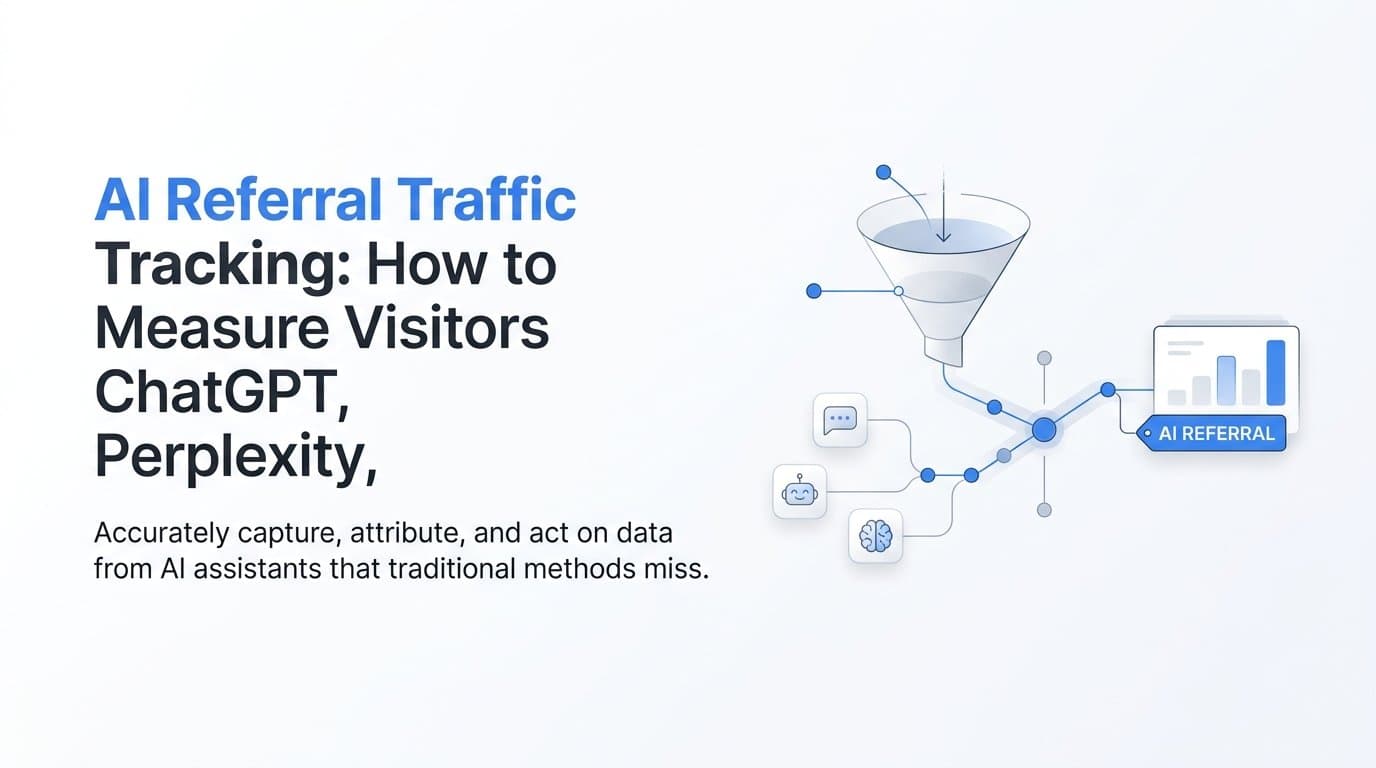
This is the core challenge of AI referral traffic tracking, and it is one of the most underappreciated measurement gaps in B2B SaaS marketing today. Traditional referral tracking was built for a web of hyperlinks: one page links to another, the browser passes a referrer header, and your analytics tool logs the source. AI assistants do not work that way. The referral context is conversational, the linking behavior is inconsistent, and the signals that analytics tools rely on are frequently absent.
For marketing teams trying to understand what is actually driving pipeline and revenue, this gap is more than an inconvenience. It is a strategic blind spot. If AI-generated traffic is being collapsed into direct, you are undervaluing the content and SEO investments that earned those citations. You are making channel allocation decisions based on incomplete data. And you are missing an emerging traffic source that is growing as AI adoption accelerates.
This article walks through why AI referral traffic behaves differently from traditional referrals, how to identify and capture it in your analytics setup, how to connect it to conversions and pipeline, and how to use that data to make smarter content and growth decisions. By the end, you will have a clear picture of what accurate AI referral traffic tracking looks like and why it is becoming a competitive advantage for data-driven marketing teams.
Why AI-Generated Traffic Behaves Differently from Traditional Referrals
To understand the measurement problem, it helps to understand how AI referral traffic is actually generated. A user opens ChatGPT or Perplexity and asks a question: "What are the best marketing attribution tools for B2B SaaS?" The AI generates a response that may include a recommendation or citation pointing to your website. The user clicks the link and lands on your page.
On the surface, this looks like a referral. But the mechanics are different from a traditional referral in ways that matter for tracking.
When a user clicks a link on a standard website, the browser sends an HTTP referrer header to the destination site. This header tells your analytics tool where the user came from. It is how Google Analytics knows that a visit originated from a blog post on another domain. AI platforms, however, do not consistently pass this referrer header. Some strip it entirely. Others pass a partial or inconsistent referrer depending on the platform, the user's browser, or whether they are using a mobile app rather than a web interface.
The result is what the analytics community calls dark traffic. Sessions that originated from an AI assistant arrive at your site without a referrer, and your analytics tool has no choice but to classify them as direct traffic. From a measurement standpoint, they are indistinguishable from a user who bookmarked your site or typed your URL directly.
This creates a compounding problem for B2B SaaS attribution. Direct traffic is typically treated as a high-intent, late-stage signal. It is the channel that gets credit in last-click attribution models for conversions that were actually influenced by much earlier touchpoints. If AI referral visits are being misclassified as direct, you are inflating the apparent value of direct traffic while simultaneously undervaluing the content and organic strategies that earned those AI citations in the first place.
For B2B SaaS companies with longer sales cycles, this distortion is particularly significant. A prospect might discover your product through an AI recommendation, spend time reading your content, and then convert weeks later through a branded search or a direct visit. If the AI touchpoint is invisible, your attribution model tells a story that starts in the middle. The channels that actually initiated the journey get no credit, and budget decisions get made on a version of reality that is missing a meaningful piece.
Understanding this dynamic is the first step toward fixing it. AI referral traffic is not inherently unmeasurable. It just requires a different approach than the one most teams currently have in place.
Identifying and Capturing AI Referral Sources in Your Analytics
The good news is that not all AI referral traffic is completely invisible. Some AI platforms do pass referrer data some of the time, and knowing which domains to look for is the starting point for building a more complete picture.
The major AI platforms that are most likely to generate referral traffic to B2B SaaS sites include chat.openai.com for ChatGPT, perplexity.ai for Perplexity, claude.ai for Anthropic's Claude, bing.com for Microsoft Copilot-driven clicks, and you.com among others. This list is growing as AI search and assistant products continue to proliferate. Setting up dedicated segments or filters in your analytics tool to surface traffic from these domains is a straightforward first step. Even if it only captures a portion of AI-referred visits, it gives you a baseline to work from.
In Google Analytics 4, you can create an exploration report filtered by session source containing these domains. In any analytics platform that supports custom channel groupings, you can create an "AI Referral" channel group that consolidates traffic from known AI domains into a single trackable segment. This makes it easier to monitor trends over time and compare AI referral performance against other channels.
UTM parameters are another tool in the tracking toolkit, though their usefulness for AI referral traffic is limited. UTM tags are only effective when the platform linking to your content preserves them. Most AI platforms do not append UTM parameters when citing sources, and they do not reliably preserve tags that are already present in a URL. This means UTM-based tracking alone will not give you a complete picture of AI-referred visits. That said, adding UTM parameters to content you are actively promoting or distributing in contexts where AI platforms might index it is still worth doing. Every signal helps.
Structured data and canonical URLs also play a supporting role. Pages that are clearly structured with schema markup and canonical tags are more identifiable when traffic arrives without referrer data. While this does not directly solve the referrer stripping problem, it improves the overall quality of your page-level data and makes it easier to correlate traffic patterns with specific content assets.
The most reliable approach for capturing AI referral signals is server-side tracking. Client-side JavaScript tracking, which is how most analytics tools work by default, depends on the browser executing a script when the page loads. When a user arrives from a mobile AI app or a platform that strips referrer data, that script may execute without the context needed to identify the traffic source accurately. Server-side tracking captures event data at the server level before the browser has a chance to lose or strip the signal, making it a more durable foundation for AI referral measurement.
Connecting AI Referral Traffic to Conversions and Pipeline
Knowing that AI platforms are sending traffic to your site is useful. Knowing whether that traffic converts into pipeline and revenue is what actually changes how you allocate budget and prioritize content investment.
The attribution challenge specific to AI referral traffic is that the AI touchpoint typically occurs early in the customer journey. A prospect discovers your brand through an AI recommendation, reads a few pages, and leaves without converting. Weeks later, they search for your brand directly, sign up for a trial, and become a customer. In a last-click attribution model, the branded search gets all the credit. The AI referral visit that initiated the journey is invisible.
This is not a new problem in attribution. The same dynamic plays out with organic search, social content, and display advertising. But AI referral traffic amplifies it because the referrer data is already unreliable, which means even the first-touch signal is often missing. You are not just failing to give AI traffic credit in a last-click model. You are frequently failing to capture the AI touchpoint at all.
Multi-touch attribution is the framework that addresses this. Rather than crediting a single touchpoint with a conversion, multi-touch models distribute credit across all the interactions a prospect had before converting. Linear attribution gives equal weight to every touchpoint. Time-decay models weight more recent touchpoints more heavily. Data-driven models use statistical analysis to assign credit based on actual conversion patterns.
For B2B SaaS companies, any of these multi-touch approaches is more appropriate than last-click when AI referral traffic is part of the mix. The key is ensuring that the AI referral touchpoint is actually captured in your tracking data so it can be included in the attribution calculation. A multi-touch model built on incomplete data still produces incomplete answers.
Connecting AI referral visits to CRM events is where the measurement becomes genuinely strategic. When you can see that a cohort of visitors who arrived through AI referral sources went on to become qualified leads, booked demos, or converted to paying customers at a meaningful rate, you are no longer talking about traffic volume. You are talking about revenue contribution. That is the conversation that changes how leadership thinks about content investment and channel strategy.
Platforms like Cometly are built specifically to make this connection. By linking website session data to CRM pipeline events and revenue outcomes, Cometly lets marketing teams trace the path from an AI referral visit all the way to closed-won revenue, giving AI traffic its proper place in the attribution story rather than letting it disappear into the direct channel.
Building a Tracking Setup That Handles AI Traffic at Scale
Identifying AI referral traffic in your analytics and connecting it to pipeline outcomes requires a technical foundation that most marketing teams have not fully built yet. The good news is that the components are not new. They are the same foundational elements that support reliable tracking across any channel. AI referral tracking just makes the gaps more visible.
The starting point is first-party data collection. As third-party cookies continue to be deprecated across browsers, first-party data is the durable foundation for any tracking infrastructure. This means capturing user identifiers and behavioral data directly from your own domain rather than relying on third-party scripts that may be blocked, degraded, or removed. For AI referral tracking specifically, first-party data collection ensures that when a user arrives from an AI platform without a referrer header, you still have a reliable record of their session and subsequent behavior on your site.
Server-side event tracking is the next layer. Rather than relying entirely on browser-based scripts to capture conversion events, server-side tracking sends event data directly from your server to your analytics and attribution tools. This approach is more resilient to the signal loss that occurs when referrer data is stripped, ad blockers are active, or users navigate between devices. For AI-referred users who may arrive through a mobile app and later convert on a desktop browser, server-side tracking is what keeps the session connected across that journey.
Integration between your website analytics, ad platforms, and CRM is the third requirement. AI referral sessions that are captured at the website level need to be connected to the lead records and pipeline data that live in your CRM. Without that integration, you have traffic data on one side and revenue data on the other, with no way to draw a line between them. This is where many tracking setups break down, not because the data is not being captured, but because it is being captured in silos that do not talk to each other.
Conversion API and server-to-server integrations play a critical role in closing this gap. When browser-based signals are incomplete, Conversion API integrations ensure that conversion events tied to AI-referred users are still captured and sent back to the platforms where you are running ads. This not only improves attribution accuracy within your own analytics but also feeds better signal data back to ad platform algorithms, improving targeting and optimization over time.
Cometly connects these data streams into a unified view, bringing AI referral traffic alongside paid, organic, and direct channels into a single attribution dashboard. This makes it possible to compare performance across channels using consistent data, rather than reconciling numbers from disconnected tools that each tell a different part of the story.
Using AI Traffic Data to Inform Your Content and Growth Strategy
Once you have a reliable picture of which pages are earning AI citations and what happens to those visitors after they arrive, the data becomes a direct input into your content and growth strategy. This is where AI referral tracking shifts from a measurement exercise to a competitive advantage.
The most immediate application is content prioritization. If you can see that certain pages are consistently generating AI referral traffic while others are not, you have a signal about what AI platforms consider authoritative and worth citing. That signal is different from organic search rankings, which reflect what Google's algorithm values. AI citations reflect what large language models have indexed and chosen to surface in response to user queries. The overlap with SEO is real, but it is not complete. Some content that ranks well in search may not earn AI citations, and some content that earns AI citations may not rank prominently in traditional search results.
Knowing which formats and topics earn AI recommendations helps teams make more informed decisions about where to invest content resources. Comprehensive, well-structured content that directly answers specific questions tends to perform well in both contexts. But tracking AI referral data gives you direct evidence rather than inference.
Traffic quality metrics add another dimension to this analysis. Not all AI referral traffic is equally valuable. Measuring time on site, pages per session, and conversion rate for visitors who arrive through AI referral sources tells you whether those visitors are a good fit for your product. High traffic volume from AI citations is only meaningful if the visitors are engaging with your content and moving toward conversion. If AI-referred visitors bounce immediately, that is a signal to investigate whether the content being cited is aligned with what your target audience actually needs from you.
For growth teams, AI referral data integrates directly into funnel analysis. When you can identify which content assets are acting as top-of-funnel entry points through AI recommendations, you can optimize the downstream journey from those entry points. If a particular blog post consistently brings in AI-referred visitors who then view your pricing page and sign up for a trial, that post deserves investment, both in keeping it current and in ensuring the path from that post to conversion is as clear as possible.
This kind of data-driven content strategy is only possible when AI referral traffic is being captured accurately and connected to downstream behavior. Without that foundation, content investment decisions default to intuition and organic search metrics, which tell an incomplete story.
Turning AI Referral Insights into Smarter Marketing Decisions
The practical value of AI referral traffic tracking is not just in the data itself. It is in the decisions that data enables. And the most important shift it requires is a change in how marketing teams think about content ROI and channel attribution.
For a long time, content marketing ROI has been measured primarily through organic search rankings, blog traffic, and email engagement. Those metrics matter, but they do not capture the full picture of how content influences the customer journey. AI referral tracking adds a new dimension: which content is being surfaced by AI assistants as a trusted source, and what happens when prospects arrive through that channel.
This changes the conversation about channel mix. If AI referral traffic is consistently producing high-quality visitors who convert at a meaningful rate, that is an argument for investing more in the types of content that earn AI citations. It is also an argument for ensuring that your tracking infrastructure is sophisticated enough to give that channel its proper credit, rather than letting it disappear into direct traffic and inflate the apparent performance of other channels.
Cometly's AI-powered recommendations layer on top of this attribution data to help marketing teams identify patterns across all channels from a single dashboard. Rather than manually analyzing traffic segments and conversion reports, Cometly surfaces insights about which content and campaigns are driving the most valuable traffic, including AI-referred visitors, and highlights where optimization opportunities exist. This makes it practical for lean marketing teams to act on AI referral data without building a dedicated analytics function around it.
The practical next step for any marketing team reading this is straightforward: audit your current analytics setup to determine whether AI referral sources are being captured or collapsed into direct traffic. Check whether your analytics tool has segments or channel groupings that include known AI referral domains. Assess whether your tracking infrastructure relies entirely on client-side scripts or whether server-side tracking is in place. And evaluate whether your attribution model is capable of capturing multi-touch journeys that include an AI referral as an early touchpoint.
Most teams will find gaps. Closing those gaps is the foundational work that makes everything else possible: accurate attribution, informed content investment, and confident decisions about where to allocate marketing resources.
The Bottom Line on AI Referral Traffic
AI referral traffic is not a future trend to prepare for. It is a present reality that most marketing teams are currently measuring poorly or not at all. As AI assistants become a primary way that B2B buyers discover products and services, the gap between teams that track this channel accurately and those that do not will translate directly into attribution errors, misallocated budgets, and missed content opportunities.
Accurate AI referral traffic tracking is not a separate analytics project. It is an extension of the same first-party data infrastructure, server-side tracking, and multi-touch attribution capabilities that any data-driven B2B SaaS team should already be building. The difference is ensuring that AI referral sources are explicitly accounted for in your channel groupings, your attribution models, and your content strategy.
A true single source of truth for marketing performance has to include every channel that influences the customer journey, including the AI assistants that are increasingly shaping how prospects discover and evaluate your product. Without that, you are optimizing based on an incomplete version of reality.
Cometly is built to connect every touchpoint, from the first AI referral click to the last interaction before a deal closes, giving marketing teams the complete picture they need to make confident decisions. Get your free demo today and start capturing every touchpoint to see exactly how AI-generated visits are contributing to your pipeline and revenue.