In B2B SaaS, closing a deal almost never comes down to convincing one person. There is a champion pushing internally, an economic buyer scrutinizing the budget, a technical evaluator stress-testing the integration, and often a handful of end users who have opinions about whether they will actually adopt the product. Yet most marketing attribution models treat the entire deal as if it belongs to a single contact who clicked a single ad.
This is not a minor measurement gap. It is a systematic blind spot that distorts your entire picture of marketing performance. When attribution only credits one touchpoint from one person, every other channel that influenced every other stakeholder becomes invisible. Budget gets cut from campaigns that were genuinely moving deals forward, and marketing teams end up optimizing for the wrong signals.
Buying group attribution B2B is the framework that fixes this. Instead of measuring individual leads in isolation, it tracks all touchpoints across every member of the buying committee at the account level, connecting those interactions to a single opportunity or deal. The result is a far more accurate and honest view of how marketing actually drives revenue. This guide breaks down why the shift matters, how buying groups are structured, and how to implement account-level attribution in a way that gives your growth team real, actionable data.
Why Single-Contact Attribution Breaks Down in Complex Deals
Think about how a typical B2B software purchase actually unfolds. A mid-level manager discovers your product through a LinkedIn ad, reads a few blog posts, and becomes your internal champion. Weeks later, their VP of Finance gets retargeted with a paid search ad and visits your pricing page. Meanwhile, a developer on the team finds your documentation through organic search and starts evaluating your API. Each of these people is influencing the deal, but in most CRM and attribution setups, only one of them gets counted.
Traditional attribution models are built around the concept of a lead: a single contact who converts on a form, clicks a final ad, or books a demo. Credit flows to whatever touchpoint that one person interacted with last, or first, or most. Everyone else who touched your brand during the evaluation process is simply not in the equation.
This creates a compounding problem. Channels that tend to influence economic buyers, such as review sites, executive-focused content, or branded search, often go uncredited because the economic buyer never became the primary lead in the CRM. Channels that reach technical evaluators, such as documentation pages, product-led growth motions, or developer communities, look like they produce no pipeline because the technical evaluator was never tagged to the opportunity record.
The downstream consequence is budget misallocation. Marketing teams look at their attribution reports, see that certain channels appear to generate few conversions, and cut spend accordingly. But those channels may have been consistently influencing stakeholders who had real decision-making power. The attribution model was not capturing their engagement, so the signal was lost entirely.
There is also a strategic problem: when you cannot see which channels are reaching which stakeholders, you cannot design campaigns that deliberately target the full buying committee. You end up optimizing for the champion who fills out forms while neglecting the economic buyer who actually signs the contract.
Defining Buying Group Attribution at the Account Level
Buying group attribution is a measurement framework that shifts the unit of analysis from the individual lead to the entire buying committee. Instead of asking "which touchpoint converted this contact?", it asks "which channels and campaigns influenced every stakeholder involved in this deal?"
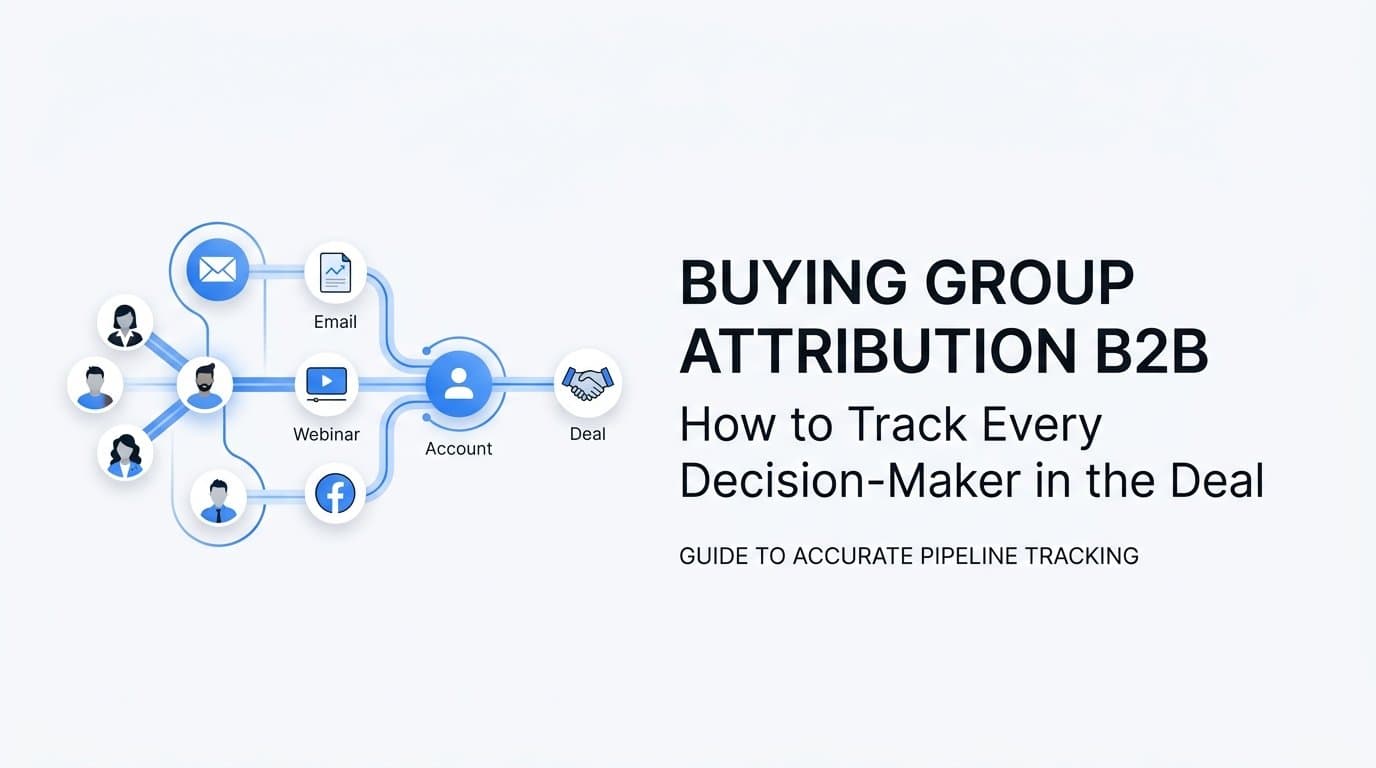
At its core, the framework requires connecting individual contact-level interactions to a shared account or opportunity record. When your champion reads a blog post, your economic buyer clicks a retargeting ad, and your technical evaluator downloads a technical brief, all three events are linked to the same deal. Attribution credit is then distributed across those touchpoints at the account level, giving marketing a complete influence map for every closed-won or in-progress opportunity.
This is a natural evolution of multi-touch attribution. Multi-touch models already distribute credit across multiple touchpoints for a single lead. Buying group attribution extends that logic to multiple contacts within the same account, applying multi-touch weighting across the entire buying committee rather than collapsing everything into one person's journey.
There are a few foundational concepts that make this work in practice.
Account-level tracking: Every contact at a target account needs to be associated with the same company record, so that their individual touchpoints can be aggregated into a unified view of how that account engaged with your marketing.
Contact role mapping: Knowing that someone is the champion versus the economic buyer versus the technical evaluator changes how you interpret their engagement. A pricing page visit from an economic buyer carries different weight than the same visit from an end user.
Opportunity-linked attribution: Touchpoints need to be tied not just to a contact or account, but specifically to an open or closed opportunity, so that you can measure influence at the deal level rather than just the account level in the abstract.
Together, these three elements create a measurement layer that reflects how B2B buying actually happens, rather than how a lead-based CRM was originally designed to track it.
Understanding the Roles Inside a B2B Buying Group
Before you can measure buying group influence, you need a clear mental model of who is actually in the buying group and how each person engages with your brand. The structure varies by company size and deal complexity, but most B2B software purchases involve a consistent set of roles.
The Champion: This is the person who identified the problem, found your product, and is driving internal adoption. Champions tend to be deeply engaged across the top and middle of the funnel. They read blog posts, watch product demos, attend webinars, and are often the contact who fills out your form or books the initial discovery call. They are highly visible in your CRM, which is part of why attribution tends to over-index on their touchpoints.
The Economic Buyer: This person controls the budget and ultimately approves the purchase. They typically enter the picture later in the process, after the champion has already done significant evaluation work. Economic buyers respond to ROI-focused content, peer reviews on sites like G2 or Capterra, case studies, and executive-level messaging. They may visit your pricing page, read a comparison article, or click a branded search ad. Their engagement is real and influential, but they rarely fill out forms, so they often go completely untracked.
The Technical Evaluator: Usually an engineer, IT lead, or security professional, the technical evaluator assesses whether your product can actually integrate with the existing stack and meet technical requirements. They dig into documentation, integration pages, API references, and developer-focused content. They may find you through organic search or developer communities. Their thumbs-up or thumbs-down can make or break a deal, but their engagement looks like anonymous web traffic in most attribution setups.
The End User: These are the people who will use the product daily. Their buy-in matters because internal adoption resistance can kill a purchase even after the economic buyer is on board. End users often engage with product tours, use-case content, and hands-on trial experiences.
Understanding these role-based engagement patterns is not just an academic exercise. It directly shapes which campaigns you build, which content you invest in, and which channels you prioritize. And once you have buying group attribution in place, you can actually measure whether your efforts to reach each role are working.
Building the Technical Foundation for Account-Level Attribution
Implementing buying group attribution B2B requires more than a mindset shift. It requires a data infrastructure that can actually capture multi-contact journeys at the account level. Here is how to build it.
Start with account-level data unification. The first requirement is connecting your ad platforms, CRM, and website tracking so that every contact at a target account is linked to the same opportunity record. This means your CRM needs to have clean account-to-contact associations, your website tracking needs to resolve anonymous visitors to known accounts where possible, and your ad platform data needs to be mapped back to account records rather than just individual leads.
Invest in server-side tracking and Conversion API integrations. Browser-based pixels are increasingly unreliable. Ad blockers, cookie restrictions, and browser privacy changes mean that a significant portion of touchpoints from stakeholders browsing your site will never be recorded by a standard JavaScript pixel. Server-side tracking captures these events at the server level before they can be blocked, ensuring that touchpoints from multiple stakeholders at the same company are recorded accurately. Conversion API integrations with platforms like Meta and Google send enriched event data directly from your server to the ad platform, improving match rates and giving those platforms better signals for optimization.
Apply attribution models at the account level, not the lead level. This is the critical configuration step that most teams skip. Even if you have multi-touch attribution set up, if it is scoped to individual leads rather than accounts, you are still missing the buying group picture. You need to aggregate touchpoints across all contacts associated with an opportunity and then apply your attribution model to that full set of interactions. This means credit can flow to a LinkedIn ad that reached the economic buyer, a blog post that the champion read, and a documentation page that the technical evaluator visited, all within the same deal's attribution report.
Map contact roles to touchpoints. Where possible, enrich your contact records with role information so that attribution reporting can break down influence by stakeholder type. This allows you to answer questions like: which campaigns are consistently reaching economic buyers in winning deals? Which content is influencing technical evaluators to move forward?
This infrastructure does not need to be built overnight. Start with account-level unification and server-side tracking, then layer in role mapping as your data quality improves.
What Buying Group Attribution Reveals About Your Marketing
Once your buying group attribution framework is in place, the insights it surfaces are fundamentally different from what standard lead-based reporting shows you. The unit of measurement has changed, and so has the quality of the signal.
The most immediate shift is in how you evaluate channel performance. Instead of asking which channels generate the most leads, you start asking which channels are influencing the most stakeholders per account. A channel that reaches three different buying group members in a deal is objectively more valuable than a channel that reaches the same champion three times. Buying group attribution makes that distinction visible.
You also gain the ability to identify which content formats resonate with specific buyer roles. If your ROI calculator consistently shows up in the touchpoint history of economic buyers in closed-won deals, that is a clear signal to invest more in that asset and promote it through channels that economic buyers use. If your API documentation page appears in the journey of technical evaluators who ultimately approved the purchase, that tells you something important about where technical confidence is being built.
Pipeline and revenue attribution become significantly more accurate. The full influence map of each deal is captured, so you are no longer systematically undervaluing channels that rarely get last-touch credit. A brand awareness campaign on LinkedIn might never generate a form fill, but if it consistently appears in the early touchpoints of economic buyers in your best deals, buying group attribution will surface that pattern. You can then make a defensible case for maintaining or increasing that spend.
There is also a strategic planning benefit. When you can see which roles are being reached by your current campaigns and which are not, you can deliberately design content and campaigns to fill those gaps. If your attribution data shows that technical evaluators are rarely engaged before the late stages of a deal, you know there is an opportunity to build earlier-stage technical content that accelerates their evaluation.
This is the difference between optimizing for vanity metrics and optimizing for revenue. Buying group attribution keeps the focus on what actually matters: which marketing efforts are influencing the people who make purchase decisions.
How Cometly Powers Buying Group Attribution for B2B Teams
The infrastructure requirements for buying group attribution, connecting ad platforms, CRM data, and website events into a unified view across multiple contacts per account, are exactly what Cometly is built to deliver.
Cometly connects your ad platforms, CRM, and website tracking into a single attribution view, making it possible to track multiple contacts from the same account across the entire customer journey. When your champion clicks a Google ad, your economic buyer visits the pricing page through a direct session, and your technical evaluator finds your integration documentation through organic search, Cometly captures all three events and links them to the same account and opportunity. No touchpoint gets lost because a different stakeholder was the one who originally filled out the form.
Server-side tracking and Conversion API integrations are built into the platform, which means the data loss that typically plagues browser-based attribution is minimized. Enriched, conversion-ready events are sent back to Meta, Google, and other ad platforms, improving their targeting and optimization algorithms while also giving your internal reporting a more complete picture of what is actually driving pipeline.
With multi-touch attribution applied at the account level and AI-powered insights, marketing teams using Cometly can identify which campaigns are influencing the most buying group members and allocate budget toward what is genuinely driving revenue. The AI surfaces patterns across winning deals, highlighting which channels and content consistently appear in the journeys of economic buyers, technical evaluators, and champions alike.
The result is a more honest and more actionable picture of marketing performance. Channels that influence every layer of the buying committee receive appropriate credit. Growth teams can scale campaigns with confidence, knowing their decisions are based on the full influence map of their deals rather than the partial story that single-contact attribution tells.
The Bottom Line on B2B Attribution
The shift from lead-level attribution to buying group attribution is not a technical upgrade for its own sake. It is a fundamental change in how B2B marketing teams understand and communicate their impact on revenue.
When you measure marketing performance at the individual lead level, you are always working with an incomplete picture. The champion who fills out your form is one person in a buying process that involves many. Every stakeholder you fail to track is a gap in your data, and those gaps add up to systematic misattribution of budget, effort, and strategy.
Buying group attribution closes those gaps. It gives marketing the visibility to see which channels are reaching the right people at the right companies, which content is building confidence across different buyer roles, and which campaigns are genuinely influencing the deals that close. For any B2B SaaS company trying to grow efficiently, that visibility is not a luxury. It is a requirement for making good decisions.
The good news is that the infrastructure to support it exists today. Account-level data unification, server-side tracking, and multi-touch attribution applied across the full buying committee are all achievable with the right platform and the right setup.
Ready to start tracking every decision-maker in your deals and connecting your ad spend directly to closed-won revenue? Get your free demo and see how Cometly captures every touchpoint across the full buying group so your marketing data finally reflects the full story.