
If your Facebook ad conversions are not showing up, you are not alone. This is one of the most common frustrations for B2B SaaS marketers running paid campaigns. You launch a campaign, leads start coming in, but your Ads Manager shows zero conversions or wildly inaccurate numbers.
The result is a broken feedback loop. You cannot tell which ads are actually working, your budget gets misallocated, and Meta's algorithm loses the signal it needs to optimize your campaigns.
The root causes range from a misconfigured Meta Pixel to browser privacy changes that block client-side tracking entirely. iOS privacy updates have made cookie-based tracking far less reliable, and more users are browsing with ad blockers than ever before. This means the old approach of dropping a pixel on your page and calling it done is no longer enough.
This guide walks you through a clear, sequential process to diagnose why your Facebook ad conversions are not tracking and how to fix each issue permanently. Whether you are a marketing manager troubleshooting a broken funnel or a growth leader trying to get accurate data before scaling spend, these steps will get your conversion tracking working correctly.
By the end, you will have a reliable system that captures conversions accurately, sends clean data back to Meta, and gives you the visibility you need to make confident budget decisions.
Step 1: Diagnose the Root Cause Before Touching Anything
The most common mistake marketers make when they can't track Facebook ad conversions is jumping straight to reinstalling the Pixel. Before you touch a single line of code, you need to understand exactly where the breakdown is occurring.
Start in Meta's Events Manager. Navigate to your Data Sources and check whether your Pixel is receiving any events at all. There is a meaningful difference between a Pixel that is completely silent and one that is receiving events but showing data quality issues. These two problems have very different solutions.
Install the Meta Pixel Helper: Add the Meta Pixel Helper Chrome extension to your browser. Visit your key conversion pages, such as your demo request page, trial signup, or lead form confirmation page, and watch which events fire in real time. This tool will immediately surface errors, missing events, and misconfigured triggers without requiring you to dig through code.
Check for duplicate Pixel IDs: One of the most overlooked causes of corrupted conversion data is multiple Pixel IDs firing on the same page. This can happen when a developer hard-codes a Pixel in the site template while a separate Pixel tag also lives in Google Tag Manager. The result is inflated or double-counted conversion numbers that make your data unreliable.
Identify the specific broken events: Document which conversion events are failing before you start making changes. Is it the Lead event on your form submission page? The CompleteRegistration event after a trial signup? The more precisely you identify the failure point, the faster you can fix it.
The natural question at this stage is whether the problem is the Pixel itself, a misconfigured event, or a tracking gap caused by browser privacy restrictions. Each requires a different fix. Diagnosing first means you fix the right thing rather than wasting time on the wrong one.
Success indicator: You have a clear list of which events are broken, which are working, and whether the issue is a missing Pixel, a bad event configuration, or a data quality problem caused by browser-level blocking.
Step 2: Verify Your Meta Pixel Is Installed and Firing Correctly
Once you know what is broken, the next step is confirming your base Pixel setup is solid. A surprising number of conversion tracking problems trace back to a Pixel that was installed correctly on the homepage but never added to the rest of the site.
The base Pixel code needs to live in the head section of every page on your site, not just the homepage. If a user converts on a page that does not have the Pixel installed, that conversion will never be recorded.
Match your Pixel ID exactly: Open your Events Manager and note your Pixel ID. Then inspect the Pixel code on your site and confirm the ID in the code matches exactly. A single digit difference means you are sending data to a Pixel that is not connected to your ad account.
Confirm PageView events are firing: Use the Meta Pixel Helper to visit several pages on your site and verify that a PageView event fires on each page load without errors. This is your baseline confirmation that the Pixel is alive and communicating with Meta.
If you are using Google Tag Manager: Open your GTM container and locate your Meta Pixel tag. Verify the trigger is set to fire on All Pages, not a specific page URL. Also check that no blocking triggers or exceptions are preventing the tag from firing. It is worth using GTM's Preview mode to walk through your conversion path and confirm every tag fires at the right moment.
Check your post-conversion pages: Your thank-you pages and confirmation pages are where your most important events should fire. Confirm that the correct standard event code is present. For a demo request, that is typically a Lead event. For a trial signup, it is usually CompleteRegistration. These events need to fire after the user has actually converted, not before.
Here is where it gets important: if your confirmation page is the same URL as your form page (a common issue with single-page form builders), the event may be firing on page load rather than after form submission. That would mean every visitor to the page is counted as a conversion, not just those who complete the form. Understanding how Facebook Pixel tracking works in detail can help you avoid these configuration mistakes.
Success indicator: Events Manager shows your Pixel as active, PageView events are registering within minutes of a test visit, and your standard conversion events appear on the correct pages without errors in the Pixel Helper.
Step 3: Set Up the Meta Conversions API to Recover Lost Signal
Even a perfectly installed Pixel is not enough in the current tracking environment. Browser-based tracking is being blocked at scale. iOS App Tracking Transparency, Safari's Intelligent Tracking Prevention, Firefox Enhanced Tracking Protection, and ad blockers all prevent the Meta Pixel JavaScript from loading or sending data. If you are relying solely on the browser Pixel, you are missing a significant portion of your actual conversions.
This is exactly why Meta built the Conversions API (CAPI). Instead of relying on a user's browser to send conversion data to Meta, CAPI sends that data directly from your server. Browser restrictions cannot block a server-to-server call.
Access CAPI in Events Manager: Inside Events Manager, navigate to Data Sources and select your Pixel. You will find the Conversions API setup option here. Meta offers several implementation paths depending on your technical setup.
Choose your implementation method: There are three main approaches. A direct API integration gives you the most control but requires developer resources. A partner integration through your CRM, marketing platform, or a tool like Cometly can get CAPI running without custom development. A gateway setup uses Meta's no-code option for simpler implementations. For most B2B SaaS teams, a partner integration is the fastest path to a reliable setup. Learn more about how to sync conversion data to Facebook Ads using server-side methods.
Run CAPI alongside your Pixel, not instead of it: Best practice is redundant tracking. Keep your browser Pixel running and add CAPI on top. The key is implementing deduplication logic using the event_id parameter so Meta knows when the same conversion has been reported by both the Pixel and CAPI. Without deduplication, you will double-count conversions and your data will be just as unreliable as before, only in the opposite direction.
Pass customer data parameters: CAPI becomes significantly more powerful when you include customer data with each event. Passing hashed email addresses, phone numbers, and the fbclid click ID improves your Event Match Quality (EMQ) score, which measures how well your conversion data matches Meta's user records. A higher EMQ score means better optimization and more accurate attribution.
Monitor your Event Match Quality score: After setting up CAPI, check your EMQ score in Events Manager. Aim for a score above 6 out of 10. Scores below that indicate your customer data parameters are incomplete or not matching well, which limits how effectively Meta can use your conversion data for campaign optimization.
Success indicator: Events Manager shows both browser and server events arriving, your EMQ score is above 6, and deduplication is confirmed so conversions are not being double-counted in your reports.
Step 4: Configure Conversion Events and Attribution Settings in Ads Manager
Your tracking infrastructure can be technically perfect and you can still see misleading conversion numbers if your attribution settings are misconfigured. This step is about making sure Ads Manager is measuring the right thing in the right window.
Confirm your optimization event: Open each ad set and verify it is optimizing for the conversion event that actually matches your campaign goal. If you are running a demo request campaign but the ad set is optimizing for PageView events, Meta is not directing your budget toward users likely to request a demo. It is directing it toward users likely to visit a page.
Check for sufficient conversion volume: Meta's algorithm needs a minimum number of conversion events within a recent window to exit the learning phase and optimize effectively. If your conversion event has very low volume, consider optimizing for an earlier funnel event temporarily, such as a form view or a button click, to give the algorithm more signal to work with.
Understand your attribution window options: Meta offers multiple attribution windows including 1-day click, 7-day click, 1-day view, and combinations. Each window reports a different number of conversions because it captures conversions within a different time frame after an ad interaction. Switching between windows mid-campaign can make it look like conversions dropped sharply when in reality you simply changed what you are measuring. Understanding Facebook Ads attribution in depth will help you choose the right window for your campaigns.
For B2B SaaS companies, the sales cycle is typically longer than a single day. A prospect might click your ad, research your product for several days, and then sign up for a trial. A 7-day click attribution window captures that journey. A 1-day click window would miss it entirely and make your campaign look like it is not converting.
Use the Compare Attribution Windows feature: Inside Ads Manager, you can view your results across multiple attribution windows simultaneously. This gives you a more complete picture of how your campaigns are actually performing across different conversion timeframes.
Success indicator: Each ad set is optimizing for the correct conversion event, your attribution window reflects your actual buying cycle, and you understand how window changes affect your reported numbers before making any adjustments.
Step 5: Test the Full Conversion Flow End to End
Testing only the Pixel install is one of the most common mistakes in conversion tracking troubleshooting. The Pixel can be firing perfectly on your homepage while the actual conversion event on your thank-you page is completely broken. You need to walk the entire path a real user would take.
Use Meta's Test Events tool: Inside Events Manager, navigate to the Test Events tab. This tool lets you send real test conversions through your funnel and watch them register in real time. Use it to confirm your end-to-end tracking chain is working before you declare the setup complete.
Walk the actual conversion path manually: Click through a real ad (or simulate the traffic source), land on your page, fill out the form, and check whether the conversion event fires on the confirmation page. Do not test individual pieces in isolation. The full path matters because issues often appear in the transitions between steps, not within any single step.
Check for fbclid parameter stripping: The fbclid URL parameter is appended to your landing page URL when a user clicks a Facebook ad. This parameter is critical for attribution. If your redirects, form handlers, or CRM integration strip this parameter before the conversion event fires, Meta loses the connection between the click and the conversion. Check every redirect in your funnel to confirm the fbclid is being passed through intact.
Watch out for single-page application issues: If your site or landing pages are built with React, Vue, or another SPA framework, standard page-load events may not fire when users navigate between views. These frameworks update the page content without triggering a full page load, so a standard Pixel PageView event never fires. You need to implement custom event tracking that fires on route changes within the application.
Third-party form tools need special attention: If your conversions happen inside a tool like Calendly, Typeform, or a HubSpot embedded form, you typically cannot place a conversion event directly inside that tool. The solution is to redirect users to a confirmation page you control after they complete the action. That confirmation page is where your conversion event fires. Following best practices for tracking conversions accurately ensures these edge cases are handled correctly.
Success indicator: A test conversion initiated from the very first click through to the final confirmation page registers correctly in Events Manager without errors or missing events along the way.
Step 6: Connect Your CRM and Revenue Data for True Conversion Attribution
Here is a hard truth about Facebook ad conversion tracking for B2B SaaS: tracking a lead form submission is not the same as tracking revenue. A form fill is a signal, not a result. If you are optimizing your campaigns based solely on lead volume, you may be scaling spend toward leads that never convert into paying customers.
The fix is connecting your CRM and revenue data to your attribution system so you can see which Facebook ads generated leads that actually moved through the pipeline and closed.
Use offline conversion uploads or server-side integrations: Meta supports offline conversions, which allow you to upload closed-won deal data from your CRM back to Meta. When this data is matched against users who previously clicked your ads, Meta can attribute revenue to specific campaigns. This closes the loop between your marketing activity and actual business outcomes. A detailed walkthrough of how to track offline conversions can help you implement this correctly.
Going further, a server-side integration that continuously syncs your CRM pipeline stages back to Meta allows the algorithm to optimize for revenue-generating customers rather than any lead. This is a meaningful shift in how your campaigns perform over time. The algorithm learns to find users who look like your best customers, not just users who fill out forms.
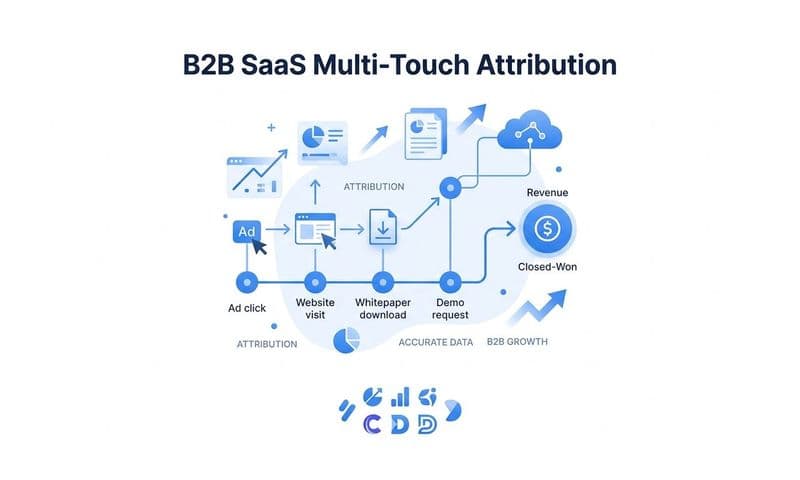
Build the full customer journey view: The goal is to see a direct line from a specific Facebook ad creative to the pipeline it created and the revenue it closed. Without this connection, you are making budget decisions based on incomplete information. You might be pausing your best-performing campaigns because they appear expensive on a cost-per-lead basis, while missing the fact that they generate your highest-value customers. Using Facebook touchpoint tracking gives you visibility into every interaction that contributes to a closed deal.
Tools like Cometly are built specifically for this problem. Cometly connects your ad platforms, CRM, and website to track the entire customer journey in real time. It sends enriched, conversion-ready events back to Meta through the Conversions API, improving targeting and optimization. For B2B SaaS teams, this means you can analyze ad performance at the revenue level, not just the lead level, and make data-driven decisions about where to scale spend.
Success indicator: You can see a direct line from a specific Facebook ad to pipeline created and revenue closed. Your optimization decisions are based on customer lifetime value and deal quality, not just lead volume.
Step 7: Monitor Data Quality and Prevent Future Tracking Gaps
Getting your tracking right is not a one-time project. Websites change, tools get updated, form handlers get replaced, and each of those changes can silently break your conversion tracking. The marketers who maintain accurate data are the ones who build ongoing monitoring into their workflow.
Set up weekly Events Manager checks: Make it a habit to review your Event Match Quality score and event volume in Events Manager every week. A sudden drop in EMQ or a sharp decline in conversion event volume often signals a tracking break before it shows up as a campaign performance problem.
Compare CRM lead volume against Ads Manager reported conversions: This is one of the most reliable ways to catch discrepancies. If your CRM shows 50 new leads this week but Ads Manager reports 12 conversions, something is broken. If Ads Manager reports 80 conversions but your CRM only shows 50 leads, you likely have duplicate tracking or attribution window overlap. Neither number is trustworthy until you understand the gap.
Audit your setup after any site changes: Any time you update your website, change landing pages, swap out form tools, or modify your CRM integration, run through the end-to-end test from Step 5 again. Changes that seem unrelated to tracking often break it. A new redirect, a CMS update, or a form plugin change can silently strip the Pixel from key pages or break the fbclid parameter chain.
Implement first-party data practices: Capture UTM parameters and attribution data directly in your CRM at the point of lead creation. When a lead fills out a form, your CRM should record which campaign, ad set, and ad drove that visit. This gives you a backup attribution layer that does not depend on the Pixel or cookies at all. Even if your Pixel breaks tomorrow, you still have attribution data captured in your CRM for every lead that came in. Understanding what UTM tracking is and how it helps your marketing is essential for building this backup layer correctly.
Use a single source of truth across channels: Relying solely on Meta's self-reported data means you are trusting a platform to accurately report on its own performance. An independent attribution platform that aggregates data from all your ad channels gives you a neutral, accurate view of what is actually driving results.
Success indicator: Your conversion volume in Ads Manager aligns closely with your CRM lead data, your EMQ score remains above 6, and your team has a documented process for auditing tracking after any site or tool change.
Putting It All Together
Fixing Facebook ad conversion tracking is not a one-time task. It requires a layered approach that combines a correctly installed Pixel, a server-side Conversions API integration, properly configured attribution windows, and a connection to your actual revenue data. Each step in this guide addresses a specific failure point in the tracking chain.
Start with the diagnostic step to identify exactly where your tracking breaks down, then work through each fix in order. Before you consider your tracking complete, run through this quick checklist:
Pixel installed on all pages: The base Pixel code is in the head section of every page and firing without errors confirmed by the Pixel Helper.
CAPI is live with deduplication: Server-side events are sending to Meta with the event_id parameter to prevent double-counting.
Conversion events are configured correctly: Each ad set optimizes for the right event and that event has sufficient volume for the algorithm to learn.
Attribution window matches your sales cycle: You are using a 7-day click window for B2B SaaS campaigns with longer consideration periods.
Full conversion path tested end to end: A real test conversion from ad click to confirmation page registers correctly in Events Manager.
CRM and revenue data are connected: You can see which Facebook ads drive pipeline and closed revenue, not just lead volume.
When your tracking is accurate, Meta's algorithm gets the signal it needs to find more of your best customers, your team can make confident budget decisions, and you stop wasting spend on campaigns that look good in Ads Manager but drive zero revenue.
Platforms like Cometly are built specifically for this: connecting every touchpoint from first ad click to closed revenue so B2B SaaS teams always know what is actually working. Get your free demo today and start capturing every touchpoint to maximize your conversions.