
Conversion tracking gaps are one of the most damaging problems a B2B SaaS marketing team can face. When your tracking breaks down, ad platforms receive incomplete data, attribution models produce inaccurate results, and budget decisions get made on faulty signals. The outcome is predictable: wasted ad spend, misattributed revenue, and a marketing team that cannot confidently answer which channels are actually driving pipeline.
The challenge is that tracking gaps are often invisible. Your dashboards may look healthy while entire conversion events go unrecorded. Form submissions get lost. CRM updates never sync back to your ad platforms. Server-side events fire inconsistently. And because the data appears to flow, the gaps stay hidden until a major budget decision reveals the disconnect between reported performance and actual revenue.
This guide walks you through a systematic process to identify, diagnose, and fix conversion tracking gaps across your entire marketing stack. Whether you are running paid campaigns on Meta, Google, or LinkedIn, or managing a multi-touch attribution setup across a complex B2B funnel, these steps will help you restore data accuracy and rebuild confidence in your conversion data.
By the end, you will have a reliable tracking foundation that captures every meaningful touchpoint, sends enriched conversion signals back to ad platforms, and connects your ad spend directly to pipeline and closed revenue. That is the kind of data clarity that allows growth teams to scale with confidence rather than guessing.
Step 1: Audit Your Current Tracking Setup
Before you can fix anything, you need a clear picture of what you actually have. Most teams are surprised by what this audit reveals. The assumption that your tracking is working because campaigns are reporting conversions is one of the most common and costly mistakes in B2B SaaS marketing.
Start by mapping every conversion event you currently track across all platforms: Google Ads, Meta, LinkedIn, and your CRM. Write it down. Include the event name, the platform it fires on, and the method used to track it. This single exercise often surfaces duplicate events, orphaned pixels, and events that were set up during a previous campaign and never cleaned up.
Next, identify which events are tracked via pixel only versus server-side or Conversion API. Browser-based pixel tracking is inherently less reliable. Ad blockers, browser privacy settings, and iOS restrictions all reduce how many events your pixel actually records. Server-side tracking bypasses these limitations entirely by sending data directly from your server to the ad platform. If your most important conversion events rely solely on a pixel, that is a gap worth prioritizing immediately.
Check for duplicate conversion events. When the same event fires through both a pixel and a Conversion API without proper deduplication, your platform reports inflated conversions and distorted cost-per-acquisition figures. Use Meta Events Manager and Google Ads conversion tracking diagnostics to review which events are firing and how they are being counted.
Use browser developer tools to verify which events are actually firing in real time. Open the network tab, complete a form submission or trigger a conversion action, and confirm the event fires as expected. Many teams assume their pixel setup from initial implementation is still intact, but site changes, tag manager updates, or third-party script conflicts often break event firing silently.
Finally, document the gap between what your ad platforms report and what your CRM records as actual leads or opportunities. If Google Ads shows 50 conversions last month but your CRM only received 30 leads, that discrepancy is your starting point for the next step.
Success indicator: You have a complete list of every conversion event, its current tracking method, and whether it is verified as firing correctly.
Step 2: Identify the Root Causes of Your Gaps
Once you know where the gaps are, the next step is understanding why they exist. Tracking gaps rarely have a single cause. In B2B SaaS environments, they typically result from a combination of technical limitations, configuration errors, and infrastructure decisions that made sense at the time but have not kept pace with how browsers and privacy settings have evolved.
Browser-side tracking failures: Ad blockers, iOS privacy restrictions, and the ongoing deprecation of third-party cookies all reduce pixel reliability. If a prospect visits your site using Safari with Intelligent Tracking Prevention enabled, or has an ad blocker installed, your pixel may not fire at all. For B2B audiences where a significant portion of users are technically sophisticated, this is a meaningful source of data loss.
Missing server-side implementation: If you rely solely on client-side pixels, a significant portion of conversion events will not be recorded by ad platforms. Server-side tracking is no longer an optional upgrade. It is a foundational requirement for accurate conversion data in the current privacy landscape.
CRM and offline conversion sync gaps: Leads that convert in your CRM after the initial form fill are often never sent back to ad platforms. This leaves pipeline and revenue data completely disconnected from your campaigns. Your ad platform sees the form fill but never learns whether that lead became a qualified opportunity or a closed deal.
Tag manager misconfigurations: Triggers set to fire on the wrong page, incorrect variable mappings, or broken dataLayer pushes are frequent causes of silent tracking failures. These are particularly hard to catch because the tag manager interface shows the trigger as active, even when it is not firing under real conditions.
Cross-domain tracking issues: B2B SaaS companies using separate marketing sites and app subdomains often lose session continuity when users move between domains. This breaks attribution chains and can cause the same user to appear as a new session, fragmenting the customer journey across multiple disconnected records.
The privacy changes introduced with iOS 14 and subsequent updates accelerated all of these gaps for paid social advertisers. What was once a minor data quality issue became a significant attribution problem almost overnight. Understanding how iOS tracking restrictions impact attribution helps explain why closing these gaps requires more than adjusting a tag.
Success indicator: You can name the specific technical or configuration reason behind each gap identified in Step 1.
Step 3: Implement Server-Side Tracking and Conversion APIs
This is where you start closing the gaps rather than just documenting them. Server-side tracking sends conversion event data directly from your server to ad platforms, bypassing the browser entirely. It is the most impactful technical change you can make to improve conversion data accuracy.
Start with Meta's Conversion API. CAPI allows you to send conversion events directly from your server to Meta, independent of what happens in the browser. This means that even if a user has an ad blocker installed or is browsing on an iOS device with tracking restrictions, the conversion event still reaches Meta's platform. Set up CAPI alongside your existing pixel rather than replacing it, and configure event deduplication so that events sent through both channels are not counted twice.
Event deduplication is critical and often misconfigured. Meta uses a unique event ID to match pixel events with CAPI events. Every event sent through both methods must carry the same event ID. If your pixel fires a Purchase event with event ID "abc123" and your server sends the same Purchase event without that ID, Meta counts it as two separate conversions. Review your Conversion API implementation setup carefully before assuming it is working correctly.
For Google, configure Enhanced Conversions to supplement your Google tag with first-party data sent server-side. Enhanced Conversions use hashed customer data such as email addresses and phone numbers to improve conversion match rates, connecting more conversions to the ads that drove them. This is particularly valuable for B2B SaaS where the buying journey often spans multiple devices and sessions.
Use first-party data fields wherever possible. Hashed email addresses and phone numbers significantly improve event matching accuracy across platforms. Higher match rates mean more conversions are correctly attributed to the campaigns that generated them, which improves the accuracy of your reported ROAS and cost-per-acquisition figures.
For B2B SaaS funnels, prioritize server-side tracking for your highest-value conversion events: demo requests, free trial signups, and qualified lead form submissions. These are the events that feed your ad platform's bidding algorithms, so accuracy here has a direct impact on campaign performance and budget efficiency.
One important note: server-side tracking requires a reliable data layer or backend event trigger. Before assuming your server-side events will fire consistently, audit your form submission infrastructure and CRM webhook setup. If your backend does not have a reliable mechanism to detect and report conversion events, the server-side implementation will be inconsistent regardless of how well it is configured on the platform side.
Success indicator: Your Conversion API event match quality scores in Meta Events Manager and Google Ads are consistently high, and server-side events are confirmed firing in platform diagnostics.
Step 4: Connect Offline Conversions and CRM Data to Ad Platforms
Here is where most B2B SaaS marketing teams leave the most value on the table. The initial form fill or demo request is rarely the conversion that matters most. What matters is whether that lead became a qualified opportunity, moved through the sales cycle, and eventually closed as a customer. Without connecting your CRM data back to your ad platforms, your campaigns are optimizing toward the wrong signal.
Set up Google Ads offline conversion imports to send CRM stage updates back to Google. When a lead created from a Google Ads click progresses to a qualified opportunity or closes as a customer, that update should flow back to Google Ads automatically. This allows Google's bidding algorithms to optimize toward the clicks that actually produce revenue, not just the clicks that produce form fills.
Use Meta's offline conversions feature or CAPI offline events to connect CRM data back to your Facebook and Instagram campaigns. The same principle applies: Meta's algorithm performs significantly better when it receives feedback about which leads actually converted downstream, not just which ones submitted a form. Learn more about offline conversion tracking best practices to implement this effectively.
Automate the sync process using webhooks or a native integration between your CRM and your attribution platform. Manual CSV uploads are error-prone and create delays that reduce the value of the data. Continuous, automated syncing ensures that your ad platforms receive conversion signals as close to real time as possible, which improves how quickly their algorithms can adapt and optimize.
Map your CRM stages to conversion events that matter for optimization. MQL, SQL, opportunity created, and closed-won are all valuable signals. Each stage tells the ad platform something different about lead quality, and sending multiple stages gives the algorithm a richer picture of what a high-value lead looks like at different points in the funnel.
Feeding revenue-level data back to ad platforms is the single most powerful thing you can do to improve campaign performance in a B2B SaaS context. When Google or Meta can see that leads from a specific campaign segment are closing at a higher rate and at higher contract values, they can shift budget and targeting toward similar prospects automatically. That is the compounding benefit of closing your offline conversion gap.
Success indicator: Your ad platforms show conversion data that aligns with your CRM pipeline reports, with closed-won revenue traceable back to specific campaigns and ad sets.
Step 5: Validate Attribution Across the Full Customer Journey
With your tracking infrastructure repaired and your offline conversions syncing, the next step is confirming that attribution is working accurately across the full customer journey. This is where you move from fixing data collection to trusting the story your data tells.
Run a cross-channel attribution audit by comparing touchpoint data in your attribution platform against what each individual ad platform reports in its native dashboard. You will almost certainly find over-attribution. Each ad platform claims credit for conversions using its own attribution logic, which means the same conversion often gets claimed by Google, Meta, and LinkedIn simultaneously. Looking at each channel in isolation inflates your total reported conversions well beyond what actually happened.
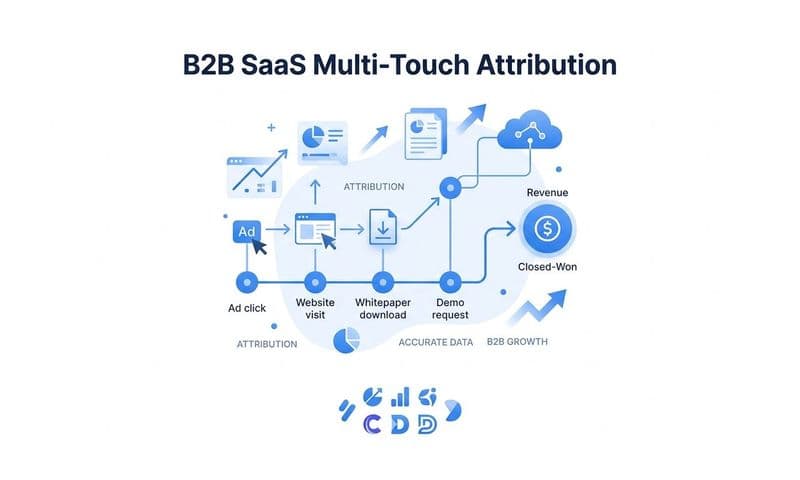
Choose an attribution model that reflects your actual B2B buying cycle. Last-click attribution significantly undervalues upper-funnel channels that create awareness and drive initial engagement. For long sales cycles involving multiple stakeholders and evaluation periods that can span weeks or months, multi-touch attribution models distribute credit more accurately across the channels that contributed at different stages.
Verify that UTM parameters are being passed consistently through your entire funnel, from ad click through landing page through form submission and into your CRM. UTM parameters are the connective tissue between ad clicks and CRM records. If they break at any point in the journey, attribution breaks with them.
Common failure points include landing page redirects that strip UTM parameters, form tools that do not pass UTM data to CRM fields, and cross-domain navigation that interrupts session continuity. Test every path a prospect can take from ad click to CRM record and confirm that UTM data survives the entire journey. This is a step that is easy to skip and costly to overlook.
Confirm that your attribution platform captures both the first touch that created awareness and the last touch that drove conversion. A complete view of which channels contribute at different funnel stages is what allows you to make confident budget allocation decisions rather than defaulting to whatever the last-click model suggests.
Success indicator: You can trace a specific closed deal back to its originating ad campaign with confidence, and your attribution data is consistent across your attribution platform and CRM.
Step 6: Build a Monitoring System to Catch Future Gaps Early
The most common misconception about conversion tracking is that fixing it is a one-time project. In reality, tracking gaps are introduced continuously through site updates, platform migrations, tag manager changes, and CRM configuration edits. Without a monitoring system, you will find yourself repeating this entire process every few months.
Set up conversion volume alerts in your ad platforms so you are notified immediately if event counts drop below expected thresholds. A sudden drop in reported conversions is almost always a signal that something broke, not that your campaigns stopped performing. Catching this within hours rather than weeks prevents compounding data loss and bad optimization decisions.
Create a weekly data health check routine that compares conversion counts across your pixel, server-side events, and CRM records. If these three numbers diverge significantly, something in your tracking chain has broken. This routine does not need to be complex. A simple comparison in a shared document or dashboard is enough to catch discrepancies before they compound into weeks of inaccurate conversion data.
Use your attribution platform's data diagnostics to monitor event match quality, deduplication accuracy, and integration health on an ongoing basis. Platforms like Cometly provide visibility into the health of your tracking integrations across ad platforms, CRM, and website events, giving you a single place to monitor the entire tracking architecture rather than logging into each platform separately.
Document your entire tracking architecture including all event names, trigger conditions, server-side endpoints, and CRM sync configurations. Undocumented tracking setups are the most common cause of undetected tracking gaps, particularly when team members change or developers make site updates without understanding the tracking dependencies.
Establish a change management process that requires a tracking audit before any major website update, CMS migration, or tag manager change goes live. Most tracking gaps are introduced during site updates, not during initial setup. A pre-launch tracking checklist is a simple process change that prevents the majority of regressions.
Success indicator: You have automated alerts, a documented tracking map, and a recurring audit schedule that prevents gaps from going undetected for more than a few days.
Your Tracking Foundation, Built to Last
Fixing conversion tracking gaps is not a one-time project. It is an ongoing discipline that separates marketing teams making confident, data-backed decisions from those perpetually questioning whether their numbers are accurate.
Use this checklist to confirm your tracking foundation is solid:
Audit complete: All conversion events have been identified and verified as firing correctly.
Root causes diagnosed: Every gap has a named technical or configuration cause that has been addressed.
Server-side tracking live: Conversion APIs are active for your highest-value events with proper deduplication configured.
Offline conversions syncing: CRM stage updates are flowing back to ad platforms automatically and continuously.
Attribution validated: UTM data survives the full funnel, and your attribution model reflects your actual B2B buying cycle.
Monitoring in place: Alerts, a weekly health check, and a change management process are all active.
When your tracking is accurate, every downstream decision improves. Ad platform algorithms optimize toward leads that actually close. Attribution models reflect reality. Budget allocation shifts toward channels that drive real pipeline.
Cometly is built to help B2B SaaS marketing teams achieve exactly this level of data accuracy. It connects your ad platforms, CRM, and website into a single source of truth, captures every touchpoint from first ad click to closed-won revenue, and sends enriched conversion signals back to Meta, Google, and other platforms to improve ad performance. If you are ready to close your tracking gaps and build a reliable attribution foundation, Get your free demo today and start capturing every touchpoint to maximize your conversions.