For B2B SaaS companies, conversion tracking for subscriptions is not just about counting sign-ups. It is about understanding the full journey from the first ad click to a paying subscriber, and then tracking what happens after that subscriber activates, upgrades, or churns.
Most marketing teams set up basic pixel tracking and call it done. The problem is that basic tracking misses the moments that matter most in a subscription model: trial-to-paid conversions, plan upgrades, renewal events, and expansion revenue. Without visibility into these touchpoints, you are optimizing your ad spend based on incomplete data.
You might be scaling campaigns that drive free trials but never convert to paid, while underinvesting in channels that consistently bring in high-LTV subscribers. That is a costly blind spot, and it is more common than most teams realize.
This guide covers eight practical strategies for building a conversion tracking system that reflects the real complexity of a subscription business. Each strategy addresses a specific gap in how most SaaS teams measure marketing performance, from server-side tracking setup to multi-touch attribution across the full subscription lifecycle. Whether you are running paid search, social ads, or a mix of both, these strategies will help you connect your marketing spend directly to subscription revenue and make faster, more confident decisions about where to invest.
1. Track the Full Subscription Lifecycle, Not Just Sign-Ups
The Challenge It Solves
Most SaaS marketing teams instrument one or two conversion events and stop there. A form submission, a free trial start, maybe a demo request. But in a subscription business, the sign-up is just the beginning. If your ad platform only sees the trial start event, it will optimize for trial volume, not for the subscribers who actually pay and stay.
The result is a feedback loop that rewards campaigns for driving activity rather than revenue.
The Strategy Explained
Define every meaningful milestone in your subscription lifecycle as a distinct conversion event. Think of it like building a map of your customer journey in your tracking system. Each stage should have its own named event with its own data payload.
A complete subscription lifecycle typically includes: trial start, email verification, product activation (the moment a user gets real value), trial-to-paid conversion, plan selection, first payment, upgrade or expansion, and renewal. Each of these events tells your ad platforms and attribution tools something different about subscriber quality.
Industry practitioners widely recognize that tracking trial-to-paid conversion rates by channel is a more meaningful signal for budget allocation than raw sign-up counts. When you instrument the full lifecycle, you can see which campaigns drive high activation rates, not just high trial volumes.
Implementation Steps
1. Map every subscription milestone from trial start to renewal and assign a unique event name to each one in your analytics and ad platform tracking plan.
2. Instrument each event with relevant metadata: plan tier, billing interval, estimated contract value, and user identifiers. This enriches the signal your ad platforms receive.
3. Set your primary conversion event in Google Ads and Meta to the paid activation event, not the trial start. Use trial starts as a secondary, informational conversion to monitor top-of-funnel volume separately.
4. Review your conversion tracking setup monthly to ensure no lifecycle stage has gone dark due to product changes or tracking gaps.
Pro Tips
Treat your trial-to-paid conversion rate as a channel-level KPI, not just a product metric. If one campaign drives a high volume of trials but a low paid conversion rate, that is a signal about audience quality, not just product fit. Your attribution system should surface this difference clearly so you can act on it quickly.
2. Use Server-Side Tracking to Capture What Pixels Miss
The Challenge It Solves
Browser-based pixel tracking has become increasingly unreliable. Ad blockers, browser privacy restrictions, and iOS privacy changes introduced in recent years have created significant gaps in client-side event data. If your conversion tracking relies entirely on JavaScript pixels firing in the browser, you are almost certainly underreporting conversions and feeding your ad platforms incomplete optimization signals.
This is not a minor issue. Incomplete data means your automated bidding strategies are working with a distorted picture of what is actually converting.
The Strategy Explained
Server-side tracking sends conversion events directly from your server to the ad platform, bypassing the browser entirely. Meta's Conversion API (CAPI) and Google's Enhanced Conversions are the two primary implementations you need for most B2B SaaS paid media programs.
Because the event originates from your server rather than the user's browser, it is not affected by ad blockers or browser-level privacy restrictions. Ad platforms publicly document that server-side events improve event match quality and campaign optimization. The signal is cleaner, more complete, and more reliable than what a pixel alone can provide.
For subscription businesses specifically, server-side tracking is essential for capturing downstream events like paid activation and renewal, which happen inside your product rather than on a public-facing web page where a pixel would typically fire.
Implementation Steps
1. Implement Meta's Conversion API to send key subscription events (trial start, paid activation, upgrade) directly from your server. Use the Meta Events Manager to verify event receipt and deduplication with your browser pixel.
2. Set up Google Enhanced Conversions by passing hashed customer data alongside your conversion events. This allows Google to match conversions to signed-in users even when cookies are unavailable.
3. Configure event deduplication using a shared event ID between your pixel and server-side implementation to prevent double-counting conversions in your reporting.
4. Monitor event match quality scores in Meta Events Manager and Google's diagnostic tools. Use these scores as ongoing indicators of data health rather than a one-time setup check.
Pro Tips
Do not remove your browser pixel when you add server-side tracking. Run both in parallel with proper deduplication. The pixel captures real-time signals that help with immediate page-level optimization, while server-side tracking tools provide the reliable, complete data that drives longer-term campaign learning. Tools like Cometly make it straightforward to implement server-side event pipelines without custom engineering work for every ad platform.
3. Connect Subscription Revenue Data to Your Ad Campaigns
The Challenge It Solves
Many B2B SaaS marketing teams track conversions as lead or trial events but never connect those events to actual subscription revenue. You might know that Campaign A drove 200 trials last month, but do you know how much MRR those trials generated? Without that connection, you cannot calculate a true return on ad spend or make confident budget allocation decisions.
The Strategy Explained
Integrating your billing platform with your attribution layer is what transforms conversion tracking from a counting exercise into a revenue measurement system. When Stripe or another billing tool fires a payment event, that event should flow back to your attribution platform with the associated campaign and channel data attached.
This is a recognized best practice among SaaS growth operators. Once you can see MRR by campaign, you can answer questions that raw conversion counts cannot: Which campaign generates the highest average contract value? Which channel produces subscribers with the best 90-day retention? Where is your CAC-to-LTV ratio most favorable?
This level of visibility changes how you make budget decisions. You stop optimizing for conversion volume and start optimizing for revenue quality.
Implementation Steps
1. Connect your Stripe account (or equivalent billing platform) to your attribution tool. Platforms like Cometly offer native Stripe integration that maps payment events to their originating ad campaigns.
2. Ensure that your customer records in Stripe carry the same unique identifier used in your attribution system. This is the key that links a payment event to a marketing touchpoint.
3. Set up MRR and LTV reporting by campaign source in your attribution dashboard. At minimum, track new MRR, expansion MRR, and churned MRR by channel.
4. Use this revenue data to recalculate your CAC by channel monthly. Compare CAC against average subscriber LTV to identify where your marketing spend is generating the strongest returns.
Pro Tips
Pass conversion values back to Google Ads and Meta using your actual subscription revenue data rather than estimated values. When your bidding algorithms optimize on real revenue signals, they make smarter targeting decisions. Even approximate LTV values based on plan tier are significantly more useful than treating all conversions as equal.
4. Apply Multi-Touch Attribution to Understand the Path to Subscribe
The Challenge It Solves
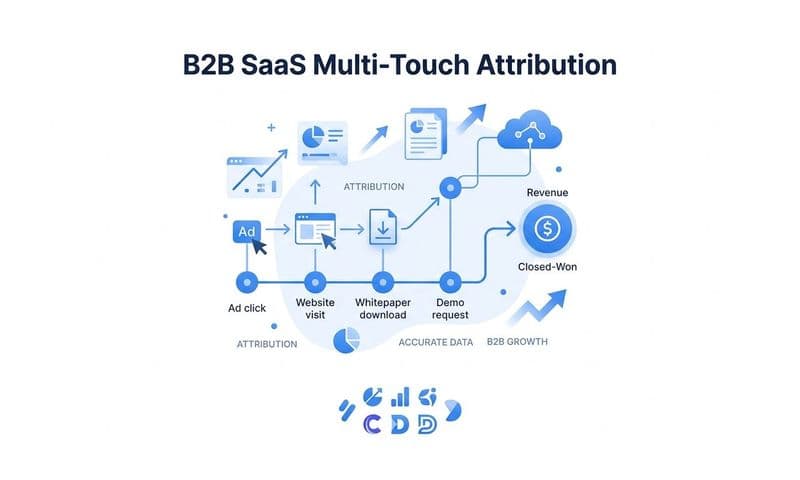
In B2B SaaS, the path from first touch to subscription often involves multiple channels and sessions spread across days or weeks. A prospect might click a LinkedIn ad, read a blog post, see a retargeting ad on Meta, and then convert through a Google branded search. Last-click attribution, the default in many ad platforms, gives all the credit to that final branded search click. The three prior touchpoints get nothing.
This systematically undervalues awareness and mid-funnel channels, leading teams to cut campaigns that are actually driving pipeline.
The Strategy Explained
Multi-touch attribution distributes conversion credit across all touchpoints in the subscriber journey, giving you a more accurate view of which channels and campaigns are influencing acquisition. There are several models to choose from: linear (equal credit to all touches), time-decay (more credit to recent touches), position-based (more credit to first and last touch), and data-driven (credit distributed based on actual conversion patterns).
For most subscription businesses, a time-decay or data-driven model tends to reflect the reality of how buyers make decisions. You can explore the tradeoffs between these approaches in detail at Cometly's attribution model guide.
The practical benefit is that you stop making budget cuts based on misleading last-click data. Channels that warm up prospects and drive consideration get the credit they deserve.
Implementation Steps
1. Audit your current attribution setup to determine which model you are currently using. Most ad platforms default to last-click or last-touch unless you have configured otherwise.
2. Select a multi-touch attribution model that fits your sales cycle length. Longer cycles with more touchpoints generally benefit from time-decay or data-driven models.
3. Implement cross-channel tracking using consistent UTM parameters and a unified attribution platform that can stitch together touchpoints across paid search, paid social, email, and organic.
4. Compare channel performance under your new model versus last-click. Identify channels that were previously undervalued and adjust budget allocation accordingly.
Pro Tips
Do not switch attribution models and immediately reallocate budget. Run both models in parallel for at least 30 to 60 days before drawing conclusions. This gives you enough data to understand the differences and make changes with confidence rather than reacting to a single reporting period.
5. Segment Conversion Events by Subscription Plan and Value
The Challenge It Solves
When every conversion is treated as equal, your automated bidding strategies optimize for volume rather than value. A free trial from a small team on a starter plan and a trial from an enterprise prospect are not the same conversion. If your ad platform cannot distinguish between them, it will optimize for whichever type is easier to acquire, which is rarely the high-value one.
The Strategy Explained
Ad platforms like Google Ads support conversion value rules that allow advertisers to assign different values to conversions based on user attributes or plan selection. For subscription businesses, passing plan tier or estimated LTV as a conversion value enables smarter automated bidding. This is documented platform functionality, not a workaround.
When you tell your bidding algorithm that an enterprise trial is worth five times more than a starter trial, it adjusts targeting and bid strategies to pursue the more valuable audience. Over time, this shifts your subscriber acquisition mix toward higher-LTV customers without requiring constant manual intervention.
Implementation Steps
1. Define conversion values for each plan tier based on average LTV or average first-year revenue. Use conservative estimates if you do not yet have enough data for precise calculations.
2. Pass the plan tier selected during signup as a parameter in your conversion event. Map these tiers to the corresponding conversion values in Google Ads and Meta.
3. Enable value-based bidding strategies in Google Ads (Target ROAS) once you have sufficient conversion value data, typically after 30 to 50 value-assigned conversions per campaign.
4. Monitor your average conversion value by campaign over time. Rising average values indicate your bidding strategy is successfully shifting toward higher-quality subscriber acquisition.
Pro Tips
If users select their plan after the initial signup event, you can still pass conversion values by firing a second event at plan selection. Use this downstream event as your primary optimization target in ad platforms, since it carries both the intent signal and the value data your bidding algorithms need to work effectively. Reviewing best practices for tracking conversions accurately can help you avoid common implementation mistakes at this stage.
6. Track Lead-to-Subscriber Attribution Through Your CRM
The Challenge It Solves
For SaaS companies with a sales-assisted motion or a longer evaluation cycle, the gap between a marketing touchpoint and a closed subscription can span weeks. During that time, attribution data is frequently lost. UTM parameters get stripped, source fields get overwritten, and by the time a deal closes in the CRM, the originating campaign is nowhere to be found.
This makes it nearly impossible to credit marketing accurately for revenue it helped generate.
The Strategy Explained
UTM parameter tracking through form submissions into a CRM is a widely used practice for connecting marketing source data to closed deals. The challenge for subscription businesses is maintaining that attribution data through the entire sales cycle, from initial lead capture through qualification, trial, and close.
The solution is a combination of reliable UTM capture at the form level, persistent storage of source data in your CRM contact and deal records, and a connection between your CRM's closed-won events and your attribution platform. You can learn more about the mechanics of this process in Cometly's lead attribution guide.
When this system works correctly, every closed subscription in your CRM has an originating campaign attached to it. That data flows into your attribution dashboard and gives you a true picture of marketing's contribution to revenue.
Implementation Steps
1. Implement UTM capture on all landing page forms using hidden fields. Store the first-touch and last-touch UTM values as separate fields in your CRM contact record.
2. Configure your CRM to preserve the original source data even when a contact is updated or reassigned. Many CRMs overwrite source fields by default, which destroys attribution history.
3. Connect your CRM's closed-won deal stage to your attribution platform. When a deal closes, the originating campaign data should flow back to your reporting system automatically.
4. Audit your CRM records quarterly to check what percentage of closed deals have source attribution data. Gaps in this percentage indicate where your UTM capture or data persistence is breaking down.
Pro Tips
Capture both the first-touch and last-touch UTM values at form submission. First-touch tells you which channel introduced the prospect to your brand. Last-touch tells you which channel drove the final conversion action. Both data points are valuable for different optimization decisions, and capturing them at the same time costs you nothing extra.
7. Use First-Party Data Enrichment to Improve Event Match Quality
The Challenge It Solves
Even when you have server-side tracking in place, the quality of your conversion data depends on how well the ad platform can match your events to actual user profiles. If your events arrive without reliable customer identifiers, the platform cannot connect them to ad impressions and clicks. The result is lower event match quality, weaker optimization signals, and less effective lookalike audience targeting.
The Strategy Explained
Event match quality (EMQ) is a metric used by Meta to assess how well conversion events can be matched to user profiles. Higher EMQ generally correlates with better campaign performance. Enriching events with hashed customer identifiers, specifically email address and phone number, is the most effective way to improve this score. This is documented in Meta's own Conversion API documentation.
The principle applies beyond Meta. Google's Enhanced Conversions also uses hashed customer data to improve match rates. When you send a conversion event accompanied by a hashed email address, the platform can match that event to a signed-in user even when cookie-based tracking is unavailable.
For subscription businesses, this is particularly valuable because your most important conversion events (paid activation, upgrade, renewal) happen inside your product where you already have authenticated user data available. You have the information you need. The question is whether you are sending it. Understanding inaccurate conversion tracking risks can help you prioritize fixing these data gaps before they compound.
Implementation Steps
1. Identify the conversion events in your subscription lifecycle where you have authenticated user data available. Paid activation and upgrade events are the most common examples.
2. Hash customer identifiers (email, phone, first name, last name) using SHA-256 before sending them with your conversion events. Both Meta and Google require hashing before transmission.
3. Include as many customer identifiers as you have available. More identifiers improve match rates. Email alone is a good start, but adding phone number and name fields meaningfully increases match quality.
4. Monitor your EMQ score in Meta Events Manager after implementation. A score of 7 or above is generally considered strong. If your score is lower, review which identifiers you are sending and whether they are formatted correctly.
Pro Tips
Collect phone numbers during your signup flow if you do not already. Even an optional phone field during trial activation can meaningfully improve your event match quality across your entire paid media program. The incremental data collection effort is small relative to the improvement in ad platform optimization you gain from better match rates.
8. Build a Unified Attribution Dashboard for Subscription KPIs
The Challenge It Solves
Marketing teams managing paid search, paid social, and organic channels often struggle with fragmented reporting. Google Ads shows one set of numbers. Meta shows another. Your CRM has its own attribution. Your billing platform has its own revenue data. Reconciling these sources manually is time-consuming, error-prone, and slow. By the time you have a clear picture of last month's performance, the optimization window has already closed.
The Strategy Explained
A unified attribution dashboard consolidates data from your ad platforms, CRM, and billing tools into a single view that surfaces subscription-specific KPIs. The metrics that matter for a subscription business are different from those for an e-commerce or lead generation business. You need CAC by channel, MRR by source, trial-to-paid conversion rate by campaign, and LTV by cohort. These are not metrics any single ad platform will show you natively.
Building this unified view is one of the core operational challenges in B2B SaaS marketing. When you have it, optimization decisions that used to take days of manual analysis can happen in minutes. You can see at a glance which campaigns are generating high-LTV subscribers, which channels are producing the best CAC-to-LTV ratios, and where your budget is being wasted on trials that never convert.
Platforms like Cometly are built specifically for this use case, connecting ad platforms, CRM, and billing data into a single attribution view with 70-plus native integrations. The goal is to eliminate the spreadsheet reconciliation process entirely and give your team a live, accurate view of subscription marketing performance.
Implementation Steps
1. Identify all the data sources that feed into your subscription marketing picture: ad platforms, website analytics, CRM, and billing platform. Document which metrics live in each system and where the gaps are.
2. Select an attribution platform that supports native integrations with your existing stack. Prioritize marketing attribution software that can ingest both ad spend data and revenue data so you can calculate true ROAS and CAC in one place.
3. Define the subscription KPIs your dashboard must surface: at minimum, CAC by channel, MRR by source, trial-to-paid conversion rate by campaign, and LTV by cohort. Build your dashboard around these metrics rather than defaulting to the metrics your ad platforms surface by default.
4. Set a weekly review cadence using the dashboard. The goal is to identify budget reallocation opportunities and underperforming campaigns before they compound into significant wasted spend.
Pro Tips
Avoid building your unified dashboard in a spreadsheet if you can help it. Spreadsheet-based attribution systems are brittle, slow to update, and prone to formula errors. The time you invest in a proper attribution platform pays back quickly in faster decisions and fewer reporting errors. Use your dashboard as the single source of truth your entire team references, not just a tool for the analytics specialist.
Putting It All Together
Building a reliable conversion tracking system for subscriptions takes more than installing a pixel. It requires intentional instrumentation at every stage of the subscriber journey, reliable server-side data pipelines, and an attribution layer that connects ad spend to real revenue outcomes.
If you are starting from scratch or rebuilding a broken tracking setup, here is a prioritized path forward. Start by auditing your current tracking and identifying where conversion events go unmeasured. Then implement server-side tracking and revenue data integration as your foundation. From there, layer in multi-touch attribution and CRM connectivity to complete the picture.
The eight strategies in this guide build on each other. Lifecycle tracking gives you the right events to measure. Server-side tracking makes those events reliable. Revenue integration makes them meaningful. Multi-touch attribution makes them accurate. Conversion value segmentation makes your bidding smarter. CRM attribution closes the loop on sales-assisted deals. First-party data enrichment strengthens your ad platform signals. And a unified dashboard brings it all together into a system your team can actually use to make faster decisions.
Cometly is built specifically for this kind of work. It connects your ad platforms, CRM, and billing data into a single attribution view so you can see which campaigns are generating high-LTV subscribers, not just free trials. With AI-powered insights and 70-plus native integrations, Cometly helps B2B SaaS marketing teams make faster, more confident decisions about where to invest their ad budgets.
If you are ready to move beyond surface-level conversion tracking, Get your free demo today and start capturing every touchpoint to maximize your subscription revenue.