Your prospect has visited your pricing page three times, read two comparison posts, clicked a LinkedIn ad, and watched a product demo video. Then they finally fill out a form. When your CRM logs that lead, it records the form submission. Everything that came before it? Gone.
This is the core tension facing B2B SaaS marketing teams today. Prospects interact with your brand across a sprawling mix of channels and touchpoints before they ever raise their hand, yet most teams are making budget decisions based on the last thing that happened before the form, not the full story of how that prospect arrived at that moment.
Understanding the customer journey sales process is no longer just a sales methodology exercise. It is a marketing intelligence challenge with direct implications for attribution accuracy, ad spend efficiency, and revenue predictability. When you can see the complete journey from first ad impression to closed-won deal, you stop optimizing for vanity metrics and start optimizing for what actually drives revenue.
This article breaks down how B2B SaaS teams can map, track, and act on every stage of that journey, including the parts that happen long before sales gets involved.
The Anatomy of a B2B Customer Journey
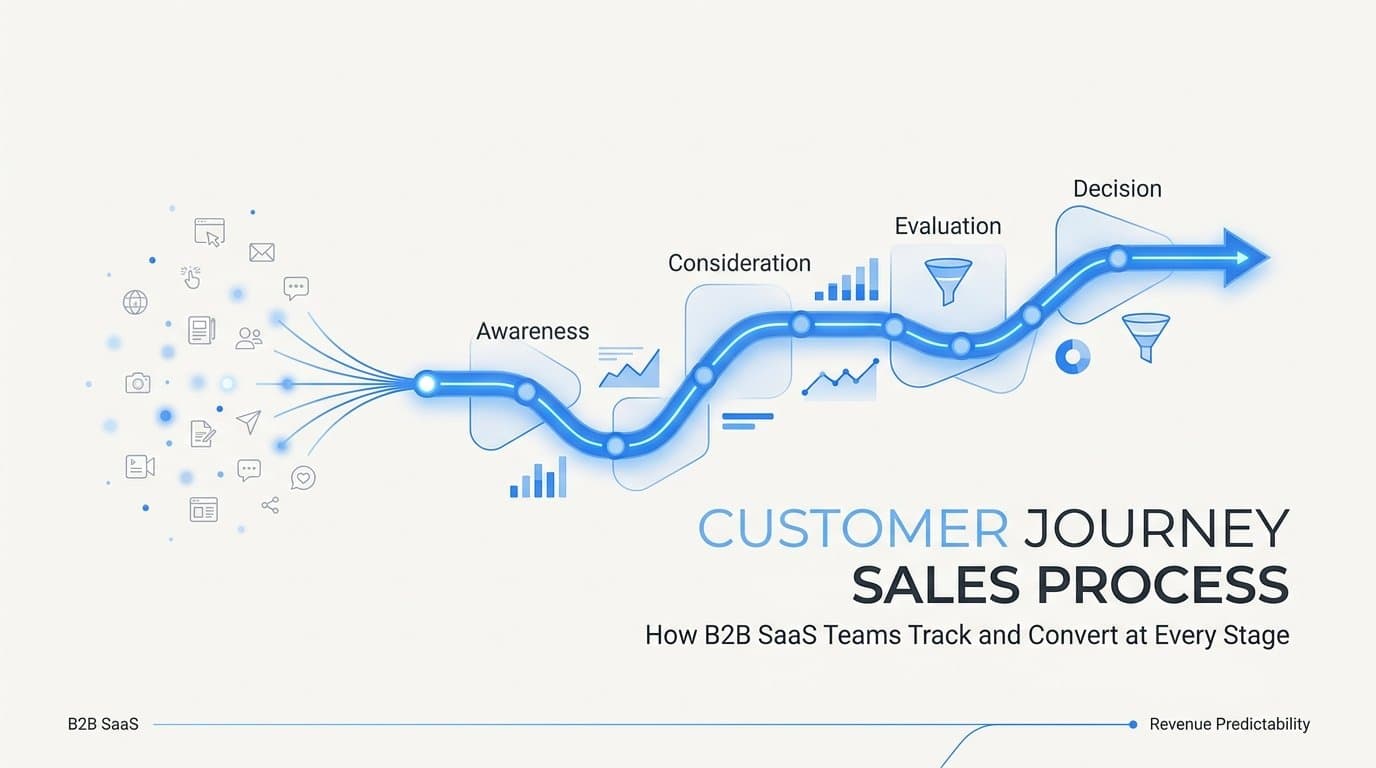
The B2B customer journey follows a recognizable arc: awareness, consideration, evaluation, decision, and post-purchase. But calling it a funnel implies a clean, downward flow that rarely matches reality. In B2B SaaS, the journey is better understood as a series of loops, pauses, and re-entries that can stretch across weeks or months.
Each stage has its own character. In the awareness stage, a prospect is recognizing a problem or exploring solutions without any urgency. They might encounter your brand through a Google search, a LinkedIn ad, or a peer recommendation in a Slack community. They are not ready to buy. They are barely ready to learn.
Consideration is where intent starts to sharpen. The prospect is actively comparing options, reading review sites like G2 or Capterra, consuming thought leadership content, and building an internal case for change. This stage often involves multiple stakeholders, each doing their own research independently.
Evaluation moves the journey into direct engagement. Demo requests, trial sign-ups, sales calls, and proposal reviews all happen here. This is where marketing-owned touchpoints hand off to sales-owned ones, though the boundary is rarely clean. A prospect might watch a product video the same week they are in active negotiation with your sales team.
The decision stage involves final approvals, procurement reviews, and contract negotiations. Post-purchase brings onboarding, expansion opportunities, and the referral behavior that seeds new awareness journeys for other buyers.
What makes B2B so different from B2C is the number of people involved at each stage. A single deal might touch a champion, an economic buyer, a technical evaluator, and a legal reviewer, each interacting with your brand through different channels and at different times. Tracking this requires capturing both marketing-owned touchpoints like ads, content, and email sequences and sales-owned touchpoints like demos, follow-up calls, and proposals.
Without visibility into both sides, you are missing half the picture. And because B2B prospects frequently go dark after initial engagement and re-enter the journey weeks later after an internal trigger, the idea of a linear funnel model breaks down quickly. The journey is non-linear by nature, which is precisely what makes accurate tracking so valuable and so difficult.
Where the Sales Process Begins Before Sales Gets Involved
Here is something worth sitting with: by the time a prospect fills out your demo form, they may have already decided you are on their shortlist. The form submission is not the beginning of the relationship. It is a milestone in the middle of a journey that started much earlier.
Modern B2B buyers self-educate aggressively. They search for solutions to specific problems, read comparison content, watch product walkthroughs on YouTube, ask for recommendations in professional communities, and scan peer reviews before they ever speak to a sales rep. This pre-sales research phase is where purchase intent is being shaped, and most of it happens invisibly if your tracking infrastructure only captures CRM entries.
This is where first-touch and multi-touch attribution become critical. First-touch attribution identifies the initial interaction that brought a prospect into your orbit, whether that was a paid search ad, an organic blog post, or a social media impression. Multi-touch attribution maps every subsequent interaction and assigns credit across the full sequence of touchpoints that contributed to a conversion.
Relying solely on CRM data or last-click attribution creates a systematic blind spot. Last-click models give all the credit to the final touchpoint before conversion, which in B2B is often a branded search or a direct visit. This makes it look like your bottom-of-funnel channels are doing all the work while your top-of-funnel investments appear to generate nothing.
The downstream consequence is real. When marketing teams cannot see the influence of early-stage touchpoints, they cut budget from channels that are actually driving qualified demand. A LinkedIn campaign that consistently initiates awareness journeys for high-fit prospects might show poor last-click conversion rates while being responsible for seeding a significant portion of your pipeline. Without multi-touch visibility, you would never know.
The fix is not just better reporting. It requires capturing data at every stage of the pre-sales journey and connecting those data points to outcomes downstream. That means tracking ad clicks, content engagement, and form submissions in a way that preserves the full sequence, so when a deal closes six weeks later, you can trace it back to its actual origin.
Connecting Marketing Data to Sales Outcomes
Knowing which ad a prospect clicked is useful. Knowing that the prospect who clicked that ad became a closed-won deal worth a specific contract value is transformative. That second level of insight is what pipeline attribution and revenue attribution make possible.
In practice, pipeline attribution works by connecting individual marketing events to CRM records and deal stages. When a prospect clicks a paid ad, visits your pricing page, and then submits a demo request, each of those events gets logged with identifiers that link them to a specific contact. As that contact moves through your sales pipeline from lead to opportunity to closed-won, the marketing touchpoints that influenced them travel with the record.
This connection allows marketing teams to answer questions that cost-per-lead metrics simply cannot address. Which campaign drove the most pipeline? Which channel has the lowest customer acquisition cost? Which ad creative is associated with deals that actually close versus deals that stall in evaluation?
Server-side tracking and Conversion API integrations play a crucial role in making this data reliable. Browser-based pixel tracking has become increasingly fragile. Ad blockers, browser privacy updates, and cookie restrictions mean that a meaningful share of conversion events never get recorded when you rely solely on client-side tracking. Server-side tracking captures those events at the server level before they can be blocked or dropped, ensuring a more complete and accurate data set.
Conversion API integrations take this further by sending enriched conversion data directly from your server to ad platforms like Meta and Google. Instead of sending a basic "form submitted" signal, you can send events that reflect what actually happened downstream: a demo was completed, an opportunity was created, a deal was closed. This gives ad platforms far more accurate signals to optimize against.
The result is a feedback loop that improves over time. More accurate conversion data leads to better ad platform optimization, which drives higher-quality traffic, which produces more accurate downstream data. And for marketing leaders, it replaces proxy metrics like cost per lead with real metrics like cost per closed deal, making budget decisions far more defensible.
Attribution Models and What They Reveal About Your Sales Cycle
Choosing an attribution model is not a technical decision. It is a strategic one. The model you use determines which touchpoints get credit for a conversion, and that directly shapes where you invest your budget next.
First-touch attribution gives all the credit to the initial interaction. It answers the question: where did this customer come from originally? For teams focused on building awareness and filling the top of the funnel, this model highlights which channels are best at initiating journeys. The limitation is that it ignores everything that happened after that first interaction, including the touchpoints that may have been more directly responsible for the final decision.
Last-click attribution does the opposite, giving all the credit to the final touchpoint before conversion. It is easy to implement and easy to understand, which is why it became the default in many analytics tools. But for B2B SaaS companies with sales cycles that span weeks or months, last-click attribution systematically undervalues top-of-funnel channels. The channel that initiated the journey almost never gets credit under this model.
Linear attribution distributes credit equally across all touchpoints in the journey. This approach acknowledges that every interaction played a role without making assumptions about which ones were more important. For longer sales cycles with many touchpoints, linear models often surface the contribution of mid-funnel channels that get lost in both first-touch and last-click reporting.
Time-decay attribution assigns more credit to touchpoints that occurred closer to the conversion event. This reflects the intuition that later interactions, like a demo or a proposal review, are more directly tied to the decision. It is a reasonable model for sales cycles where the final stages involve significant evaluation activity.
Data-driven attribution uses statistical modeling to assign credit based on actual patterns in your conversion data, rather than a predetermined rule. It is the most sophisticated approach and requires sufficient data volume to produce reliable results, but it tends to surface the most accurate picture of how touchpoints actually contribute to closed deals in your specific market.
The most valuable exercise is not picking one model and committing to it. It is comparing models side by side. When you look at the same set of deals through first-touch, linear, and last-click lenses simultaneously, patterns emerge about how your specific audience moves through the sales process. Those patterns inform both your media mix and your sales enablement strategy in ways that any single model alone cannot.
Using Customer Journey Data to Scale What Works
Once you have a clear picture of how prospects move through your customer journey sales process, the next question becomes obvious: how do you do more of what is working?
AI-driven analysis of journey data is increasingly useful here. Rather than manually reviewing campaign performance reports, AI can surface patterns across large volumes of journey data to identify which ad creatives, campaigns, and channels consistently initiate or accelerate movement through the sales process. This is not about automating decisions. It is about giving marketers faster, clearer signals so they can make confident scaling choices with less guesswork.
For example, if journey data shows that a specific type of educational content consistently appears in the early touchpoints of deals that eventually close, that is a signal to invest more in that content format. If a particular ad campaign is associated with prospects who move quickly from demo to closed-won, that is a candidate for increased budget. These insights are present in your data. The challenge is surfacing them at scale.
Enriched first-party data also creates a compounding advantage when it is sent back to ad platforms. When you feed Meta or Google conversion signals that reflect actual revenue events rather than just lead form submissions, those platforms can identify the characteristics of your highest-value customers and find more people like them. This improves targeting quality over time, which means your ad spend goes further and your pipeline becomes more predictable.
Journey analytics also reveals where the sales process breaks down. Every B2B funnel has stages where prospects consistently drop off, and those drop-off points are opportunities in disguise. If a large share of prospects who attend a demo never move to a second meeting, that signals a gap in the post-demo follow-up sequence or in how the demo itself is structured. If prospects consistently go dark after receiving a proposal, that points to a pricing or value communication problem.
Addressing these bottlenecks requires collaboration between marketing and sales, but the data that surfaces them comes from tracking the full journey. Without that visibility, teams tend to focus on generating more leads rather than improving the conversion rate of the leads they already have. Journey data shifts that conversation toward efficiency rather than just volume.
Building a Single Source of Truth for the Entire Journey
Here is the operational reality for most B2B SaaS teams: your ad spend data lives in Google Ads and Meta Ads Manager. Your lead and pipeline data lives in Salesforce or HubSpot. Your revenue data lives in Stripe or your billing system. And your website behavior data lives in Google Analytics. Each of these tools tells part of the story, but none of them tells all of it.
This fragmentation is not just inconvenient. It makes it functionally impossible to answer the most important questions in marketing. Which campaign drove the most closed-won revenue? What is the true customer acquisition cost by channel? Which touchpoint combination is most predictive of a deal closing quickly? When the data needed to answer these questions is spread across four or five disconnected systems, the answers require manual exports, spreadsheet stitching, and significant margin for error.
A unified attribution platform solves this by integrating all of those data sources into a single view where every touchpoint is visible and connected to outcomes. Ad platform data, CRM events, website behavior, and revenue data all flow into one place, linked by consistent identifiers that allow you to trace a customer's journey from first click to closed deal.
The practical steps for B2B SaaS teams looking to build this unified view start with conversion tracking. You need to ensure that meaningful events throughout the customer journey, not just form submissions but also demo completions, trial activations, and opportunity stage changes, are being captured accurately. Server-side tracking is the foundation here, given the limitations of browser-based methods.
The next step is connecting your CRM so that lead and pipeline data flows into your attribution platform alongside your marketing data. This is what makes it possible to connect ad clicks to deals. From there, integrating your billing or revenue system closes the loop, allowing you to tie marketing activity to actual contract value rather than just pipeline estimates.
Finally, defining which events represent meaningful milestones in your specific sales process matters more than most teams realize. Every B2B SaaS company has a slightly different journey. Some have long enterprise cycles with multiple evaluation stages. Others have shorter, more transactional processes. Your attribution setup should reflect the actual shape of your sales process, not a generic funnel template.
Platforms like Cometly are built specifically to solve this integration challenge for B2B SaaS companies. By connecting ad platforms, CRM data, website behavior, and revenue data in one place, Cometly gives marketing and growth teams a single source of truth for the entire customer journey, so every budget decision is grounded in what is actually driving closed-won revenue.
The Bottom Line on Journey Intelligence
The customer journey sales process is not something you map once and pin to a wall. It is a living data set that evolves as your market changes, your product evolves, and your buyers' behavior shifts. Teams that treat it as a dynamic system to be continuously tracked and analyzed gain a compounding advantage over those who rely on static funnel assumptions.
The central insight running through everything covered in this article is this: marketing data and sales data must be connected. When they exist in separate systems with no bridge between them, you are making budget decisions based on incomplete information. When they are unified, you can see which channels initiate journeys, which touchpoints accelerate deals, and which campaigns produce customers who actually stay and expand.
B2B SaaS teams that invest in attribution and journey analytics are not just getting better reports. They are building the operational infrastructure to scale efficiently, cut waste from channels that look productive but are not, and double down on the investments that are actually driving revenue.
The complexity of the modern B2B buying journey is not going away. If anything, it will continue to grow as buyers do more independent research and involve more stakeholders in their decisions. The teams that win will be the ones who can see that complexity clearly and act on it with precision.
Ready to connect every touchpoint in your customer journey to closed-won revenue? Explore how Cometly brings your ad data, CRM, and revenue data together in one place. Get your free demo today and start building the attribution foundation your growth strategy depends on.