
You've got a real problem if you're running broad demand generation campaigns for a B2B SaaS product. You spend budget attracting hundreds of leads, your team celebrates the MQL numbers, and then sales looks at the list and says: "These aren't the right companies." That disconnect is expensive, demoralizing, and completely avoidable.
Account based marketing exists precisely to solve that problem. Instead of casting a wide net and hoping the right fish swim in, ABM starts with a defined list of companies that actually fit your ideal customer profile and focuses every marketing and sales resource on engaging those specific accounts. It is a fundamentally different operating model, and for B2B SaaS teams with complex sales cycles and multiple stakeholders to win over, it often produces far better outcomes than traditional demand generation.
This article breaks down the definition of account based marketing in plain terms, explains how it works in practice, walks through the three core ABM models, and covers how to measure whether your ABM efforts are actually driving pipeline and revenue. If you are evaluating ABM for your team or trying to sharpen an existing program, this is the foundation you need.
Account Based Marketing, Defined in Plain Terms
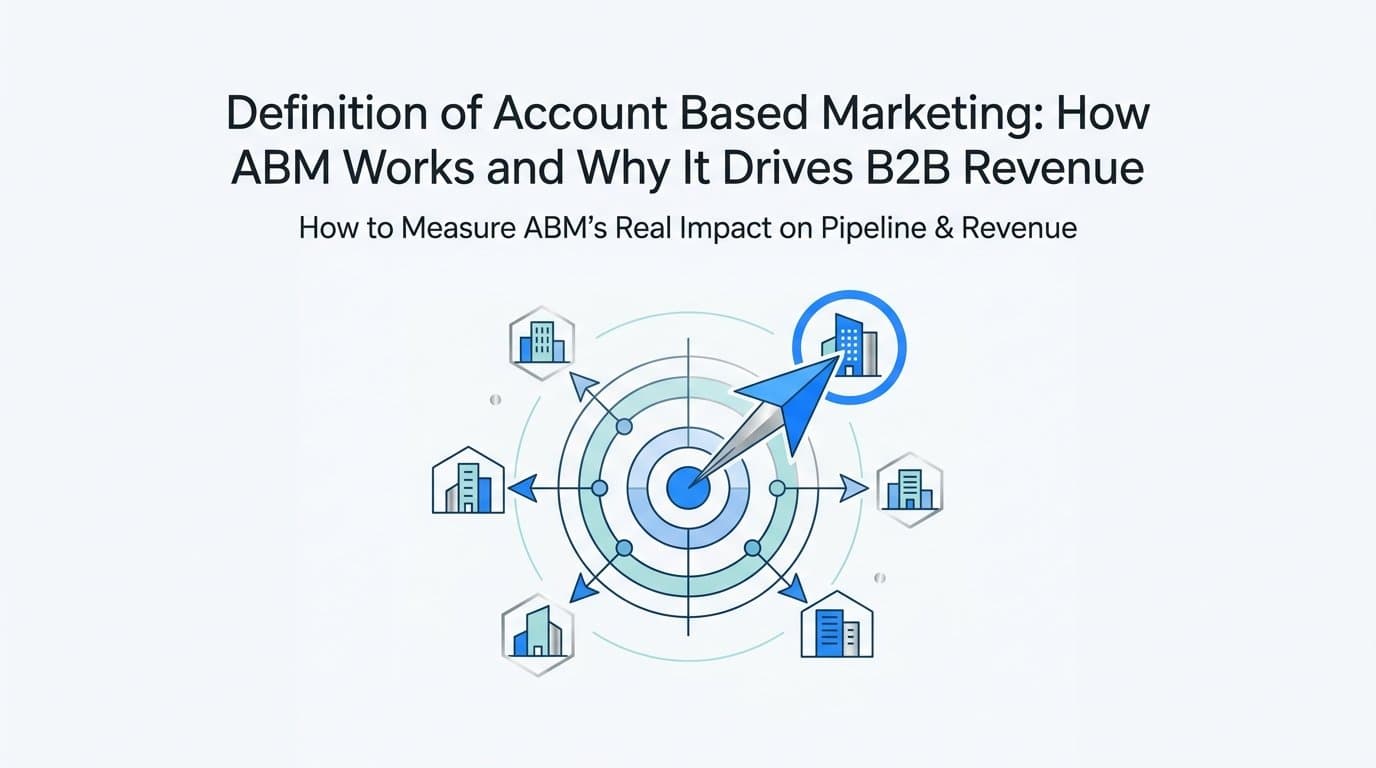
Account based marketing is a B2B go-to-market strategy where marketing and sales align around a shared list of high-value target accounts rather than pursuing individual leads at volume. The definition sounds simple, but the implications for how you run your marketing operation are significant.
In traditional demand generation, the funnel flows top-down. You attract a broad audience, generate as many leads as possible, score and filter them, and then pass the qualified ones to sales. The assumption is that volume creates opportunity. ABM inverts that logic entirely.
With ABM, you start at the bottom and work backward. You define your ideal customer profile first, identify the specific companies that match it, and then build campaigns designed exclusively to reach and engage those accounts. Volume is not the goal. Precision is.
One of the most important concepts in the definition of account based marketing is that each target account is treated as a market of one. That means the messaging, content, and outreach your team produces are tailored to the specific company, its industry, the business problems it faces, and the people involved in its buying decision. A generic whitepaper sent to a thousand contacts is not ABM. A personalized campaign built around a specific company's priorities, delivered to its entire buying committee across multiple channels, is.
The buying committee piece matters a great deal in B2B SaaS. Enterprise and mid-market software purchases rarely involve a single decision maker. There is often a champion who drives the evaluation, a technical stakeholder who validates the solution, a finance person who approves the budget, and an executive who signs off. ABM accounts for all of them. Rather than targeting one contact at a company, ABM teams engage the full committee with coordinated, relevant touchpoints.
The unit of measurement also shifts. In traditional demand gen, you measure leads, MQLs, and contact-level conversions. In ABM, you measure account engagement, account progression through the funnel, and revenue generated from target accounts. This change in measurement is not cosmetic. It forces marketing to be accountable to business outcomes rather than activity metrics.
Put simply: ABM is what happens when marketing stops trying to attract anyone who might be interested and starts focusing entirely on the companies you actually want to win as customers.
Why B2B SaaS Teams Are Shifting Away from Lead Volume
The traditional demand generation model made more sense when buyer behavior was simpler and sales cycles were shorter. For many B2B SaaS companies today, it creates more problems than it solves.
Here is the core tension. Marketing optimizes for MQL volume because that is how success gets measured. Sales ignores most of those MQLs because the companies behind them do not match the profile of accounts they can actually close. Both teams end up frustrated, and the misalignment compounds over time as marketing keeps investing in channels that generate the wrong kind of attention.
ABM solves this by making the target account list the shared foundation for both teams. Marketing does not generate leads and hand them to sales. Marketing and sales agree upfront on which accounts to pursue, what an ideal fit looks like, and how they will coordinate outreach. The result is that every dollar of marketing spend goes toward companies that sales has already identified as worth pursuing.
For B2B SaaS companies specifically, this alignment matters for several reasons. Software buying cycles are long. It is common for enterprise deals to take six months to a year from first touch to closed-won. During that time, a prospect might interact with your paid ads, your content, your sales team, your product demo, and your customer success team before making a decision. If marketing is generating leads that sales does not want, all of that investment is wasted before the journey even begins.
There is also the stakeholder complexity to consider. The more expensive and strategic a software purchase, the more people are involved in approving it. ABM is designed for exactly this environment because it focuses on engaging the full buying committee at a target account rather than capturing a single contact and hoping they can sell internally.
Another reason B2B SaaS teams are moving toward ABM is pipeline efficiency. When you concentrate resources on a defined account list, you reduce wasted spend on companies that will never buy, shorten the time it takes to build meaningful engagement with the right accounts, and create a cleaner path from marketing activity to revenue. That efficiency is increasingly important as growth teams face pressure to do more with leaner budgets.
The shift is not about abandoning inbound or content marketing entirely. Many ABM programs run alongside inbound strategies. The difference is intentionality: ABM ensures that your highest-investment efforts are directed at the accounts most likely to generate real revenue.
The Three Core ABM Models and When to Use Each
Not all ABM programs look the same. The industry recognizes three distinct tiers of ABM, each reflecting a different balance between personalization and scale. Understanding which model fits your situation is one of the first strategic decisions an ABM team needs to make.
One-to-One ABM (Strategic ABM): This is the highest-touch, most resource-intensive model. Your team selects a small number of strategic accounts, often fewer than twenty, and builds fully customized campaigns for each one. That might mean dedicated landing pages, custom content that references the account's specific business context, personalized executive outreach, and bespoke event experiences. One-to-one ABM is best suited for enterprise deals with large contract values where the potential revenue from a single account justifies significant investment. If a single closed deal could represent hundreds of thousands of dollars in annual recurring revenue, spending meaningfully on a tailored campaign for that account makes economic sense.
One-to-Few ABM (Segment-Based ABM): This model groups target accounts by shared characteristics such as industry vertical, company size, tech stack, or growth stage. Instead of building a fully custom campaign for each account, you create messaging and content that speaks directly to the segment's shared challenges and goals. A campaign targeting mid-market fintech companies, for example, would address the problems specific to that segment without requiring fully bespoke assets for every account in the group. One-to-few ABM allows a meaningful level of personalization at moderate scale, making it practical for teams that cannot sustain the resource demands of one-to-one but still want more precision than broad demand generation.
One-to-Many ABM (Programmatic ABM): This model uses technology and data to deliver personalized experiences across a larger account list, sometimes hundreds or thousands of companies. Personalization at this scale is driven by intent data, firmographic filters, and ad platform targeting rather than manual content creation. Programmatic ABM is particularly well suited for growth-stage SaaS companies that have a well-defined ICP but need to engage a larger addressable market efficiently. The tradeoff is that personalization is less deep than in the other models, but the targeting is still far more precise than traditional demand generation.
Choosing the right model depends on your average contract value, your team's capacity, and the size of your target account list. Many mature ABM programs actually run multiple tiers simultaneously, applying one-to-one treatment to the most strategic accounts while running programmatic campaigns across a broader tier of qualified companies.
How ABM Campaigns Actually Reach Target Accounts
Defining your target account list is only the first step. The harder question is how you actually get your message in front of the right people at those companies. ABM campaigns typically combine paid advertising, content, and direct outreach into a coordinated multi-channel approach.
Paid advertising plays a central role in most ABM programs because modern ad platforms offer the targeting precision ABM requires. LinkedIn is particularly valuable here. You can target by company name, job title, seniority level, department, and industry, which means you can serve ads specifically to the buying committee members at your target accounts. Google Ads and display retargeting add reach across the broader web, keeping your brand visible to target account contacts even when they are not on LinkedIn.
Intent data layers add another dimension to paid ABM. By identifying accounts that are actively researching topics related to your solution, you can prioritize budget toward companies that are already showing buying signals, making your paid campaigns more efficient.
Content and outbound touchpoints work alongside paid advertising to surround the buying committee from multiple directions. Personalized email sequences, direct mail for high-value accounts, and event invitations create additional points of contact that reinforce the paid ad exposure. The goal is not to overwhelm a prospect but to maintain consistent, relevant presence across the channels they actually use.
Sales and marketing coordination is what separates ABM from expensive outbound. When a target account engages with a paid ad, visits a key page, or downloads content, that signal should flow immediately to the sales team so they can follow up with context. That coordination requires shared data and agreed-upon workflows between marketing and sales.
Here is where the measurement challenge becomes acute. The multi-channel nature of ABM means that a single account might interact with a LinkedIn ad, a retargeting banner, a personalized email, a sales call, and a product demo before moving forward in the buying process. Without tracking every one of those touchpoints and attributing them back to the account, you have no idea which channels are actually influencing pipeline. You are flying blind on budget decisions, and that is a problem ABM teams cannot afford to ignore.
Measuring ABM: The Metrics That Actually Matter
One of the most common mistakes teams make when launching an ABM program is applying traditional demand gen metrics to a strategy that requires a completely different measurement framework. Lead volume, MQL count, and cost per lead are largely irrelevant in ABM. They measure the wrong things.
The metrics that matter in ABM are account-level and revenue-focused. Here is how to think about each one.
Account Engagement Rate: This measures how actively your target accounts are interacting with your marketing and sales touchpoints. Are contacts at target accounts clicking your ads, visiting your website, opening emails, attending webinars? Rising engagement across a target account is a leading indicator that the buying committee is paying attention. Falling engagement is a signal to adjust your approach or reassess whether the account belongs on your list.
Pipeline Influenced by Target Accounts: This metric connects your ABM activity to actual pipeline creation. When a target account enters the sales pipeline as an opportunity, you need to be able to trace which marketing touchpoints contributed to that outcome. Pipeline influenced is a direct measure of whether ABM is generating real business momentum, not just marketing activity.
Deal Velocity for ABM Accounts: Are the accounts in your ABM program moving through the sales cycle faster than accounts that came through other channels? If ABM is working, you should see shorter time-to-close for target accounts because the buying committee has been educated and engaged before sales even enters a formal conversation.
Revenue from Target Accounts: Ultimately, ABM is a revenue strategy. The clearest measure of success is how much closed-won revenue came from the accounts on your target list. This metric requires tight integration between your marketing data and your CRM so you can see which accounts converted and trace the marketing investment that preceded the deal.
Attribution is the engine that makes all of this measurement possible, and it is where many ABM teams struggle. Because the buying journey in B2B SaaS can span months and involve dozens of touchpoints across multiple channels, connecting marketing activity to pipeline and revenue requires more than a last-touch attribution model. You need multi-touch attribution that captures every interaction, from the first paid ad impression to the final demo request, and maps it to the account-level journey.
Without accurate attribution, ABM budget decisions become guesswork. You might be investing heavily in LinkedIn ads while the touchpoints that are actually moving accounts through the funnel are your retargeting campaigns or your personalized email sequences. Only multi-touch attribution tells you the truth.
Connecting ABM to Revenue Attribution
Understanding which touchpoints drive revenue in an ABM program is not a nice-to-have. It is the difference between scaling a program that works and continuing to invest in one that looks active but is not generating returns.
This is where a platform like Cometly becomes directly relevant to ABM teams. Cometly connects your ad spend data, CRM events, and conversion signals into a single attribution view so you can see exactly which touchpoints influenced each target account from first click to closed-won deal. Rather than stitching together data from separate ad platforms, your CRM, and your analytics tool, you get a unified picture of the customer journey at the account level.
Pipeline attribution shows you which campaigns and channels contributed to opportunities entering the pipeline. Revenue attribution goes further, connecting those same touchpoints to deals that actually closed. For ABM teams, this means you can answer questions like: Which LinkedIn campaigns are generating pipeline from target accounts? Which ad creative is resonating with the buying committee at enterprise accounts? Which channels are influencing deals that close fastest?
Those answers give ABM teams the evidence they need to make confident budget decisions. When you can show that a specific campaign influenced a significant portion of your target account pipeline, you have a clear case for scaling that investment. When you can see that a channel is generating account engagement but no pipeline, you know to reallocate.
Real-time data matters here too. ABM programs that rely on quarterly reporting cannot optimize fast enough to make a difference within a campaign cycle. Cometly's real-time insights into ad performance and customer journey data allow growth teams to adjust targeting, messaging, and budget allocation while campaigns are running, not after they have already concluded.
The AI-driven recommendations within Cometly also help ABM teams identify which ads and campaigns are performing across channels, so you can scale what is working with confidence rather than relying on intuition. And because Cometly sends enriched conversion data back to ad platforms like Meta and Google, your paid ABM campaigns benefit from better algorithmic optimization, improving targeting precision over time.
Putting It All Together
The definition of account based marketing comes down to one strategic shift: from pursuing volume to pursuing precision. Instead of generating as many leads as possible and hoping the right companies are in the mix, ABM starts with the companies you want to win and builds everything around engaging them effectively.
For B2B SaaS teams, that shift addresses some of the most persistent problems in go-to-market execution: the misalignment between marketing MQLs and sales priorities, the wasted spend on leads that never convert, and the difficulty of engaging complex buying committees across long sales cycles.
But ABM only delivers its full value when you can measure what is actually driving revenue at the account level. Account engagement, pipeline influenced, deal velocity, and closed-won revenue from target accounts are the metrics that tell you whether your program is working. And multi-touch attribution is the infrastructure that makes those metrics meaningful rather than approximate.
If your team is running ABM campaigns without a clear view of which touchpoints are influencing pipeline and revenue, you are making budget decisions without the data you need. That is a solvable problem.
Ready to see exactly which ABM touchpoints are driving pipeline and revenue for your B2B SaaS team? Get your free demo and see how Cometly connects every ad click, CRM event, and conversion to the accounts that matter most.