You've found product-market fit. Deals are closing. Inbound interest is picking up. And somewhere between your third sales call of the day and your fifth content request of the week, it hits you: you cannot keep doing this alone.
The decision to make your first marketing hire is one of the most consequential moves a B2B startup founder will make. Get it right, and you unlock a scalable demand engine that compounds over time. Get it wrong, and you've spent six to twelve months and a significant salary on someone who couldn't move the needle, or worse, someone who was measuring the wrong things entirely.
The anxiety founders feel around this decision is completely justified. It's not just about finding a good marketer. It's about hiring the right archetype at the right stage, with the right skills, into an environment that's actually set up for them to succeed. Too many first marketing hires fail not because of talent, but because of missing infrastructure: no attribution, no clear ICP, no data to work from on day one.
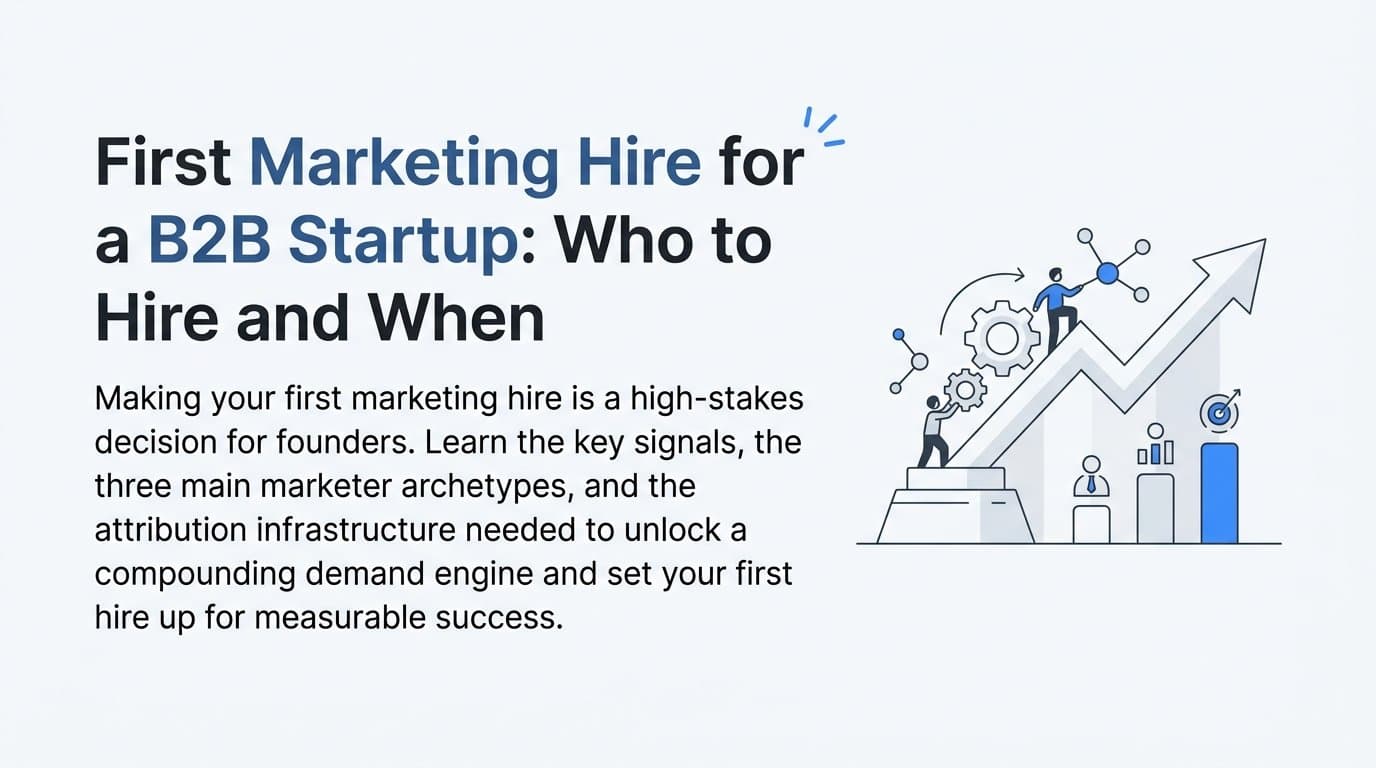
This article walks through exactly how to approach this decision. You'll learn the signals that tell you it's time to hire, the three main archetypes and when each makes sense, the skills that actually matter for B2B, what to build before your new hire starts, and how the right attribution foundation turns a good marketer into a great one.
Reading the Room: Signals That Tell You It's Time
Not every founder who feels overwhelmed by marketing needs to hire a marketer. Sometimes the answer is a better process or a focused sprint. But there are specific signals that tell you the problem isn't bandwidth, it's structural.
Consistent inbound interest: If you're seeing a repeatable pattern of leads coming in through the same channels, whether that's organic search, LinkedIn, or word of mouth, that's a signal worth investing in. Randomness doesn't justify a hire. Repeatability does.
A sales cycle you can describe: Before you hire a marketer, you need to understand how deals actually close. If you can articulate the typical buyer journey, the common objections, and the decision-making timeline, your first marketer has something to work with. If you can't, you'll be asking them to build strategy without a foundation.
Marketing tasks are crowding out strategic work: When writing a newsletter, updating the website, or managing an ad account is consistently bumping strategic priorities off your calendar, that's the tipping point. You're not just spending time on marketing tasks. You're losing time on the decisions only you can make.
Pipeline growth is stalling: If sales is ready to close more deals but the top of the funnel isn't keeping up, that's a clear signal. The bottleneck has moved from product to go-to-market, and a dedicated marketer is the right solution.
On the other side, hiring too early is a real risk. If you don't yet have a repeatable go-to-market motion, a first marketing hire will spend their time experimenting without enough signal to learn from. That's expensive and demoralizing for everyone involved. The sweet spot is when you have enough data to give your hire a starting point, but not enough capacity to act on it yourself.
Hiring too late carries its own cost. Every month without a dedicated marketer is pipeline you're not building, content you're not creating, and channels you're not optimizing. Founders who wait until they're completely overwhelmed often hire reactively, which leads to the wrong role at the wrong time.
The Three Archetypes: Generalist, Specialist, or Growth Leader
Once you've decided it's time to hire, the next question is: what kind of marketer do you actually need? There are three common archetypes for a first B2B marketing hire, and choosing the wrong one is one of the most common and costly mistakes founders make.
The Marketing Generalist: This is typically the right first hire for pre-Series A startups. A generalist can run paid campaigns, write content, manage email sequences, update the website, and coordinate with sales. They're not the deepest expert in any one area, but they can cover the full funnel without needing a team behind them. For early-stage companies, this breadth is more valuable than depth.
The Demand Generation Specialist: If your primary need is pipeline and you already have some content or brand foundation in place, a demand gen specialist might make sense. They're focused on driving qualified leads through paid and owned channels, and they're comfortable working closely with sales to define what "qualified" actually means. The risk is that they may struggle with the broader operational and content work that early-stage marketing requires.
The Marketing Leader or VP: This archetype makes sense at Series A and beyond, when you need someone who can build a team, own the marketing budget, and set long-term strategy. The mistake many founders make is hiring at this level too early. A VP of Marketing without a repeatable go-to-market motion to build on will spend their time doing work that a generalist could have done for half the cost, and they'll likely leave frustrated within a year.
Here's where it gets interesting: many founders default to hiring a senior content or brand marketer because that's the work that feels most visible. Blog posts, social presence, brand voice. But in most B2B SaaS environments, especially early on, what you actually need is someone who can drive measurable pipeline. Brand matters, but it doesn't pay the bills in month six.
The right archetype depends on your stage, your existing assets, and what's actually blocking growth. Be honest about which problem you're trying to solve before you write the job description.
Core Skills Your First B2B Marketing Hire Must Have
Beyond the archetype, there's a specific skill set that separates effective first marketing hires from those who struggle in early-stage environments. These aren't nice-to-haves. They're table stakes.
Demand generation fundamentals: Your first hire needs to understand how to build and manage a pipeline-generating marketing program. That means knowing how to run paid campaigns, nurture leads through email, and align marketing activity with sales outcomes. If they've never thought in terms of pipeline, they'll default to vanity metrics.
Paid media literacy: Even if paid isn't your primary channel, your first marketer should be comfortable running campaigns on Google Ads, LinkedIn Ads, or Meta. They don't need to be a specialist, but they should be able to set up a campaign, read the data, and make optimization decisions without outsourcing every judgment call.
CRM and marketing automation familiarity: In B2B, the CRM is the source of truth for pipeline. Your first hire needs to be comfortable working inside tools like HubSpot or Salesforce, understanding how leads flow through the funnel, and connecting marketing activity to deal data. Marketing automation, whether through HubSpot, Marketo, or similar tools, is also essential for managing nurture sequences and lead scoring.
Clear, audience-specific writing: B2B marketing lives and dies on messaging. Your first hire needs to write clearly and specifically for your ICP, not generic marketing copy. This includes ads, emails, landing pages, and case study narratives.
Analytical capability deserves its own emphasis. This is not optional. Your first marketing hire should be comfortable reading campaign data, understanding conversion rates at each funnel stage, and connecting their work to pipeline metrics. Marketers who can't do this will always struggle to justify their budget or defend their decisions.
Beyond skills, mindset matters enormously in early-stage environments. Look for a bias toward action over perfection, comfort with ambiguity and shifting priorities, and the ability to make smart trade-offs with limited resources. The marketer who waits for a perfect brief before starting will be a poor fit for a startup. The one who ships a test campaign on week two and learns from it will thrive.
What to Build Before Day One
One of the most overlooked factors in a first marketing hire's success is what the company has in place before they start. Walking into a blank slate is demoralizing and inefficient. The more you can prepare, the faster your new hire can move.
A documented ICP: Your first marketer needs to know exactly who they're marketing to. Company size, industry, job title, pain points, buying triggers. If this isn't written down, they'll spend their first month trying to extract it from your head and from sales conversations, which is time they could be spending on execution.
Basic positioning and messaging: You don't need a full brand playbook, but you should have a clear articulation of what you do, who it's for, and why it's different. Your first hire can refine and expand this, but they shouldn't be starting from scratch.
CRM with historical deal data: Even if your CRM is messy, having some record of closed deals, lost deals, and pipeline history gives your first marketer something to learn from. They can identify patterns in win rates, deal sizes, and sales cycles that will inform their channel and messaging strategy.
Access to existing ad accounts and channels: If you've been running any paid campaigns, managing a LinkedIn presence, or publishing content, make sure your new hire has full access from day one. Historical data is valuable context.
The attribution and conversion tracking infrastructure deserves particular attention. This is where many startups set their first marketing hire up to fail without realizing it. If there's no proper tracking in place, your marketer will spend months generating activity they can't measure. They won't know which channels are driving leads, which campaigns are contributing to pipeline, or where the conversion drop-offs are happening.
Setting up attribution before or immediately after your first hire starts isn't a technical afterthought. It's a strategic priority. Without it, every budget decision is a guess.
For 30-60-90 day expectations, think in phases. The first month should focus on learning: auditing existing channels, understanding the sales process, and mapping the current state of marketing. The second month is for running initial experiments with clear hypotheses. The third month is for optimizing based on what the data is showing. Founders who expect immediate pipeline results in month one often create pressure that leads to poor decisions and short tenures.
How Attribution Shapes Your First Marketer's Success
Here's a reality that many B2B founders don't fully appreciate until it's too late: without a clear attribution framework, your first marketing hire is operating blind. They can run campaigns, publish content, and manage ad spend, but they cannot tell you with confidence what is actually driving pipeline and revenue.
This matters more than it might seem. Without attribution, your marketer can't defend budget requests with data. They can't make confident decisions about which channels to scale or cut. And when leadership asks "what is marketing contributing to revenue?", the honest answer is "I'm not sure." That's a difficult position for a first hire trying to establish credibility.
B2B customer journeys are complex. A buyer might discover you through a LinkedIn ad, read three blog posts over two weeks, attend a webinar, and then click a Google search ad before booking a demo. First-touch attribution would credit LinkedIn. Last-touch would credit Google. Neither tells the full story.
Multi-touch attribution connects the dots across the entire journey, giving your first marketer a complete picture of which channels and campaigns are contributing to pipeline at each stage. This is particularly important for mid-funnel channels like content, retargeting, and email, which often drive significant influence but get undervalued in simpler attribution models.
Server-side conversion tracking is increasingly important as well. As third-party cookie reliability continues to decline, client-side tracking alone misses a meaningful portion of conversions. Server-side tracking captures events more accurately, which means your ad platform algorithms get better data to optimize against.
This is where Cometly directly addresses one of the most common infrastructure gaps first marketing hires face. Cometly connects your ad platforms, including Google Ads, LinkedIn Ads, and Meta, with your CRM data and website behavior to give your first marketer a single source of truth. Instead of toggling between platform dashboards and guessing at cross-channel contribution, they can see exactly which campaigns are generating pipeline and closed revenue.
For a first marketing hire who needs to move fast and prove ROI without a large team behind them, having that attribution layer in place from the start isn't a luxury. It's the foundation everything else is built on.
Building the Systems That Let Your First Marketer Scale
Getting a great first hire into the role is one thing. Giving them the environment to succeed and eventually scale is another. The difference between a marketing function that stays at one person forever and one that grows into a team often comes down to the systems built in the first six months.
Documented playbooks: As your first marketer figures out what works, they should be documenting it. Campaign structures, email sequences, ad creative frameworks, landing page templates. These aren't just efficiency tools. They're the foundation for onboarding the next hire.
A content calendar with clear ownership: Content without a calendar is content that doesn't get published consistently. Even a simple monthly calendar with topics, formats, and deadlines creates accountability and helps your marketer maintain a publishing rhythm without scrambling.
A reporting cadence: Establish a regular rhythm for reviewing marketing performance, whether that's weekly pipeline reviews with sales or monthly channel performance reports for leadership. The cadence matters less than the consistency. Regular reporting creates a feedback loop that improves decision-making over time.
A tight feedback loop with sales: In B2B, marketing and sales alignment is not optional. Your first marketer should be in regular communication with sales to understand lead quality, common objections, and which campaigns are generating conversations that actually close. Without this loop, marketing optimizes for metrics that don't reflect revenue reality.
Real-time performance data changes the game for a first marketer working alone. When they can see which campaigns are generating pipeline without waiting for a monthly report, they can reallocate budget in days rather than weeks. AI-driven insights that surface high-performing ads and flag underperformers give a solo marketer leverage that would otherwise require an analyst.
At the six-month mark, success for a first B2B marketing hire should look like: a functioning demand generation engine with consistent lead flow, measurable pipeline contribution from marketing that sales acknowledges, and a clear view of cost per lead and cost per acquisition by channel. If those three things are in place, you have a marketing function worth investing in further.
The Bottom Line on Your First Marketing Hire
The first marketing hire is not just another headcount decision. It's the moment a B2B startup transitions from founder-led growth to a scalable marketing function. Done well, it accelerates everything. Done poorly, it sets you back by a year or more.
The key decision points are straightforward, even if the execution isn't. Hire when the signals are clear: consistent inbound, a repeatable sales cycle, and marketing tasks crowding out strategic work. Choose the right archetype for your stage, typically a generalist executor before Series A and a strategic leader after. Prioritize analytical skills and demand generation experience over brand or content depth. And build the data infrastructure before day one, so your new hire can measure what matters from the moment they start.
The attribution layer is not a detail to sort out later. It's what allows your first marketer to connect their work to revenue, defend their budget, and make confident scaling decisions. Without it, even a talented hire is guessing.
Ready to give your first marketing hire the foundation they need to prove impact from day one? Get your free demo and see how Cometly connects your ad platforms, CRM, and website data into a single source of truth, so your first marketer can move fast, measure everything, and scale with confidence.