B2B marketers are navigating a growing paradox. Ad platforms promise more targeting precision than ever, yet the data feeding those platforms is becoming less reliable by the day. Third-party cookies are disappearing, browser privacy restrictions are tightening, and the conversion signals that once powered campaign optimization are increasingly incomplete. The result is a widening gap between what platforms report and what is actually happening in your pipeline.
The marketers closing that gap are not the ones with the biggest budgets. They are the ones who built a strong first-party data foundation before the signal loss became critical. They own their data, control how it flows, and use it to power attribution models that connect ad spend directly to closed revenue.
This guide is written for B2B SaaS marketing and growth teams who want a clear, practical understanding of what a first-party data strategy actually looks like: what to collect, how to activate it across ad channels, and how to use it to make attribution genuinely reliable. No hype, no vague frameworks. Just the infrastructure and logic you need to build something durable.
Why Third-Party Data Is Failing B2B Marketers
For years, B2B paid media ran on a relatively simple assumption: drop a pixel on your site, let the ad platform track conversions, and optimize from there. That model is breaking down, and the cracks are getting harder to ignore.
The shift away from third-party cookies is the most visible driver. Major browsers have systematically restricted cross-site tracking, and the advertising ecosystem built on top of that tracking is losing fidelity at every layer. Ad blockers compound the problem. Many B2B audiences, particularly technical buyers and decision-makers, use ad blockers at high rates, which means your browser-based pixel may be missing a meaningful share of actual conversions before the cookie debate even enters the picture.
For B2B teams running paid campaigns on Meta, Google, and LinkedIn, this signal loss has direct consequences. When platforms receive fewer conversion events, their algorithms have less data to work with. Optimization suffers. Audience matching degrades. Campaigns that once scaled efficiently start hitting walls that are difficult to diagnose because the reporting itself is incomplete.
The attribution blind spots go deeper than most teams realize. Platform-reported data tends to inflate click counts and misattribute conversions, with each platform taking credit for outcomes that were influenced by multiple channels. When you layer in the reality that B2B deals often close weeks or months after the initial ad interaction, and frequently involve offline touchpoints like sales calls and demos, the gap between platform metrics and actual revenue becomes significant.
Relying on CRM data alone does not solve the problem either. Without a mechanism to connect CRM events back to the specific ad interactions that preceded them, you are left with disconnected data sets that cannot tell you which campaigns actually drove pipeline.
First-party data is the durable alternative. It is data your team collects directly from your own properties and relationships: your website, your product, your CRM, your email platform. You own it, you control it, and you can use it across channels without depending on third-party intermediaries who are increasingly constrained by privacy regulations and browser policies. As the third-party data ecosystem continues to erode, first-party data is not just a nice-to-have. It is the foundation that serious B2B marketing programs are being built on.
Defining First-Party Data in a B2B Context
The term "first-party data" gets used broadly, so it is worth being precise about what it actually means for B2B teams and why the distinction from other data types matters.
First-party data is any data collected directly from your own audience through your own channels. In a B2B context, that includes CRM records containing contact and account information, form submissions from landing pages and gated content, product usage events from your application, email engagement signals like opens and clicks, and behavioral data collected from visitors on your website. The defining characteristic is that you collected it directly, with the user's knowledge, through a direct relationship.
Second-party data is another company's first-party data that they share with you directly, often through a partnership. Third-party data is collected by external providers who aggregate information from many sources and sell access to it. Both have their uses, but neither offers the reliability or control of first-party data, particularly as privacy regulations tighten and data brokers face increasing scrutiny.
The distinction matters for attribution because data quality degrades as you move further from the source. Third-party audience data may be months old, built on probabilistic matching, or sourced from contexts that have little relevance to your buyers. First-party data reflects actual behavior from actual people who have engaged with your brand, which makes it far more accurate as an input for both attribution analysis and ad platform optimization.
What makes B2B first-party data particularly valuable is its richness at the account level. Unlike B2C, where a single consumer makes a purchase decision, B2B deals typically involve multiple stakeholders across an organization, a sales cycle that spans weeks or months, and conversion events that happen off-platform. Your first-party data can capture account-level signals: which companies are visiting your pricing page, which contacts from the same organization have downloaded content, how deal stages are progressing in your CRM. That kind of multi-stakeholder, revenue-tied signal is something no third-party data source can replicate, because it is specific to your business and your buyers.
This richness is exactly what makes first-party data so powerful for attribution and ad optimization. When you can connect a closed deal back to the specific ad interactions, content engagements, and CRM events that preceded it, you have something genuinely actionable. That connection is what a strong first-party data strategy is designed to create.
The Infrastructure Behind a Solid First-Party Data Strategy
Understanding why first-party data matters is the easy part. Building the infrastructure to collect, enrich, and activate it is where most B2B teams need a clear roadmap.
The foundation is server-side event tracking. Traditional browser-based pixels send conversion data from the user's browser to the ad platform. Server-side tracking sends that data from your own server, which means browser restrictions, ad blockers, and cookie policies do not interfere with the signal. For B2B teams, moving to server-side tracking is the single most impactful technical step in a first-party data strategy because it immediately improves the quality and completeness of conversion data reaching your ad platforms.
Conversion API integrations are the mechanism that makes this work at scale. Meta's Conversion API and Google's Enhanced Conversions allow you to send first-party event data directly from your server to each platform. When implemented correctly, these integrations pass hashed identifiers like email addresses alongside event data, which dramatically improves match rates. Better match rates mean the platform can connect more of your conversion events to actual users in its system, giving the algorithm more signal to optimize toward the right audiences.
Beyond the technical layer, you need to think carefully about which touchpoints you are capturing across the full B2B funnel. Ad clicks and landing page visits are the obvious starting points, but a complete first-party data strategy also captures form fills, demo requests, trial sign-ups, and CRM stage changes. Each of these events represents a meaningful signal about buyer intent and progression, and each one should be flowing into your attribution layer so that no part of the customer journey is invisible.
Data enrichment is the next layer. A raw form submission tells you that someone converted. An enriched form submission tells you that a VP of Marketing at a 200-person SaaS company converted, that their company is already in your CRM as an open opportunity, and that they previously engaged with two of your LinkedIn ads. That enriched signal is dramatically more useful both for attribution analysis and for feeding back into ad platforms. When you pass enriched, revenue-weighted conversion events through your Conversion API integration, you are giving ad platform algorithms the context they need to find more high-value prospects, not just more clicks.
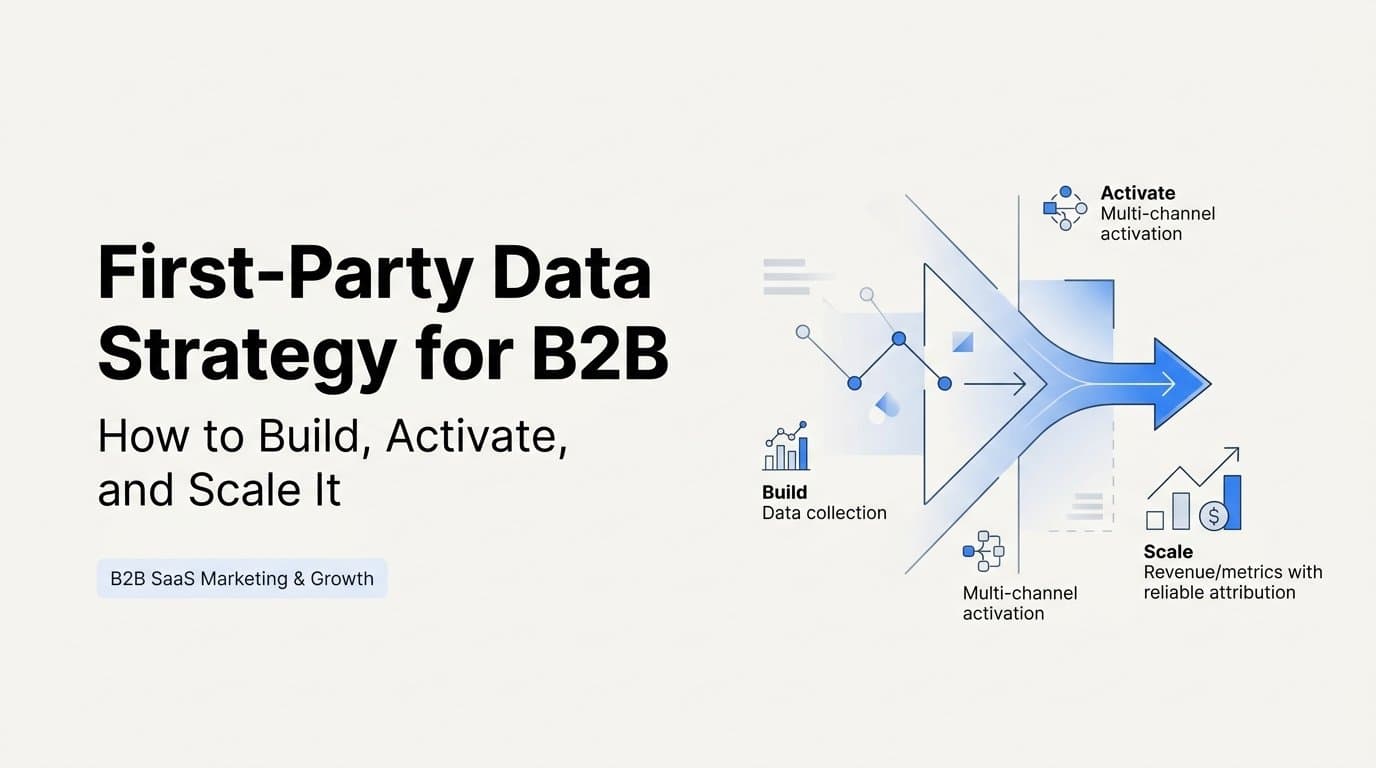
The goal of this infrastructure is a continuous, bidirectional flow of first-party data: from your properties and CRM into your attribution layer, and from your attribution layer back into your ad platforms as enriched conversion signals. That loop is what separates teams with genuinely optimized campaigns from teams that are still flying partially blind.
Activating First-Party Data Across Your Ad Channels
Collecting first-party data is only half the equation. The other half is activating it in ways that directly improve ad performance and audience quality across your paid channels.
The most immediate activation lever is improving the conversion signals you send back to ad platforms through Conversion API integrations. When platforms receive enriched, server-side conversion events instead of incomplete browser-pixel data, several things improve simultaneously. Event match quality scores increase, meaning more of your conversions are tied to identifiable users. Duplicate event reporting decreases, giving you cleaner data to optimize against. And ad platform algorithms receive better signal quality, which directly influences how they allocate budget and which audiences they target.
For B2B teams, this matters because the default optimization target for most campaigns is a top-of-funnel event like a form fill or a click. When you can pass mid-funnel and bottom-funnel events back to the platform, such as demo completed, opportunity created, or deal closed, you shift the algorithm's optimization target closer to actual revenue. That shift tends to produce higher-quality leads even if volume decreases initially, which is the right tradeoff for most B2B programs where lead quality drives pipeline efficiency.
First-party audiences built from CRM data and behavioral events are another high-impact activation. Third-party lookalike audiences are built on probabilistic matching against external data that may not reflect your actual buyers. First-party audiences built from your own customer and prospect data are built on real behavioral signals from real people who have engaged with your brand. These audiences consistently outperform third-party alternatives for retargeting, suppression, and prospecting across Meta, Google, and LinkedIn.
Suppression is particularly valuable in B2B. Loading your current customer list as a suppression audience prevents you from spending budget on people who are already paying customers. Loading your active pipeline as a suppression audience for top-of-funnel prospecting campaigns prevents redundant messaging to contacts already in conversation with your sales team. These are simple activations that directly improve budget efficiency.
Closing the loop is the most powerful activation of all. Sending offline conversion data and CRM pipeline events back to your ad platforms means that campaign optimization reflects actual revenue outcomes rather than surface-level click activity. When your platforms know which campaigns contributed to closed deals, not just form fills, they can optimize toward the signals that actually predict revenue. That is the core promise of a well-executed first-party data strategy: better data in, better outcomes out.
How First-Party Data Makes Marketing Attribution Reliable
Attribution is only as accurate as the data feeding it. This is a simple truth that many B2B teams overlook when they build attribution models on top of platform-reported metrics, which are inherently incomplete and self-serving.
First-party data forms the foundation of reliable multi-touch attribution because it captures the customer journey from your own systems, independent of what any single ad platform chooses to report. When you collect server-side event data across every touchpoint, from the first ad click to the demo request to the CRM stage changes that follow, you have a complete, unbiased record of how buyers moved through your funnel. That record is the raw material for attribution that actually reflects reality.
Consider what happens when attribution relies on platform-reported data alone. Each platform tracks within its own ecosystem and claims credit for conversions it influenced, often using attribution windows that overlap with other platforms. Touchpoints that occurred outside a platform's tracking window, on a different device, or after a cookie was blocked simply disappear from the model. The result is a fragmented picture where the numbers do not add up and budget decisions are made on incomplete information.
When attribution models are built on first-party event data, the picture changes significantly. First-touch, last-click, and linear attribution models all become more accurate because they are drawing from a more complete data set. You can see which channels introduced buyers to your brand, which touchpoints drove consideration, and which interactions preceded conversion. The model is not filling gaps with assumptions; it is working from actual recorded events.
For B2B SaaS teams specifically, the most valuable application of first-party data in attribution is revenue attribution. This means connecting specific campaigns, channels, and even individual ads directly to pipeline value and closed revenue. When your CRM stage changes flow into your attribution layer, you can evaluate campaigns not just on cost per lead but on cost per opportunity, cost per pipeline dollar, and revenue influenced. Those metrics give marketing leadership the language to have meaningful budget conversations with finance and executive teams.
Platforms like Cometly are built specifically to enable this kind of revenue attribution for B2B SaaS teams. By unifying first-party data from ad platforms, CRM systems, and website events, Cometly creates a single source of truth that connects every touchpoint to actual revenue outcomes. Instead of toggling between platform dashboards and spreadsheets, teams get real-time visibility into which campaigns are driving pipeline and which are consuming budget without producing returns. That visibility is what makes smarter budget allocation possible.
Putting Your First-Party Data Strategy Into Practice
The most common mistake B2B teams make is treating first-party data strategy as a future project. The signal loss is happening now, and the teams building data infrastructure today are the ones who will have a competitive advantage as conditions continue to tighten.
A practical starting point is an honest audit of your current data collection. Map out every touchpoint in your funnel and ask a simple question for each one: is this event being captured server-side, and is it flowing into your attribution layer? Most teams discover gaps quickly. Demo requests tracked by a browser pixel but not passed through Conversion API. CRM stage changes that never reach your ad platforms. Trial sign-ups that are logged in your product database but disconnected from your marketing attribution. Each gap is a blind spot that reduces the accuracy of your reporting and the quality of your ad optimization.
Once you have identified the gaps, prioritize server-side tracking as the foundation. This is not a minor technical upgrade; it is a structural shift in how your marketing data flows. Work with your engineering or data team to implement Conversion API integrations for your primary ad platforms, and ensure that key mid-funnel and bottom-funnel CRM events are included in what gets passed back. The goal is a continuous, enriched signal that reflects the full customer journey, not just the top of the funnel.
From there, Cometly provides the layer that unifies everything. It connects your ad platforms, CRM, and website event data into a single attribution view, giving you real-time visibility into what is driving pipeline and revenue across every channel. You can analyze performance by attribution model, compare channels on revenue impact rather than click volume, and use AI-driven recommendations to identify which campaigns to scale and which to cut. For B2B SaaS teams that want accurate attribution without building custom data infrastructure from scratch, it is a practical path to getting there faster.
The forward-looking reality is straightforward. Ad platforms are continuing to restrict third-party data access, and they are increasingly rewarding advertisers who provide high-quality first-party signals with better ad delivery and more efficient optimization. Teams that invest in first-party data infrastructure now are building a compounding advantage: better signals today lead to better algorithm performance, which leads to more efficient spend, which frees up budget to invest in more data infrastructure. The teams still relying on browser pixels and platform-reported metrics are running in the opposite direction.
The Bottom Line on First-Party Data for B2B
A first-party data strategy is not a technical project you hand off to engineering and revisit in six months. It is a marketing imperative for any B2B SaaS team that wants accurate attribution, efficient ad spend, and scalable growth in an environment where third-party data is becoming less reliable every quarter.
The path forward is clear. Collect rich first-party signals across every touchpoint in your funnel, from the first ad click to CRM stage changes and closed revenue. Activate those signals through Conversion API integrations that give ad platforms the enriched data they need to optimize toward real outcomes. Use that data to power attribution models that connect your spend directly to pipeline and revenue, so that every budget decision is grounded in evidence rather than platform-reported estimates.
The teams that do this well will have something genuinely durable: a data foundation that gets stronger over time, independent of whatever changes ad platforms or privacy regulations introduce next. That is the real value of a first-party data strategy, not just better reporting today, but a competitive advantage that compounds as the landscape continues to shift.
Ready to elevate your marketing game with precision and confidence? Discover how Cometly's AI-driven recommendations can transform your ad strategy. Get your free demo today and start capturing every touchpoint to maximize your conversions.