
Picture this: you've been running a Facebook campaign for six weeks. The data looks rough. Conversions are low, ROAS is disappointing, and your team decides to pull the plug. Two weeks later, you discover the Meta Pixel was misfiring the entire time. The campaign was actually generating leads. You just couldn't see them.
This scenario plays out more often than most marketing teams want to admit. Inaccurate Facebook ad tracking is one of the most expensive silent problems in paid social, not because it's dramatic, but because it's invisible. You make confident decisions based on data that looks real, feels real, and is completely wrong.
The problem has grown significantly more complex over the past few years. Browser privacy restrictions, Apple's iOS changes, and the general decline of third-party cookies have all eroded the reliability of pixel-based tracking. For B2B SaaS companies in particular, where buyers are often technical, privacy-conscious, and spread across long sales cycles, the gap between what Facebook reports and what's actually happening in your pipeline can be enormous.
This article breaks down exactly why Facebook ad tracking breaks down, what it costs you when it does, and how to build a tracking infrastructure that gives you accurate, actionable data. The goal isn't to alarm you. It's to give you a clear, practical path to making better decisions with your ad spend.
Why Facebook Ad Tracking Breaks Down in the First Place
The Meta Pixel is a browser-based JavaScript tag. That single fact explains most of the tracking problems advertisers face today. When a user visits your site, the pixel fires in their browser and sends conversion data back to Facebook. It's a straightforward mechanism, and for years it worked reasonably well. But the modern web has made browser-based tracking increasingly unreliable.
Intelligent Tracking Prevention (ITP): Apple introduced ITP in Safari to limit cross-site tracking by restricting how long third-party cookies can persist. In practice, this means the Meta Pixel's ability to track users across sessions in Safari is severely limited. Since Safari is widely used, particularly on mobile and among Apple device users, a meaningful portion of your audience is already partially invisible to pixel-based tracking. Firefox has implemented similar protections. The result is that cookie-based attribution windows get compressed or cut off entirely before a conversion is recorded.
Ad blockers and privacy tools: This is where the B2B SaaS audience creates a specific challenge. Your buyers are often developers, product managers, IT professionals, and technical decision-makers. These are exactly the people most likely to run ad blockers, use privacy-focused browsers like Brave, or route traffic through VPNs. When an ad blocker is active, the Meta Pixel simply doesn't fire. That conversion disappears from your reporting entirely. For consumer brands, ad blocker adoption is a moderate concern. For B2B SaaS, it can represent a significant share of your most valuable traffic.
iOS App Tracking Transparency (ATT): Apple's ATT framework, introduced with iOS 14.5, required apps to explicitly ask users for permission to track them across other companies' apps and websites. A large share of users opted out. This reduced the signal available to Facebook's pixel-based attribution substantially, creating a gap between the conversions that actually happened and what Facebook could attribute. Meta responded by introducing aggregated event measurement and modeling to fill in some of the gaps, but modeled data is not the same as measured data. Discrepancies between reported and actual conversions became a standard feature of the post-iOS 14 advertising landscape.
Pixel misconfiguration and duplicate events: Beyond privacy restrictions, the pixel itself is frequently misconfigured. Common issues include firing the same event multiple times on a single page load, triggering purchase events on thank-you pages that users visit more than once, or placing the pixel in a way that fires on page views that don't represent real conversions. Duplicate pixel fires inflate your reported conversion counts, making campaigns look more effective than they are. On the flip side, missing event parameters or incorrect event placement can cause real conversions to go unrecorded, making campaigns look worse than they actually are. Both directions create decision-making problems.
The compounding effect of these issues is significant. A B2B SaaS company running Facebook ads to a technical audience may be losing a substantial portion of its conversion signal before it ever reaches Meta's reporting dashboard. And because the data still looks like data, the problem often goes undetected for weeks or months.
The Hidden Cost of Trusting Flawed Data
Inaccurate tracking doesn't just give you wrong numbers. It distorts every decision that flows from those numbers. And in paid advertising, where you're making daily choices about budget, audience, and creative, the downstream cost of bad data compounds quickly.
Budget misallocation driven by phantom conversions: Facebook's ad delivery algorithm is optimized to find more of the people who convert. When your pixel is misfiring or over-attributing, the algorithm learns from the wrong signal. It starts optimizing toward users who look like your "converters," but those converters are phantom events. Your budget flows toward audiences and creatives that appear to be working, but aren't. The algorithm is doing exactly what it's designed to do. The problem is that you've given it the wrong objective.
Attribution window inflation: Facebook's default attribution settings include both click-through and view-through attribution. View-through attribution is particularly problematic because it credits Facebook for a conversion any time a user saw your ad and then converted, even if they converted through a completely different channel days later. A prospect who saw your Facebook ad, ignored it, searched for your brand on Google, clicked an organic result, and signed up for a trial may appear in Facebook's reporting as a Facebook conversion. That same conversion likely also appears in your Google Analytics data. Both platforms are claiming credit for the same event. Your actual conversion count is one. Your reported conversion count is two or more.
Decision paralysis and false confidence: These two failure modes sit at opposite ends of the same broken-data spectrum. False confidence happens when inflated tracking makes campaigns look better than they are. You scale budget into campaigns that aren't actually generating pipeline, because the numbers say they are. Decision paralysis happens when underreported tracking makes good campaigns look ineffective. You pause or kill campaigns that are quietly driving real results, because the data doesn't reflect it. Both outcomes are costly. And both stem from the same root cause: you're making strategic decisions based on a distorted picture of reality.
For B2B SaaS teams where a single closed deal can represent significant annual contract value, the stakes of these misallocations are high. Scaling the wrong campaign for two months, or cutting a high-performing one, isn't a minor budget variance. It's a material impact on pipeline and revenue.
How the Meta Conversion API Changes the Equation
Meta built the Conversions API (CAPI) specifically to address the limitations of pixel-based tracking. Understanding how it works, and how to implement it correctly, is the first major step toward restoring data accuracy.
Server-side tracking bypasses browser restrictions: Instead of relying on a JavaScript tag firing in a user's browser, CAPI sends conversion events directly from your server to Meta's servers. This means ad blockers can't intercept it. ITP can't shorten the cookie lifespan. iOS privacy settings don't affect it. The event travels server-to-server, completely bypassing the browser layer where most tracking failures occur. For B2B SaaS companies with technically sophisticated audiences who are more likely to use privacy tools, this shift from browser-side to server-side tracking can recover a meaningful volume of conversion signal that was previously lost.
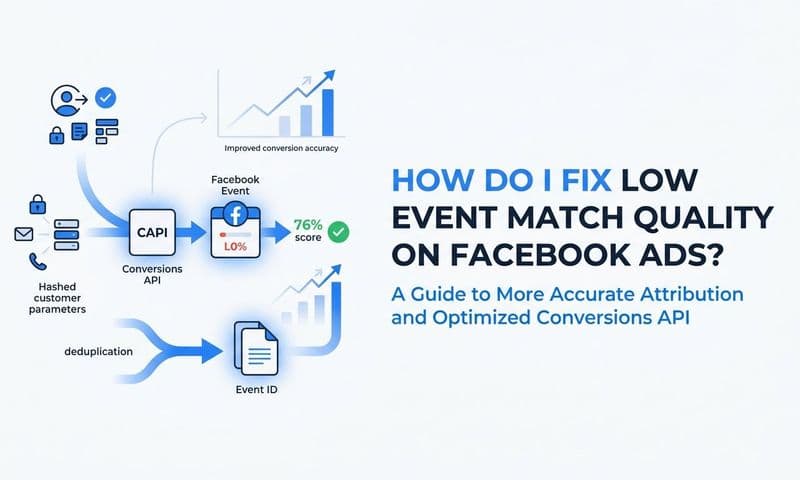
Running pixel and CAPI in parallel with deduplication: The recommended approach is to run both the browser pixel and CAPI simultaneously. The pixel captures events quickly and in real time. CAPI provides the reliable server-side signal. But running both creates a new risk: counting the same conversion twice. Meta uses event IDs to deduplicate events when the same conversion is reported by both the pixel and CAPI. To make this work correctly, you must pass a matching event ID with both the pixel event and the CAPI event. If deduplication is not configured properly, you'll end up with inflated conversion counts, which creates a different version of the same problem you were trying to solve. This step is not optional. It's a technical requirement, and getting it wrong is one of the most common implementation mistakes.
First-party data improves event match quality: One of the most significant advantages of CAPI is the ability to pass enriched, first-party customer data alongside your conversion events. This includes hashed email addresses, phone numbers, and customer IDs. Meta uses this information to match your conversion events to actual Meta user accounts, a process scored through the Event Match Quality (EMQ) metric in Events Manager. Higher match quality means Meta can attribute more conversions accurately, which improves the reliability of your reporting and strengthens the algorithm's ability to optimize toward real outcomes. As third-party cookies continue to decline in utility, first-party data becomes the most durable foundation for accurate attribution.
CAPI is not a complete solution on its own. It improves the signal you send to Meta, but it doesn't give you an independent view of performance that sits outside of Meta's reporting ecosystem. For that, you need to go further.
Beyond CAPI: Building a Complete Tracking Foundation
Fixing your signal to Meta is important. But it only addresses part of the problem. The larger issue is that Facebook's native reporting, even when CAPI is implemented correctly, still reflects a single-platform perspective on your customer journey. For B2B SaaS companies with complex, multi-touch buying cycles, that perspective is inherently incomplete.
Multi-touch attribution versus last-click: Facebook's native reporting defaults to attributing conversions to Facebook. That's not a conspiracy. It's simply how platform-native reporting works. Every ad platform has an incentive to show its own contribution in the best possible light. When you rely solely on Facebook's numbers, you get a Facebook-centric view of your marketing performance. Multi-touch attribution models distribute conversion credit across all the touchpoints that contributed to a conversion, including the first ad click, the email that re-engaged the prospect, the organic search that brought them back, and the retargeting ad that closed the deal. This gives you a far more accurate picture of the role Facebook actually plays in your pipeline, which may be more or less significant than the platform's native reporting suggests.
CRM and pipeline integration: For B2B SaaS companies, the conversion events that matter most don't happen on your website. They happen in your CRM. A demo request is a start. But what you really need to know is whether that demo request became a qualified opportunity, whether the opportunity became a closed deal, and what the contract value was. Native Facebook reporting can't tell you any of that. Connecting your ad data to CRM events, MQLs, SQLs, and closed-won deals, gives you a complete view of downstream ROI. You stop optimizing for form fills and start optimizing for revenue. That shift in measurement changes everything about how you allocate budget and evaluate channel performance.
Cross-channel data reconciliation: An independent attribution platform gives you a single source of truth that sits outside of any individual ad platform's reporting. When you compare Facebook's reported conversions against what your CRM shows and what your attribution platform records, discrepancies become visible. Those discrepancies are diagnostic. They tell you where over-attribution is occurring, where tracking gaps exist, and which channels are genuinely contributing to pipeline. Without this reconciliation layer, you're always relying on each platform to grade its own homework.
Signals That Your Facebook Tracking Is Currently Inaccurate
You don't need to audit your entire tracking setup to get an initial read on whether your data is reliable. There are a few specific signals that consistently indicate a tracking problem is already in progress.
Conversion volume discrepancies: The most direct signal is a significant gap between what Facebook reports and what your CRM or payment processor records. If Facebook says you generated 80 leads last month and your CRM shows 45, that's not a minor rounding difference. It's a tracking problem. This gap can be caused by view-through attribution inflation, duplicate pixel fires, or events being triggered on pages that users visit multiple times. Whichever the cause, a consistent discrepancy between platform-reported conversions and actual downstream records is a clear indication that your tracking setup needs attention.
Low Event Match Quality scores: Meta's Event Match Quality (EMQ) score in Events Manager rates how well the customer data you're sending with your conversion events matches actual Meta user accounts. Scores are rated on a scale from zero to ten. A low EMQ score means Meta is struggling to match your events to real users, which directly reduces attribution accuracy. If your score is low, it typically means you're not passing enough first-party identifiers with your events, or the identifiers you're passing aren't being hashed and formatted correctly. Checking your EMQ score is one of the fastest ways to assess the quality of your current tracking setup.
Unexplained ROAS swings: Sudden, significant changes in reported ROAS that don't correspond to any changes in your campaign settings, audience, creative, or budget are often a tracking symptom rather than a real performance shift. If your ROAS doubles overnight without any campaign changes, the most likely explanation is a tracking change, not a sudden improvement in ad performance. Similarly, a sharp drop in reported conversions following a website update often indicates that a pixel event stopped firing correctly. Treating these swings as tracking signals rather than performance signals is an important diagnostic habit.
Restoring Accuracy and Scaling With Confidence
Once you understand where your tracking is breaking down, the path to fixing it becomes clearer. The goal is not just to patch individual problems but to build a tracking infrastructure that is reliable, independent, and connected to real revenue outcomes.
Audit your current tracking setup: Start with Meta's Events Manager. Review the diagnostics tab for any flagged issues, check your EMQ scores for each event, and look for duplicate events or events firing at unexpected volumes. Verify that your CAPI implementation is sending events with matching event IDs to the pixel, and confirm that deduplication is working correctly. Cross-reference your reported conversion counts against your CRM records for the same time period. This comparison alone will tell you a great deal about the scale of your tracking gap.
Implement an independent attribution layer: This is where the approach shifts from reactive to strategic. An independent attribution platform, one that sits outside of any single ad platform's ecosystem, gives you a view of performance that isn't shaped by platform bias. For B2B SaaS teams, the most valuable version of this is a platform that tracks the full customer journey from the first ad click through to closed-won revenue. That means connecting your ad platforms, your website, and your CRM into a unified data model. Platforms like Cometly are built specifically for this use case, giving B2B SaaS marketers a complete, accurate view of what their Facebook ads are actually driving, not just what Facebook says they're driving.
Feed better data back to Facebook: Accurate tracking isn't just about better reporting. It also improves your ad performance. When you pass enriched, high-quality conversion signals back to Facebook through CAPI, including first-party identifiers and downstream revenue events, you improve the quality of the data Facebook's machine learning uses to optimize your campaigns. Better input data leads to better audience targeting, more accurate value optimization, and lower CPAs over time. The relationship between data quality and campaign performance is direct: the more accurate the signal you send, the smarter Facebook's algorithm becomes at finding the right people.
The Bottom Line on Facebook Ad Tracking
Inaccurate Facebook ad tracking is not a minor inconvenience you can work around with a gut feel and a rough ROAS target. It is a strategic liability that distorts every decision downstream, from budget allocation to creative testing to channel investment. And because the data still looks like data, it often goes undetected until real money has been misallocated.
The solution is not simply fixing the pixel. It's building a tracking infrastructure that is server-side, independent of any single platform's reporting, and connected to real revenue data in your CRM. That means implementing CAPI with proper deduplication, passing enriched first-party data to improve event match quality, and layering in a multi-touch attribution model that gives you a complete view of the customer journey.
For B2B SaaS teams, where the buying cycle is long, the audience is privacy-conscious, and a single deal can represent significant revenue, getting this right is not optional. It's the foundation that every other marketing decision rests on.
Cometly is built to give B2B SaaS marketers exactly this foundation. It connects your ad platforms, CRM, and website into a single source of truth, tracks every touchpoint from first click to closed-won revenue, and uses AI to surface the insights that drive smarter spending decisions. Get your free demo today and start capturing every touchpoint to maximize your conversions.