
When Apple rolled out iOS 14 and its App Tracking Transparency framework, it fundamentally changed how marketers track conversions and attribute ad spend. For B2B SaaS companies running paid campaigns on Meta, Google, and other platforms, the impact was immediate and lasting. Pixel-based tracking became unreliable. Attribution windows shortened. Reported conversions dropped. And the data your ad platforms used to optimize campaigns became incomplete at best, misleading at worst.
The problem is not just about missing data points. When your tracking is broken, your attribution is broken. You cannot confidently answer which campaigns are driving pipeline, which channels are generating qualified leads, or where to scale your ad spend. That uncertainty costs real money.
This guide walks you through the exact steps to address iOS 14 tracking issues head-on. You will learn how to audit your current tracking gaps, implement server-side tracking through Conversion APIs, configure your ad platforms correctly, and build an attribution setup that gives you reliable data regardless of what users have opted into.
These steps are designed for marketing teams and growth leaders who want to stop guessing and start making decisions backed by accurate, first-party data. Whether you are just starting to address this problem or looking to tighten up an existing setup, this guide gives you a clear, actionable path forward.
Step 1: Audit Your Current Tracking Gaps
Before you can fix anything, you need to understand exactly what is broken. Many teams skip this step and jump straight to implementation, which means they end up solving the wrong problems or missing the biggest gaps entirely. Start with a structured audit.
Pull your ad platform data against your CRM records. Export conversion data from Meta Ads Manager and Google Ads for the past 30 to 90 days, then compare those numbers against what your CRM shows for the same period. Look for discrepancies in lead volume, demo requests, and trial signups. A significant gap between what your ad platform reports and what your CRM captured is your first signal that tracking is incomplete.
Check your Meta Event Match Quality scores. Inside Meta Events Manager, each conversion event receives a match quality rating ranging from poor to excellent. This score reflects how effectively Meta can match a conversion event back to a specific user. Low scores indicate that iOS 14 opt-outs are meaningfully reducing your data quality. If your key events are scoring in the poor or fair range, your campaign optimization is already degraded.
Identify which events are most affected. Not all conversion events are equally impacted. Lower-funnel events like form submissions, demo requests, trial signups, and purchase confirmations tend to show the largest gaps because they happen later in the journey when users are more likely to have opted out or switched devices. Map out which specific events have the largest discrepancies between platform-reported data and your CRM records.
Document your current attribution window settings. After iOS 14, Meta changed the default attribution window from 28-day click to 7-day click. If you have not reviewed these settings since the update, you may be comparing current performance against historical benchmarks that used different windows, which distorts your analysis. Note the current settings across every active campaign and every platform you are running.
Quantify the gap in concrete terms. Put a number on it. If your CRM shows 80 qualified leads in a month but Meta reports 45 conversions, you have a 44 percent data gap. Knowing the scale of the problem helps you prioritize which steps in this guide to tackle first and gives you a baseline to measure improvement against.
By the end of this step, you should have a clear picture of how much conversion data you are losing, which events are most impacted, and what your current attribution window settings look like across platforms. That clarity drives every decision that follows.
Step 2: Set Up Server-Side Tracking with Conversion APIs
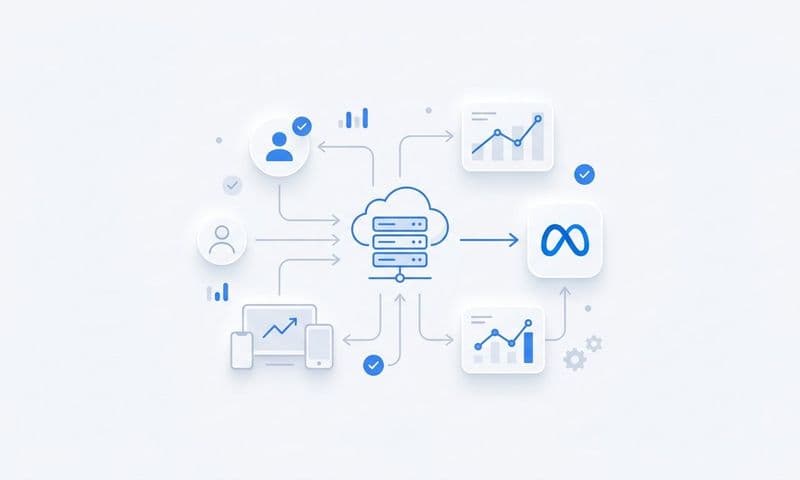
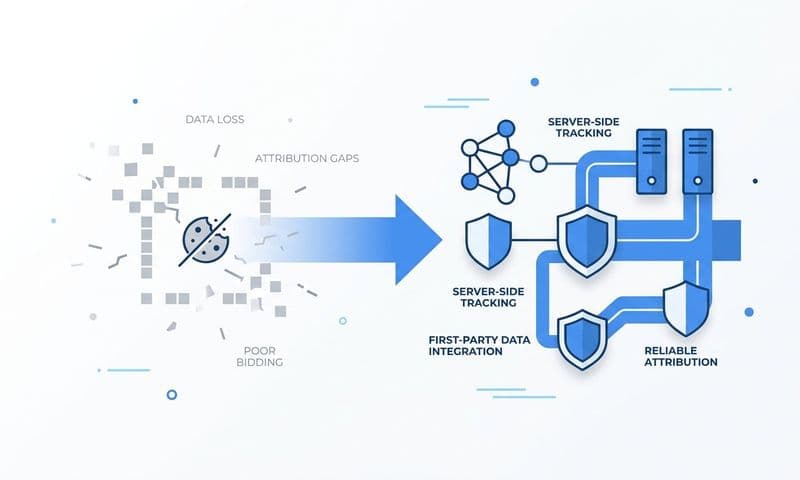
This is the most important technical step in fixing iOS 14 tracking issues. Server-side tracking fundamentally changes where conversion events originate. Instead of firing from a user's browser, where iOS privacy settings can block or limit tracking, events are sent directly from your server to the ad platform. iOS 14 opt-outs cannot interfere with that connection.
Implement the Meta Conversion API (CAPI). The Meta Conversion API sends conversion events server-to-server, bypassing the browser entirely. This restores visibility into actions that your browser pixel is missing due to opt-outs, ad blockers, and browser restrictions. You can implement CAPI directly through your server using Meta's API documentation, through a tag management system, or through a third-party integration platform. Prioritize your highest-value conversion events first: demo requests, trial signups, and qualified lead form submissions.
Set up Google Enhanced Conversions. For Google Ads, Enhanced Conversions works similarly to CAPI. It uses hashed first-party data, such as email addresses submitted through your lead forms, to match conversions back to Google users server-side. This supplements your standard Google Ads conversion tag and recovers conversion data that would otherwise be lost due to cookie restrictions. Implement it alongside your existing Google tag rather than replacing it.
Use first-party data to improve match rates. The quality of your server-side tracking depends heavily on the identifiers you send with each event. Hashed email addresses, phone numbers, and user IDs give the ad platform more data points to match a conversion back to a specific user. The more identifiers you include, the higher your event match quality score will be, and the better your campaigns will optimize.
Configure event deduplication carefully. When you run both a browser pixel and a server-side CAPI setup simultaneously, which is the recommended approach, the same conversion event can fire twice. Without deduplication, you will double-count conversions and distort your data in the opposite direction. Meta uses an event_id parameter to identify and remove duplicate events. Make sure every event fired by your pixel and your server-side setup shares the same unique event_id for the same user action.
Validate that events are appearing correctly. After implementation, check Meta Events Manager and your Google Ads conversion tracking dashboard to confirm that server-side events are registering. Look for an improvement in your event match quality scores within a few days of going live. If scores are not improving, review the identifiers you are sending and ensure your deduplication logic is functioning correctly.
A well-implemented server-side setup is the foundation that every other step in this guide builds on. Without it, you are still working with incomplete data no matter how well you configure everything else.
Step 3: Configure First-Party Data Collection on Your Website
Server-side tracking is only as good as the data you feed into it. This step is about ensuring that your website and conversion points are set up to capture rich, reliable first-party data that can be used to improve match rates and attribution accuracy.
Implement consistent UTM parameters across all paid campaigns. UTM parameters are the backbone of campaign attribution. When a user clicks an ad and lands on your site, the UTM data in the URL tells you exactly which campaign, ad set, and creative drove that visit. That data needs to be captured server-side at the moment of conversion so it travels with the event regardless of what happens in the browser. Audit every active campaign across Meta, Google, and LinkedIn to confirm UTM parameters are present and consistent. Inconsistent or missing UTMs create attribution blind spots that no amount of server-side tracking can fix.
Capture lead data at form submission and push it to your CRM immediately. When a user submits a form, that is your most reliable conversion signal. At the moment of submission, capture the email address, any other identifiers the user provides, and the UTM parameters from their session. Pass all of this to your CRM in real time. This creates a server-side record of the conversion event that is completely independent of browser tracking and gives you a ground-truth dataset to compare against your ad platform reporting.
Build a data enrichment layer for conversion events. Before sending a conversion event to Meta or Google via CAPI, enrich it with as many identifiers as possible. In addition to the email address, include the user's IP address, user agent, and any other first-party identifiers your system has. Each additional identifier increases the probability of a successful match, which directly improves your event match quality score and the accuracy of your campaign optimization.
Review your privacy policy and consent mechanisms. Using first-party data for tracking requires that your privacy practices are transparent and legally sound. Make sure your website clearly discloses how you collect and use data, and that your consent mechanisms align with the requirements in the markets where you operate. This is not just a legal consideration; it also affects the quality of data you can lawfully use for attribution purposes.
When your first-party data collection is set up correctly, your event match quality scores should reach the strong or excellent range in Meta Events Manager. That improvement translates directly into better campaign performance because the algorithm has more reliable data to optimize against.
Step 4: Reconfigure Attribution Windows and Campaign Settings
Even with server-side tracking in place, your campaign settings may still be working against you if they have not been updated to reflect the post-iOS 14 environment. This step ensures your ad platforms are configured to make the most of the data you are now collecting.
Review and update attribution window settings in Meta Ads Manager. The default attribution window in Meta shifted to 7-day click after iOS 14. If your campaigns were set up before that change, you may have inconsistent settings across your account. Go through your active campaigns and confirm that attribution windows are set deliberately and consistently. For most B2B SaaS companies, a 7-day click window is a reasonable starting point, but the right choice depends on your typical lead-to-conversion timeline.
Align attribution windows across platforms. Comparing Meta performance against Google performance is meaningless if each platform is using a different attribution window. Standardize your windows across platforms so you are looking at data on a consistent basis. This will not eliminate the inherent self-attribution bias each platform has, but it will at least put you on a level playing field when making cross-channel budget decisions.
Adjust campaign optimization settings to use high-volume server-side events. Ad platform algorithms need a minimum volume of conversion signals to optimize effectively. If you are optimizing toward a low-volume event like a closed-won deal, the algorithm may not have enough data to function well. Use the conversion events where you now have the strongest server-side data volume, typically demo requests or trial signups, as your primary optimization signal. You can still track downstream revenue through your attribution platform without making it the primary optimization event.
Re-evaluate automated bidding strategies. Many B2B SaaS teams saw their automated bidding strategies degrade after iOS 14 because the conversion signals feeding the algorithm became sparse and unreliable. Now that you have server-side data flowing, revisit your bidding approach. Target CPA and target ROAS strategies can perform well again when they have sufficient, high-quality conversion data to work with.
Avoid over-relying on view-through attribution. View-through attribution, which credits a conversion to an ad that was seen but not clicked, became more prominent in Meta's reporting post-iOS 14 as the platform used modeled data to fill gaps. For B2B SaaS companies, view-through attribution is often inflated and does not reflect genuine intent. Use it cautiously and cross-reference view-through attributed conversions against your CRM data to assess whether they represent real pipeline.
When your campaigns are optimizing toward events with strong server-side data and your attribution windows are aligned, your cost-per-result metrics should stabilize and your algorithm-driven campaigns should begin performing more consistently.
Step 5: Build a Unified Attribution Layer Outside the Ad Platforms
Here is an important truth about post-iOS 14 attribution: no individual ad platform will give you an accurate, unbiased view of cross-channel performance. Meta will credit Meta. Google will credit Google. Each platform uses its own attribution model, its own data, and its own interests when reporting results. The only way to get a real picture of what is driving pipeline and revenue is to build an attribution layer that sits outside those platforms entirely.
Implement a dedicated attribution platform. A purpose-built attribution platform connects your ad spend data, CRM records, and website events into a single source of truth. Unlike ad platform dashboards, a dedicated attribution tool is not incentivized to over-attribute conversions to any particular channel. It gives you a neutral, data-driven view of how your marketing investments are performing across the full customer journey.
Use multi-touch attribution models. Last-click attribution, which gives all credit to the final touchpoint before conversion, was already a flawed model before iOS 14. Post-iOS 14, it is even less reliable because the last click is often the one most affected by tracking gaps. Multi-touch attribution models distribute credit across all the touchpoints in a customer journey, giving you a more accurate picture of how different channels and campaigns contribute to pipeline. This matters especially for B2B SaaS companies where buyers interact with multiple ads and content pieces before converting.
Connect revenue data back to ad touchpoints. Form submissions and trial signups are leading indicators, but they are not revenue. For B2B SaaS teams, the most meaningful attribution metric is which campaigns and channels are generating closed-won revenue. Connect your Stripe data or CRM closed-won records back to the original ad touchpoints so you can measure true ROI rather than just cost-per-lead. This changes the conversation from "which campaign got the most form fills" to "which campaign drove the most pipeline and revenue."
Track the full customer journey from first click to closed revenue. A complete attribution picture starts at the first ad click and ends at closed-won revenue. Every touchpoint in between, including retargeting ads, email clicks, and organic visits, should be captured and attributed. This level of visibility is what allows you to make confident budget decisions based on actual business outcomes rather than platform-reported conversions that may or may not reflect reality.
Platforms like Cometly are built specifically for this use case. Cometly connects ad platform data, CRM records, and website events server-side, giving B2B SaaS teams accurate attribution that does not depend on browser-based pixel data. With Cometly, you can see exactly which campaigns are driving qualified pipeline and closed revenue, and use AI-driven recommendations to identify where to scale your ad spend with confidence.
The success indicator for this step is straightforward: you can answer, with confidence, which campaigns and channels are driving qualified pipeline and closed revenue. Not just what your ad platforms are telling you, but what your first-party data and CRM records confirm.
Step 6: Validate Your Setup and Monitor Data Quality Ongoing
Implementation is not the finish line. Tracking setups break. Platforms update their APIs. Campaigns get restructured. Without ongoing monitoring, a tracking gap can go undetected for weeks, quietly distorting your data and degrading your campaign performance. This final step builds the habits and systems that keep your tracking healthy over time.
Run a validation check after implementation. Once your server-side setup is live, compare your server-side event data against your CRM records for a defined period, ideally the most recent 30 days. The numbers will not match perfectly, but they should be directionally aligned. If your CAPI is reporting significantly more conversions than your CRM, you likely have a deduplication issue. If it is reporting significantly fewer, check your server-side implementation for gaps in event firing.
Monitor for deduplication issues actively. Double-counting is one of the most common problems in server-side tracking setups. If your conversion volumes look unusually high after implementation, investigate whether your pixel and server-side events are both firing for the same actions without proper deduplication. A sudden spike in reported conversions without a corresponding increase in CRM leads is a reliable warning sign.
Set up data quality alerts. Configure alerts that notify you if event volumes drop significantly below their normal range. A sudden drop in server-side event volume often means something broke in your implementation, whether it is a code change on your website, an API authentication issue, or a form that stopped firing correctly. Catching these breaks early prevents them from compounding into larger data quality problems.
Review event match quality scores weekly. In Meta Events Manager, check your match quality scores at least once a week. A decline in scores can indicate that the identifiers you are sending have changed, that your first-party data collection has broken somewhere, or that a platform update has affected how events are being processed. Treat declining match quality scores as an early warning system for tracking health.
Build a simple tracking health dashboard. Create a lightweight dashboard that surfaces your key data quality metrics in one place: server-side event volumes, event match quality scores, and a comparison of platform-reported conversions against CRM data. Review it monthly with your team to ensure everything stays aligned. This does not need to be complex; a shared spreadsheet or a simple report in your analytics platform is sufficient to start.
Putting It All Together
Fixing iOS 14 tracking issues is not a one-time task. It requires a combination of server-side infrastructure, first-party data practices, and an attribution layer that sits outside your ad platforms. When you follow these steps, you move from relying on browser-based pixel data that disappears when users opt out, to a server-side setup that captures conversion events reliably regardless of device or privacy settings.
The payoff is significant. You get cleaner data feeding back to your ad platform algorithms, which improves campaign optimization. You get accurate attribution that shows which channels and campaigns are actually driving pipeline and revenue. And you get the confidence to make budget decisions based on real numbers rather than incomplete platform-reported data.
Before you consider this done, run through this quick checklist:
Audit your tracking gaps: Quantify the discrepancy between platform-reported conversions and CRM records.
Implement CAPI and Google Enhanced Conversions: Set up server-side event tracking with proper deduplication.
Collect and use first-party data: Ensure UTM parameters, form data, and user identifiers are captured and enriched.
Align your attribution windows: Standardize settings across platforms and optimize toward high-volume server-side events.
Build a unified attribution layer: Connect ad spend, CRM data, and revenue into a single source of truth outside the ad platforms.
Set up ongoing data quality monitoring: Create alerts, review match quality scores regularly, and validate against CRM records monthly.
For B2B SaaS teams ready to take attribution beyond the basics, Cometly connects your ad platforms, CRM, and revenue data into one place so you can see exactly what is working and scale with confidence. Get your free demo today and start capturing every touchpoint to maximize your conversions.