You're running campaigns across Meta, Google, TikTok, and LinkedIn. Your CRM tracks leads and sales. Your website analytics shows traffic patterns. Each platform claims credit for the same conversion. Your CFO asks which channel actually drives revenue, and you're staring at five different dashboards with five different answers.
This isn't a data problem. It's a data integration problem.
Marketing data warehouse integration solves the fragmentation that plagues modern marketing teams. It brings scattered data from dozens of platforms into one unified source of truth, enabling accurate attribution, confident budget decisions, and the ability to actually answer the question: "Which campaign drove that sale?"
This guide breaks down what marketing data warehouse integration involves, why it's become essential for serious marketers, and how to approach it strategically without becoming a data engineer.
Why Your Marketing Data Lives in Silos (And Why That's Costing You)
The average marketing team today uses dozens of platforms. Ad accounts on Meta, Google, TikTok, and LinkedIn. A CRM like HubSpot or Salesforce. Website analytics through Google Analytics. Email platforms, customer data platforms, conversion tracking pixels, and more.
Each system stores data differently. Meta counts conversions using its attribution window. Google Ads uses a different one. Your CRM tracks leads by form submission timestamp. Your analytics platform groups sessions by first touch. None of them talk to each other natively.
The result? Attribution chaos.
A customer clicks a Facebook ad, visits your site, leaves, sees a Google retargeting ad, clicks through, browses again, then converts three days later after receiving an email. Facebook claims the conversion. Google claims the conversion. Your email platform claims the conversion. Your analytics shows organic search as the converting channel because that's how they returned.
Everyone's right from their limited perspective. No one has the complete picture.
This fragmentation creates real business consequences. You're making budget decisions based on incomplete data, potentially cutting spend on channels that actually contribute to conversions while scaling channels that just happen to get last-click credit. You're running reports that contradict each other, eroding confidence in your data across the organization.
Worse, you're likely double-counting conversions. When every platform claims credit for the same sale, your reported ROI looks artificially inflated until finance reconciles the numbers and questions why marketing's reported revenue doesn't match actual revenue.
The cost isn't just confusion. It's wasted ad spend on underperforming channels, missed opportunities to scale what genuinely works, and strategic decisions made on fundamentally flawed data. Understanding why marketing data accuracy matters for ROI reveals just how significant these hidden costs can be.
What Marketing Data Warehouse Integration Actually Means
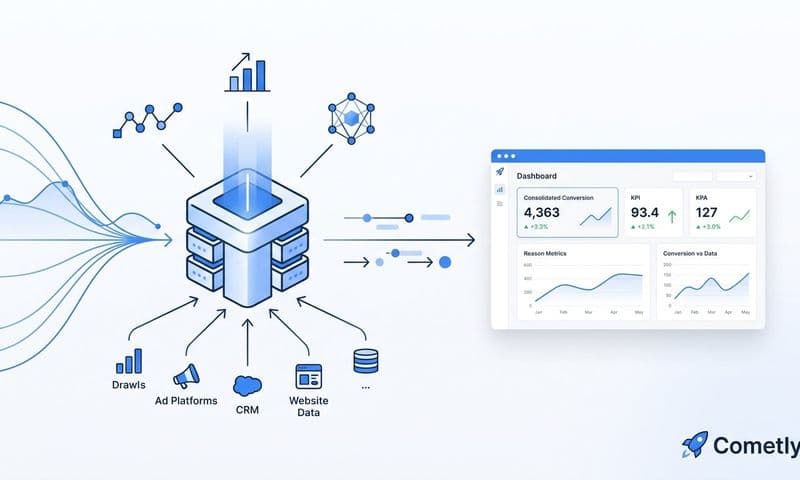
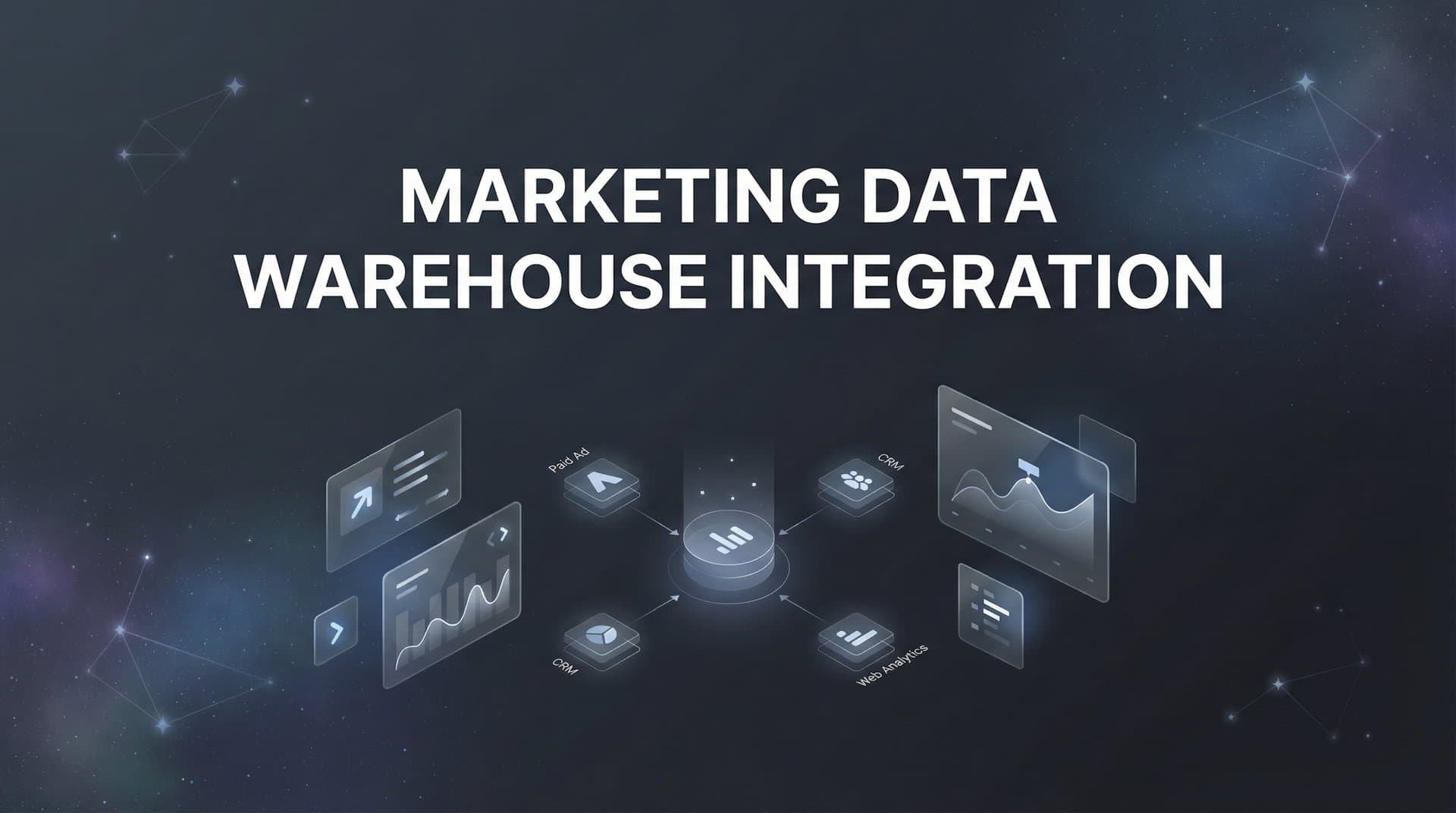
Marketing data warehouse integration is the process of connecting all your marketing platforms, CRM systems, and analytics tools to a central data repository where information can be unified, standardized, and analyzed together.
Think of it as creating a single source of truth for your marketing data.
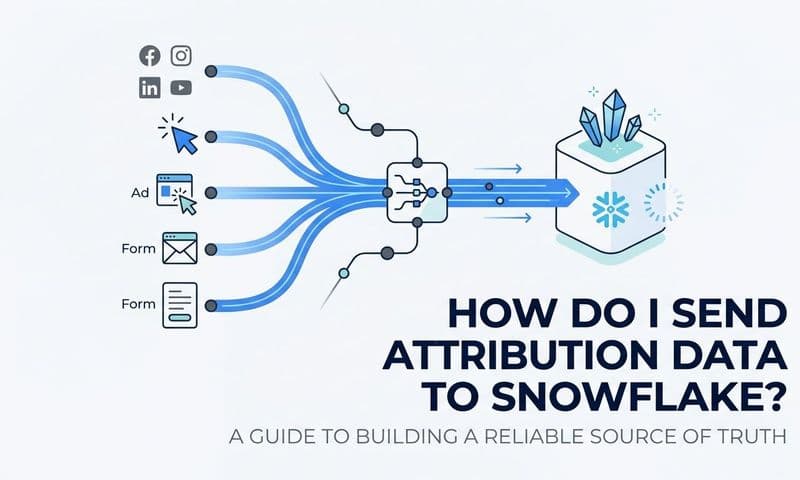
The technical process involves three core components. First, extraction: pulling data from each source platform through APIs or connectors. Second, transformation: standardizing different data formats into a consistent structure and resolving customer identities across platforms. Third, loading: moving that unified data into the warehouse where it can be queried and analyzed.
This is often called ETL (Extract, Transform, Load) or, increasingly, ELT (Extract, Load, Transform) when transformation happens inside the warehouse rather than before loading.
But here's what matters for marketers: integration isn't just about dumping data into a database.
Basic data aggregation might pull numbers from different platforms into a spreadsheet or dashboard. That's useful for reporting, but it doesn't solve the attribution problem because each row of data still represents a platform's isolated view of reality.
True integration goes deeper. It matches customer identities across platforms—recognizing that the person who clicked your Meta ad, visited from Google three days later, and converted after an email is the same individual. It maps the complete customer journey across every touchpoint. It resolves conflicts in how different platforms measure the same events.
This identity resolution is critical. Without it, you're just looking at siloed data in one place instead of many places. With it, you can see the actual path customers take from first awareness to final conversion.
Modern integration also enables reverse ETL—pushing enriched data back to operational tools. When your warehouse knows that a lead who clicked a TikTok ad later converted into a high-value customer through a different channel, you can feed that information back to TikTok's algorithm to find more similar prospects.
The goal isn't perfect data architecture for its own sake. It's actionable insights that help you confidently allocate budget, understand which creative actually resonates, and scale campaigns that genuinely drive revenue.
The Building Blocks of Effective Marketing Data Integration
Effective integration starts with identifying which data sources actually matter for your business decisions. Not every tool needs to be connected immediately—focus on the platforms that drive the majority of your spend and conversions. Learning how to connect all marketing data sources strategically prevents overwhelm while maximizing impact.
Core Ad Platforms: Start with wherever you're spending money. Meta Ads, Google Ads, TikTok Ads, LinkedIn Ads—these platforms generate the majority of paid traffic for most businesses. Integration needs to capture campaign structure, ad creative performance, spend data, and platform-reported conversions.
Website and App Analytics: Google Analytics or similar tools track how users behave on your properties. This data shows the full session context—pages visited, time on site, engagement patterns—that ad platforms can't see. Integration connects ad clicks to on-site behavior.
CRM and Sales Data: Platforms like Salesforce, HubSpot, or Pipedrive track leads and revenue. This is where conversions become actual business outcomes. Integration connects marketing touches to closed deals, enabling true revenue attribution rather than just lead attribution.
Offline Conversions: For businesses with phone sales, in-store purchases, or manual deal closures, offline conversion data completes the picture. Integration needs to match these conversions back to the original marketing touches that initiated the customer journey.
Beyond data sources, effective integration requires specific technical capabilities.
Real-time or near-real-time syncing matters for marketers who need to make fast optimization decisions. Batch processing that updates once daily might work for monthly reporting, but it's too slow for active campaign management. Modern integrations typically sync data every few minutes to hours.
Consistent customer identity matching is non-negotiable. The system needs to recognize when the same person interacts across platforms using different identifiers—email addresses, phone numbers, device IDs, cookies, or first-party identifiers. Without this, you're back to fragmented data that can't tell a complete story.
For the warehouse itself, most marketing teams choose from three main options. Snowflake offers powerful performance and flexibility, making it popular for teams with complex data needs and technical resources. Google BigQuery integrates naturally with Google's marketing tools and offers straightforward pricing for variable workloads. Amazon Redshift works well for teams already using AWS infrastructure.
The choice depends less on technical superiority—all three handle marketing data well—and more on your team's existing infrastructure, technical capabilities, and specific integration requirements. Exploring a marketing data warehouse solution that fits your stack can accelerate implementation significantly.
From Raw Data to Revenue Insights: Making Integration Work
Unified data transforms how marketers understand campaign performance. Instead of platform-specific metrics that tell partial stories, you can analyze the complete customer journey from first touch to revenue.
Multi-touch attribution becomes possible when all touchpoints live in one place. You can see that a customer first discovered you through a TikTok ad, returned via Google search, engaged with email content, and finally converted after clicking a retargeting ad. With this complete view, you can credit each touchpoint appropriately rather than giving 100% credit to whichever platform happened to get the last click.
Different attribution models—first touch, last touch, linear, time decay, position-based—can be applied to the same unified data set. This lets you understand how different channels contribute at different stages of the customer journey. You might discover that TikTok excels at awareness but rarely converts directly, while Google search captures high-intent prospects ready to buy.
These insights drive smarter budget allocation. Instead of cutting spend on TikTok because it shows poor last-click conversions, you recognize its role in initiating profitable customer journeys and adjust your expectations accordingly.
Integration also enables reverse ETL—feeding enriched conversion data back to ad platforms. When someone converts, your warehouse knows their complete journey including CRM data about deal size and customer quality. Sending this enriched information back to Meta or Google helps their algorithms understand what a valuable conversion actually looks like, improving targeting and bidding.
This is how platforms learn to find more of your best customers rather than just more conversions.
The real power shows up in dashboards that answer actual business questions. What's the true customer acquisition cost by channel when you account for multi-touch journeys? What's the real ROAS when you attribute revenue correctly instead of relying on platform-reported numbers? Which customer journey patterns lead to the highest lifetime value?
Unified data makes these questions answerable. You can segment by cohort, compare time periods accurately, and drill down into specific campaigns or creative variations with confidence that you're looking at complete, accurate information. A robust marketing data analytics platform turns these insights into actionable reports your entire team can use.
Common Integration Pitfalls and How to Avoid Them
Data quality issues derail more integration projects than technical complexity. The most sophisticated warehouse architecture can't fix fundamentally messy data. Understanding common marketing data integration challenges before you start helps you avoid the most expensive mistakes.
Inconsistent naming conventions create chaos when you try to analyze unified data. One campaign uses "Spring_Sale_2026" while another uses "spring-sale-2026" and a third uses "SpringSale2026". Your analysis treats these as three separate campaigns when they're the same initiative. Establish and enforce naming standards before integration, not after.
Missing UTM parameters leave gaps in attribution. If some campaigns lack proper tracking tags, you can't connect conversions back to their source. The integration works perfectly, but the data coming in is incomplete. Make UTM tagging mandatory and build validation into your campaign launch process.
Timezone mismatches cause reporting discrepancies. Your ad platform reports in Pacific time, your CRM in Eastern time, and your analytics in UTC. When you try to match events that happened "on the same day," you're comparing different 24-hour windows. Standardize everything to a single timezone in your warehouse.
Over-engineering is tempting but counterproductive. Teams sometimes try to integrate every possible data source from day one, building complex pipelines for platforms that contribute minimal value. This delays time to value and creates maintenance burden for low-impact data.
Start simple. Connect your highest-spend ad platforms and your CRM first. Get attribution working for those core sources. Prove value. Then expand incrementally to additional platforms based on actual business needs rather than theoretical completeness.
The maintenance reality surprises many teams. Integrations aren't "set it and forget it." Ad platforms update their APIs. Data schemas change. New campaign types get added. Tracking breaks and needs fixing.
Plan for ongoing management. Someone needs to monitor data quality, investigate discrepancies, and update integrations when platforms change. Implementing marketing data accuracy improvement methods as part of your workflow prevents small issues from becoming major problems. This might be a part-time responsibility for a marketing operations person or a full-time role for larger teams, but it's always necessary.
Choosing Your Integration Approach: Build, Buy, or Hybrid
Building custom integrations gives maximum flexibility but requires significant technical resources. Tools like Fivetran, Stitch, or Airbyte provide pre-built connectors for common marketing platforms, reducing development time. You can also write custom scripts using platform APIs for specialized needs.
This approach works well when you have in-house data engineering talent, unique integration requirements that off-the-shelf solutions don't address, or existing warehouse infrastructure you want to leverage. You control exactly how data flows and transforms.
The tradeoff is time and ongoing maintenance. Even with connector tools, you're responsible for configuring integrations, handling errors, updating when APIs change, and building the analysis layer on top of raw data. This can take months to set up properly and requires continuous technical oversight.
All-in-one attribution platforms handle integration automatically as part of their core functionality. These solutions connect to your marketing platforms, track customer journeys, resolve identities, and provide attribution analysis without requiring you to build data pipelines.
This approach delivers faster time to value. You're typically seeing unified attribution within days rather than months. The platform handles maintenance, API updates, and data quality monitoring. You get purpose-built marketing analytics rather than generic warehouse queries.
The tradeoff is less customization. You work within the platform's attribution models and reporting framework rather than building exactly what you want. For most marketing teams, this is actually an advantage—you get proven attribution methodologies rather than having to figure them out yourself.
Hybrid approaches combine elements of both. You might use an attribution platform for core ad platform integration and attribution analysis while also maintaining a warehouse for custom analysis or integration with internal systems. Some teams even explore a marketing data warehouse alternative that offers flexibility without the full infrastructure burden.
Evaluation criteria should focus on practical outcomes rather than technical elegance.
Team technical capacity matters most. If you have experienced data engineers and analysts, building custom integration might be viable. If your marketing team is focused on campaigns rather than data infrastructure, an all-in-one solution makes more sense.
Time to value affects business impact. Can you wait months to build custom integration, or do you need attribution insights this quarter to inform budget planning? Faster implementation often justifies higher tool costs through earlier optimization opportunities.
Total cost of ownership includes more than subscription fees. Custom integration requires engineering time for initial build, ongoing maintenance, troubleshooting, and updates. Calculate the fully-loaded cost of internal resources against tool pricing for accurate comparison.
Ongoing maintenance burden determines long-term sustainability. Who monitors data quality? Who fixes broken integrations when platforms update? Who builds new reports when business needs change? Following marketing data integration best practices from the start reduces these burdens significantly. Make sure you have realistic answers before committing to an approach.
Turning Data Integration Into Marketing Advantage
Marketing data warehouse integration isn't a technical project for its own sake. It's the foundation that enables confident, data-driven marketing strategies when you're managing campaigns across multiple platforms and need to understand what actually drives revenue.
The goal isn't perfect data architecture. It's actionable insights that help you allocate budget effectively, understand which creative resonates with valuable customers, and scale campaigns with confidence rather than guesswork.
Unified data eliminates attribution blind spots. You can see complete customer journeys instead of fragmented platform views. You can compare channel performance accurately instead of reconciling contradictory reports. You can feed better data back to ad platforms to improve their targeting algorithms.
The approach you choose—building custom integration, using specialized tools, or combining both—matters less than ensuring you actually get value from unified data. Start with core platforms that drive the majority of your spend and conversions. Prove value through better attribution and optimization decisions. Expand systematically based on business impact.
For teams that want attribution accuracy without becoming data engineers, platforms that handle integration complexity automatically offer the fastest path to value. Cometly connects ad platforms, CRM, and website data to track complete customer journeys from first touch to revenue. Server-side tracking captures accurate conversion data despite iOS privacy changes. Conversion sync feeds enriched data back to ad platforms to improve targeting. Multi-touch attribution shows exactly which channels contribute to revenue across the entire customer journey.
Ready to elevate your marketing game with precision and confidence? Discover how Cometly's AI-driven recommendations can transform your ad strategy—Get your free demo today and start capturing every touchpoint to maximize your conversions.