Your sales team is running outbound sequences. Reps are sending cold emails, making calls, and booking meetings through LinkedIn. Pipeline is being created. But when your board asks which outreach efforts are actually driving closed revenue, the room goes quiet.
This is the reality for most B2B SaaS teams. Outbound motions generate activity, and CRMs capture that activity, but the connection between a specific sequence, channel, or rep and a closed-won deal remains frustratingly opaque. Finance sees revenue. Sales sees logged calls. Marketing sees ad spend. Nobody sees the full picture.
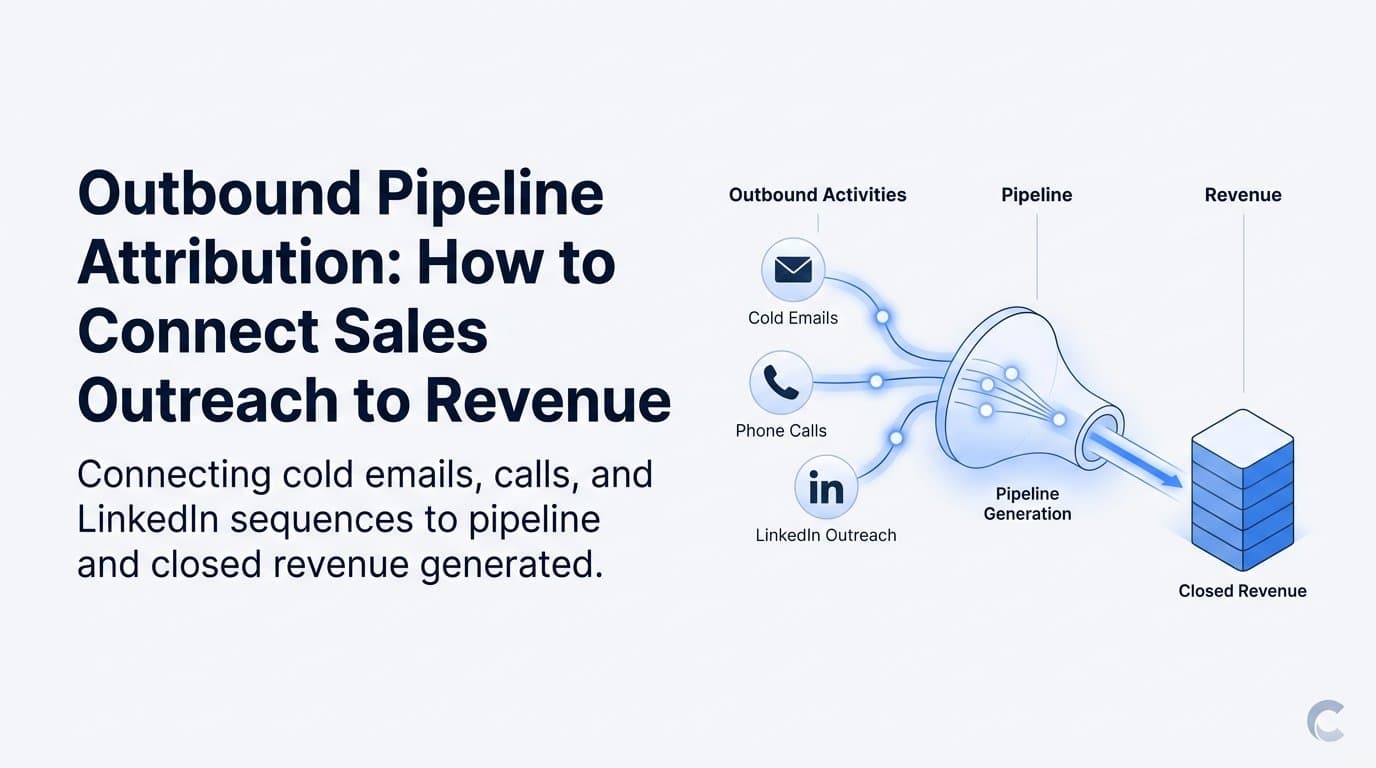
Outbound pipeline attribution is the discipline that closes this gap. It gives revenue operations leaders, demand generation managers, and growth-focused founders the ability to trace pipeline and closed revenue back to the specific outbound activities that initiated and influenced each deal. When done well, it transforms your outbound motion from a cost center with fuzzy ROI into a measurable growth engine with clear signal.
This article unpacks why outbound attribution is structurally harder than inbound, what it actually measures, which attribution models apply best to outbound motions, how to build the data foundation required, which metrics reveal true outbound performance, and how modern AI-powered platforms are making this discipline more accessible than ever.
The Outbound Attribution Problem Most B2B Teams Ignore
Inbound attribution is relatively straightforward. A prospect clicks an ad, lands on a page, fills out a form, and every step of that journey is recorded through cookies, UTM parameters, and session data. The tracking infrastructure does most of the work automatically.
Outbound works completely differently, and that difference creates a structural attribution problem that most teams never fully solve.
When a rep sends a cold email and the prospect replies to book a meeting, that interaction produces no cookie, no landing page visit, and no tracked URL by default. The meeting gets logged in the CRM. The opportunity gets created. But the attribution chain from that first email to the eventual closed deal exists only in the rep's memory and a few activity records, not in any system that can connect it to revenue outcomes at scale.
The gap between CRM activity data and actual revenue outcomes is where most outbound attribution breaks down. Reps log calls, emails, and LinkedIn touches as activities. But when finance runs a pipeline source report, they typically see categories like "outbound" or "SDR-generated" with no visibility into which sequences, messaging angles, or channels within that bucket are producing the best results. You know outbound is working in aggregate. You cannot tell what specifically is working.
This matters enormously when it comes to resource allocation. If cold email outperforms LinkedIn outreach by a wide margin for your specific ICP, but your data cannot surface that distinction, you are likely spreading effort and budget across channels based on intuition rather than evidence. The cost of that blind spot compounds over every planning cycle.
The problem becomes even more complex when you factor in the multi-touch reality of B2B SaaS deals. A single opportunity is rarely the product of one rep's efforts. An SDR might send the initial cold email sequence. An AE follows up with a personalized video. A marketing retargeting campaign reaches the prospect on LinkedIn. A colleague forwards a case study. A webinar seals the deal. Multiple team members, channels, and sequences all contribute to a single closed-won outcome.
Standard last-touch or first-touch attribution models applied to outbound will always tell an incomplete story in this environment. Multi-touch attribution that spans both the outbound prospecting phase and the inbound marketing touches that follow is the only way to accurately understand how pipeline gets created and closed.
Defining the Measurement Objects in Outbound Attribution
Before you can build an outbound attribution system, you need clarity on what you are actually measuring. The core measurement objects are outbound touchpoints mapped to pipeline stages and deal outcomes.
Outbound touchpoints include cold emails, phone calls, LinkedIn messages, direct mail, and any other proactive reach-out that a rep or automated sequence delivers to a prospect. Each touchpoint needs to be captured, timestamped, and linked to a contact and account record in your CRM so it can be connected to downstream pipeline and revenue events.
There is an important distinction between activity attribution and revenue attribution that many teams conflate. Activity attribution credits the rep or sequence that booked the meeting. Revenue attribution credits the full chain of touches that ultimately closed the deal. Both types of measurement serve different purposes.
Activity attribution answers operational questions: Which SDR is booking the most qualified meetings? Which email sequence has the highest reply rate? Which channel generates the most first conversations? These metrics help you manage day-to-day outbound performance.
Revenue attribution answers strategic questions: Which outbound sequences produce deals that actually close? Which channels generate pipeline that converts at the highest rate? Which combination of outbound and inbound touches correlates with the shortest sales cycles? These metrics inform budget allocation, headcount decisions, and go-to-market strategy.
Most teams are reasonably good at activity attribution. Revenue attribution is where the gaps appear, because it requires connecting outbound touchpoint data across the full customer journey, including the inbound marketing touches that often occur between the first outbound contact and the eventual close.
This brings up a critical nuance in outbound pipeline attribution as a broader discipline. Outbound-sourced opportunities rarely travel through the funnel in isolation. A prospect who receives a cold email will often research your company independently, encounter a retargeting ad, read a blog post, or attend a webinar before signing a contract. Attribution systems that only credit the first outbound touch ignore the marketing activity that nurtured the deal to close. Systems that only credit the last marketing touch before close ignore the outbound prospecting that initiated the relationship in the first place. Accurate outbound attribution requires a model that spans both worlds.
Attribution Models That Work for Outbound Motions
Not all attribution models are created equal when applied to outbound sequences, and choosing the wrong one can systematically distort how you allocate budget and headcount.
First-touch attribution credits the first recorded interaction with the prospect. In an outbound context, this typically means the first cold email or call gets full credit for any deal that eventually closes. The problem is that first-touch ignores everything that happened after that initial contact, including the marketing campaigns, nurture sequences, and sales conversations that moved the deal through the funnel. For outbound teams, first-touch tends to over-credit SDR prospecting activity and undervalue the marketing and AE work that followed.
Last-touch attribution has the opposite problem. It credits the final interaction before a deal closes, which in many B2B SaaS sales cycles is an AE-led activity like a contract review call or a final demo. This model ignores all the prospecting work that initiated the relationship and the marketing touches that nurtured the prospect along the way. Last-touch attribution makes outbound prospecting look less valuable than it actually is.
Linear attribution distributes credit equally across every recorded touchpoint in the customer journey. This is a significant improvement over single-touch models because it acknowledges that multiple interactions contribute to a closed deal. For outbound teams with clean, complete touchpoint data, linear attribution provides a more honest picture of how pipeline gets created. The limitation is that it treats every touch as equally valuable, which is rarely accurate in practice.
Time-decay attribution weights more recent touches more heavily, on the assumption that interactions closer to the close date had more influence on the buying decision. For some outbound motions, this is a reasonable approximation. But for deals where early prospecting did the heavy lifting of identifying and engaging the right prospect, time-decay can undervalue the outbound work that initiated the relationship.
Custom weighted models are often the most accurate option for mature outbound operations. These models assign credit based on the actual role each touchpoint type plays in your specific sales motion. If your data shows that the first cold email and the final demo call are the two highest-leverage interactions in your average deal, a custom model can weight those touchpoints accordingly while still distributing partial credit to the touches in between.
Data-driven attribution, which uses machine learning to assign credit based on observed patterns across many deals, is the most sophisticated option but requires significant deal volume and clean CRM data to produce statistically meaningful results. Smaller outbound teams are typically better served by a well-configured linear or custom weighted model than by attempting data-driven attribution with insufficient data.
Building the Data Foundation for Accurate Outbound Tracking
Attribution models are only as good as the data they run on. For outbound pipeline attribution, the data foundation requires specific integrations and tagging practices that many teams have not fully implemented.
The first requirement is a reliable connection between your sales engagement platform and your CRM. Tools like Outreach, Salesloft, and Apollo need to sync every touchpoint, including emails sent, calls logged, and LinkedIn messages recorded, to the corresponding contact and account record in your CRM. If this sync is incomplete or inconsistent, your attribution data will have gaps that make it impossible to trace deals back to their originating sequences.
The second requirement is connecting your CRM to your marketing platforms and ad networks. When an outbound-sourced contact later engages with a paid ad, attends a webinar, or visits your website, those interactions need to be linked to the same contact record so they can be included in a complete customer journey view. Without this connection, marketing and sales are each measuring their own contribution in isolation, and nobody can see how the two motions interact to produce revenue.
Server-side tracking and Conversion API integrations play an increasingly important role here. Many outbound-influenced conversions occur after a prospect has been contacted but before they complete a trackable digital action. When a prospect receives a cold email, does their own research, and then converts through a channel that does not pass standard cookie-based tracking signals, that conversion can be lost entirely from your attribution data. Server-side tracking captures these events at the server level rather than relying on browser-based cookies, improving the completeness of your conversion data significantly.
Conversion API integrations with platforms like Meta and Google allow you to send enriched, first-party conversion data directly from your CRM and server back to the ad platforms. This improves match rates and ensures that outbound-influenced conversions are properly attributed even when cookie tracking falls short.
UTM parameters, campaign tagging, and sequence-level identifiers are the final layer of the data foundation. Every outbound sequence should be tagged with consistent identifiers that allow you to trace which specific campaign or sequence a prospect was part of when they first engaged. When those prospects later click on a paid ad or visit your website, the UTM parameters on those downstream interactions can be linked back to the originating outbound sequence, giving you a complete view of the multi-touch journey.
Key Metrics That Reveal Outbound Pipeline Performance
Once your data foundation is in place, the metrics you track determine whether outbound attribution actually changes how decisions get made. There are four metrics that provide the clearest signal on outbound pipeline performance.
Outbound-sourced pipeline value is the total pipeline value where the first meaningful engagement was an outbound touch. This metric tells you how much of your current pipeline would not exist without your outbound motion. It is the primary indicator of whether your outbound investment is generating sufficient opportunity volume to justify its cost.
Outbound-influenced pipeline value is the total pipeline value where at least one outbound touch occurred, regardless of the original source. This metric captures deals that may have originated from inbound but were accelerated or re-engaged through outbound activity. It is typically larger than outbound-sourced pipeline and reflects the full breadth of outbound's contribution to revenue.
The distinction between sourced and influenced pipeline matters enormously for budget and headcount decisions. If you conflate the two, you will likely overstate outbound's role in deals that were primarily inbound-driven, which can lead to over-investing in outbound headcount at the expense of marketing programs that are doing more of the actual conversion work. Keeping these two metrics separate in your reporting is a discipline that pays dividends in planning accuracy.
Sequence-to-opportunity rate measures the percentage of outbound sequences that result in a qualified opportunity. This metric is your primary lever for evaluating the quality and efficiency of your outbound prospecting. A high sequence-to-opportunity rate indicates that your targeting, messaging, and timing are well-calibrated for your ICP. A low rate signals that something in the prospecting motion needs adjustment.
Outbound contribution to closed-won revenue is the share of total revenue attributable to outbound-originated or outbound-influenced deals. This is the metric that boards and CFOs care most about, because it connects outbound investment directly to the revenue line. When you can show that a specific percentage of closed-won revenue traces back to outbound activity, you have a defensible basis for outbound budget requests.
These metrics also enable channel-level decisions. When you can see that cold email outreach produces a higher sequence-to-opportunity rate than LinkedIn outreach for your specific ICP, or that paid retargeting of outbound prospects generates significantly better pipeline conversion than cold outreach alone, you can allocate resources accordingly rather than spreading effort evenly across channels based on assumption.
How AI and Modern Attribution Platforms Change the Game
The volume of touchpoint data generated by a modern outbound motion, across multiple reps, sequences, channels, and deal stages, quickly exceeds what human analysts can process manually. This is where AI-powered attribution platforms create a meaningful advantage.
AI can surface patterns across thousands of outbound touchpoints that would be invisible in a standard CRM report. Which sequence steps correlate with higher close rates? Which messaging angles produce opportunities that convert faster? Which combination of outbound channel and follow-up timing produces the best pipeline quality? These are questions that require pattern recognition across large datasets, and AI is well-suited to answer them at scale.
Beyond pattern recognition, AI-driven attribution platforms can generate recommendations that help marketing and sales teams act on their data rather than simply observe it. When the system identifies that a specific sequence type consistently produces deals with shorter sales cycles and higher average contract values, it can surface that insight as an actionable recommendation rather than burying it in a dashboard that nobody checks.
Platforms like Cometly connect ad spend, CRM events, and outbound activity into a single customer journey view, giving marketing and sales a shared source of truth. Instead of marketing measuring its contribution in one tool and sales measuring its contribution in another, both teams see the same unified timeline of every touchpoint from the first cold email to the closed-won event. This shared visibility reduces the attribution disputes that often create friction between marketing and sales, and it enables more collaborative decisions about where to invest.
One of the most powerful capabilities that modern platforms enable is the feedback loop between outbound attribution data and ad platform performance. When Cometly sends enriched conversion data back to Meta and Google via Conversion API, the ad platforms receive richer signals about which prospects actually converted into revenue, not just which ones clicked an ad or filled out a form. This allows the ad platforms' own AI to optimize targeting toward prospects who resemble your best outbound-converted customers, improving the quality of paid traffic over time.
The result is a compounding effect. Better outbound attribution data improves your paid media targeting. Better paid media targeting reaches prospects who are more likely to respond to outbound sequences. Better outbound sequences generate higher-quality pipeline. And higher-quality pipeline produces cleaner attribution data that further improves the system. Each component reinforces the others when the data connections are in place.
Putting Outbound Attribution Into Practice
The gap between understanding outbound pipeline attribution and implementing it is where most teams stall. The practical path forward starts with an honest audit of your current data connections.
Map out whether your sales engagement platform is syncing every touchpoint to your CRM consistently. Check whether your CRM is connected to your marketing platforms and ad networks in a way that enables unified contact records. Identify where conversion data is being lost due to cookie limitations or tracking gaps, and evaluate whether server-side tracking or Conversion API integrations would recover that signal.
Next, align on an attribution model with your sales and finance stakeholders before you build any reports. The model you choose will determine how credit is distributed, and different stakeholders will have different instincts about what is fair. Getting alignment upfront prevents the attribution disputes that undermine confidence in the data later.
Implement consistent tagging across all outbound sequences and campaigns so that every touchpoint carries identifiers that allow it to be traced through the full customer journey. Establish a reporting cadence that surfaces the key metrics on outbound-sourced pipeline, outbound-influenced pipeline, sequence-to-opportunity rate, and outbound contribution to closed-won revenue at a frequency that enables timely decisions.
Outbound attribution is not a one-time setup. It is an ongoing discipline that improves as data accumulates and models are refined based on what the data reveals. The teams that treat it as a continuous practice rather than a project will consistently outperform those that do not.
Cometly provides the infrastructure to make this discipline practical. By unifying outbound and inbound attribution into a single dashboard, connecting ad spend to CRM events, and enabling enriched conversion data to flow back to ad platforms, Cometly gives revenue operations and marketing teams the clear, actionable visibility they need to invest confidently in what works. Get your free demo and start connecting every outbound and inbound touchpoint to the revenue it actually drives.