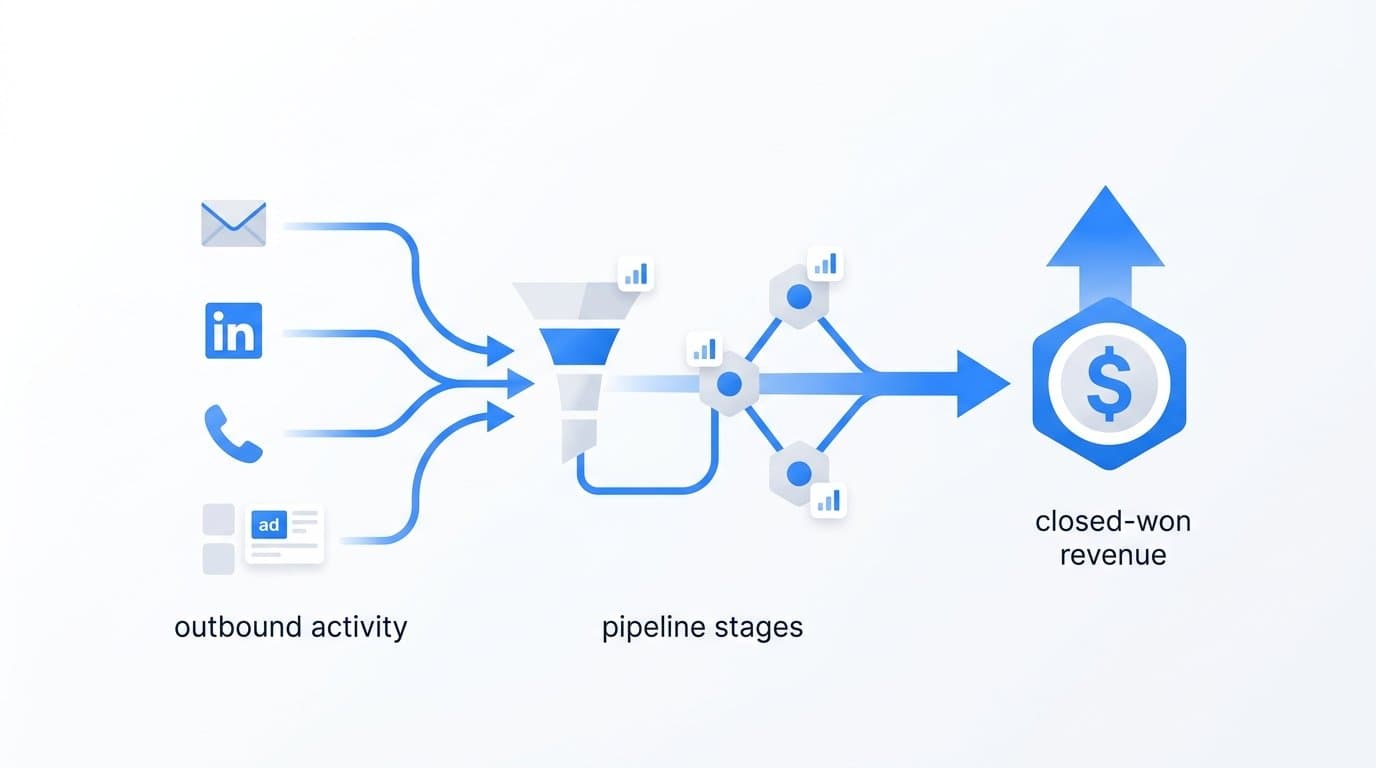
Every B2B SaaS revenue leader has been in this meeting. The outbound team is booking demos, pipeline is growing, and the board wants to know what's working. But when someone asks which sequences, channels, or reps are actually driving closed revenue, the room goes quiet. The data exists in fragments: call logs here, email open rates there, CRM notes that vary by rep. No one can draw a clean line from outbound activity to revenue outcome.
This is the problem that outbound revenue attribution is designed to solve. It is the discipline of connecting proactive sales outreach, cold email, LinkedIn prospecting, cold calling, and paid prospecting, to pipeline stages and ultimately to closed-won revenue. Done well, it gives marketing and sales teams a shared language for what is working and the evidence to back up every budget conversation.
This article breaks down how outbound revenue attribution works, which models apply to outbound motions, how paid channels fit into the picture, and what it takes to build a system that actually produces reliable data. If you are trying to scale what works in your outbound motion without guessing, this is where to start.
The Attribution Gap That Costs Outbound Teams Their Budget
Outbound revenue attribution is the practice of connecting proactive outreach activities to pipeline stages and closed-won revenue. That definition sounds straightforward, but the execution is structurally harder than almost any other attribution challenge in B2B SaaS.
Here is why. Inbound attribution has a natural tracking anchor: the click. When a prospect clicks a paid ad, visits your website, and fills out a form, every major analytics platform captures that journey. Cookies fire, UTM parameters populate, and the CRM records a source. The path from ad spend to opportunity is visible.
Outbound does not work this way. When a sales rep sends a cold email, no pixel fires. When a prospect reads that email and saves your company name to research later, there is no trackable event. When they eventually respond to a follow-up three weeks later, the CRM might log a reply, but the attribution chain is already fragmented. The first touch happened in an inbox, not on a tracked webpage.
This structural invisibility creates a real business problem. Marketing and finance teams allocate budget based on what they can measure. When inbound channels produce clean attribution data and outbound produces ambiguity, budget naturally flows toward inbound. Not because inbound is performing better, but because it is easier to defend in a spreadsheet.
The consequence is that outbound teams often operate without the budget, headcount, or tooling they need, even when their sequences are generating significant revenue. The reps know it. The sales leader knows it. But without attribution data to prove it, the argument does not hold up in a budget review.
This gap also creates friction between marketing and sales. Marketing teams point to MQL volume and paid channel ROAS. Sales teams point to booked demos and pipeline generated. Neither team has a complete view of how their activities combine to produce revenue. The result is internal competition for credit rather than collaboration on what actually moves the number.
Closing this gap requires more than better CRM hygiene, though that matters. It requires an attribution framework that accounts for the specific ways outbound touches occur: across email inboxes, phone calls, LinkedIn messages, and ad impressions, none of which naturally connect to each other without intentional system design.
The teams that solve this problem gain a genuine competitive advantage. They can scale sequences that work, cut the ones that do not, and bring hard evidence to every budget conversation. The teams that do not solve it keep guessing, and eventually, the budget follows the data somewhere else.
How Outbound Revenue Attribution Actually Works
The core mechanics of outbound revenue attribution come down to one goal: creating a unified record of every interaction a prospect had with your company before they became a customer, regardless of whether that interaction happened in an inbox, on a call, or through an ad.
The foundation is the CRM. Every outbound touch, every email sent, every call logged, every LinkedIn message recorded, needs to be captured in the CRM against the correct contact and account record. This sounds obvious, but most CRMs are inconsistent in how reps log activity. Without consistent source fields and activity types, attribution models have nothing reliable to work with.
The next layer is link tracking. When outbound sequences include links, whether to a landing page, a booking tool, or a case study, those links should carry UTM parameters that identify the source, medium, and campaign. This creates a bridge between the outbound email and any web-based behavior that follows. If a prospect clicks a link in a cold email and later books a demo, the UTM data connects those two events.
First-party data plays a critical role here. Rather than relying on third-party cookies, which are increasingly unreliable, outbound attribution systems use server-side data from your CRM and booking tools to establish the sequence of events. When a prospect who was in an email sequence books a call, that booking event can be matched back to the sequence record in the CRM using the prospect's email address or account ID.
Multi-touch attribution becomes essential when you map out how B2B deals actually close. Consider a realistic outbound journey: a prospect receives a cold email on day one, ignores it. They receive a follow-up on day five, still no reply. On day eight, they see a LinkedIn retargeting ad for your product. On day twelve, a personalized email lands and they finally respond. On day twenty, they attend a webinar and book a demo.
That journey involves at least five distinct touchpoints across three different channels. A single-touch attribution model would credit either the first cold email or the demo booking page, missing everything in between. Multi-touch attribution distributes credit across all of those interactions, giving you a more accurate picture of what combination of touches actually moved the deal forward.
In practice, this requires your attribution platform to ingest data from multiple sources simultaneously: your sales engagement tool, your CRM, your ad platforms, and your website. When those data streams are unified against a single contact or account record, you can see the full sequence of events that preceded a closed deal. That is when outbound revenue attribution starts producing decisions rather than just reports.
Attribution Models That Apply to Outbound Motions
Not all attribution models are equally useful for outbound-heavy B2B SaaS teams. Understanding how each model handles outbound touches helps you choose the right framework for your motion.
First-Touch Attribution: This model credits the first recorded interaction with the prospect. In an outbound context, that is often the first cold email or call. First-touch is useful for understanding which sequences or rep behaviors are opening new relationships, but it ignores everything that happened afterward. A deal that took six months and twenty touchpoints to close gets fully credited to the first email, which distorts your understanding of what actually drove the outcome.
Last-Touch Attribution: This model credits the final interaction before conversion. In outbound motions, the last touch is frequently a marketing asset: a demo booking page, a webinar registration, or a case study. This creates a misleading picture where marketing gets credit for deals that outbound sequences spent weeks developing. Sales teams understandably push back on this model because it systematically undercounts their contribution.
Linear Attribution: This model distributes equal credit across every recorded touchpoint. It is more balanced than single-touch models and works reasonably well for shorter outbound cycles. The limitation is that it treats every touch as equally important, which rarely reflects reality. The email that got a response is not equivalent to the fifth follow-up that went unread.
Time-Decay Attribution: This model gives more credit to touchpoints that occurred closer to the conversion event. For outbound motions with long sales cycles, this can be useful because it emphasizes the interactions that ultimately pushed the deal across the line. The tradeoff is that early-stage outbound touches that opened the relationship get undervalued.
Data-Driven Attribution: This is the most accurate model for complex B2B outbound motions. Rather than applying arbitrary rules, data-driven attribution analyzes your actual conversion patterns and assigns credit to touchpoints based on how much each one statistically contributed to closed revenue. It learns from your data, which means it improves over time as more deals close.
Account-level attribution deserves special attention in outbound contexts. B2B buying decisions rarely involve a single contact. A cold email might go to a manager, while a LinkedIn ad reaches a director, and a webinar registration comes from the VP. All three are at the same company. Contact-level attribution treats these as separate journeys, missing the fact that the account was engaged across multiple channels simultaneously. Account-level attribution aggregates all of these touches into a single company-level view, which reflects how B2B deals actually close.
The Role of Paid Channels in Outbound Attribution
Paid advertising and outbound sequences are increasingly inseparable in modern B2B SaaS go-to-market strategies. Understanding how they interact is essential for accurate outbound revenue attribution.
Here is a common pattern. A prospect enters a cold email sequence on Monday. They do not respond. By Wednesday, they are browsing LinkedIn and see a sponsored post from your company. On Friday, they visit your website through a Google search. The following week, they receive another email from the rep and finally book a call. Which channel gets credit for this conversion?
In a siloed attribution system, the answer depends entirely on which tool you look at. Your ad platform reports a view-through conversion. Your CRM credits the outbound sequence. Your website analytics might show an organic search conversion. Each system is telling a partial truth, and none of them are telling the whole story.
This is where server-side tracking and Conversion API integrations become critical. Browser-based tracking misses a significant portion of ad interactions, particularly view-through events where a prospect sees an ad but does not click it. Server-side tracking captures conversion events directly from your server rather than relying on browser cookies, which means it records what actually happened rather than what the browser was able to track.
Conversion API integrations, available through platforms like Meta and Google, allow you to send conversion data directly from your CRM or attribution platform back to the ad network. When a prospect who saw a LinkedIn ad later converts through an outbound sequence, that conversion signal can be sent back to LinkedIn with the account-level data attached. This improves the ad platform's ability to optimize for similar accounts, which makes your prospecting campaigns more efficient over time.
Connecting ad spend data to CRM pipeline and revenue data is what makes this actionable. When you can see that prospects who received both a cold email sequence and a retargeting ad converted at a meaningfully higher rate than those who received only the email, you have a data-backed reason to run both in parallel. You can calculate the actual cost contribution of the paid channel to outbound-sourced revenue, which justifies the spend in terms leadership understands.
This blended outbound-inbound journey is increasingly the norm rather than the exception. Attribution systems that treat paid and outbound as separate silos will consistently misread which activities are driving revenue. The ones that unify these data streams give teams the full picture they need to make confident decisions.
Building an Outbound Attribution System: What You Need
Building a reliable outbound attribution system is not primarily a technology problem. It is a data architecture problem. The technology only works if the underlying data is clean, consistent, and connected. Here is what that requires in practice.
A CRM That Logs All Outbound Activity: Every email sent, call made, and LinkedIn message recorded needs to be captured in the CRM with consistent source fields. This means defining a standard taxonomy for outbound activity types and enforcing it across the sales team. If some reps log activity under "Cold Email" and others use "Outbound Email" or leave it blank, your attribution model cannot distinguish between outbound-sourced and inbound-sourced pipeline. Consistency here is non-negotiable.
UTM-Consistent Tracking for Sequence Links: Any link included in an outbound sequence should carry UTM parameters that identify the source as outbound and the campaign as the specific sequence name. This creates a trackable connection between the email and any downstream web behavior. When a prospect clicks a link and books a demo, the UTM data tells your attribution platform that this conversion originated from an outbound sequence rather than an organic search or a paid ad.
An Attribution Platform That Connects CRM and Ad Data: This is where the three data layers come together. Your attribution platform needs to ingest CRM activity data, ad platform impression and click data, and revenue data from your CRM or billing system. When these sources are unified at the account level, you can trace a closed deal back to the specific sequence, ad interaction, and rep behavior that contributed to it.
Defining what counts as an outbound-sourced opportunity is a critical step that many teams skip. Is an opportunity outbound-sourced if the first touch was a cold email? What if the prospect had visited the website before the rep reached out? What if marketing ran a paid campaign to the same account simultaneously? Your CRM and attribution tool need consistent rules that answer these questions, because without them, every revenue review becomes a debate about definitions rather than a conversation about what to do next.
Pipeline attribution and revenue attribution serve different purposes and both are necessary. Pipeline attribution shows which outbound activities create opportunities: which sequences are generating meetings, which rep behaviors are converting cold contacts into active deals. Revenue attribution shows which activities close deals: which sequences are associated with accounts that actually pay, which channels contribute to the touches that precede a signature. Teams that only track pipeline often optimize for meeting volume without realizing that certain sequences produce meetings but not revenue. Teams that only track revenue miss the early-stage signals that predict which pipeline will close. You need both layers to make complete decisions.
From Attribution Data to Outbound Decisions
Attribution data is only valuable if it changes decisions. The most important thing outbound revenue attribution data tells you is what to scale, what to cut, and where to invest next.
At the sequence level, attribution data reveals which email sequences are associated with closed revenue versus which ones generate meetings that stall. If one sequence consistently appears in the attribution chain of closed-won deals and another generates the same number of meetings but rarely appears in closed revenue, that is a clear signal about where to invest rep time and sequence development effort.
At the channel level, attribution data shows whether cold email alone is sufficient or whether sequences that run alongside paid retargeting produce materially better outcomes. This is the kind of insight that justifies paid prospecting budgets in terms that both marketing and sales leadership can agree on. Instead of debating whether LinkedIn ads are worth the spend, you can show the revenue contribution of accounts that were touched by both the outbound sequence and the paid campaign.
At the rep level, attribution data connects individual behaviors to revenue outcomes. Which reps are generating pipeline that closes? Which ones are booking meetings with accounts that consistently stall at the same stage? This is not about surveillance; it is about identifying the patterns that work and replicating them across the team. When you know which rep behaviors are associated with closed revenue, you can build those behaviors into training and sequencing frameworks.
Marketing teams use outbound attribution data to improve paid ad targeting in a specific and powerful way. When you know which outbound-sourced accounts converted to customers, you can build look-alike audiences in Meta and Google based on those accounts' firmographic characteristics. You are not targeting based on general ICP assumptions; you are targeting based on accounts that your attribution data has confirmed actually buy. This feeds better conversion signals back to the ad platforms, which improves their optimization algorithms and makes your prospecting campaigns more efficient over time.
Budget conversations change completely when attribution data is in the room. When a revenue leader can show that a specific outbound motion, running alongside a specific paid campaign, produced a measurable amount of closed revenue at a defined cost, the budget discussion shifts from opinion to evidence. Headcount requests, tool investments, and ad spend decisions all become easier to defend and easier to approve.
Putting It All Together
Outbound revenue attribution is not about achieving perfect measurement. It is about getting directionally accurate data that consistently improves the decisions your team makes. Every organization will have gaps in their tracking, reps who occasionally miss a log entry, or ad interactions that go uncaptured. The goal is a system that captures enough of the picture to see what is working with confidence.
The three principles that matter most are a unified data layer, consistent CRM hygiene, and an attribution platform that bridges ad data with sales activity. When these three elements are in place, the signal-to-noise ratio improves substantially. You stop debating which team deserves credit for pipeline and start having conversations about which combinations of activity produce the best revenue outcomes.
Outbound revenue attribution also improves over time. As more deals close and more data flows through your attribution system, the patterns become clearer. Data-driven models get more accurate. Look-alike audiences get more refined. The conversations between marketing and sales get more productive because both teams are looking at the same numbers.
For B2B SaaS teams that want to connect every ad touch, CRM event, and revenue outcome into a single source of truth, Cometly is built for exactly this. It ingests data from your ad platforms, CRM, and website, unifies it at the account level, and gives you the attribution clarity to see which outbound activities and paid channels are actually driving revenue. You can compare attribution models, analyze the full customer journey, and send enriched conversion signals back to Meta and Google to improve your prospecting targeting.
If your outbound team is generating pipeline but you cannot prove which activities are closing deals, that is the gap Cometly closes. Get your free demo today and start connecting every touchpoint to the revenue outcomes that actually matter.