Your sales team sends hundreds of cold emails every month. Your SDRs are working LinkedIn sequences, making calls, and logging follow-ups. Your paid team is running targeted prospecting campaigns against named account lists. And yet, when a prospect finally books a demo, your attribution model gives all the credit to the Google ad they clicked on their way to the landing page.
This is the outbound attribution blind spot, and it's costing B2B SaaS teams real money. When you can't see how outbound interactions contribute to pipeline and revenue, you make budget decisions based on a distorted version of reality. Inbound channels look like heroes. Outbound efforts look like overhead.
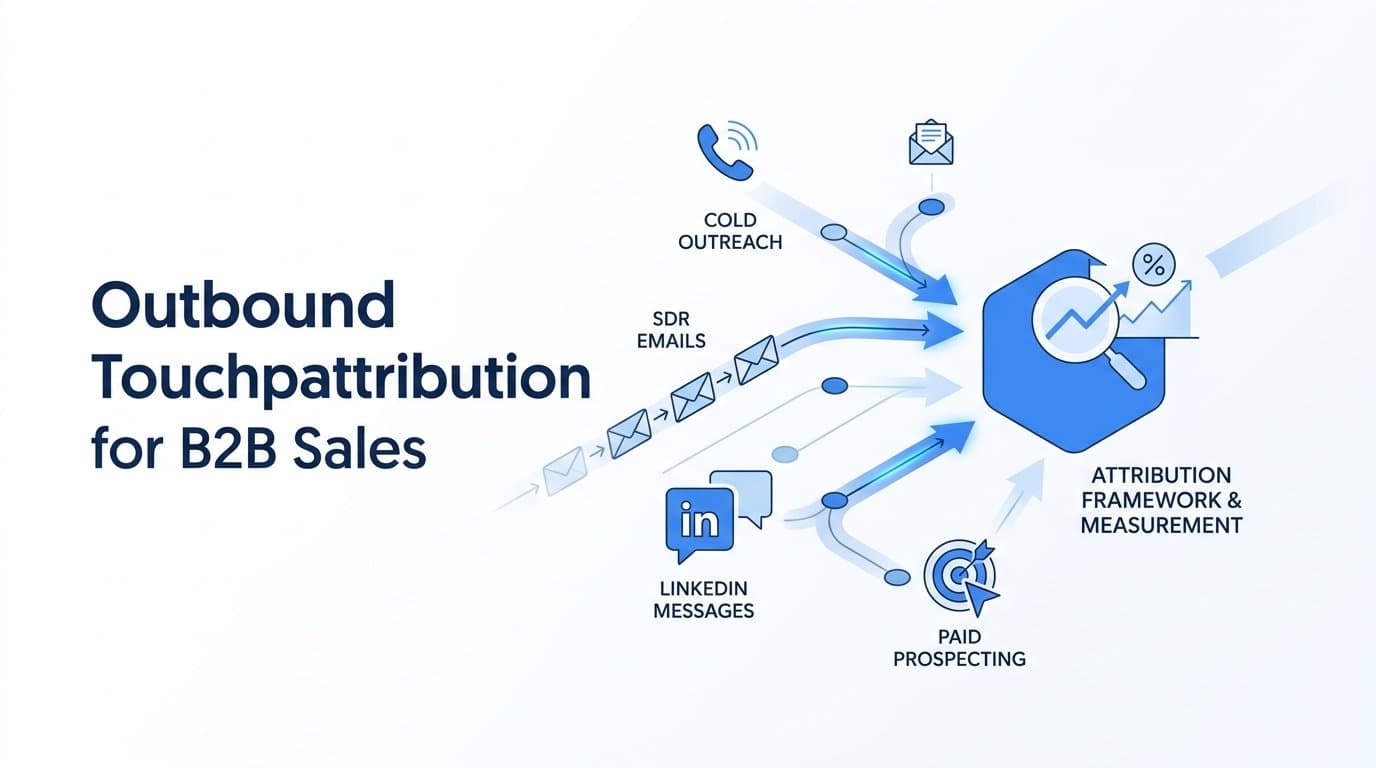
Outbound touchpoint attribution fixes this. It brings your cold outreach, SDR sequences, LinkedIn messages, and paid prospecting into the same attribution framework as your inbound channels, so you can finally see the full picture of what's actually driving revenue. This article breaks down what outbound touchpoint attribution means, how to implement it, and how to use it to make smarter decisions across marketing and sales.
The Hidden Gap in Most B2B Attribution Setups
Most marketing attribution tools were built for inbound behavior. They're designed to track what happens after someone arrives on your website: which ad they clicked, which page they landed on, which form they filled out. That's a reasonable starting point for consumer marketing, where the customer journey is often short and self-directed.
In B2B SaaS, it's a fundamentally incomplete picture.
Consider a typical enterprise prospect journey. A sales development rep finds the account on a target list and sends a cold email. No response. Three days later, the SDR connects on LinkedIn and sends a message. The prospect sees a LinkedIn Sponsored InMail the following week. Then a display ad. Then another email from the sequence. Finally, six weeks after the first touch, the prospect clicks a Google search ad and books a demo.
What does a standard attribution model see? A Google click and a form fill. Everything that happened before that moment is invisible.
This creates a compounding problem. When marketing teams review channel performance, inbound sources appear to generate most of the pipeline because those are the only touchpoints being measured. Outbound efforts, which often do the heavy lifting of warming up cold accounts, get no credit. Over time, budget flows toward the channels that look productive on paper, and outbound programs get underfunded or cut entirely, even when they're actually driving significant pipeline influence.
The issue isn't that outbound doesn't work. The issue is that the data infrastructure to prove its value usually doesn't exist. Sales engagement platforms capture email open rates and call logs. CRMs store activity notes. Ad platforms track impressions and clicks. But none of these systems talk to each other in a way that produces a unified view of the customer journey.
Without outbound data in your attribution model, marketing and sales leaders are making high-stakes budget decisions based on a partial dataset. The result is a systematic bias toward inbound channels that can skew strategy, misalign teams, and leave significant revenue-generating activity unmeasured and undervalued.
Closing this gap starts with understanding what outbound touchpoint attribution actually involves and how it fits into a broader multi-touch framework.
Defining Outbound Touchpoint Attribution
Outbound touchpoint attribution is the practice of assigning credit to proactive sales and marketing interactions within a broader multi-touch attribution model. Where inbound attribution tracks prospect-initiated contact, outbound attribution tracks team-initiated contact: the cold email your SDR sent, the LinkedIn message your AE wrote, the display ad your paid team served to a named account list.
A touchpoint in this context is any intentional interaction your team initiates that influences a prospect's journey toward becoming a customer. The key word is "intentional." Outbound touchpoints are deliberate acts of outreach, not passive content that a prospect discovers on their own. They represent your team actively working to bring a prospect into the funnel rather than waiting for the prospect to arrive.
What makes outbound attribution challenging is the data fragmentation involved. Inbound attribution is relatively straightforward because web analytics tools can track clicks and sessions automatically. Outbound attribution requires pulling data from multiple sources: CRM activity logs, sales engagement platform events, ad platform impression data, and sometimes offline records like event attendance or direct mail delivery confirmation.
Effective outbound attribution connects all of this into a unified customer journey timeline. When a contact in your CRM receives a cold email, that event gets recorded as a touchpoint. When the same contact sees a LinkedIn ad, that impression gets recorded. When they attend a webinar your team invited them to, that gets recorded. And when they eventually submit a demo request, all of those prior touchpoints are visible in the attribution model alongside the final inbound action.
The result is a complete picture of the customer journey rather than a partial one that only starts when the prospect shows up on your website. This matters because the credit assigned to each touchpoint directly influences how you allocate budget, how you structure outbound sequences, and how you evaluate the ROI of your sales development function.
Think of it like this: if you were trying to understand why a deal closed, you wouldn't ignore everything that happened before the prospect visited your pricing page. Outbound touchpoint attribution ensures your data model reflects that same logic.
Types of Outbound Touchpoints Worth Tracking
Not all outbound interactions are created equal, and different types of touchpoints require different tracking approaches. Understanding the categories helps you build a framework that captures the full range of outbound activity your team generates.
Direct outreach touchpoints are the most common and the most frequently untracked. These include cold emails sent through a sales engagement platform, LinkedIn connection requests and follow-up messages, phone calls, and voicemails. When SDRs and AEs log these activities consistently in your CRM, they become attributable touchpoints. The challenge is consistency: if some reps log every call and others log nothing, your attribution data becomes unreliable.
Paid outbound touchpoints sit at the intersection of your marketing and sales motions. LinkedIn Sponsored InMail campaigns sent to targeted prospect lists, programmatic display ads served to named accounts, and retargeting campaigns built around contact lists your team assembled proactively all qualify as outbound because your team is initiating the exposure rather than waiting for organic discovery. These touchpoints are often easier to track than direct outreach because ad platforms generate impression and click data automatically.
Offline and hybrid touchpoints are the most complex to capture but often among the most influential. Event follow-up emails sent to contacts your team met at a conference, webinar invitations sent to a curated prospect list, and direct mail sequences sent to target accounts all represent intentional outbound interactions that can influence a prospect's decision to engage. Tracking these requires connecting your marketing automation platform and event management tools to your CRM so that the activity is recorded against the right contact record.
The common thread across all three categories is intentionality. Your team chose to reach out to this specific person at this specific time. That choice deserves to be measured. When you map all of these touchpoint types into a single attribution framework, you start to see patterns that were previously invisible: which outreach channels tend to open doors, which sequences appear most often in the journeys of high-value customers, and which combinations of outbound and inbound activity drive the fastest conversions.
How Attribution Models Handle Outbound Interactions
Once you have outbound touchpoints flowing into your attribution system, you need to decide how credit gets distributed across those interactions. The attribution model you choose shapes how you interpret the data and what decisions you make based on it.
First-touch attribution gives full credit to the first outbound interaction that initiated a prospect's journey. If a cold email was the first touchpoint in a deal that eventually closed, first-touch gives that email 100% of the credit. This model is useful for understanding what opens doors and which channels are best at generating initial awareness among cold accounts. The limitation is that it ignores everything that happened between that first touch and the closed deal, which in a complex B2B sale can span months and dozens of interactions.
Multi-touch attribution models distribute credit across all touchpoints in the journey, and these tend to be more useful for B2B SaaS teams running blended outbound and inbound motions. A linear model splits credit equally across every touchpoint. A time-decay model gives more credit to touchpoints that occurred closer to the conversion event. A position-based model assigns heavier weight to the first and last touchpoints while distributing the remaining credit across the middle interactions. Each of these approaches gives outbound touchpoints a seat at the table rather than letting a single inbound action claim all the value.
Data-driven attribution is the most sophisticated option. Instead of applying a fixed rule for distributing credit, data-driven models use algorithmic weighting based on actual conversion patterns in your data. If SDR email sequences consistently appear in the journeys of deals that close quickly and at high contract values, the model learns to weight those touchpoints more heavily. This approach is particularly well-suited to complex B2B sales cycles where the relationship between outbound sequences, inbound nurture, and paid advertising is nuanced and variable.
The right model depends on your data maturity and the complexity of your sales motion. Many teams start with a position-based or linear model to get outbound touchpoints into the picture at all, then evolve toward data-driven attribution as their data quality improves and their attribution infrastructure matures.
Building an Outbound Attribution Framework for B2B SaaS
Understanding the theory of outbound attribution is one thing. Building a system that actually captures and uses that data is another. Here's how to approach it practically.
Start with data consistency in your CRM. Outbound attribution only works if your sales team is logging activities reliably. That means standardized fields for touchpoint type, channel, date, and outcome. Whether an SDR sends an email, makes a call, or sends a LinkedIn message, that activity needs to be recorded in a consistent format so it can be fed into an attribution model. This often requires a combination of process enforcement and tooling: sales engagement platforms like Outreach or Salesloft can auto-log activities to your CRM, reducing the manual burden on reps and improving data completeness.
Connect your systems into a unified attribution layer. Your CRM holds outbound activity data. Your sales engagement platform holds sequence performance data. Your ad platforms hold impression and click data. Your website analytics holds session and conversion data. For outbound touchpoint attribution to work, all of these need to be connected so that a single contact record can show every interaction across every channel in chronological order. This is where a platform like Cometly becomes critical: it connects your ad platforms, CRM, and conversion events into a single source of truth, giving you a unified view of the customer journey from first outbound touch to closed-won revenue.
Define your conversion events clearly. In an outbound context, a conversion isn't always a form fill. It might be a booked meeting, a completed demo, or an opportunity created in your CRM. You need to decide what counts as a meaningful conversion event and configure your attribution platform to track those events alongside ad-driven conversions. When your outbound sequences generate a booked meeting, that meeting should appear as a conversion in your attribution model with all the preceding touchpoints credited accordingly.
Map outbound touchpoints to pipeline stages. Beyond individual conversion events, effective outbound attribution tracks how touchpoints relate to movement through the pipeline. Which outbound interactions tend to accelerate deals from discovery to proposal? Which channels appear most often in deals that reach the negotiation stage? This level of analysis requires connecting your attribution data to your CRM pipeline stages, which allows you to evaluate outbound effectiveness not just at the top of the funnel but throughout the entire sales cycle.
Turning Outbound Attribution Data Into Smarter Decisions
Collecting outbound attribution data is only valuable if it changes how you operate. Here's where the insights translate into action.
Identify what works in winning customer journeys. Use your attribution data to analyze the touchpoint patterns that appear most frequently in deals that closed quickly and at high contract values. If a specific email sequence combined with LinkedIn outreach consistently precedes high-value closes, that's a signal to standardize that sequence and prioritize it for your best-fit accounts. This kind of analysis moves your outbound strategy from intuition-based to evidence-based.
Align marketing and sales around shared attribution data. One of the most valuable outcomes of outbound attribution is that it gives marketing and sales a common dataset to work from. When both teams can see that LinkedIn outreach combined with a specific paid ad sequence consistently precedes high-value closes, they can coordinate their efforts more deliberately. Marketing can time paid prospecting campaigns to support active outbound sequences. Sales can prioritize accounts that have already received ad exposure. This kind of alignment is only possible when both teams are looking at the same attribution data.
Feed enriched conversion data back into your ad platforms. This is where outbound attribution connects directly to paid media performance. When you track outbound-influenced conversions and send that enriched data back to Meta, Google, and LinkedIn through server-side tracking and Conversion API integrations, your ad platforms get a more accurate signal of which audiences and behaviors actually lead to revenue. Instead of optimizing toward clicks or form fills, your campaigns start optimizing toward the signals that correlate with real pipeline and closed deals. Cometly's server-side tracking and Conversion API integrations make this possible, allowing you to send conversion-ready events back to ad platforms so they can improve targeting and reduce wasted spend on audiences that don't convert.
Evaluate your outbound investment with confidence. When you can attribute pipeline and revenue to specific outbound activities, you can make a defensible case for outbound investment. Instead of justifying your SDR team's headcount based on activity metrics like calls made and emails sent, you can show how many dollars of pipeline those activities influenced and at what cost per opportunity. That's a fundamentally different conversation, and it's one that outbound attribution makes possible.
The Bottom Line on Outbound Touchpoint Attribution
Outbound touchpoint attribution isn't a nice-to-have feature for mature marketing teams. For B2B SaaS companies running blended sales-led and marketing-led growth motions, it's a strategic necessity. Without it, a significant portion of your revenue-generating activity is invisible in your data, and your decisions about budget, headcount, and channel mix are built on an incomplete foundation.
The good news is that the infrastructure to do this well exists. When your CRM, sales engagement platform, and ad platforms are connected into a unified attribution layer, every outbound interaction gets the credit it deserves alongside every inbound touchpoint. You stop over-crediting the last click and start understanding the full sequence of interactions that actually drives revenue.
Cometly is built for exactly this. It connects your ad platforms, CRM data, and conversion events into a single source of truth, giving you a complete view of every customer journey from first outbound touch to closed-won deal. With multi-touch attribution, server-side tracking, and Conversion API integrations, Cometly ensures that your paid prospecting campaigns optimize toward real revenue signals and that your outbound efforts finally get measured the way they deserve to be.
If your team is investing in outbound and not seeing it reflected in your attribution data, it's time to change that. Get your free demo today and start capturing every touchpoint to maximize your conversions.