Most attribution reports tell you what already happened. A deal closed, you look back at the touchpoints, and you try to reverse-engineer why it worked. That's not strategy. That's archaeology.
For B2B SaaS marketing teams running campaigns across LinkedIn, Google, content, webinars, and email, the gap between "what happened last quarter" and "where should we invest next month" is where budget gets wasted. Traditional attribution models were built to describe the past, not inform the future. And in a world where sales cycles stretch across weeks or months and involve dozens of interactions, that limitation is costly.
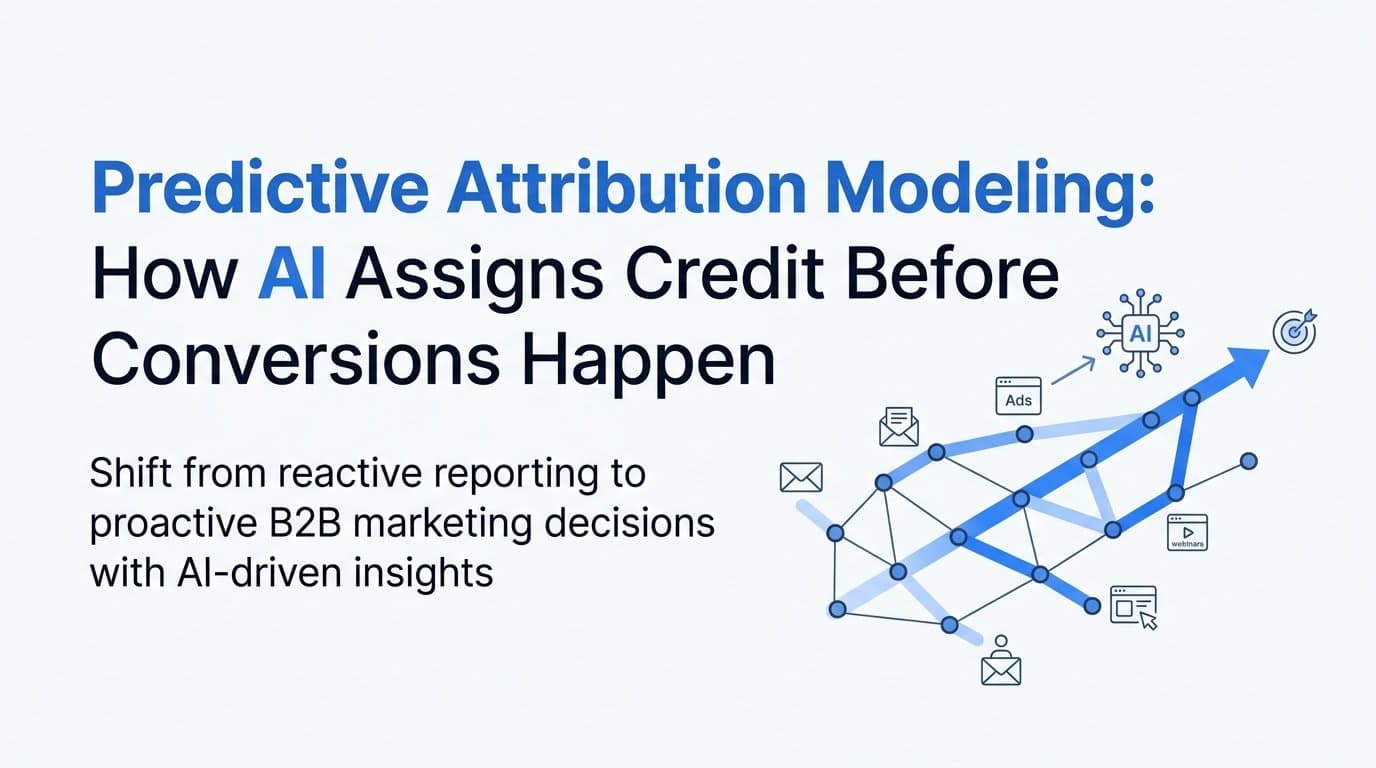
Predictive attribution modeling changes the equation. Instead of assigning credit based on fixed rules, it uses machine learning to analyze historical customer journey data and identify which touchpoints are statistically most likely to drive conversions. The result is a model that doesn't just explain what worked before. It helps you understand what's working right now and what's most likely to work next.
This article breaks down what predictive attribution modeling is, how it works under the hood, how it compares to traditional approaches, and what you need in place to actually use it. If you're a growth marketer or demand gen leader trying to make smarter budget decisions, this is the framework you need to understand.
Why Traditional Attribution Models Leave Marketers Guessing
Rule-based attribution models have been the industry default for years, and they work well enough in simple environments. But B2B SaaS is not a simple environment. When a prospect takes 60 days to move from first ad click to closed-won, touching your brand across paid social, organic search, webinars, sales emails, and direct visits along the way, a fixed rule for assigning credit stops being useful and starts being misleading.
Take last-click attribution. It gives 100% of the credit to the final touchpoint before conversion. In a B2B context, that's often a branded search query or a direct visit from a sales follow-up email. The problem is that touchpoint didn't create intent. It just happened to be last. Every campaign that ran earlier in the journey, the LinkedIn ad that introduced the brand, the blog post that explained the product, the webinar that built trust, gets zero credit. Budget decisions made on last-click data will systematically under-invest in top and mid-funnel channels.
First-touch attribution has the opposite problem. It over-credits the channel that generated initial awareness and ignores everything that nurtured the prospect through a long evaluation process. Linear attribution splits credit evenly across all touchpoints, which sounds fair but treats a quick bounce on a landing page the same as a 45-minute product demo watch. None of these models ask the most important question: which touchpoints actually influenced the outcome?
The fundamental issue is that rule-based models assign credit based on position, not probability. They don't learn from data. They apply a predetermined formula regardless of what the actual conversion patterns in your pipeline look like. For a B2B SaaS company with a complex buying journey involving multiple stakeholders and a mix of paid, organic, and direct channels, this creates consistent misattribution that compounds over time.
Attribution should be predictive, not just descriptive. The goal isn't to label touchpoints after the fact. It's to understand which interactions carry real conversion influence so you can invest in them before the next deal closes. That's the shift predictive attribution modeling makes possible.
Defining Predictive Attribution Modeling
Predictive attribution modeling is a machine learning-driven approach that analyzes historical customer journey data to assign conversion probability weights to each touchpoint in a buyer's path. Rather than applying a fixed rule like "give all credit to the last click," the model learns from patterns in your actual pipeline data and uses those patterns to estimate how much each interaction contributed to a conversion.
The distinction from standard data-driven attribution is worth clarifying. Data-driven attribution looks backward. It analyzes historical paths and distributes credit based on observed patterns. Predictive attribution goes a step further: it applies those learned patterns forward, scoring current touchpoints based on their probability of influencing future conversions. It's the difference between a report that explains last quarter and a model that informs next month's budget.
The model relies on several core inputs to produce accurate scores. Touchpoint sequence matters because the order in which a prospect encounters your brand affects how they process each interaction. Time decay between interactions is relevant because a touchpoint that occurred three months before conversion likely had less direct influence than one that occurred three days before. Channel type carries weight because different channels tend to serve different functions in the buying journey. Content engagement signals, such as time on page, video completion rates, or webinar attendance, help the model distinguish between passive impressions and active engagement. And CRM pipeline stage data is critical because it connects marketing interactions to actual revenue outcomes, not just form fills.
Together, these inputs give the model a rich, multidimensional view of what a high-probability conversion path looks like. Once trained on enough historical data, the model can score new touchpoints in real time, surfacing which interactions are carrying the most conversion influence at any given moment.
This is what makes predictive attribution genuinely useful for B2B SaaS teams. You're not waiting for a deal to close to understand what drove it. You're getting signal while the deal is still in progress, which gives you the ability to act on it.
The Mechanics: How Predictive Attribution Models Learn and Score
Understanding how these models work at a conceptual level helps you trust the outputs and use them more effectively. You don't need to be a data scientist, but knowing what's happening under the hood makes the difference between treating the model as a black box and actually integrating it into your decision-making process.
The modeling process starts with historical conversion data. The algorithm ingests thousands of customer journey paths, each one a sequence of touchpoints that either ended in a closed-won deal or didn't. It looks for patterns: which sequences of interactions correlate with conversion? Which channels tend to appear early in paths that convert? Which content types show up in deals with shorter sales cycles? Over time, the model builds a probabilistic map of what a high-converting journey looks like.
Several technical approaches are commonly used in predictive attribution, each with a slightly different logic for how credit gets assigned.
Logistic regression models estimate the probability that a given touchpoint sequence leads to conversion based on historical patterns. Think of it as the model learning to recognize the fingerprints of a deal that closes. When a new prospect follows a similar path, the model assigns a conversion probability score based on how closely it matches previously successful journeys.
Markov chain models analyze transition probabilities between touchpoints. They identify which channels have the highest "removal effect" on conversion rates. In other words, if you removed a specific touchpoint entirely from the journey, how much would your overall conversion rate drop? Channels with a high removal effect receive more credit because they are structurally important to the path, not just incidentally present.
Shapley value distribution comes from cooperative game theory and is designed to fairly distribute credit among all contributing touchpoints. It works by calculating each touchpoint's marginal contribution across every possible sequence in which it could appear. Rather than asking "what did this touchpoint do in the specific journey we observed," it asks "what does this touchpoint contribute on average across all the ways it could have been part of a journey?" This approach is particularly good at surfacing the true value of mid-funnel touchpoints that rule-based models consistently undervalue.
One of the most important properties of predictive attribution models is that they improve over time. As your pipeline generates more conversion events, the model has more patterns to learn from, and its probability scores become more accurate. This makes predictive attribution especially powerful for growth-stage B2B SaaS companies where deal volume is increasing. The model compounds in value as your business scales.
Predictive vs. Other Attribution Models: Where the Difference Shows Up
The clearest way to understand what predictive attribution actually changes is to run the same buyer journey through multiple models and see what each one produces.
Picture a B2B SaaS prospect who follows this path: they see a LinkedIn ad and click through to a product overview page. A week later, they find a blog post through organic search and spend several minutes reading it. Two weeks after that, they register for and attend a live webinar. A few days later, a sales development rep sends a personalized email, and the prospect books a demo. The deal eventually closes.
Under last-click attribution, the sales email gets 100% of the credit. Every upstream touchpoint, the LinkedIn ad, the blog post, the webinar, is invisible. The marketing team sees their paid social and content investment as unproductive.
Under first-touch attribution, the LinkedIn ad gets 100% of the credit. The webinar that likely accelerated the evaluation and the blog post that built credibility are ignored entirely. The team over-invests in top-of-funnel paid social and under-invests in content and events.
Under linear attribution, each of the four touchpoints gets 25% of the credit. This feels more balanced, but it treats a quick LinkedIn click-through the same as a 45-minute webinar attendance. The weights don't reflect actual conversion influence.
Under predictive attribution, the model scores each touchpoint based on its statistical contribution to conversion across thousands of similar journeys. If the data shows that webinar attendance is highly correlated with deals closing within 30 days, the webinar receives proportionally more credit. If the LinkedIn ad consistently appears at the start of high-value conversion paths, it gets meaningful credit for initiating the journey. The result reflects actual buyer behavior patterns, not positional rules.
A reasonable concern about machine learning-based models is that they can feel opaque. If the model assigns 40% of the credit to the webinar and 15% to the LinkedIn ad, marketers want to understand why. Modern attribution platforms address this through explainability layers that surface the reasoning behind credit scores. You can see which patterns in the historical data drove the model's decision, making the outputs actionable rather than mysterious. Transparency is not at odds with sophistication. The best predictive attribution tools give you both.
Practical Applications for B2B SaaS Marketing Teams
Predictive attribution modeling is only valuable if it changes how you make decisions. Here are the three areas where it has the most direct impact for B2B SaaS marketing teams.
Budget allocation with confidence: The most immediate application is shifting ad spend toward channels that have the highest predicted conversion influence, rather than those with the most last-click credit. When you can see that a specific LinkedIn audience segment or a particular content category consistently appears in high-probability conversion paths, you have a data-backed reason to increase investment there. You're no longer guessing or following intuition. You're following the model's signal, which is trained on your actual pipeline outcomes.
This also means you can make a defensible case for top and mid-funnel investment. One of the persistent challenges for B2B SaaS marketers is justifying spend on brand awareness or content when last-click models show those channels producing few direct conversions. Predictive attribution surfaces the contribution those channels make to deals that eventually close through other touchpoints, giving you the evidence you need to protect and grow those budget lines.
Pipeline acceleration through mid-funnel insight: Predictive models can identify which mid-funnel touchpoints are most correlated with deals moving from marketing qualified lead to sales qualified lead. If webinar attendance, a specific product comparison page, or a particular email sequence consistently appears in journeys where MQLs convert to SQLs quickly, that's a lever the marketing team can pull intentionally. You can build campaigns specifically designed to drive prospects toward those high-velocity touchpoints, shortening the sales cycle without requiring the sales team to do more work.
Creative and campaign optimization: Predictive attribution data surfaces which ad creatives, landing pages, and content assets appear most frequently in high-probability conversion paths. This is different from click-through rate or engagement metrics, which measure attention but not conversion influence. When you know that a specific case study format or a particular ad message consistently shows up in paths that close, you can prioritize creating more of that type of content and deprioritize formats that generate engagement but don't contribute to pipeline.
Across all three applications, the common thread is that predictive attribution moves the team from reacting to what happened to proactively shaping what happens next. That shift in operating mode is where the real competitive advantage lives.
What You Need in Place Before Predictive Attribution Can Work
Predictive attribution is only as accurate as the data it trains on. Before investing in a predictive modeling approach, teams need to be honest about whether their data infrastructure is ready to support it.
Data completeness is the foundation: The model needs a connected, clean view of the entire customer journey, from the first ad impression through to closed-won revenue. That means your ad platforms, CRM, and website tracking all need to be integrated and talking to each other. If there are gaps, such as ad clicks that don't map to CRM contacts, or website events that aren't captured due to ad blockers or browser privacy restrictions, the model is training on an incomplete picture. Its outputs will reflect those gaps.
This is where server-side tracking becomes critical. Browser-based pixel tracking is increasingly unreliable. Ad blockers, browser privacy restrictions, and platform-level privacy changes mean that a meaningful portion of conversion events never get recorded by client-side pixels. Server-side tracking captures these events at the infrastructure level, bypassing the browser entirely. For predictive attribution to work accurately, you need first-party data collected through server-side methods, not just browser pixels.
Minimum data volume matters: Predictive models need a sufficient history of conversion events to identify statistically meaningful patterns. There's no universal threshold, but the principle is straightforward: the more closed-won deals in your historical dataset, the more reliable the model's pattern recognition becomes. For early-stage B2B SaaS companies with limited conversion volume, simpler data-driven attribution approaches may be more appropriate while pipeline data accumulates. As deal volume grows, the case for predictive modeling strengthens significantly.
Integration depth determines prediction quality: The model needs to connect ad click data all the way through to revenue, not just lead form submissions. In B2B SaaS, pipeline value varies dramatically across deals. A model that only sees form fills treats a $5,000 SMB deal the same as a $200,000 enterprise contract. When the model can see actual deal value from CRM data, it can weight touchpoints not just by their contribution to conversion probability, but by their contribution to revenue, which is the metric that actually matters.
Building the Foundation With Cometly
Predictive attribution requires a unified, enriched data layer that most marketing teams don't have natively. Cometly is built to create exactly that foundation for B2B SaaS companies.
Cometly connects your ad platforms, CRM, and website events into a single customer journey view. Every touchpoint, from the first ad click to the closed-won CRM event, is captured and mapped to the same prospect record. This gives predictive models the complete, connected data they need to identify meaningful patterns rather than working from fragmented snapshots of the buyer journey.
The platform's AI surfaces recommendations based on attribution data, identifying which ads and campaigns are driving the highest conversion influence across every channel. Instead of manually digging through reports to find which touchpoints are performing, the AI flags them directly, giving marketing teams a clear signal for where to scale and where to pull back. This closes the gap between having attribution data and acting on it.
Cometly's server-side tracking and Conversion API integrations address the data completeness problem directly. By capturing conversion events at the server level and sending enriched, first-party data back to ad platforms like Meta and Google, Cometly ensures that the events feeding your attribution model are as complete and accurate as possible. In a privacy-first environment where browser-based tracking is becoming less reliable, this infrastructure layer is what separates attribution models that produce accurate outputs from those that produce misleading ones.
When the data flowing into your attribution model is clean, connected, and complete, the model's predictions become genuinely useful. Cometly is designed to make that data infrastructure accessible without requiring a data engineering team to build it from scratch.
Moving From Reactive Reporting to Proactive Strategy
The core shift that predictive attribution modeling enables is straightforward: it moves marketing teams from looking backward to looking forward. Instead of explaining what happened after a deal closes, you're working with a model that tells you which touchpoints are carrying the most conversion influence right now, while you still have time to act on that information.
The key takeaways are worth anchoring. Predictive attribution assigns credit based on statistical conversion probability, not positional rules. It improves continuously as more conversion data flows through the model. It requires clean, connected data across your ad platforms, CRM, and website to produce reliable outputs. And it's most powerful when it can see all the way from the first ad interaction to closed-won revenue, not just to form fills.
For B2B SaaS teams managing complex buying journeys across multiple channels and long sales cycles, this is the level of intelligence that makes budget decisions defensible and campaign optimization systematic rather than intuitive.
The foundation for all of it is data infrastructure. If your touchpoint data is fragmented, incomplete, or disconnected from revenue outcomes, no attribution model, predictive or otherwise, will give you reliable answers. Building that foundation is the first step.
Ready to elevate your marketing game with precision and confidence? Discover how Cometly's AI-driven recommendations can transform your ad strategy. Get your free demo today and start capturing every touchpoint to maximize your conversions.