

Third-party cookies are fading fast. Browser restrictions, privacy regulations, and platform-level changes have forced marketers to rethink how they track users across the web. For B2B SaaS marketing teams, this shift is particularly painful because the sales cycle is long, the touchpoints are many, and attribution accuracy directly affects budget decisions.
If your tracking relies on third-party cookies, you are likely already losing conversion data, misattributing revenue, and feeding ad platforms incomplete signals. Browser-level restrictions have made third-party cookie tracking increasingly unreliable across all major platforms, and the trend is only accelerating.
The good news is that cookieless tracking is not a limitation. It is an opportunity to build a more durable, accurate, and privacy-respecting measurement foundation. The strategies in this guide move beyond cookie-dependent approaches and into first-party data collection, server-side infrastructure, and AI-powered attribution.
Each method addresses a specific gap in the modern tracking stack. Whether you are trying to improve ad platform performance, close attribution blind spots, or get a clearer picture of which campaigns drive pipeline, these strategies give you a practical roadmap. The goal is not just to replace cookies. It is to build a tracking system that is more reliable than what cookies ever provided.
1. Build a First-Party Data Foundation
The Challenge It Solves
When third-party identifiers disappear, marketers who relied on them are left with significant blind spots. Without a direct relationship with user data, you lose the ability to track behavior across sessions, connect ad interactions to conversions, and build the kind of audience profiles that power effective targeting. First-party data eliminates that dependency entirely.
The Strategy Explained
First-party data is collected directly from users through your own channels: your website, CRM, product, email list, and any other touchpoint you own. Because it comes from direct interactions with your brand, it is the most durable tracking signal available in a cookieless environment.
For B2B SaaS companies, this means capturing identifiers like email addresses at every meaningful point in the funnel, from gated content downloads to trial signups to demo requests. These identifiers become the backbone of your attribution system, allowing you to link ad interactions to actual people rather than anonymous browser sessions.
The key is making first-party data collection systematic rather than opportunistic. Every form, every CRM record, and every product event is a data point that can be used to build a complete picture of the customer journey.
Implementation Steps
1. Audit every owned channel to identify where user data is currently being collected and where gaps exist.
2. Implement consistent data capture across all high-intent touchpoints, including demo request forms, free trial signups, newsletter subscriptions, and gated resources.
3. Ensure your CRM is receiving and storing these identifiers in a structured format that can be used for downstream attribution and audience targeting.
4. Connect your CRM data to your analytics and ad platforms so that first-party identifiers can be used to enrich conversion events and improve match quality.
Pro Tips
Do not treat first-party data as a one-time collection effort. Build ongoing capture mechanisms into your product and marketing workflows so your data asset grows continuously. The richer your first-party dataset, the more accurate your attribution becomes across every channel and campaign.
2. Implement Server-Side Tracking
The Challenge It Solves
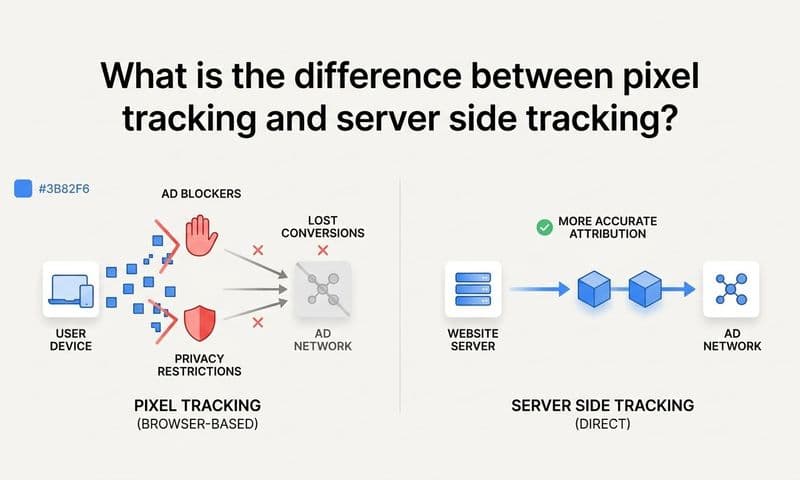
Browser-based tracking pixels are increasingly unreliable. Ad blockers, Safari's Intelligent Tracking Prevention, and Chrome's evolving privacy features all interfere with client-side scripts before they can fire. The result is incomplete event data, undercounted conversions, and attribution gaps that distort your understanding of campaign performance.
The Strategy Explained
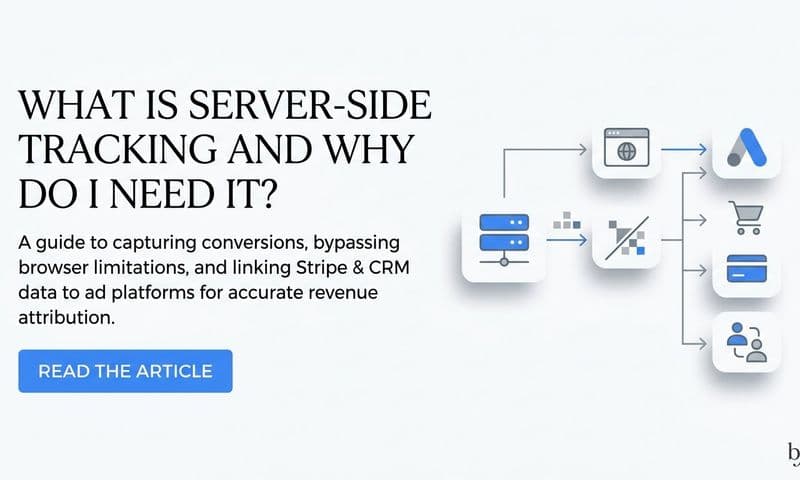
Server-side tracking moves the conversion event logic from the user's browser to your own server. Instead of relying on a JavaScript pixel to fire in the browser, your server sends the conversion data directly to your analytics and ad platforms. Because the request originates from your infrastructure rather than the user's browser, it bypasses ad blockers, ITP restrictions, and other client-side interference entirely.
For B2B SaaS teams, this is especially important for capturing high-value conversion events like demo requests, trial activations, and form completions. These are the events that directly inform ad platform optimization, and losing even a fraction of them can meaningfully degrade campaign performance.
Server-side tracking also gives you greater control over the data you send, allowing you to standardize event schemas, strip unnecessary parameters, and ensure that only clean, accurate data reaches your attribution system.
Implementation Steps
1. Set up a server-side tagging container using a solution like Google Tag Manager's server-side configuration or a dedicated tracking infrastructure.
2. Migrate your highest-priority conversion events from client-side pixels to server-side endpoints, starting with the events that most directly influence ad platform bidding.
3. Validate that server-side events are firing accurately by comparing event volumes against your existing client-side data before fully decommissioning browser-based pixels.
4. Integrate your server-side tracking layer with your attribution platform to ensure all captured events flow into a unified data model.
Pro Tips
Run server-side and client-side tracking in parallel during your migration period. This lets you identify discrepancies and fine-tune your setup before relying on server-side data exclusively. Understanding the full server-side tracking benefits will help you prioritize deduplication logic, which is essential here to avoid double-counting events across both systems.
3. Use Conversion APIs to Feed Ad Platforms Directly
The Challenge It Solves
Ad platforms like Meta and Google optimize their algorithms based on the conversion signals you send them. When browser-based pixels miss events due to ad blockers or privacy restrictions, those platforms receive an incomplete picture of your campaign performance. This degrades their optimization, inflates your cost per acquisition, and reduces the accuracy of your return on ad spend reporting.
The Strategy Explained
Meta's Conversions API and Google's Enhanced Conversions are server-to-server integration tools that allow you to send conversion data directly from your server to the ad platform, bypassing the browser entirely. As documented by both platforms, these tools are specifically designed to improve event match quality and recover conversions that pixel-based tracking misses.
For B2B SaaS companies, Conversion API integrations are particularly valuable because your conversion events often happen deep in the funnel, sometimes days or weeks after the initial ad interaction. Sending these events server-side ensures the ad platform can still attribute them correctly and use them to optimize future targeting.
Platforms like Cometly are built to streamline this process, connecting your ad platforms, CRM, and website so that enriched conversion events flow back to Meta, Google, and other channels with the accuracy needed to improve targeting and ad ROI.
Implementation Steps
1. Set up Meta's Conversions API through a direct integration or a supported partner platform, ensuring you are sending the same events as your pixel with proper deduplication parameters.
2. Configure Google's Enhanced Conversions by mapping your first-party user data to the conversion events you are already tracking in Google Ads.
3. Monitor event match quality scores in both platforms after implementation and iterate on the data fields you are sending to improve match rates.
4. Expand your Conversion API coverage to include mid-funnel events like MQL creation and opportunity opened, not just bottom-funnel conversions, to give ad platforms richer optimization signals.
Pro Tips
Hashed email addresses are among the most powerful identifiers you can include in Conversion API payloads. When a user who converted is already known to the ad platform, a hashed email match dramatically improves attribution accuracy and helps the platform find similar high-value prospects.
4. Adopt Multi-Touch Attribution Models
The Challenge It Solves
Last-click attribution was already a flawed model before cookies became unreliable. It ignores every touchpoint that contributed to a conversion except the final one, which consistently undervalues top-of-funnel channels and distorts budget decisions. Without cookie-based cross-site tracking to connect early interactions to late conversions, last-click attribution becomes even more misleading.
The Strategy Explained
Multi-touch attribution distributes conversion credit across every touchpoint in the customer journey, from the first ad click to the final demo request. For B2B SaaS companies with complex, multi-channel sales cycles, this approach gives marketing teams a far more accurate view of what is actually driving pipeline and revenue.
Different attribution models weight touchpoints differently. Linear attribution gives equal credit to every interaction. Time-decay models give more credit to touchpoints closer to conversion. Position-based models weight the first and last touch most heavily. Data-driven models use machine learning to assign credit based on actual conversion patterns in your data.
The right model depends on your sales cycle length, the number of touchpoints involved, and the level of data granularity you have available. Platforms like Cometly allow you to compare multiple attribution models side by side, so you can see how credit distribution changes depending on the model and make more informed decisions about where to invest your budget.
Implementation Steps
1. Map your typical customer journey from first touch to closed-won to understand how many interactions occur and which channels appear most frequently.
2. Choose an attribution model that aligns with your sales cycle complexity and test it against your historical conversion data to validate its accuracy.
3. Integrate your CRM pipeline data with your attribution platform so that revenue, not just lead volume, is included in the attribution model.
4. Review attribution model outputs regularly and adjust your channel mix and budget allocation based on what the data shows is driving actual pipeline.
Pro Tips
Avoid locking into a single attribution model permanently. The most effective approach is to use multiple attribution models in parallel and look for consistent patterns across them. When several models agree that a channel is underperforming, that is a much stronger signal than any single model alone.
5. Leverage UTM Parameters and URL-Based Tracking
The Challenge It Solves
Many marketers overlook UTM parameters as a primary tracking mechanism because they seem basic compared to pixel-based solutions. But in a cookieless environment, their simplicity is their strength. UTM parameters are not affected by browser privacy settings, ad blockers, or ITP. They work because they are embedded in the URL itself, not in the browser's storage.
The Strategy Explained
UTM parameters are query string tags appended to URLs that identify the source, medium, campaign, content, and term associated with a click. When a user clicks a UTM-tagged link, those parameters are passed to your analytics platform and stored alongside the session data, giving you reliable campaign-level attribution that survives any browser-level restriction.
For B2B SaaS teams running paid campaigns across Google, LinkedIn, and Meta, consistent UTM implementation creates a persistent signal that connects ad spend to website sessions, form submissions, and ultimately pipeline. When combined with server-side tracking and Conversion APIs, UTM data becomes part of a layered attribution system that is significantly more resilient than any single tracking method.
The critical requirement is consistency. UTMs only work if they are applied uniformly across every campaign, every ad set, and every piece of content. Inconsistent tagging creates gaps that are difficult to diagnose and impossible to backfill.
Implementation Steps
1. Define a standardized UTM naming convention for your team and document it in a shared reference guide that everyone working on campaigns can access.
2. Build a UTM builder tool or use a spreadsheet template to generate consistent tags for every campaign, ensuring no ad goes live without proper attribution parameters.
3. Audit your existing campaigns to identify untagged or inconsistently tagged URLs and correct them before your next reporting cycle.
4. Configure your analytics platform to capture and store UTM parameters at the session level so they can be joined with conversion events for downstream attribution analysis.
Pro Tips
Store UTM parameters in your CRM at the lead level, not just in your analytics platform. When a form submission passes UTM data into the contact record, you can trace that lead's original source all the way through the pipeline to closed-won revenue, even if months pass between the first click and the deal close.
6. Use Identity Resolution and Data Enrichment
The Challenge It Solves
One of the most significant challenges in cookieless tracking is connecting anonymous browsing sessions to known individuals. Without third-party cookies linking sessions across sites, a user who clicks an ad, visits your website, and later submits a form may appear as multiple unconnected data points. Identity resolution bridges that gap.
The Strategy Explained
Identity resolution is the process of connecting multiple data points, including email addresses, CRM IDs, device fingerprints, and hashed identifiers, to a single unified user profile. When a user submits a form or logs into your product, that first-party identifier can be used to retroactively connect their earlier anonymous sessions to a known contact record.
Combined with data enrichment, which appends firmographic and behavioral data to contact records from third-party sources, identity resolution gives B2B SaaS teams a much clearer picture of who their prospects are and how they engaged before converting. This directly improves attribution accuracy because you can match ad interactions to real people rather than relying on probabilistic browser-based connections.
Platforms like Cometly support this approach by connecting ad platform data, CRM records, and website events into a single source of truth, making it possible to track the entire customer journey from first ad click to closed-won revenue even when individual sessions would otherwise appear disconnected.
Implementation Steps
1. Implement a consistent user identification mechanism on your website, such as a first-party cookie set at form submission, that persists across sessions and can be used to stitch together the user's journey.
2. Pass user identifiers into your CRM at every conversion point so that the contact record becomes the central node connecting all touchpoint data.
3. Evaluate data enrichment providers that can append company size, industry, and role data to your contact records, giving your attribution model richer context for analyzing which audience segments are converting.
4. Build a process for regularly syncing enriched CRM data back to your attribution and ad platforms so that your audience targeting and conversion signals stay current.
Pro Tips
The earlier in the funnel you can capture a first-party identifier, the more complete your identity graph becomes. Consider offering high-value content like benchmarks, templates, or tools that justify an email submission earlier in the user journey, creating more opportunities to connect anonymous sessions to known contacts.
7. Apply AI-Driven Attribution to Connect Incomplete Data
The Challenge It Solves
Even with server-side tracking, Conversion APIs, and strong UTM hygiene, there will always be touchpoints that fall through the cracks. Users who browse without submitting forms, interactions that happen on channels without direct tracking integrations, and long B2B sales cycles that span multiple devices and sessions all create attribution gaps that deterministic tracking cannot fully close.
The Strategy Explained
AI-driven attribution uses probabilistic matching and behavioral pattern recognition to infer which touchpoints contributed to a conversion when direct tracking signals are missing or fragmented. Rather than requiring a complete, unbroken chain of identifiers, AI attribution models analyze patterns across large volumes of conversion data to assign credit based on what typically drives outcomes in your specific funnel.
For B2B SaaS companies, this is particularly valuable because the sales cycle often spans weeks or months and involves multiple anonymous touchpoints before a prospect ever identifies themselves. AI attribution can look at the behavioral signals available, such as content consumed, pages visited, and time between sessions, and use them to infer the likely influence of earlier interactions.
Cometly's AI-powered attribution is built specifically for this challenge. It captures every touchpoint from first ad click to closed-won revenue, uses AI to surface which campaigns are actually driving growth, and sends enriched conversion signals back to ad platforms like Meta and Google to improve their optimization algorithms. The result is a clearer, more actionable picture of marketing performance even when the underlying data is incomplete.
Implementation Steps
1. Ensure your foundational tracking layers, including server-side events, UTM parameters, and first-party identifiers, are in place before implementing AI attribution, since AI models perform better with richer input data.
2. Connect all of your data sources, including ad platforms, CRM, and website analytics, to a single attribution platform so the AI model has access to the full customer journey.
3. Define the conversion events that matter most to your business, including pipeline created, opportunities opened, and closed-won revenue, and ensure they are flowing into your attribution system.
4. Review AI attribution outputs regularly and use the insights to inform budget allocation decisions, pausing underperforming campaigns and scaling those that the model identifies as high contributors to revenue.
Pro Tips
Use AI attribution as a complement to your deterministic models, not a replacement for them. When AI-inferred attribution aligns with what your UTM and server-side data shows, you have high confidence in the signal. When they diverge, that discrepancy is worth investigating and often reveals a tracking gap worth fixing.
Putting It All Together
Cookieless tracking is not a single fix. It is a layered system where each strategy reinforces the others. First-party data gives you the raw material. Server-side tracking captures it reliably. Conversion APIs send it back to ad platforms. Multi-touch attribution distributes credit accurately. UTM parameters create persistent campaign signals. Identity resolution connects the dots between sessions and people. And AI attribution fills the gaps where direct signals fall short.
For B2B SaaS teams, the priority should be getting server-side tracking and Conversion API integrations in place first, since these have the most direct impact on ad platform performance and ROAS. From there, building out a multi-touch attribution model gives you the visibility to make confident budget decisions across your entire channel mix.
The strategies in this guide are designed to work together. Implementing even two or three of them will meaningfully improve your attribution accuracy compared to a cookie-dependent setup. Implementing all seven creates a measurement foundation that is more resilient, more accurate, and more aligned with how B2B buyers actually behave.
Cometly is built to support this entire stack. It connects your ad platforms, CRM, and website into a single source of truth, tracks every touchpoint from first ad click to closed-won revenue, and uses AI to surface the campaigns that are actually driving growth. If your current tracking setup still depends on third-party cookies, now is the time to rebuild it on a foundation that will hold.
Ready to elevate your marketing game with precision and confidence? Discover how Cometly's AI-driven recommendations can transform your ad strategy. Get your free demo today and start capturing every touchpoint to maximize your conversions.