
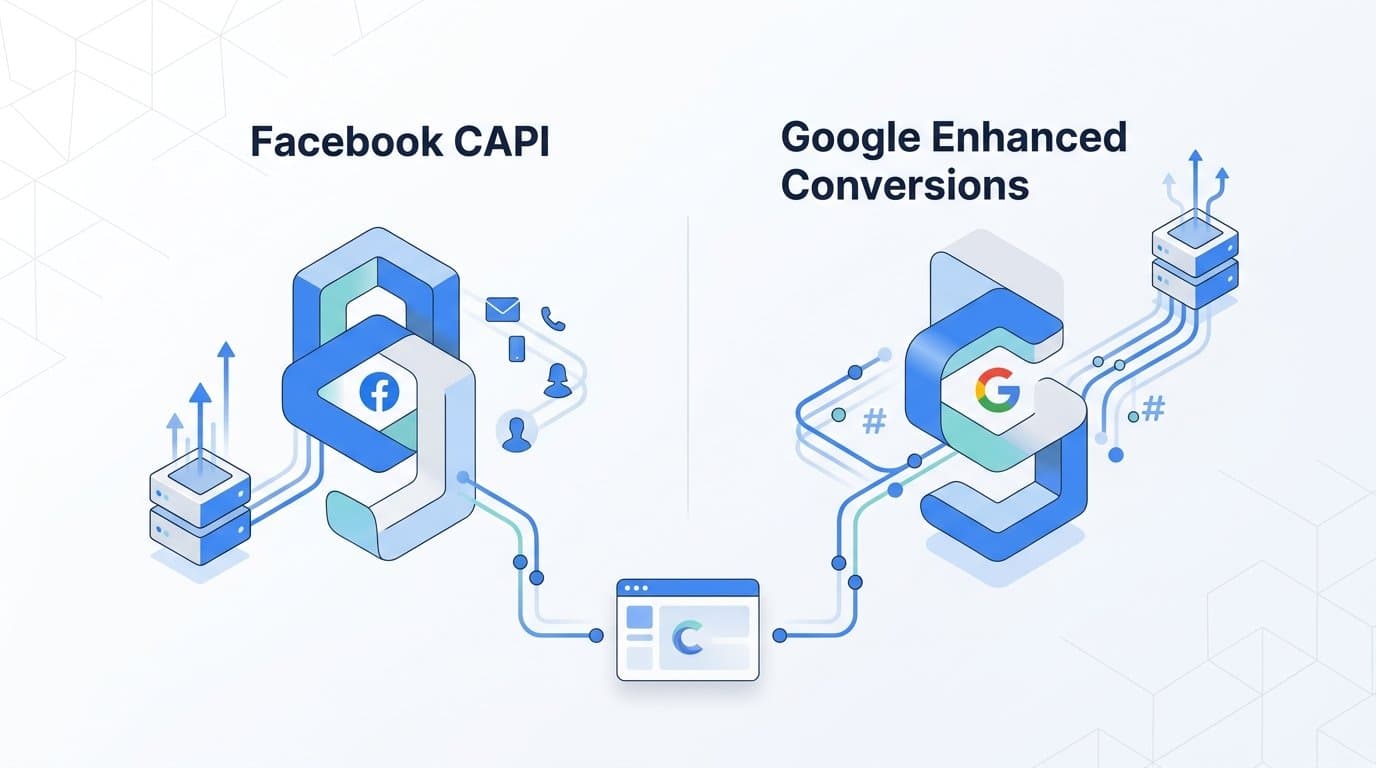
Facebook CAPI and Google Enhanced Conversions both send first-party conversion data from your server to their respective ad platforms, bypassing browser-based tracking limitations, but they serve different platforms, use different matching signals, and require different technical setups. If you run paid ads on both Meta and Google, you need both technologies working in parallel, and a platform like Cometly makes that possible by sending enriched, server-side conversion events to Meta and Google simultaneously without requiring separate engineering sprints.
The confusion between these two technologies is understandable. They solve the same root problem: browser-based tracking has become increasingly unreliable due to privacy updates, iOS restrictions, and the widespread use of ad blockers. But the way each platform solved that problem is architecturally different, and those differences have real implications for how you implement them and which audiences they serve best.
This guide breaks down exactly how each technology works, what data they need, how complex they are to set up, and which one your B2B SaaS team should prioritize first.
How Each Technology Works Under the Hood
Understanding the architectural difference between these two tools is the fastest way to cut through the confusion.
Facebook Conversions API (CAPI) is a server-to-server event pipeline. When a conversion happens on your site or in your CRM, your server sends that event data directly to Meta's servers using Meta's Graph API. The data includes hashed customer identifiers like email address, phone number, browser ID, and click ID, along with event details like the event name, timestamp, and value. Critically, CAPI can operate entirely without a browser pixel. If a user has an ad blocker installed or their browser restricts third-party cookies, CAPI still captures the conversion because the data flows server-to-server, not browser-to-server.
Google Enhanced Conversions works differently at a fundamental level. It is not a standalone event pipeline. Instead, it is an enhancement layer that sits on top of your existing Google Ads conversion tags. When your Google Ads tag fires on a conversion page (a thank-you page, a form submission confirmation, or a demo booking confirmation), Enhanced Conversions sends hashed first-party data alongside that standard tag hit to improve match accuracy. The base Google Ads conversion tag must still fire for Enhanced Conversions to do anything.
This architectural distinction matters more than it might seem at first glance. CAPI gives you a complete alternative to browser-based tracking. Enhanced Conversions gives you a more accurate version of browser-based tracking. Both improve your data quality, but they do it in fundamentally different ways.
There is one important nuance on the Google side worth flagging for B2B SaaS teams specifically. Google offers two variants of Enhanced Conversions: Enhanced Conversions for Web, which supplements the standard tag on a conversion page, and Enhanced Conversions for Leads, which allows you to send CRM data back to Google after a lead converts downstream. The Leads variant is closer in concept to CAPI because it enables offline conversion import from your backend, making it far more relevant for B2B SaaS companies where the real conversion event (a closed deal or a qualified pipeline opportunity) happens in a CRM days or weeks after the initial form fill.
Many B2B SaaS marketing teams implement only the Web variant and miss the Leads variant entirely. That is a meaningful gap in attribution coverage when your sales cycle extends beyond the landing page.
Matching Signals, Data Requirements, and Match Rates
The data each platform uses to match your conversion events to ad impressions and clicks is where the practical differences become most visible.
Meta CAPI uses a broad set of matching signals. When you send a conversion event, Meta attempts to match it to a user in its system using any combination of hashed email address, hashed phone number, first and last name, city, state, zip code, country, date of birth, gender, IP address, user agent, click ID (fbclid), and external ID. The more signals you provide, the higher your match rate. Meta's matching algorithm is designed to work even when only a subset of these identifiers is available.
One critical implementation detail: when you run CAPI alongside the Meta Pixel (which Meta recommends), you must pass a matching event_id parameter in both the Pixel event and the CAPI event. Meta uses this event_id to deduplicate and count the conversion only once. Skipping this step is one of the most common implementation mistakes, and it causes inflated conversion reporting that distorts your campaign performance data.
Google Enhanced Conversions relies primarily on hashed email address as its core matching signal. Google cross-references that hashed email against logged-in Google accounts, which includes Gmail, Google Workspace, and any other Google service the user is signed into. This makes Enhanced Conversions particularly effective for professional audiences who use Google accounts regularly, which describes a large share of B2B SaaS buyers.
The practical implication for audience fit is worth thinking through carefully. Meta's broader set of matching signals tends to perform well across consumer and SMB audiences where users may not all be signed into a Google account but do have diverse identifiers available. Google Enhanced Conversions performs especially well for enterprise and professional audiences who are almost always signed into Google Workspace throughout their workday. For most B2B SaaS companies, both audience profiles are relevant because your buyers exist in both ecosystems.
The minimum data requirement for both is similar: you need at least an email address captured at the point of conversion. For CAPI, additional identifiers improve match rates. For Enhanced Conversions, email is the primary signal and often sufficient on its own for professional audiences.
Setup Complexity and What Your Team Actually Needs to Build
This is where the two technologies diverge most sharply in terms of practical implementation effort.
Building Facebook CAPI from scratch is a meaningful engineering project. You need a server-side endpoint that receives conversion events from your application or CRM, authenticates with Meta's Graph API using an access token, maps your internal event data to Meta's required parameter schema, hashes customer identifiers using SHA-256, and implements event deduplication logic using the event_id parameter. If you also want to send offline conversion events from your CRM (which you should for B2B SaaS pipeline attribution), you need additional logic to trigger events when deal stages change or revenue is recognized. This is not a one-afternoon task for most engineering teams.
Google Enhanced Conversions for Web has a much lower barrier to entry. If you are already using Google Tag Manager and have a Google Ads conversion tag firing on your confirmation pages, you can enable Enhanced Conversions through the GTM interface with relatively minimal technical overhead. You configure the tag to capture the email field from your form and hash it before sending. For teams already comfortable with GTM, this is a realistic self-service implementation.
However, Enhanced Conversions for Leads is a different story. This variant requires you to send conversion data from your CRM or backend to Google's API after the fact, using a user-provided data payload. The setup complexity is comparable to CAPI: you need server-side logic, API authentication, and a process for triggering the upload when a lead reaches a qualifying stage in your pipeline. Many B2B SaaS teams underestimate this complexity because they conflate the Leads variant with the simpler Web variant.
This is where a platform like Cometly changes the equation. Rather than building separate server-side integrations for Meta and Google, Cometly provides native connections that handle event sending to both platforms simultaneously. It manages event deduplication for Meta, enriches conversion data using your CRM and website signals, and sends conversion-ready events to both Meta's Conversions API and Google's Enhanced Conversions without requiring custom engineering work. For marketing teams that want both activated quickly, this removes the dependency on engineering sprint capacity entirely.
The build-versus-buy decision here is worth being honest about. If your engineering team has bandwidth and you want full control over the implementation, building in-house is viable. If your priority is getting accurate conversion data flowing to both platforms as quickly as possible, a purpose-built attribution tool is the faster path.
Which One Should B2B SaaS Teams Prioritize?
The direct answer is: you need both. But if you are resource-constrained and need to sequence your implementation, here is how to think about it.
Facebook CAPI should be treated as non-negotiable if you run any meaningful spend on Meta. iOS privacy changes have significantly degraded the Meta Pixel's ability to track conversions across Apple devices, and ad blockers compound that problem for desktop users. CAPI recovers attribution for leads and pipeline events that the Pixel misses entirely. Without it, Meta's optimization algorithm is working with an incomplete picture of which ads are actually driving conversions, which means your bidding and targeting are degraded in ways that are hard to see but real in their impact on cost per acquisition.
Google Enhanced Conversions is equally critical for teams running Google Ads, particularly for lead generation and demo request campaigns. The Web variant helps Google match your form conversions to the users who clicked your ads. The Leads variant, which is underused by most B2B SaaS teams, allows you to close the loop between a Google Ads click and a downstream revenue event in your CRM. That closed-loop data is what enables Google's Smart Bidding to optimize toward the outcomes that actually matter to your business, not just form fills.
The honest reality for most B2B SaaS marketing teams is that your ad budget is split across both Meta and Google, and each platform's machine learning needs accurate conversion signals to perform well. Prioritizing one and neglecting the other means you are optimizing half your spend on incomplete data. The platforms cannot share conversion signals with each other, so you need to implement both independently.
If you are starting from zero, the practical sequencing often looks like this: implement the Meta Pixel and CAPI together first (since CAPI without the Pixel leaves browser-side signals uncaptured), then implement Google Enhanced Conversions for Web, then layer in Enhanced Conversions for Leads once your CRM integration is in place. Or, use a tool like Cometly to activate all of these simultaneously without the sequential dependency.
Related Questions Marketers Ask About CAPI and Enhanced Conversions
Can you run Facebook CAPI and the Meta Pixel at the same time?
Yes, and Meta recommends it. Running both together with proper deduplication gives you the highest possible match rates because the Pixel captures browser-side signals (including signals available before a user converts) while CAPI captures server-side signals that survive browser restrictions. The key requirement is passing a consistent event_id in both the Pixel event and the CAPI event so Meta can deduplicate and count the conversion only once. Without matching event IDs, you will see inflated conversion counts that make your campaigns look better than they are.
Does Google Enhanced Conversions replace Google Ads conversion tracking?
No. Enhanced Conversions supplements your existing conversion tags by adding hashed first-party data to improve match accuracy. The base Google Ads conversion tag must still fire for Enhanced Conversions to work. Think of it as an upgrade to your existing tracking rather than a replacement. If your base conversion tag stops firing for any reason, Enhanced Conversions stops working too, because it has no independent event pipeline of its own.
How does server-side tracking differ from cookie-based tracking?
Server-side tracking sends event data from your server directly to the ad platform's API, making it immune to browser privacy restrictions, ad blockers, and iOS tracking prevention. The data flow happens entirely outside the browser environment. Cookie-based tracking depends on a JavaScript pixel firing successfully in the user's browser, which requires the browser to allow third-party cookies, not block the pixel script, and not be subject to iOS App Tracking Transparency restrictions. As browser privacy defaults have tightened, cookie-based tracking has become increasingly unreliable for accurate attribution, which is exactly why both Meta and Google built server-side alternatives.
What first-party data do you need to implement both?
For CAPI, you need at least one of the following captured at the conversion point: email address, phone number, name, or browser identifiers like IP address and user agent. Providing more identifiers improves your match rate. For Google Enhanced Conversions, a hashed email address is the primary required signal, and for professional B2B audiences it is often sufficient on its own. Both technologies work best when your form tool or CRM captures the user's email address at the moment of conversion, which is standard for demo request and lead generation flows. If your forms do not capture email, that is the first thing to fix before implementing either technology.
Running Both Without the Complexity
To bring this back to the core question: Facebook CAPI is a full server-to-server event pipeline built for Meta that can operate independently of any browser pixel. Google Enhanced Conversions is an enrichment layer for Google Ads that improves match accuracy by adding hashed first-party data to your existing conversion tags. Both exist to solve the same root problem of degraded browser-based tracking, but they solve it in different ways for different platforms.
For B2B SaaS marketing teams, both are necessary. Your ad spend is almost certainly distributed across Meta and Google, and each platform's optimization algorithms depend on accurate conversion signals to improve bidding and targeting. Running only one means half your spend is optimizing on incomplete data.
The practical barrier for most teams is not understanding what to build. It is finding the engineering capacity to build it. Cometly removes that barrier by connecting your ad platforms, CRM, and website data into a single attribution layer that sends enriched conversion events to both Meta and Google simultaneously. It handles event deduplication for Meta, enriches conversion data with CRM signals, and gives your team a real-time view of which ads are driving pipeline and revenue across every channel.
If you are not sure which conversions your current setup is missing, that is exactly the kind of gap Cometly surfaces. Get your free demo and see how much attribution coverage you are leaving on the table.