Most B2B SaaS marketing teams know the problem well. A prospect clicks an ad, reads a blog post, downloads a guide, attends a webinar, and then disappears for two weeks before resurfacing to request a demo. At every step along the way, someone on the team is manually deciding what to send next, when to follow up, and whether this person is even worth pursuing. That approach does not scale, and it leaves revenue on the table every single day.
Automated customer journeys solve this by replacing reactive, manual follow-up with a system that responds to real behavior in real time. Instead of sending the same email sequence to everyone who fills out a form, automation responds to what a prospect actually does: which pages they visit, which content they engage with, how active they are in a trial, and where they are in the buying cycle. The result is a more relevant experience for the prospect and a more efficient process for the team.
But here is the part that most articles skip over: automated journeys are only as smart as the data powering them. Without accurate attribution, you cannot know which channel brought a prospect in, which touchpoints influenced their decision, or which journey paths actually lead to closed revenue. This article covers all of it. You will learn how automated journeys are structured, how to map them across B2B SaaS buying stages, why attribution data is the engine behind everything, and how to measure and optimize performance over time.
The Anatomy of an Automated Customer Journey
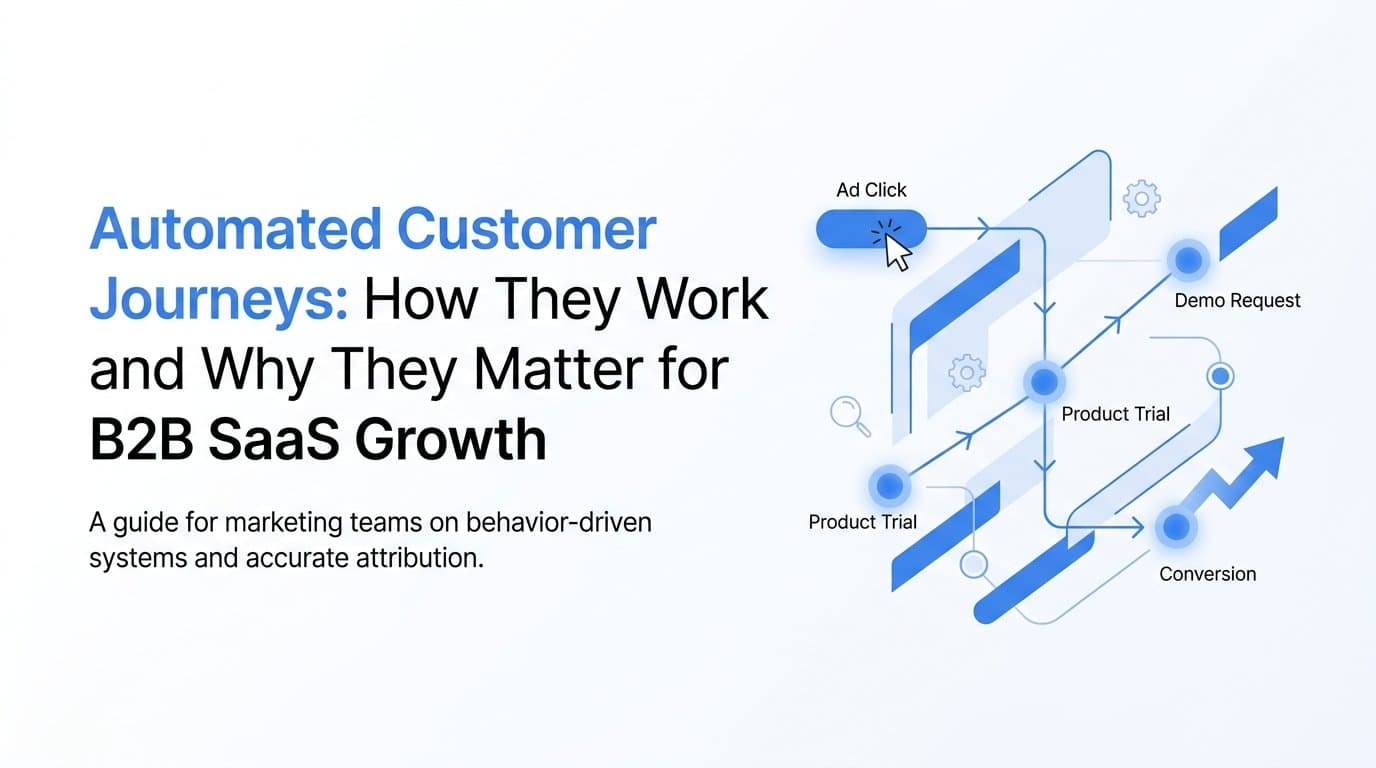
An automated customer journey is a behavior-triggered sequence of marketing and sales interactions designed to move a prospect through the funnel without requiring manual action at each step. Think of it as a decision tree that runs in the background, constantly evaluating what a prospect has done and determining the most relevant next action to take on their behalf.
Every automated journey is built from four core components. Understanding each one is essential before you try to build or optimize anything.
Triggers: A trigger is the event that starts the journey. It could be a form submission, a page visit, a lead score crossing a threshold, a trial signup, or an ad click. The trigger tells the system that a prospect has taken a meaningful action and that an automated response should begin.
Conditions: Conditions are the logic layer. They determine which path a contact takes based on what is already known about them. Is this person a returning visitor or a first-time visitor? Did they come from a paid LinkedIn campaign or an organic search? Have they already spoken to sales? Conditions allow a single journey to branch into multiple paths, each tailored to a different audience segment or behavioral profile.
Actions: Actions are what the journey actually does in response to a trigger and a set of conditions. Sending an email, displaying a retargeting ad, updating a CRM field, notifying a sales rep, or enrolling a contact in a new sequence are all examples of actions. The action is the moment the prospect experiences the journey, even if they have no idea it is automated.
Exit criteria: Exit criteria define when a contact leaves the journey. This might happen when they convert, when they book a demo, when they become a customer, or when they have gone a certain number of days without engaging. Good exit logic prevents contacts from receiving messages that are no longer relevant and keeps the experience clean.
The critical distinction between automated journeys and traditional drip campaigns comes down to responsiveness. A drip campaign sends the same message to everyone on a fixed schedule regardless of what they have done since the last email. An automated journey listens. If a prospect visits the pricing page after receiving your second email, the journey can recognize that signal and immediately send a more conversion-focused message rather than waiting for day seven of a pre-written sequence. That responsiveness is what makes automation genuinely useful rather than just convenient.
Mapping the Stages: From First Click to Closed Deal
B2B SaaS buying cycles are not linear, but they do follow recognizable patterns. Understanding what typically happens at each stage allows you to design automation logic that meets prospects where they are rather than pushing them through a process that does not match their behavior.
The journey generally moves through three broad stages: awareness, consideration, and decision. Each stage requires different messaging, different automation logic, and different data inputs.
Awareness: This is the first meaningful interaction. A prospect clicks a paid search ad, lands on a blog post through organic search, or sees a LinkedIn ad and visits your homepage. At this stage, they are likely problem-aware but not yet solution-aware. Automated actions here focus on capturing attention and providing value: a retargeting ad that reinforces the message they just saw, a content recommendation based on the page they visited, or a soft CTA to download a relevant guide. The goal is not to push for a demo immediately. It is to give the prospect a reason to come back.
Consideration: The prospect has now engaged more deeply. They downloaded a piece of content, signed up for a free trial, registered for a webinar, or requested a demo. This is where automation becomes most powerful. The touchpoint data collected during the awareness stage now informs what happens next. A prospect who came in through a paid LinkedIn ad targeting a specific job title should receive different messaging than one who found you through organic search for a generic keyword. Automated actions at this stage include personalized email sequences, trial onboarding flows, in-app messaging, and sales alerts triggered by high-intent behavior.
Decision: The prospect is evaluating whether to buy. They may have had a sales call, received a proposal, or been in an active deal for several weeks. Automation at this stage works alongside the sales team rather than replacing it. CRM events such as a deal moving to a new pipeline stage can trigger automated touchpoints: a case study sent at the right moment, a reminder about a limited-time offer, or a re-engagement email if the deal has gone quiet. These actions keep the deal warm without requiring the sales rep to manually manage every follow-up.
What ties all three stages together is touchpoint data. Every interaction a prospect has with your brand generates a signal. When that signal is captured accurately and fed into the automation layer, the journey logic can respond intelligently. When it is not captured, the automation is essentially flying blind, sending generic messages based on incomplete context. This is why the data infrastructure behind your journeys matters as much as the journeys themselves.
Why Attribution Data Is the Engine Behind Smarter Journeys
Here is a scenario that plays out constantly in B2B SaaS marketing. A prospect clicks a LinkedIn ad, visits the website, reads three blog posts over two weeks, downloads a guide, and then converts via a direct visit a month later. The CRM records the conversion. The attribution model credits direct traffic. The LinkedIn campaign gets zero credit, the budget gets cut, and the team wonders why lead quality drops the following quarter.
This is what happens when journey automation is built on top of weak attribution data. The journey may be well-designed, but if it does not know where a prospect came from or what they engaged with before entering the funnel, it cannot personalize effectively. It cannot send the right message based on the actual path a prospect took. It can only guess.
Multi-touch attribution solves this by giving marketers a complete picture of every interaction before the conversion event. Instead of crediting a single touchpoint, multi-touch models distribute credit across the full sequence of interactions, revealing which channels and content assets are actually influencing decisions. That data then feeds directly into journey logic, making it possible to personalize based on reality rather than assumption.
Consider what becomes possible when your automation layer has accurate attribution data. A prospect who entered through a paid search ad for a specific use case can receive journey content that speaks directly to that use case. A prospect who came in through a LinkedIn campaign targeting a specific company size can receive messaging calibrated to their scale. A prospect who has engaged with three pieces of bottom-of-funnel content can be fast-tracked to a sales alert rather than continuing through a nurture sequence they have already outgrown.
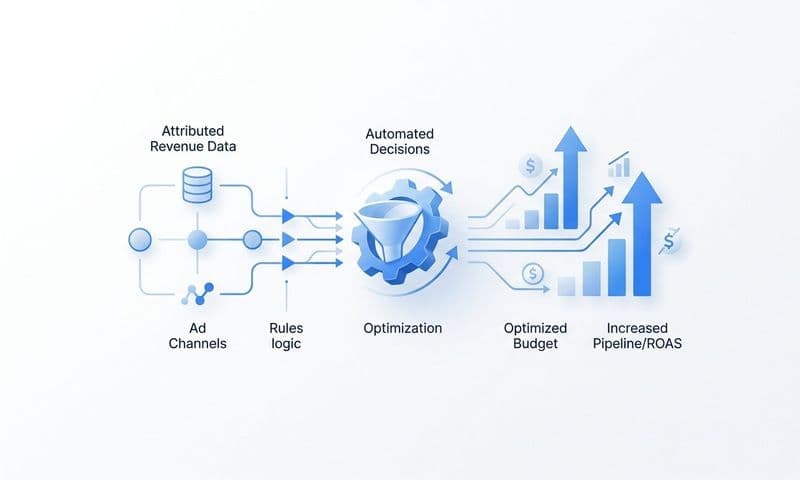
This is where platforms like Cometly play a critical role. Cometly connects ad platform data, CRM events, and website behavior into a single source of truth, giving the automation layer the enriched context it needs to trigger the right actions at the right time. Instead of working from fragmented data across disconnected tools, your journey logic operates from a unified view of each prospect's actual path from first touch to conversion.
When ad spend data, pipeline data, and behavioral data all live in the same place, you can see not just which journeys are converting but which entry channels are feeding the highest-value journeys. That visibility transforms attribution from a reporting exercise into an active input that makes your automation smarter with every campaign cycle.
Building Journey Logic That Converts: Key Triggers and Branching Rules
Good journey logic is not complicated, but it does require intentional design. The most effective B2B SaaS journeys are built around triggers that reflect genuine buying intent, branching conditions that create relevant experiences for different segments, and exit rules that keep the experience clean and non-repetitive.
Start with your triggers. The most reliable triggers in B2B SaaS marketing are the ones tied to high-intent behavior rather than passive engagement. A prospect who visits your pricing page three times in a week is sending a very different signal than one who opened a single email. Effective trigger types include:
Page visits to high-intent URLs: Pricing pages, comparison pages, and demo request pages indicate a prospect who is actively evaluating. Triggering a journey from these visits allows you to respond while intent is at its peak.
Form submissions: Any form completion, whether it is a content download, a trial signup, or a contact request, represents a meaningful commitment of attention. These are among the most reliable journey entry points available.
Lead score thresholds: When a contact crosses a lead score threshold based on accumulated engagement, that threshold can trigger a handoff to sales or an escalation in messaging frequency. This keeps your automation aligned with where each prospect actually is in their evaluation.
Trial activity signals: Feature adoption milestones, login frequency, and in-app behavior are powerful triggers for SaaS products. A trial user who has activated a key feature is a very different prospect than one who signed up and never returned.
Ad engagement events: When a prospect engages with a specific ad or campaign, that engagement can be used to personalize the journey they enter. This requires clean attribution data connecting ad platform events to your automation layer.
Branching logic is what allows a single journey to serve multiple audience segments without building separate campaigns from scratch. An if-then condition might route a prospect down one path if they came from a paid campaign and another path if they came from organic search. It might send a more technical email sequence to a prospect identified as a developer and a more business-focused sequence to someone identified as a VP of Marketing. The branching is only as good as the data informing it.
Exit and re-entry rules deserve more attention than they typically receive. A contact who books a demo should exit the nurture journey immediately. A contact who becomes a customer should never receive a prospect-facing email again. And a contact who re-engages after going dormant should be able to re-enter the journey at the appropriate stage rather than starting from the beginning. These rules prevent the kind of irrelevant messaging that erodes trust and hurts deliverability.
Measuring Automated Journey Performance Without Guessing
You cannot optimize what you cannot measure, and measuring automated journey performance requires looking at more than open rates and click rates. Those metrics tell you whether a single email worked. They do not tell you whether the journey is moving prospects toward revenue.
The metrics that actually matter for journey health operate at two levels: the step level and the pipeline level.
At the step level, you want to track open and click rates for each automated touchpoint, stage progression rates showing what percentage of contacts advance from one stage to the next, and drop-off points where contacts consistently disengage or exit without converting. These metrics tell you where the journey is working and where it is losing people.
At the pipeline level, you want to track time-to-conversion for contacts who move through the journey, pipeline influenced by automated touchpoints, and closed-won revenue that can be attributed to journey interactions. These metrics connect your automation to business outcomes rather than just engagement signals.
Here is where attribution model choice becomes critical. Last-click attribution consistently undervalues the automated touchpoints that happen in the middle of a journey. If a prospect converts after a sales call, last-click gives all the credit to the sales call and none to the email sequence, the retargeting ads, or the trial onboarding flow that kept them engaged for six weeks. That misattribution leads teams to underinvest in the nurture infrastructure that is actually doing the heavy lifting.
Multi-touch attribution models, whether linear, time-decay, or position-based, distribute credit across all the interactions that contributed to a conversion. This gives automated journey touchpoints their fair share of credit and gives teams an accurate picture of which parts of the journey are genuinely influencing outcomes.
Server-side conversion tracking adds another layer of reliability. Browser-based tracking is increasingly unreliable due to ad blockers, cookie restrictions, and browser privacy updates. When journey entry events and conversion signals are captured only through pixel-based tracking, you are likely missing a meaningful portion of interactions. Server-side tracking and Conversion API integrations capture these events at the server level, ensuring that the automation layer has complete, accurate data to work with. Platforms like Cometly are built with this in mind, using server-side tracking to ensure that every touchpoint is recorded regardless of what is happening in the browser.
Turning Journey Insights Into Continuous Optimization
The most effective automated customer journeys are not set-and-forget systems. They are living infrastructure that improves over time as performance data flows back into the decisions that shape them.
The optimization feedback loop works like this. Journey performance data reveals which entry points produce the highest-value contacts. It shows which stages have the highest drop-off rates. It identifies which automated touchpoints correlate with faster time-to-close and which ones contacts consistently ignore. That information then informs two sets of decisions: updates to the journey logic itself and adjustments to the ad spend that feeds the journey.
On the journey logic side, optimization might mean rewriting an email that consistently sees low click rates at step three, adding a new branch for a segment that is currently getting generic messaging, or shortening the time delay between steps for prospects who show high-intent behavior. Each of these changes is informed by data rather than intuition.
On the ad spend side, the optimization is even more impactful. When you can see which channels are sourcing the contacts who progress furthest through the journey and convert to closed-won revenue, you have a clear signal about where to increase budget. A LinkedIn campaign that brings in contacts who consistently reach the decision stage is worth more than a Google campaign that generates more leads but sees most of them drop off after the first email. Without attribution data connecting ad spend to journey outcomes, that comparison is impossible to make accurately.
AI-driven analytics accelerate this process by surfacing patterns that would be difficult to detect through manual analysis. Cometly's AI-driven recommendations can identify which ad channels and creative types are most likely to bring in prospects who convert through your journeys, which journey branches are underperforming relative to their potential, and where the highest-value optimization opportunities exist across your entire campaign portfolio. Instead of manually reviewing dozens of data points to find a signal, the AI surfaces the insight directly so you can act on it faster.
This is the compounding advantage of investing in both journey automation and accurate attribution. Each optimization cycle makes the journey smarter, and each improvement in attribution data makes the optimization more precise. Over time, the system gets better at identifying the right prospects, delivering the right messages, and converting attention into revenue.
Your Next Steps Toward Scalable Revenue Infrastructure
Automated customer journeys are not a marketing convenience. They are revenue infrastructure. When built correctly, they scale personalized engagement without scaling headcount, maintain consistent touchpoints across a long and complex buying cycle, and convert more of the attention you are already generating into pipeline and closed-won revenue.
But the quality of that infrastructure depends entirely on the quality of the data behind it. A well-designed journey running on incomplete attribution data will underperform because it cannot personalize effectively, cannot measure its own contribution accurately, and cannot improve based on what is actually working. The journey logic and the attribution layer are inseparable.
B2B SaaS teams that invest in accurate multi-touch attribution, server-side conversion tracking, and a unified view of the customer journey will build automation that continuously improves. They will know which channels to invest in, which journey paths to optimize, and which touchpoints are genuinely driving revenue. That is a durable competitive advantage in a market where most teams are still guessing.
If you are ready to connect every touchpoint to revenue and give your automated journeys the data they need to perform, see how Cometly makes it possible. Get your free demo and start capturing every touchpoint to maximize your conversions.