Your outbound team is grinding. Hundreds of cold emails sent, LinkedIn sequences running, calls being made every day. Then a deal closes, and suddenly everyone has a different story about how it happened. Marketing points to the paid ad the prospect clicked before signing. Sales says it was the sequence they ran three months ago. And nobody can prove either claim with data.
This is the outbound attribution problem, and it's more than an internal politics issue. For B2B SaaS companies, where sales cycles stretch across months and buying committees involve multiple stakeholders, the inability to accurately credit outbound activity creates a dangerous blind spot. Budget decisions get made on incomplete data. Outbound programs that are quietly generating qualified pipeline get defunded. Inbound channels that merely closed deals outbound already warmed get over-resourced.
The good news is that outbound attribution is solvable. It requires the right technical foundation, clear operational definitions, and a platform that can stitch together data from your CRM, sales engagement tools, ad platforms, and website into a single coherent view. By the time you finish reading this, you'll understand exactly how outbound attribution works, why it behaves differently from inbound attribution, and how to build a system that connects outbound activity to real pipeline and revenue.
Why Outbound Creates an Attribution Blind Spot
Most attribution tools were built for inbound. They rely on pixels, cookies, and click-through tracking to follow a prospect's journey from an ad or organic search result to a form fill or purchase. That approach works reasonably well when the prospect initiates contact by clicking something on the web.
Outbound flips that dynamic entirely. When a sales development rep sends a cold email, makes a phone call, or sends a LinkedIn connection request, none of that activity generates a trackable web event. It happens in an email client, on a phone, or inside LinkedIn's platform. Standard analytics tools like Google Analytics simply have no visibility into it. The touchpoint is functionally invisible to your attribution system.
The problem compounds in B2B SaaS because of how long sales cycles actually are. Consider a realistic scenario: a prospect receives a cold email sequence in January, ignores it, then sees a retargeting ad in March, clicks it, reads a blog post, and finally books a demo in April after a follow-up LinkedIn message from the same rep. If your attribution model is last-touch, the demo booking gets credited to the retargeting ad. The three months of outbound work that kept the prospect in the funnel and ultimately triggered the conversion gets zero credit.
This creates a systematic bias across your entire revenue reporting. Inbound channels appear to drive more revenue than they actually do, because they're the ones capturing the final click before conversion. Outbound programs look underperforming on paper, even when they're doing the heavy lifting of initiating relationships and warming prospects who later convert through other channels.
The downstream consequence is predictable: revenue operations and marketing leadership look at the data, see that paid ads are "driving" most pipeline, and reallocate budget away from outbound. The outbound team shrinks. Pipeline quality drops. And the root cause, which is a measurement problem rather than a performance problem, never gets addressed.
For B2B SaaS companies running hybrid go-to-market motions that combine sales development with demand generation, this attribution blind spot is particularly costly. The two motions are deeply interdependent, but without accurate attribution, you can't see that interdependence in your data. You're essentially flying with half your instruments broken.
The Metrics That Define Outbound Attribution
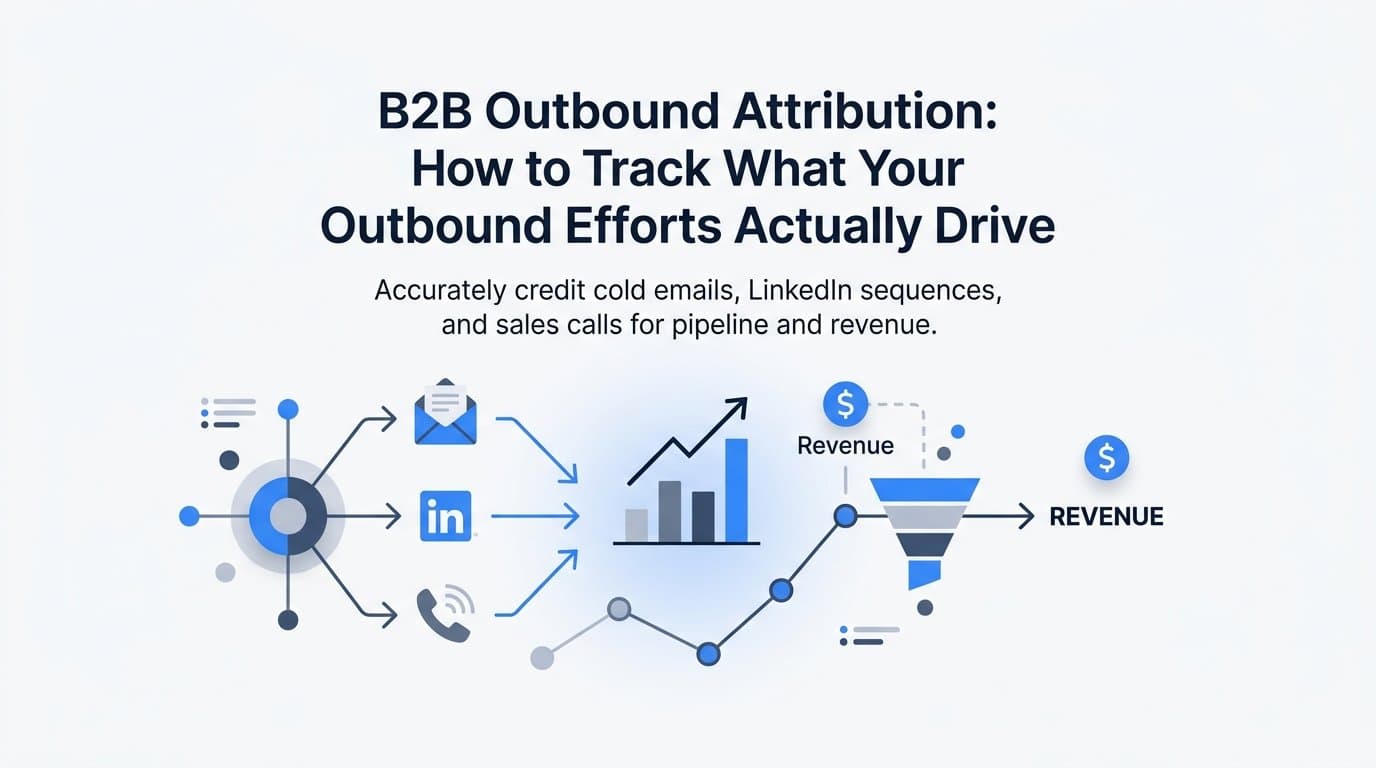
Before you can build an outbound attribution system, you need to be precise about what you're actually measuring. Outbound attribution is the practice of assigning measurable credit to specific outbound touchpoints, sequences, or reps for their contribution to pipeline creation, opportunity progression, and closed revenue.
That definition contains a few important layers worth unpacking. Attribution isn't just about who gets credit for a closed deal. It's about understanding how outbound activity contributed at every stage of the funnel, from first contact through to closed-won.
The key metrics you want to track in an outbound attribution system include the following:
Outbound-sourced pipeline value: The total dollar value of opportunities where outbound activity initiated the first meaningful contact with the account. This is your clearest signal of outbound's top-of-funnel contribution.
Outbound-influenced pipeline value: The total dollar value of opportunities where outbound touched an account already in motion from another source. This captures outbound's role in accelerating or supporting deals that originated elsewhere.
Sequence-to-meeting rate: The percentage of prospects who entered an outbound sequence and ultimately booked a meeting. This tells you which sequences and messaging frameworks are actually converting.
Meeting-to-opportunity rate: The percentage of outbound-sourced meetings that converted into formal opportunities in your CRM. This separates tire-kickers from genuine pipeline.
Revenue attributed per channel or rep: The closed-won revenue tied back to specific outbound channels, campaigns, or individual reps. This is the number that ultimately justifies outbound investment.
The distinction between sourced and influenced attribution deserves particular attention because it shapes how you interpret your data and how you have conversations internally. Sourced means outbound initiated the relationship. Influenced means outbound touched an account that was already in motion from another source, and that touch contributed to the deal progressing or closing.
Both matter. Both deserve credit. But conflating them leads to inflated numbers and credibility problems when leadership scrutinizes your attribution reports. Getting your team aligned on these definitions before you build your reporting is one of the most valuable things you can do upfront.
Attribution Models That Reflect How Outbound Actually Works
Not all attribution models are created equal, and the one you choose will significantly shape how your outbound program appears to be performing. Understanding the tradeoffs is essential before you commit to a reporting framework.
First-touch attribution gives full credit to the outbound touchpoint that initiated the conversation. If a cold email was the first interaction a prospect had with your company, that email sequence gets 100% of the credit for any revenue that eventually closes. This model is useful for measuring top-of-funnel outbound effectiveness and making the case for outbound investment, but it ignores everything that happened after that initial contact. For long B2B sales cycles where paid ads, content, and multiple sales calls all contributed to a close, first-touch paints an incomplete picture.
Last-touch attribution does the opposite, crediting the final touchpoint before conversion. As discussed earlier, this model systematically disadvantages outbound because outbound typically initiates relationships rather than closing them. Last-touch is the default in most ad platforms and analytics tools, which is precisely why outbound tends to look undervalued when teams rely on platform-native reporting.
Multi-touch attribution distributes credit across all touchpoints in the customer journey. This is generally the most appropriate model for B2B SaaS companies with long sales cycles, because it acknowledges that outbound, paid ads, content, and sales calls all play a role in moving a deal forward. The challenge is that multi-touch attribution requires complete data across all touchpoints, which means your CRM logging, web tracking, and ad platform data all need to be connected and clean.
Time-decay models give more credit to touchpoints that happened closer to the conversion event. For outbound-heavy go-to-market motions, this can actually work against you if your outbound activity happens early in the cycle. However, time-decay can be configured with custom weights to better reflect your specific sales motion.
Custom weighted models are increasingly popular for teams that want attribution to reflect the actual reality of how deals get done in their business. You might decide that first outbound contact deserves 30% of the credit, mid-funnel touches each get 10%, and the closing call gets 20%. The right weights depend on your data and your sales process, but the flexibility to configure them is what makes custom models powerful for outbound-heavy teams.
The practical recommendation for most B2B SaaS companies is to run multi-touch attribution as your primary model while also tracking first-touch data separately. First-touch tells you where relationships started. Multi-touch tells you how they developed. Together, they give you a complete picture of outbound's contribution.
Building the Technical Foundation for Outbound Tracking
Understanding attribution models is only useful if you have the underlying data infrastructure to support them. This is where most outbound attribution efforts break down: the concepts are clear, but the technical setup is incomplete. Here's what you actually need to build.
UTM parameters in outbound emails are your first line of defense. When a prospect clicks a link in a cold email, that click should carry UTM parameters that identify the source as outbound, the medium as email, and the campaign as the specific sequence or rep. This connects the outbound touchpoint to downstream web behavior, so you can see what pages the prospect visited, whether they converted on a form, and how they behaved relative to prospects who arrived from paid ads or organic search.
CRM logging discipline is the backbone of everything else. Every call, email send, LinkedIn message, and meeting must be logged against the contact and opportunity record in your CRM. This sounds obvious, but it's the most common failure point in outbound attribution. If reps aren't logging consistently, the data you need to build accurate attribution simply doesn't exist. Sales engagement platforms like Outreach, Salesloft, and Apollo can auto-log activities directly to your CRM, which dramatically improves data completeness without adding manual work for reps.
Opportunity source fields in your CRM need to be standardized and enforced. When a new opportunity is created, the source should be captured accurately: outbound-sourced, inbound-sourced, partner-referred, and so on. This field becomes the foundation for your sourced pipeline attribution reports. Without it, you can't separate outbound-originated deals from everything else.
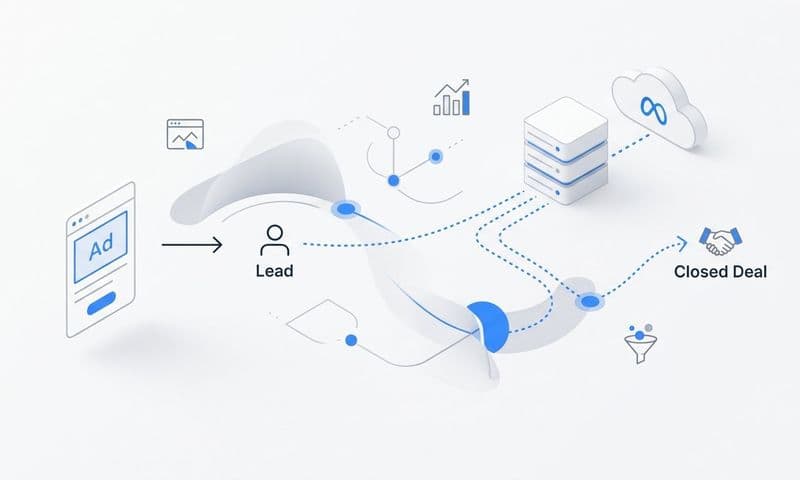
Server-side tracking and Conversion APIs complete the loop by connecting your CRM conversion events back to your ad platforms and analytics layer. When a deal closes in your CRM, that event can be passed back to Meta, Google, and other ad platforms via their Conversion APIs. This does two things: it prevents ad platforms from claiming credit for revenue that outbound actually drove, and it allows ad algorithms to optimize toward actual revenue rather than surface-level lead form fills. This is a meaningful upgrade from standard pixel-based tracking, which can only report on web events rather than downstream CRM outcomes.
The combination of UTM tracking, disciplined CRM logging, standardized source fields, and server-side event passing creates the data foundation that makes accurate outbound attribution possible. Each component depends on the others. Skip one, and your attribution reports will have gaps that undermine their credibility.
Connecting Outbound Data to Revenue in a Unified Platform
Once you have the technical foundation in place, the next step is connecting all of those data sources into a single view that lets you see outbound's contribution to revenue alongside every other channel. This is where a dedicated attribution platform becomes essential.
A unified attribution platform ingests data from your sales engagement tools, CRM, ad platforms, and website to create a complete customer journey view that includes both outbound and inbound touchpoints. Instead of looking at your CRM data in one tab, your ad platform data in another, and your web analytics in a third, you get a single report that shows how each touchpoint contributed to a specific deal or a segment of closed-won revenue.
Pipeline and revenue attribution reports in this kind of platform let you see, at the campaign or sequence level, how much outbound activity contributed to closed-won revenue. You can answer questions like: Which outbound sequences generated the most pipeline last quarter? Which reps are driving the most outbound-sourced revenue? How does outbound-influenced pipeline compare to outbound-sourced pipeline across different market segments?
These are the questions that justify outbound investment and inform decisions about where to scale or cut. Without a unified reporting layer, answering them requires manual data pulls from multiple systems and hours of spreadsheet work. With a unified platform, they become routine reports that marketing and sales leadership can review together.
Cometly is built specifically for this use case. It connects ad spend data, CRM events, and website conversion data into one place, giving marketing and sales teams a shared source of truth that eliminates the guesswork around outbound contribution to revenue. By connecting your Stripe revenue data with your ad and outbound activity data, Cometly lets you trace a closed-won deal all the way back to the first outbound touch, showing exactly which touchpoints contributed and how much credit each deserves under your chosen attribution model.
The AI-driven recommendations layer in Cometly adds another dimension: rather than just showing you what happened, it helps you identify which outbound campaigns and sequences are generating the highest-quality pipeline so you can scale what's working and stop investing in what isn't. That's the difference between attribution as a reporting exercise and attribution as a growth lever.
From Outbound Activity to Attributed Revenue: Your Action Plan
Building an outbound attribution system is a process, not a one-time project. Here's how to approach it in a way that generates value quickly while setting you up for increasingly accurate data over time.
Start with an audit of your current tracking gaps. Look at your CRM and ask: are all outbound activities being logged consistently? Are opportunity source fields being filled in accurately? Are UTM parameters being used in outbound emails? Most teams discover significant gaps at this stage, and identifying them is the first step toward fixing them.
Next, implement logging and tracking standards. Work with your sales engagement platform to enable auto-logging to your CRM. Create a UTM naming convention for outbound emails and enforce it across your team. Standardize your opportunity source field values so everyone is using the same definitions for sourced versus influenced pipeline.
Then choose an attribution model that reflects your sales motion. For most B2B SaaS teams, multi-touch attribution is the right starting point, with first-touch data tracked separately for top-of-funnel analysis. Document the model you've chosen and make sure marketing and sales leadership are aligned on it before you start sharing reports.
Finally, connect everything into a unified reporting layer. This is where a platform like Cometly accelerates the process significantly, because it handles the data ingestion and attribution logic that would otherwise require significant engineering work to build in-house.
Outbound attribution improves over time as more data flows through the system and as your team gets better at logging consistently. The teams that build this infrastructure now will have a significant advantage in their ability to make data-driven decisions about go-to-market investment as competition for B2B SaaS buyers intensifies.
The channels doing the heaviest lifting in your pipeline deserve to be seen. Get your free demo of Cometly today and start connecting every outbound touchpoint to the revenue it actually drives.